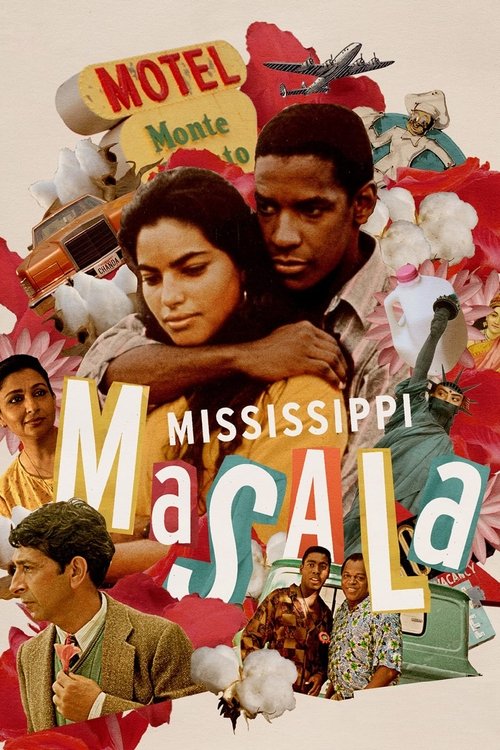
Mississippi Masala
1991 · Mira Nair
For when you want to fall in love but also want the movie to be about something — a date-night pick with real substance, comfort food with a peppery aftertaste.
What it's about
Mina's Indian family was expelled from Uganda in 1972, when Idi Amin drove out the country's South Asians; twenty years later she's in her twenties, helping run a motel in small-town Mississippi. When she falls for Demetrius, a charming Black carpet cleaner with his own small business, their romance drags into the open every prejudice both the local Indian community and his African-American family have carefully never discussed.
The experience
Warm, sensual, and sharp all at once — a genuinely swoony romance that keeps its eyes open about race, family pressure, and what exile does to people. It's funny and humane even when it stings.
Performances
Denzel Washington at his most effortlessly charming, opposite Sarita Choudhury in a remarkably assured screen debut; Roshan Seth is quietly heartbreaking as Mina's father, still litigating his lost Uganda.
The craft
Mira Nair and writer Sooni Taraporevala thread three continents through one love story, and Ed Lachman's cinematography gives the Deep South a humid, saturated glow that flatters both the motel-corridor world and the romance. The music and food and texture of two immigrant cultures are rendered with rare specificity.
Why it matters
A landmark of 1990s independent film that put a rarely-dramatized subject — the friction and kinship between Indian and Black communities in America — on screen, and confirmed Nair as a major voice of diasporic cinema.
Snapshot
Mississippi Masala is Mira Nair's second narrative feature, a diasporic romance that threads three continents through a single love story. Its premise is deceptively simple — Mina, a young Indian woman displaced from Uganda, falls for Demetrius, an African-American carpet cleaner, in small-town Greenwood, Mississippi — but the film uses that romance to map a rarely-dramatized fault line: the friction and unspoken kinship between two communities of color, Indian and Black, sharing the same Deep South economy. Written by Nair's longtime collaborator Sooni Taraporevala, photographed by Ed Lachman, and anchored by Denzel Washington opposite the debuting Sarita Choudhury, the film opens with the 1972 expulsion of South Asians from Idi Amin's Uganda and closes two decades later in a Mississippi motel corridor. It is at once an intimate melodrama and an essay on exile, colorism, and the meaning of "home" for people twice-removed from any homeland. The film premiered at the Venice Film Festival in 1991 and became, for Nair, the pivotal work that established her recurring subject: the interior life of the South Asian diaspora.
Industry & production
Mississippi Masala arrived on the strength of Nair's 1988 debut Salaam Bombay!, which had been nominated for the Academy Award for Best Foreign Language Film and won the Caméra d'Or at Cannes. That success gave Nair the standing to mount an American-set, English-language production with an international cast and multi-country locations. The film was produced through Nair's own production entity in partnership with producer Michael Nozik, with Nair herself credited as a producer, and it was distributed in the United States by the Samuel Goldwyn Company — an independent-minded distributor that specialized in exactly this register of festival-launched, adult-audience art cinema.
Production was genuinely transnational. Sequences were shot on location in Kampala and rural Uganda for the framing story of the family's expulsion and Jay's later return, and the bulk of the picture was filmed on location in Greenwood, Mississippi, and the surrounding Delta. The choice to shoot in a real Southern town rather than a studio backlot is central to the film's texture: the motels, the used-carpet trade, the liquor stores and roadside diners are drawn from an actual regional economy in which South Asian families had, by the 1980s, become significant motel operators. The genesis of the project is bound up with Nair's own life — she was married to the scholar Mahmood Mamdani, himself a Ugandan of Indian descent whose family was affected by the Amin expulsions — and that personal proximity to the material is well documented as motivation, though the screenplay is Taraporevala's authored work rather than memoir.
Precise budget and box-office figures for the film are not something I can state reliably, and I will not invent them; the record I can vouch for is that it was a modestly-budgeted independent production that performed respectably for a specialty release and traveled widely on the festival circuit.
Technology
Mississippi Masala is a conventional 35mm photochemical production of its era, and its technology is unremarkable in the best sense — it does not announce itself. What matters technologically is the commitment to location shooting under available and naturalistic light, which Ed Lachman's cinematography exploits rather than fights. The film predates the digital-intermediate era, so its color — crucial to a work partly about skin color and the warmth of the Delta — was achieved photochemically, through film stock selection, lighting, production design, and lab timing. There are no visual-effects set pieces; the "spectacle," such as it is, is the human face and the Southern and East African landscape. In that sense the film belongs to a tradition of character-driven independent cinema that treated the camera and the lab as instruments of observation rather than fabrication.
Technique
Cinematography
Ed Lachman — later celebrated for his work with Todd Haynes and Steven Soderbergh — shoots Mississippi Masala with a warm, saturated naturalism attentive above all to skin and to color-as-meaning. The film is knowingly built around gradations of brown: the spectrum of complexion within the Indian family, between the Indian and Black communities, and the way light falls on Choudhury's and Washington's faces in their intimate scenes. Lachman favors close, tactile framing for the lovers and a more expansive documentary-inflected eye for the communal and landscape material — the Ugandan exteriors, the Mississippi roadsides. The palette leans into the ochres, golds, and greens of the Delta, lending the film a sensuous heat that mirrors the romance and quietly rebukes the "hierarchy of color" that the story dissects.
Editing
The picture is cut by Roberto Silvi, an editor with a long association with John Huston's late films. The editing's principal structural task is temporal: the film must bind the 1972 prologue in Uganda to the 1990-set main action in Mississippi, and it returns periodically to Jay, Mina's father, whose longing to reclaim his Kampala property runs as a counter-melody beneath the love story. Silvi's cutting keeps these strands legible without over-signaling, letting the Uganda material function as memory and unfinished business rather than flashback exposition. The romance is edited for warmth and duration rather than propulsion.
Mise-en-scène / staging
Nair stages the film in the concrete spaces of a specific working world — the family-run motels, the carpet-cleaning vans, extended-family living rooms crowded with relatives and gossip, the wedding and party gatherings that are a Nair signature. These communal set pieces, dense with bodies, food, music, and overlapping talk, do double duty: they establish the Indian community's warmth and its claustrophobic surveillance of Mina, and they dramatize how a private romance becomes a public scandal. Against this density, the scenes between Mina and Demetrius are staged more openly and privately — cars, motel rooms, the outdoors — visually enacting the freedom the couple seeks outside both communities' policing.
Sound
The score is by the South Indian violinist and composer L. Subramaniam, and the soundtrack more broadly braids Indian musical idioms with the African-American musical vernacular of the Delta, sonically staging the cultural encounter the plot enacts. The film's sound world moves between the diegetic music of parties and juke joints and the scored underscoring of the romance; language itself is part of the design, with the family's mix of English, Gujarati, and Hindi-inflected speech marking generational and cultural distance.
Performance
The performances are the film's engine. Denzel Washington — arriving fresh off his Oscar-winning turn in Glory (1989) and just before Malcolm X (1992) — plays Demetrius with a grounded dignity and easy charm, giving the film a leading man of real star wattage and lending the interracial romance both tenderness and stakes. Opposite him, Sarita Choudhury makes a remarkable screen debut as Mina, headstrong and sensual, holding her own against Washington. The supporting ensemble is equally vital: Roshan Seth as Jay, the father consumed by his exile and his lawsuit to recover the Ugandan home, gives the film its melancholy gravity, and Sharmila Tagore — a major star of Bengali and Hindi cinema — plays Mina's mother Kinnu with quiet resilience.
Narrative & dramatic mode
The film operates primarily in the mode of romantic melodrama, but a melodrama structurally doubled. The foreground is the classic transgressive love story — two young people whose union is forbidden by the prejudices of their elders — and it follows that shape faithfully, through attraction, consummation, exposure, communal rupture, and a resolution that requires both lovers to break from their families. The background is the story of the father, Jay, and his inability to let go of a lost homeland; his arc supplies the film's thematic thesis, that the couple's freedom depends on refusing the very attachment to lineage and place that has imprisoned him. The two strands rhyme: the elders' opposition to Mina and Demetrius is shown to be continuous with the racial hierarchies and nostalgias that expelled the family in the first place. Some critics have found the African subplot less fully realized than the romance, and that unevenness is a fair, established observation rather than a flaw the film hides.
Genre & cycle
Mississippi Masala sits at the intersection of the interracial romance and the diaspora film, and it belongs to an emergent early-1990s cycle of independent American cinema attentive to hyphenated identity and communities outside the Black-white binary that had long structured Hollywood's treatment of race. It is one of the first American features to place the South Asian immigrant experience at its center, and — unusually — to stage race relations as a matter between two minority communities rather than between a minority and white America. In the lineage of the forbidden-love drama it inherits the melodramatic architecture of films about socially prohibited couples; in its diasporic dimension it anticipates the wave of South Asian diaspora cinema that would flourish across the following decade.
Authorship & method
The defining authorial partnership is that of Mira Nair and screenwriter Sooni Taraporevala, who had already written Salaam Bombay! together and who would continue to collaborate (later on The Namesake). Taraporevala's screenplay supplies the film's structural intelligence — the yoking of a Ugandan expulsion to a Mississippi romance — and its ear for the texture of immigrant family life. Nair's method, forged partly in documentary before Salaam Bombay!, is evident throughout: a preference for real locations and communities, for ensemble scenes of eating, dancing, and gossip, and for casting that mixes stars with unknowns and non-professionals. Her interest is consistently the interior emotional life of diasporic South Asians, and Mississippi Masala is where that authorial signature crystallizes.
Among the key collaborators, cinematographer Ed Lachman provides the sensuous, color-conscious image; composer L. Subramaniam supplies the cross-cultural score; and editor Roberto Silvi manages the film's braided time-scheme. The casting of Denzel Washington — a bankable, Oscar-winning Black star — in an independent film about Indian-Black romance is itself an authorial and industrial decision of some daring, and it is inseparable from the film's reach and reception.
Movement / national cinema
The film is difficult to file under a single national cinema, which is precisely its point. It is an American independent film by an Indian director, set among a twice-displaced people, shot on two continents, and financed and distributed through the U.S. specialty-film system. It belongs to the broader current of transnational and diasporic cinema that gathered force in the late 1980s and 1990s, and it is a foundational text of South Asian diasporic filmmaking specifically. Within American independent cinema it stands alongside the era's other films of racial and cultural border-crossing, but its vantage — Indian, African, and American at once — is close to singular for its moment.
Era / period
Mississippi Masala is a film of the early 1990s, and it carries that moment's independent-cinema sensibility: adult, character-driven, socially engaged, released through a specialty distributor and launched from the festival circuit. It is also a period film in its own reach, using the 1972 Ugandan expulsion under Idi Amin as historical bedrock — a real and traumatic event in which tens of thousands of South Asians were forced from a country many of their families had lived in for generations. That the film treats this history not as costume drama but as living memory shaping a present-day romance is central to its seriousness.
Themes
The film's governing theme is home — its loss, its impossibility, and the danger of clinging to it. Jay embodies a nostalgia so total it blinds him to his daughter's future; the film ultimately valorizes the willingness to build a home from love rather than inherit one from lineage. Braided with this is the theme of colorism and the hierarchy of race: the film is unusually candid that prejudice runs within and between communities of color, that the Indian family's resistance to Demetrius is a color prejudice inseparable from the racial logics that unhoused them. Diaspora and belonging — the condition of being from everywhere and nowhere, "masala," a mixture — organizes the whole. And beneath the romance lies a meditation on Afro-Asian solidarity and its failures, the missed recognition between two peoples the American South has positioned near one another economically but kept apart socially.
Reception, canon & influence
Critically, Mississippi Masala was well received on release and traveled widely, premiering at the Venice Film Festival in 1991; the specific awards it received there I would rather not misstate, but its festival profile was substantial and consistent with Nair's Cannes-honored debut. Reviewers singled out the freshness of its subject, the chemistry between Washington and the newcomer Choudhury, and Nair's confident handling of a multicultural milieu. The most common reservation — voiced then and since — was that the Ugandan father-and-homeland strand felt less resolved than the central romance, a critique that is part of the established record.
Looking backward, the film draws on the tradition of the forbidden-love melodrama and on Nair's own documentary-rooted, ensemble-driven method from Salaam Bombay!; its deepest source, though, is historical — the lived reality of the Ugandan Asian expulsion and the subsequent South Asian presence in the American motel economy, material Nair approached with the intimacy of someone connected to that history by marriage.
Looking forward, its influence is considerable and durable. It helped inaugurate a body of South Asian diaspora cinema and marked out the terrain Nair herself would return to, most notably in The Namesake (2006), again written with Taraporevala. It launched Sarita Choudhury's screen career and stands as an early, prominent instance of a Hollywood-scale Black star anchoring an independent film about non-white interracial romance. Perhaps most lastingly, it has become a touchstone for scholars and critics writing on Afro-Asian relations, diaspora, and colorism — a film repeatedly returned to because it dramatized, before it was common to do so, that the story of race in America is not only Black and white. Its reputation has if anything grown, and it is now widely regarded as a formative work in the history of South Asian and diasporic filmmaking.
Reception
A warm arthouse hit in 1991 — Sooni Taraporevala's script won a prize at Venice — it then spent years frustratingly hard to see, until a 2022 4K restoration and Criterion release triggered a full-blown reappraisal as a landmark of diaspora cinema.
How Mississippi Masala was received, from release to now →
Influences: the films it descends from and the films it influenced
- Salaam Bombay! (1988) — Establishes the Nair–Taraporevala working method Mississippi Masala inherits wholesale: a documentary-rooted approach that shoots in real locations, casts non-professionals alongside leads, and builds scenes around communal rituals of eating, gossip, and street life rather than plot beats.
- Pather Panchali (1955) — Models the available-light, location-based humanist observation of extended-family texture — long patient takes of domestic labor and idle time — that underwrites Nair's treatment of the motel-clan interiors.
- Shakespeare Wallah (1965) — Pioneers the transnational drama of Anglo-Indian cultural collision shot on real Indian locations (with Subrata Mitra's naturalist camera), prefiguring Nair's cross-cultural staging of displaced communities negotiating a host society.
- Guess Who's Coming to Dinner (1967) — Supplies the structural template of the interracial-romance melodrama built as a family-confrontation chamber piece, where the couple's private choice is litigated through parental and communal set-pieces — the scaffolding Taraporevala repurposes and complicates.
- My Beautiful Laundrette (1985) — Prefigures the exact terrain — South Asian immigrant small-business economy (laundrette/motel) crossed with an interdicted interracial romance — treating the ethnic enterprise as the material stage on which forbidden desire is negotiated.
- Do the Right Thing (1989) — Demonstrates heat-saturated, color-as-meaning expressionism and the single-community ensemble block as a pressure cooker of race relations that refuse the Black/white binary — a palette and staging logic Nair adapts to the Deep South.
- Under the Volcano (1984) — Editor Roberto Silvi's Huston-honed handling of a memory-haunted, temporally layered narrative feeds directly into the braided time-scheme he cuts for Nair, folding the Ugandan expulsion into the Mississippi present.
- Crossing Delancey (1988) — Nair and Ed Lachman stage the romance as traffic between two fully realized social systems, each with its own commercial geography and gossip network, using documentary-textured location shooting so neither community reads as backdrop to the other.
- Monsoon Wedding (2001) — Scales up Mississippi Masala's communal-ensemble set-pieces — the eating, dancing, and multilingual cross-talk of a family gathering shot in saturated color — into a full polyphonic wedding, extending Nair's signature staging of diasporic celebration.
- The Namesake (2006) — The direct Nair–Taraporevala continuation, reusing the braided two-continent structure (home and exile cut against each other) and the interior emotional focus on diasporic South Asians navigating belonging in America.
- Bhaji on the Beach (1993) — Carries forward the diaspora-ensemble melodrama built around a communal outing, using overlapping women's storylines and cross-generational, multilingual dialogue to map the same tensions of colorism and cultural loyalty within the British-Asian community.
- Bend It Like Beckham (2002) — Popularizes the South Asian diaspora cross-cultural romance for a mainstream audience, staging the couple's transgression against communal set-pieces of family cooking and celebration in the ensemble-comedy register Nair helped legitimize.
- East Is East (1999) — Applies the diasporic-family ensemble method to a mixed-heritage household, dramatizing intergenerational and interracial friction through communal domestic scenes rather than issue-driven exposition.
- Chutney Popcorn (1999) — Inherits the early-90s-indie, star-newcomer-scaled diaspora film that centers South Asian American identity and cross-community romance, extending Nair's opening of the Afro/Asian/American terrain beyond a single ethnic lens.
- Jungle Fever (1991) — Released the same year, it is the parallel American interracial-romance melodrama that foregrounds colorism and intra-community policing of desire, sharing Mississippi Masala's insistence that the couple's love be read through skin-tone hierarchy, not only Black/white opposition.
- Far From Heaven (2002) — Extends cinematographer Ed Lachman's color-as-meaning method — richly keyed, emotionally coded hues in a Sirkian melodrama of forbidden interracial attraction — the same expressive palette he brought to Nair's Mississippi frames.
- Fire (1996) — A fellow transnational South Asian woman auteur's melodrama of interdicted desire, sharing Nair's strategy of using saturated, sensuous imagery and intimate domestic staging to make forbidden love legible against communal constraint.
Similar films
- Monsoon Wedding (2001) — influence & lineage
- Salaam Bombay! (1988) — influence & lineage
- Pather Panchali (1955) — influence & lineage
- The Help (2011) — shared sensibility
- Mudbound (2017) — shared sensibility
- Minari (2021) — shared sensibility
- Mirch Masala (1987) — shared sensibility
- Masaan (2015) — shared sensibility