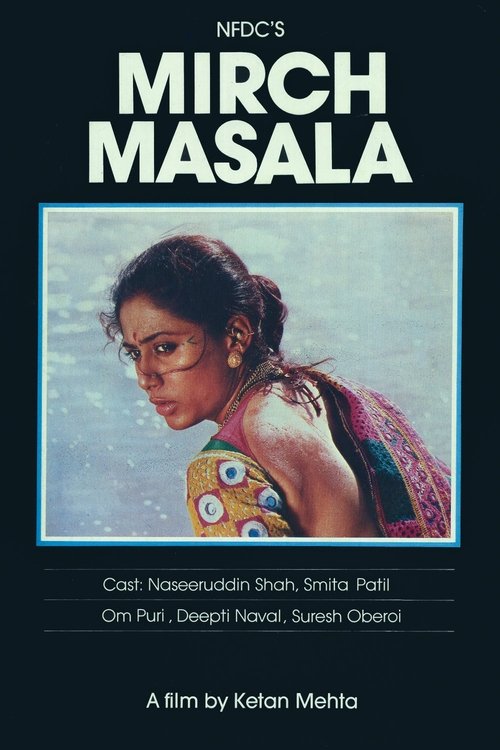
Mirch Masala
1987 · Ketan Mehta
When you want to feel righteous fire — a film for the mood where you need to see someone refuse to bend. It's a challenge, not a comfort, but a galvanizing one.
What it's about
In a rural village in early-1940s British India, a touring tax collector rolls in with soldiers, a gramophone, and the assumption that anything he wants is his. When Sonbai, a married woman who labors at the local chili-grinding factory, refuses his advances, she takes refuge inside the factory's walled compound — and its elderly Muslim gatekeeper bars the door. What follows is a standoff that strips the village bare: cowardly elders, a complicit headman, and the women workers deciding how much they are willing to take.
The experience
It burns slowly and then all at once — a fable told in blazing color that builds an almost unbearable moral pressure. You watch it with rising anger, and it pays that anger off with one of the most electrifying endings in Indian cinema.
Performances
Smita Patil, in one of her final roles, gives Sonbai a defiance that never needs a raised voice. Naseeruddin Shah makes the subedar a vain, petty tyrant who is all the more chilling for being so ordinary, and Om Puri's aging gatekeeper is the film's quiet moral center.
The craft
The film turns its setting into its palette — mountains of red chilies, ochre walls, white dust — so the imagery of spice becomes the imagery of resistance itself. Ketan Mehta stages it like a folk tale with the tension of a siege thriller, simple in outline and searing in effect.
Why it matters
One of the defining works of India's parallel cinema movement, its final image has become an icon of women's resistance on screen, and it remains a fixture of conversations about feminist Indian film.
Snapshot
Mirch Masala ("A Touch of Spice," literally "chili and spices") is among the most enduring works of India's parallel cinema, a stylized fable of patriarchal and colonial oppression that turns a rural spice factory into an arena of resistance. Set in early-1940s Saurashtra during the last years of the British Raj, it follows Sonbai (Smita Patil), a spirited married laborer who refuses the sexual demands of a touring subedar (Naseeruddin Shah), a petty government tax-collector accustomed to taking whatever he wants. When Sonbai flees into the walled compound of the village chili-grinding factory, the aged Muslim gatekeeper Abu Mian (Om Puri) bars the gate against the subedar's men, and the standoff exposes the cowardice of the village elders, the complicity of the headman, and finally the collective courage of the women workers. The film is best remembered for its climactic image — the women hurling handfuls of red chili powder into the subedar's eyes — one of the most reproduced endings in Indian cinema. It was among the last films of Smita Patil, who died in December 1986 before its wide release, lending the picture an elegiac weight it did not originally set out to carry.
Industry & production
Mirch Masala belongs institutionally to the movement of state-supported "middle" and art cinema that the National Film Development Corporation (NFDC) sustained through the late 1970s and 1980s. Ketan Mehta, a graduate of the Film and Television Institute of India (FTII) at Pune, had already made his mark with the Gujarati-language Bhavni Bhavai (1980); Mirch Masala, though in Hindi, retains a strong Gujarati regional identity in its setting, folk texture, and source material. The screenplay is drawn from a Gujarati literary source — commonly attributed to the writer Chunilal Madia — though the specifics of the adaptation credit are not something I can fully verify from the historical record and should be treated as a point to confirm rather than assert.
The production drew on the remarkable repertory ensemble of the parallel-cinema world: Patil, Shah, Puri, Suresh Oberoi (the collaborating village headman, the Mukhi), Deepti Naval (the Mukhi's questioning wife), Dina Pathak, Ratna Pathak Shah, Supriya Pathak, Benjamin Gilani, and others familiar from the Shyam Benegal / Govind Nihalani / Saeed Mirza films of the era. These were performers who moved fluidly between low-budget NFDC productions and mainstream work, and their presence signaled the film's ambitions to a specific festival and metropolitan-arthouse audience rather than the wide commercial circuit.
Budgets in this sector were modest by design, and precise financial figures for Mirch Masala are not something I can responsibly cite. What is clear is that the film was shot largely on location in the arid Kutch/Saurashtra landscape of Gujarat, and that its production values — its costumes, its constructed factory compound, its use of natural light and dust — reflect resourceful location filmmaking rather than studio expenditure.
Technology
The film was shot on 35mm color stock, the standard for feature production of the period, and its aesthetic depends heavily on available and natural light in exterior and semi-exterior spaces. Nothing about Mirch Masala is technologically experimental in the sense of new formats or optical processes; its innovation is entirely one of craft applied to constrained means. The sound was post-synchronized (dubbed) in the conventional Indian production manner of the era rather than recorded live on set, which is worth noting because so much of the film's power lies in its vocal performances and its ambient soundscape of grinding stones, wind, and drums — all built in the mix rather than captured in the moment.
Technique
Cinematography
The photography, credited to Jehangir Choudhury, is the film's most celebrated formal element and is inseparable from its meaning. The palette is saturated and heat-struck: ochre earth, whitewashed walls, indigo skies, and above all the deep crimson of the chili powder that accumulates as a visual motif long before it becomes a weapon. The camera favors the wide, sun-bleached expanse of the Kutch desert for the subedar's arrivals and departures — his caravan a black intrusion on an empty horizon — and contrasts this with the enclosed, geometric interior of the factory compound where the women are penned. Framing repeatedly organizes power spatially: the subedar shot from below or centered in imperious symmetry, the women framed through doorways, gratings, and the slats of the gate. The red chili spread out to dry, or ground into clouds of powder, functions as a slow-building chromatic threat, so that the ending feels less like a twist than the detonation of an image the film has been loading from its first reel.
Editing
The film's rhythm is deliberate and accumulative, built on a rising pressure between the closed compound and the besieging village outside. The editing patiently cross-cuts among three centers of gravity — Sonbai and the women within the walls, the vacillating men of the village council, and the subedar's imperial impatience — tightening these threads toward the confrontation at the gate. The specific editor's credit is not something I can state with confidence, so I will not attribute it; the effect, however, is of classical suspense construction adapted to a fable's moral clarity, withholding release until the collective action of the finale.
Mise-en-scène / staging
Mehta's staging is frankly theatrical and folk-derived, drawing on Gujarati performance traditions and a fable's schematic legibility. The factory compound is treated almost as a single stage set — a besieged fort — and much of the drama is blocked as a siege: gate, wall, threshold, interior. Costume and production design encode the social order precisely, from the subedar's uniformed authority to the women's working saris stained with spice. Crowd staging is important: the village men assemble, deliberate, and retreat as a chorus of complicity, so that cowardice is dramatized as a collective posture rather than an individual flaw.
Sound
Rajat Dholakia's score leans on folk idiom, percussion, and regional melody rather than symphonic underscoring, reinforcing the rootedness of the setting. Equally important is the film's designed ambience — the rhythmic scrape of the grinding stones, wind across the desert, the swelling murmur of the assembled men — which builds a sonic environment of labor and menace. The soundtrack works with the image to make the factory a living, breathing space of women's work before it becomes the site of their defiance.
Performance
Performance is the film's beating heart. Smita Patil's Sonbai is proud, physical, and unbroken — a portrayal that gathers additional pathos from the actress's death shortly before release, though the performance stands entirely on its own as one of the definitive roles of Indian parallel cinema's greatest female star. Naseeruddin Shah plays the subedar not as a cartoon villain but as an entitled, sensual, casually brutal instrument of power, which makes his menace credible. Om Puri's Abu Mian — the frail old gatekeeper who becomes the story's unlikely conscience — supplies the film's tragic dignity. The surrounding ensemble, especially Deepti Naval as the headman's wife whose conscience stirs against the men's cowardice, gives the fable its texture of ordinary people making moral choices under pressure.
Narrative & dramatic mode
The film operates in the register of parable or moral fable rather than psychological realism. Its structure is a siege drama: an inciting transgression (the subedar's demand and Sonbai's refusal), a retreat into a defensible space, a mounting external pressure to surrender the fugitive, and a cathartic collective reversal. Characters function partly as social types — the tyrant, the collaborator headman, the vacillating elders, the righteous outsider-guardian, the awakening woman — but the best performances lend them enough interiority to keep the film from flattening into pure allegory. The dramatic engine is moral: at each stage the film asks who will protect Sonbai and at what cost, and it answers by exposing the failure of patriarchal "protection" and locating courage instead in the women themselves and in a marginalized old Muslim man.
Genre & cycle
Nominally a period drama and thriller, Mirch Masala is more precisely a work of socially engaged art cinema in the vein of the Indian New Wave's rural-oppression dramas. It sits in dialogue with the cycle of parallel-cinema films examining caste, class, feudal power, and gendered violence — the terrain of Benegal's Ankur (1974) and Nishant (1975) and Nihalani's Aakrosh (1980). Within that cycle it is distinguished by its heightened, folk-inflected stylization and its unusually direct feminist resolution, which pushes it toward the register of a revolutionary fable rather than sober realism.
Authorship & method
Ketan Mehta is the film's controlling authorial intelligence, and Mirch Masala is central to understanding him. Trained at FTII and shaped by the political-modernist currents of 1970s Indian cinema, Mehta combined a taste for Brechtian stylization and folk-theatrical form (visible already in Bhavni Bhavai) with an appetite for popular energy that would later carry him toward more commercial projects. His method here fuses regional folk aesthetics with the siege-thriller's classical suspense, and stages political argument through bold visual symbolism — the chili as both the women's labor and their weapon.
Among his collaborators, cinematographer Jehangir Choudhury is decisive to the film's identity, translating its moral scheme into color and space. Composer Rajat Dholakia grounds the film in regional musical idiom. The writing derives from a Gujarati literary source (attributed to Chunilal Madia, a point worth verifying), which supplies the fable's spine. The ensemble of parallel-cinema actors constitutes a collaborative authorship of its own, since so much of the film's meaning is carried in faces and voices. The editing credit I cannot confirm and therefore leave open rather than guess.
Movement / national cinema
The film is a signature product of the Indian New Wave / parallel cinema, the state-nurtured art-film movement that ran roughly from the late 1960s through the 1980s under FTII training and NFDC financing. It shares that movement's commitments — social critique, non-star (or repertory-star) casting, location shooting, realism of milieu — while inflecting them with a distinctly Gujarati regional and folk sensibility. It also belongs to a specifically feminist strand within that movement, one attentive to women's labor and women's resistance, and it stands as one of the tradition's most internationally visible titles.
Era / period
Made in the mid-1980s and released in 1987, the film arrives near the twilight of the parallel-cinema movement, as state support waned and the arthouse repertory system began to disperse into television and mainstream work. Its historical setting — the early 1940s, the final years of British colonial rule — allows Mehta to fold together two axes of domination: the colonial-feudal apparatus embodied by the subedar (a functionary of imperial revenue power) and the indigenous patriarchy of the village that collaborates with it. The period setting is not nostalgic; it is a lens for examining structures of authority that the film clearly regards as unfinished business.
Themes
The film's governing theme is the intersection of patriarchal and state power, and the moral bankruptcy of a social order that treats a woman's body as a resource to be surrendered for communal peace. Sonbai's refusal exposes how "protection" under patriarchy is conditional and negotiable — the village men are willing to trade her to preserve their own safety and standing. Against this, the film locates virtue in the marginalized: an aging Muslim gatekeeper and a collective of working women. Female solidarity is the redemptive force, and labor itself — the grinding of chili — becomes the source of the women's weapon, a potent image of the oppressed turning the instruments of their exploitation against the oppressor. Secondary themes include colonial complicity, the cowardice of respectable men, and the awakening of conscience (embodied in the headman's wife). The famous ending reads as a parable of collective, specifically female, revolt.
Reception, canon & influence
Mirch Masala was received as a major work of Indian art cinema and became one of the more widely traveled Indian films of its moment on the international festival circuit, where it helped represent the parallel-cinema tradition abroad. It garnered recognition at the Indian National Film Awards, though I would rather flag the exact categories as something to verify than risk misstating the specific honors. Its critical standing has only grown, and it is now routinely cited in accounts of feminist cinema in India and of the New Wave's achievements; the closing chili-powder image has passed into the culture as an emblem of women's resistance.
Looking backward, the film draws on Gujarati folk theater and regional literature for its fable form, on the Benegal–Nihalani rural-oppression cycle for its political subject matter, and on the broader traditions of neorealist location shooting and Brechtian political stylization that shaped FTII-trained filmmakers of Mehta's generation. Looking forward, its influence is felt less in direct remakes than in the durability of its central image and its model of the collective-female-uprising climax, which subsequent Indian films addressing gendered violence have echoed. It also stands as a keystone of Smita Patil's legacy — a final, definitive statement from an actress whose early death made this among the last testaments of parallel cinema's most important female performer. For "Sightlines," the film sits at a rich crossroads: a node where colonial history, regional folk form, the Indian New Wave, and a distinctly feminist politics of the image converge.
Reception
A parallel-cinema prestige item on release — it won the National Film Award for Best Hindi Feature — Mirch Masala has only grown since, rediscovered in the #MeToo era as a film that was decades ahead of the conversation.
How Mirch Masala was received, from release to now →
Influences: the films it descends from and the films it influenced
- Bhavni Bhavai (1980) — Mehta's own earlier film established the Bhavai folk-theater frame — direct-address, painted color-coded stylization and parable structure — that Mirch Masala tightens into a siege drama.
- Nishant (1975) — Supplies the template of the rural community rising in a collective climactic uprising against a feudal sexual predator, the structural blueprint for the chili-powder revolt.
- Ankur (1974) — Launched the parallel-cinema rural-oppression cycle, framing a landlord's coercion of a village woman in unglamorized naturalist location space that Mehta inherits wholesale.
- Bhumika (1977) — Anchors the Smita Patil star-text of the willful, self-possessed woman whose interior resistance is read entirely in the face — the performance grammar Mirch Masala gives its final, definitive statement.
- Aakrosh (1980) — Nihalani's stark power-framing — low angles and compositional imbalance that make the oppressor loom over the powerless — is the cinematographic idiom of Mirch Masala's subedar-versus-Sonbai geometry.
- Manthan (1976) — Modeled the use of real rural Gujarat locations and non-studio natural light to lend a social-fable a documentary-grade authenticity of place.
- Seven Samurai (1954) — Defined the besieged-enclosure blocking and cross-cut suspense of a fortified community defending its walls against a mounted aggressor, which Mehta maps onto the spice-factory siege.
- High Noon (1952) — Provides the moral-fable siege in which a community's cowardice abandons a lone principled stand, its tightening real-time suspense echoed in the factory's escalating standoff.
- Battleship Potemkin (1925) — Its montage of the oppressed massing into collective revolt against uniformed authority is the deep grammar behind Mirch Masala's women-as-one uprising climax.
- Do Bigha Zamin (1953) — Indianized De Sica's neorealist location shooting and empathy for the rural dispossessed, seeding the location-realist lineage Mehta's FTII generation drew on.
- Distant Thunder (Ashani Sanket) (1973) — Pioneered saturated natural-light color as social meaning in a rural-patriarchy setting, precedent for Mirch Masala's charged red-chili palette.
- Garm Hava (1973) — Model of socially-engaged art cinema staging a political-historical argument through intimate location realism rather than melodrama.
- Bandit Queen (1994) — Extends the parallel-cinema image of a rural woman turning patriarchal-caste violence back on her oppressors, inheriting the female-revolt climax in a harsher register.
- Parched (2015) — Reprises the collective-female-uprising against rural patriarchy set in saturated desert-Rajasthan color, a direct heir to the solidarity-revolt structure and earthy palette.
- Lipstick Under My Burkha (2016) — Carries forward the model of women's small acts of labor and desire massing into defiance of patriarchal control, the collective-revolt logic transposed to a contemporary town.
- Rudaali (1993) — Shares the late-parallel-cinema fusion of regional folk performance idiom (the professional mourner) with a Smita-Patil-school female lead carrying social critique in the face.
Similar films
- Pather Panchali (1955) — shared sensibility
- Kadaisi Vivasayi (2022) — shared sensibility
- Sarpatta Parambarai (2021) — shared sensibility
- Kill (2024) — shared sensibility
- Tumbbad (2018) — shared sensibility
- Viduthalai: Part I (2023) — shared sensibility
- Thaniyavarthanam (1987) — shared sensibility
- Kantara (2022) — shared sensibility