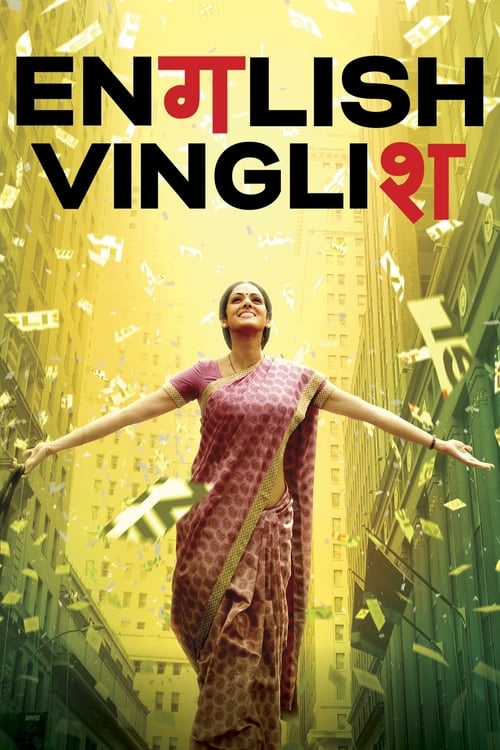
English Vinglish
2012 · Gauri Shinde
For when you need to feel something warm — a film for watching with your mother, or for anyone who's ever been underestimated by the people they love. Comfort viewing with a real spine.
What it's about
Shashi is a Mumbai housewife who runs a small business selling homemade sweets — and whose shaky English makes her the family joke, gently belittled by her own husband and teenage daughter. Sent alone to New York ahead of the family to help with her niece's wedding, she secretly enrolls in a four-week conversational English class full of fellow strangers to the language. What she's really studying, the film makes clear, is her own worth.
The experience
Gentle, funny, and quietly piercing — the humiliations are small and domestic, which is exactly why they sting, and the triumphs feel earned rather than engineered. It builds to a finish that will put a lump in your throat without a single manipulative beat.
Performances
Sridevi, returning to the screen after some fifteen years away, gives a masterclass in understatement: she plays Shashi's embarrassment, pride, and blooming confidence almost entirely through her eyes and posture, and turns a simple role into one of the most beloved performances of her career.
The craft
Gauri Shinde's debut script is a model of economy — every small slight and small victory is precisely observed — and she frames Manhattan from a newcomer's eye level, intimidating and then gradually navigable. The film balances Bollywood warmth with an indie's restraint, trusting quiet scenes to carry the weight.
Why it matters
A word-of-mouth hit that engineered one of Indian cinema's great comebacks for Sridevi, announced Gauri Shinde as a major new voice among women directors, and became a touchstone for Hindi films centering middle-aged women's inner lives.
Snapshot
English Vinglish is the debut feature of writer-director Gauri Shinde, a Hindi-language comedy-drama built around the return of Sridevi to a leading role after an absence from the screen of roughly fifteen years. Sridevi plays Shashi Godbole, a Maharashtrian housewife and small-scale entrepreneur — she sells homemade laddoos — whose halting English makes her the object of casual condescension inside her own household, chiefly from her husband Satish (Adil Hussain) and her adolescent daughter Sapna. Dispatched alone to New York ahead of the family to help prepare her niece's wedding, Shashi secretly enrolls in a four-week conversational English course, and in doing so recovers a sense of dignity and selfhood that the film treats as its true subject. The picture is at once a modest domestic drama, an immigrant fish-out-of-water comedy, and a quietly feminist parable about respect. It premiered at the Toronto International Film Festival in September 2012 and opened commercially soon after to warm reviews and strong word of mouth, its reception inseparable from the event of Sridevi's comeback.
Industry & production
The film was produced under Hope Productions, the company associated with R. Balki (the director Balakrishnan, Shinde's husband), together with Sunil Lulla, and distributed by Eros International, one of the dominant Hindi-cinema distributors of the period. It sits in the commercially significant but non-blockbuster tier of early-2010s Bollywood: a mid-budget, star-anchored film pitched at multiplex audiences and the overseas diaspora rather than the mass single-screen market. That positioning matters, because English Vinglish is in many ways a film about the diaspora audience it courted — Indians abroad, and the class of urban Indians for whom English fluency is a marker of status.
The production was bilingual in its footprint, shooting substantially on location in New York City alongside Indian interiors, and it was conceived from the outset for pan-Indian and international reach: the film was released not only in Hindi but dubbed and distributed in Tamil and Telugu, and it carried significant English-language dialogue as an organic feature of its premise rather than as a marketing afterthought. Its festival launch at Toronto signaled an ambition to be read as crossover art-house-adjacent cinema as much as mainstream entertainment.
Technology
The reliable public record on the film's specific capture technology is thin, and I will not invent a camera package or format for it. What can be said with confidence is that English Vinglish is a product of the digital-era Hindi industry of the early 2010s, when mid-budget productions had largely moved to digital acquisition and to location-heavy shooting made feasible by lighter rigs. The film's aesthetic — naturalistic Manhattan exteriors, handheld-inflected coverage in the language-classroom scenes, and a generally unshowy, available-light-leaning look — is consistent with that transition, but absent a documented technical source I flag the specifics as uncertain rather than assert them.
Technique
Cinematography
The photography, by Laxman Utekar — who would later become a director in his own right — is functional and warm rather than flamboyant, and that restraint is a deliberate fit for the material. New York is shot not as spectacle but as an intimidating, then gradually navigable, everyday space: the film's most-discussed visual set-piece is Shashi's disastrous first attempt to order coffee at a Manhattan café, staged so that the camera aligns us with her disorientation and shame amid an indifferent, fast-talking counter. Utekar's framing tends to isolate Sridevi within crowds and doorways early on, then to open up and steady as her confidence grows, using the city's scale as an emotional barometer. The visual grammar is unobtrusive precisely so that the performance can carry the meaning.
Editing
Hemanti Sarkar's cutting keeps the film in a comic-dramatic middle register, balancing the episodic classroom scenes — each anchored by a small ensemble of fellow learners — against the ticking-clock structure of the four-week course and the approaching wedding. The editing's chief task is tonal modulation: the film repeatedly pivots from humor (Shashi's misadventures with idiom) to sudden emotional exposure (the humiliations that puncture her), and the transitions are managed without whiplash. The song sequences, integrated in the Hindi-film manner, are cut for celebratory momentum rather than narrative interruption.
Mise-en-scène / staging
Shinde's staging draws a pointed contrast between two domestic-social worlds. The Indian household is composed to emphasize Shashi's marginalization within her own kitchen and home — she is framed serving, tidying, at the edges of family attention — while the New York classroom is staged as a horizontal, egalitarian space in which a Frenchman, a Pakistani, a Mexican, and others sit as equals, each defined by the same vulnerability of the non-native speaker. The wedding milieu allows for costume and color to signal the diaspora's negotiation of tradition and Americanisation. Small props carry thematic weight: the laddoos that are Shashi's undervalued craft, the coffee cup, the phrasebook.
Sound
Amit Trivedi's score and songs, with lyrics by Swanand Kirkire, are central to the film's texture. The best-known number, "Navrai Majhi," is a Marathi-inflected wedding song that both roots Shashi in her Maharashtrian identity and provides the film's most exuberant communal sequence; Trivedi's palette elsewhere is gentle and folk-tinged rather than dance-floor oriented, in keeping with the intimate scale. Equally important is the film's design of speech itself: the drama lives in accents, mispronunciations, code-switching, and the gap between Hindi, Marathi, and English, so that language is treated almost as a sound-design element — the anxiety and comedy of how things are said as much as what.
Performance
The film is, finally, a performance vehicle, and Sridevi's playing of Shashi is its reason for being. She works largely in a minor key — downcast eyes, contained gesture, a smile that masks hurt — and reserves her fuller expressiveness for the moments of recovered confidence, culminating in a wedding-toast speech in imperfect but heartfelt English that functions as the film's thesis delivered in dramatic form. Adil Hussain gives the husband a crucial shading: he is thoughtlessly belittling rather than cruel, which keeps the film from tipping into melodrama. Mehdi Nebbou, as the French classmate Laurent who is drawn to Shashi, supplies a current of tenderness and temptation that the film handles with notable restraint, and the classroom ensemble is played warmly. Amitabh Bachchan appears in a brief, much-noted cameo as a fellow air traveler.
Narrative & dramatic mode
The dramatic mode is the intimate transformation narrative — a self-actualisation arc — dressed in the clothes of gentle comedy. Structurally the film uses a classic enabling device: physical and cultural displacement (Shashi alone in a foreign city) creates the space for change that the home did not permit. The stakes are deliberately domestic and internal rather than external; there is no antagonist in the conventional sense, only the accumulated small humiliations of being underestimated. The Laurent subplot introduces the possibility of a different life, but the film resolves it in favour of restored self-respect within the marriage rather than romantic rupture, choosing dignity over melodramatic escape. This is a screenplay organized around emotional beats and set-pieces of embarrassment-then-mastery rather than around plot mechanics.
Genre & cycle
English Vinglish belongs to a strand of 2000s–2010s Hindi cinema that turned toward smaller, character-driven, socially observant stories aimed at the multiplex and diaspora — a movement often glossed as "new Bollywood" or the multiplex film, distinct from the big star-vehicle spectacle. Within that, it participates in a recognizable cycle of films foregrounding women's interiority and everyday feminism, and in the perennial NRI/diaspora genre of Hindi cinema, though it inverts the usual glamorized expatriate fantasy by centering a marginal, non-anglophone protagonist. It is also legible within a broader international lineage of language-and-immigration comedy-dramas about the adult learner reclaiming agency. Its comedy is observational and empathetic rather than farcical.
Authorship & method
The film is strongly authored by Gauri Shinde, who wrote as well as directed, and who has spoken of drawing on her own mother's experience of being condescended to for imperfect English — a personal origin that accounts for the film's specificity and its refusal to mock its heroine. Shinde's method here is one of tonal control: sustaining warmth without sentimentality, and comedy without ridicule of the very trait the film is about. Her key collaborators form a coherent team — cinematographer Laxman Utekar, editor Hemanti Sarkar, and composer Amit Trivedi with lyricist Swanand Kirkire — each working in the film's register of restraint. The producing partnership with R. Balki placed the project within an established sensibility for offbeat, high-concept mainstream dramas (Balki's own Cheeni Kum and Paa). Above all the authorship is shared with Sridevi, whose casting is itself an authorial statement: the film's meaning about underestimated women is amplified by the meta-narrative of a great actress returning from the margins.
Movement / national cinema
The film is a work of Hindi popular cinema (Bollywood) at a moment of stylistic broadening, when the industry was making room for intimate, realist-leaning, socially engaged features alongside spectacle. It is also, importantly, a film about Indian multilingualism and the politics of English within India — the way English fluency operates as a class and status marker, a colonial legacy that stratifies domestic and social life. By locating that theme in a Maharashtrian protagonist abroad and releasing in Hindi, Tamil, and Telugu, the film consciously addresses a pan-Indian and transnational audience, positioning itself within both national cinema and diasporic cinema at once.
Era / period
English Vinglish is very much of the early 2010s: the multiplex-and-diaspora economics, the festival-launch strategy, the mid-budget star vehicle, and a cultural moment in which questions of gender, respect, and women's autonomy were gaining prominence in mainstream Indian storytelling. It arrived shortly before a run of commercially successful women-centred Hindi films later in the decade, and can be read as an early, influential entry in that turn. Its New York setting also reflects a period in which Hindi cinema routinely globalized its locations to speak to overseas markets.
Themes
The governing theme is self-respect — the film's recurring assertion is that a person who is loved should not be belittled, and that dignity, once withdrawn by others, can be reclaimed from within. Language is the vehicle for this: English functions as a gatekeeping marker of class and worth, and Shashi's project is less to master a foreign tongue than to refuse the verdict that her worth depends on it. Adjacent themes include the invisibility of domestic labor and craft (the undervalued laddoos), the loneliness and possibility of the immigrant experience, marriage as a site of unequal esteem, and the gap between generations within diaspora families. The film's treatment of the near-romance with Laurent underlines a mature theme: that recognition can be found outside a marriage without requiring its destruction, and that the deeper need is to be seen.
Reception, canon & influence
Critically, English Vinglish was received with warmth and considerable affection, with the overwhelming share of praise directed at Sridevi's performance and at Shinde's assured, humane debut; the film's comeback narrative gave it a cultural resonance beyond its modest scale. It was widely regarded as a commercial success, and while I will avoid citing specific box-office figures I cannot verify, it performed strongly relative to its budget and traveled well internationally, aided by its festival premiere and its multilingual releases.
Looking backward, the film's influences lie in the tradition of empathetic social comedy and in the long Hindi-cinema lineage of NRI/diaspora storytelling, which it revises rather than repeats; it also draws on the universal template of the adult-learner and language-barrier drama common to world cinema. Its personal wellspring in Shinde's family history grounds it more in lived observation than in cinematic pastiche.
Looking forward, its legacy is threefold. It decisively relaunched Sridevi's career, leading to further leading roles (notably Mom in 2017) before her death in 2018, and it is now frequently cited among the finest performances of her later period. It established Gauri Shinde as a distinctive directorial voice; her subsequent feature Dear Zindagi (2016) confirmed her interest in interior, character-driven emotional narratives. And it stands as an influential early example of the commercially viable, women-centred Hindi film of the 2010s, helping to demonstrate that a story built around an ordinary middle-aged housewife's self-worth could command both critical respect and an audience. Its afterlife in Tamil and Telugu versions and its continued circulation as a touchstone for discussions of language, class, and dignity in Indian life secure its place in the period's canon.
Reception
A warm critical and commercial hit in 2012, celebrated then mostly as Sridevi's triumphant comeback — since her death in 2018 it's been re-embraced as her defining late-career performance and a modern comfort-film classic.
How English Vinglish was received, from release to now →
Influences: the films it descends from and the films it influenced
- My Fair Lady (1964) — The template of elocution-as-class-engine — a heroine judged by accent and pronunciation — which English Vinglish inverts by having Shashi tutor herself toward dignity rather than being remade by a condescending male teacher.
- Shirley Valentine (1989) — The middle-aged-housewife-reclaims-self-worth-abroad structure, played as liberating comedy that never mocks the woman, with confessional warmth that Shinde translates into Shashi's quiet interiority.
- Educating Rita (1983) — The adult-learner/teacher-pupil two-hander in which class is encoded entirely in speech and vocabulary, calibrated as comedy-drama that respects the student's intelligence beneath her 'wrong' language.
- Monsoon Wedding (2001) — Multilingual code-switching (English/Hindi) staged as lived social texture and status-marking within one family, the same register in which Shashi's imperfect English becomes a marker of standing at home.
- The Namesake (2006) — The first-generation-Indian-abroad negotiating dignity across languages, handled with restrained, non-melodramatic emotional register that Shinde and Utekar adopt for the New York sequences.
- Dilwale Dulhania Le Jayenge (1995) — The canonical NRI/diaspora template of 1990s Hindi cinema that English Vinglish consciously revises — shifting the diasporic gaze from the patriarch and the romantic hero to the overlooked housewife.
- Chandni (1989) — The Sridevi 'luminous everywoman' star persona whose reactivation is itself an authorial device — the meta-narrative of a great actress returning from the margins amplifies the film's theme of underestimated women.
- Cheeni Kum (2007) — The Hope Productions house style — high-concept, dialogue-driven, restrained mainstream comedy-drama built around unglamorous middle-aged protagonists — that shaped the film's producing sensibility and tonal restraint.
- Queen (2014) — Extends the self-actualisation-abroad arc — an underestimated woman gaining agency in a foreign city through a found community — sustaining comedy that empowers rather than ridicules its heroine.
- Dear Zindagi (2016) — Shinde's own follow-up carrying forward the interior, talk-based self-worth narrative, where the therapist's couch replaces the English classroom as the egalitarian space of self-repair.
- Nil Battey Sannata (2016) — Re-runs the woman-re-enters-education-for-dignity engine in a realist women-centred comedy-drama, foregrounding class-and-learning and a mother reclaiming standing through study.
- Tumhari Sulu (2017) — Multiplex-era women-centred warmth built on an ordinary housewife discovering self-worth via a new skill, extending the proof that a middle-class homemaker's dignity can anchor a commercial film.
- Secret Superstar (2017) — Continues the commercially viable, women-centred Hindi film of female aspiration pressing against domestic constraint that English Vinglish helped make bankable.
- Mom (2017) — Sridevi's later leading role directly enabled by the comeback English Vinglish engineered, extending her second-act stardom as a serious dramatic lead.
- Lost in Translation (2003) — Sibling in sound design: untranslated ambient foreign speech used to dramatize the isolation of not commanding the local language, the same use of language-as-design that scores Shashi's disorientation in New York.
- English (Padakkalam) (2013) — The film's own Tamil and Telugu regional versions, extending the language-as-class-marker premise across India's linguistic hierarchies and confirming its portability as a craft template.
- Lost Ladies (2024) — The overlooked housewife rendered literally invisible to her family, then granted voice and worth through a warm comic arc — the female-invisibility theme played tender, not tragic.
Similar films
- Monsoon Wedding (2001) — influence & lineage
- Lost in Translation (2003) — influence & lineage
- Dilwale Dulhania Le Jayenge (1995) — influence & lineage
- Lost Ladies (2024) — shared sensibility
- Main Vaapas Aaunga (2026) — shared sensibility
- Charulata (1964) — shared sensibility
- A Separation (2011) — shared sensibility
- All We Imagine as Light (2024) — shared sensibility