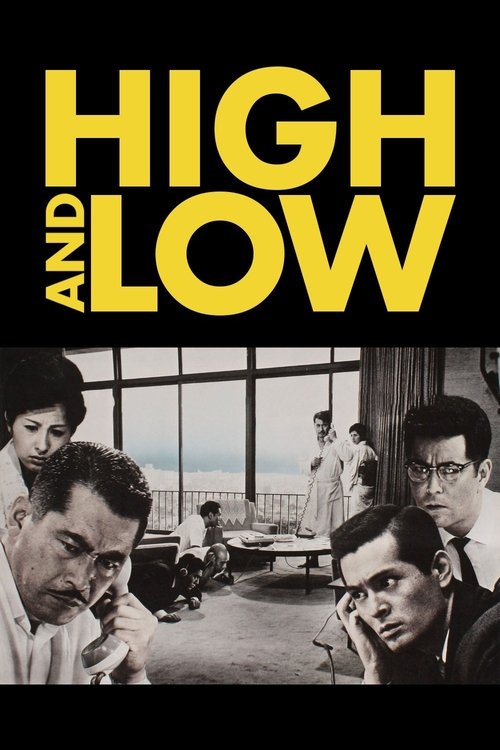
High and Low
1963 · Akira Kurosawa
For when you want a serious, meaty thriller that respects your intelligence — a crime story you can sink a whole evening into and still be arguing about at breakfast. More gripping than grim, but it asks something of you.
What it's about
A self-made shoe executive in Yokohama has bet everything he owns on a boardroom power play when the phone rings: kidnappers say they have his son. Then comes the twist of the knife — they've grabbed his chauffeur's boy by mistake, and they still want the full ransom. What begins as one man's impossible moral choice in a hilltop mansion opens out into a sprawling manhunt through the sweltering streets, docks, and back alleys of the city below.
The experience
The first half is a pressure cooker — one room, a handful of people, and a decision that gets heavier by the minute. Then the film exhales into a gripping, methodical police procedural, and the tension shifts from your conscience to the chase. It's absorbing the whole way through, and it leaves you turning the rich-man-poor-man question over long after.
Performances
Toshiro Mifune, so often cast as a force of nature, here plays a man in a suit being crushed by an invisible weight — his stillness and slow-burn anguish carry the entire first hour.
The craft
Kurosawa stages the mansion scenes like chess, arranging bodies across the widescreen frame so you can read every power shift without a word — then flips the style completely for the street-level hunt, all trains, heat, and crowds. The black-and-white photography is crisp and architectural, with one famous flash of color used like a signal flare. A big screen makes the geometry of it sing.
Why it matters
It set a template for the two-act kidnapping thriller and the modern police procedural, and it remains one of the most admired crime films ever made — proof that a genre picture can carry the weight of a social novel.
Snapshot
One of Kurosawa's most formally daring and socially penetrating works, High and Low splits its 143 minutes almost exactly in two: a suffocating chamber drama set in a single hillside penthouse, followed by an expansive police procedural that descends into the slums and drug dens of postwar Yokohama. Based on Ed McBain's 1959 crime novel King's Ransom, the film transforms a pulpy American source into a meditation on class, guilt, and the moral geometry of modern capitalism. Shoe executive Kingo Gondo is told that his son has been kidnapped — then learns the kidnappers have seized his chauffeur's son by mistake and intend to hold him to the original terms. The question of whether a man should sacrifice his fortune for another man's child drives the film's first half; the systematic hunt for the kidnapper drives its second. The title translates the Japanese Tengoku to Jigoku — Heaven and Hell — with spatial literalism: Gondo's glass-walled house crowns a bluff above the city, visible to everyone below as a symbol of aspirational distance.
Industry & production
High and Low was produced by Toho Studio under Kurosawa's own production company, Kurosawa Productions, which he had established in 1959. By the early 1960s Kurosawa occupied an unusual position within the Japanese studio system — sufficiently celebrated internationally to exercise near-complete creative control, yet expensive enough that his films placed pressure on Toho's budgets. The production was logistically demanding: the first act required constructing a detailed, precisely configured penthouse set on a Toho soundstage, while the second act called for extensive location work throughout Yokohama's harbor district, its crowded commercial zones, and the Doyama district, then associated with heroin use. The ransom handoff aboard a moving limited express train presented particular challenges: Kurosawa deployed multiple cameras inside the train simultaneously, coordinating action across several compartments. The film was released in Japan in March 1963 and received international distribution through 1963–64, reaching Western critics relatively quickly given Kurosawa's standing following Rashomon and Seven Samurai.
Technology
The film was shot in TohoScope, Toho's anamorphic widescreen format, yielding a 2.35:1 aspect ratio that Kurosawa uses architecturally — the wide frame holds multiple characters in sustained tension without cutting, and makes the horizontal spread of the city visible as a presence pressing against the apartment's glass walls. The most technically celebrated decision in the film is the brief insertion of color footage into an otherwise entirely black-and-white work. When the kidnapper burns the ransom money in a trash incinerator near Yokohama's harbor, the resultant smoke is chemically colored — a pink-salmon hue that the police can use to locate him. For this fleeting moment, Kurosawa inserted a strip of color film into the print, producing a flash of chromatic information amid the grayscale. The effect lasts only seconds but is viscerally startling: color here is not aesthetic embellishment but forensic evidence. This technique places the moment firmly within the narrative logic of visibility and concealment that structures the entire film. The decision anticipated later uses of selective color in cinema, though it remains unusual for its functional rather than expressionistic motivation.
Technique
Cinematography
The principal cinematographers were Asakazu Nakai and Takao Saito, both longtime Kurosawa collaborators. Nakai had shot Seven Samurai, Ikiru, and Yojimbo; Saito would continue with Kurosawa through Kagemusha and Ran. The two halves of the film demand and receive distinct visual registers. The apartment sequences are lit with controlled, almost theatrical precision — strong sidelighting carves Mifune's face into planes of certainty and doubt, and the wide frame of the TohoScope format turns the penthouse into a stage where Gondo's decision is observed by the grouped ensemble of family, police, and employees. The glass walls function as a constant reminder of exterior space: the city is always visible beyond the characters, framing the moral stakes in topographic terms. The investigative second half opens the film radically. Kurosawa and his cinematographers move into available-light and near-documentary conditions, tracking through narrow alleys, crowded train platforms, and fluorescent-lit jazz clubs. The shift in texture — from composed studio geometry to gritty, handheld-adjacent location work — is itself an argument about social space.
Editing
Kurosawa edited his own films, a practice he maintained throughout his career, and the cut of High and Low is among his most precise. The first act depends almost entirely on sustained long takes and tableau compositions — cuts are withheld to sustain the pressure of the locked-room situation. The second act inverts this: the procedural sequences are assembled from rapid, overlapping fragments of evidence, witness accounts, and surveillance, building tension through accumulation rather than confrontation. The editing grammar shifts to match the epistemological mode — the audience is now processing data alongside the detectives rather than observing moral deliberation. The transition between the two halves is handled with unusual abruptness: a title card marks the passage of time and the change in mode, and the film simply begins again in a different key.
Mise-en-scène / staging
The staging of the apartment sequences is one of Kurosawa's most sustained exercises in spatial dramaturgy. Gondo, his wife Reiko, his business partners, and a growing number of police officers occupy the same continuously present space across nearly an hour of screen time. Kurosawa blocks the figures in depth and groupings that shift as the moral weight of the situation redistributes — those urging Gondo to pay the ransom cluster differently from those urging him to protect his investment. The room itself becomes a kind of argument: the visible city below, the phone that carries the kidnapper's voice, the architectural openness that makes the house a display case of affluence. The lower-city sequences draw on a different tradition — deep-focus location staging that allows the teeming background of Yokohama to register as social texture rather than mere setting. The kidnapper's haunts are narrow, fetid, and close; the spatial contrast with Gondo's house is never schematic but always present.
Sound
The film's sound design exploits the telephone as a vector of power and helplessness. The kidnapper's voice, heard but never seen in the first half, commands Gondo's domestic space from outside it; the law's phone calls, the police's surveillance equipment, the recorded replays of the ransom conversation — all extend a logic in which sonic presence substitutes for physical access. Masaru Sato composed the score, as he had for several preceding Kurosawa films including The Bad Sleep Well and Sanjuro. The music is notably restrained in the first act, where silence and ambient sound carry much of the atmospheric weight; the second half uses jazz — performed in the Yokohama clubs where investigators eventually close in — as both local color and atmospheric pressure, the idiom of the underground economy bleeding into the investigative soundtrack.
Performance
Toshiro Mifune's performance as Gondo is one of his most controlled. Stripped of the kinetic physicality that defined his samurai roles, Mifune plays a man whose vigor is converted entirely into static deliberation — the body coiled, the face a register of competing calculations. The performance respects the character's fundamental hardness: Gondo is not soft; his eventual choice does not come easily or sentimentally. Tatsuya Nakadai as the lead investigator Tokura brings the same cool intelligence he had shown in The Hidden Fortress and Sanjuro, here deployed in a procedural register, patient and methodical. Tsutomu Yamazaki, in his early career, plays the kidnapper Takeuchi with a controlled malevolence that only fully reveals itself in the film's final exchange — a scene that remains one of Japanese cinema's more disturbing codas. The ensemble of police officers is handled with documentary-like restraint, individual figures emerging from the group as the investigation demands.
Narrative & dramatic mode
The film's two-part structure is genuinely unusual and poses persistent difficulties for genre classification. The first half is an almost Aristotelian closed drama: unity of place, compressed time, a single governing ethical question. It owes as much to stage tragedy as to cinema. The second half is procedural expansiveness — the systematic reconstruction of a criminal's movements, the patient accumulation of forensic detail, the grinding institutional labor of detective work. What holds these halves together is the film's sustained interest in visibility: who can see whom, from where, and at what social cost. The narrative's forward motion is always also a social descent, and the investigative structure of the second half mirrors the audience's own drive to understand how such a crime — rooted in class resentment — was possible in this particular city at this particular moment.
Genre & cycle
High and Low sits at the intersection of the police procedural, the social crime film, and what Japanese cinema of the period was developing as a shakai-ha (social tendency) mode — crime narratives that make the structures of postwar Japanese capitalism their real subject. It shares this orientation with The Bad Sleep Well (1960), Kurosawa's earlier anatomy of corporate corruption. The film also participates in the global procedural tradition of the late 1950s and 1960s, a cycle that ran from French police films through American television drama to Lumet's urban realism. McBain's 87th Precinct novels, which spawned the source material, were themselves shaping that procedural cycle internationally. Kurosawa's adaptation strips away the American setting and emplaces the story so thoroughly in Yokohama's specific topography that it becomes something the novel could not be: a film about a particular city's class geography at a particular moment.
Authorship & method
The screenplay was adapted from McBain by a four-person team: Kurosawa, Hideo Oguni, Ryuzo Kikushima, and Eijiro Hisaita. Kurosawa's standard practice was to work with a writing group sequentially and then in simultaneous isolation — each writer would draft independently, then the versions would be compared and synthesized. Oguni had been a core member of Kurosawa's creative circle since the late 1940s; Kikushima had co-written Yojimbo and Sanjuro. The resulting script departs significantly from McBain's novel in its social and spatial emphases, relocating the moral center of gravity from a conventional thriller premise to an explicit study of class antagonism. Kurosawa's directorial method in this period relied heavily on detailed pre-production preparation — storyboards, set pre-construction, extensive rehearsal — but also on the use of multiple cameras running simultaneously, which he regarded as essential to capturing actors' behavior without the self-consciousness that comes from knowing which camera is on them at any given moment. The film was edited by Kurosawa himself, as was his invariable practice.
Movement / national cinema
The film is a product of the Japanese New Wave moment insofar as it shares that movement's sociological directness and its willingness to depict the underside of the economic miracle — the Yokohama drug trade, the slum districts visible from affluent heights, the resentment fermenting below the postwar prosperity. But it sits apart from the New Wave proper (Oshima, Shinoda, Yoshida) by virtue of Kurosawa's older formal commitments: his preference for classical continuity, for deliberate staging, for the moral legibility that the New Wave often refused. The film is better understood as Kurosawa's most sustained engagement with the contemporary realist strain of Japanese cinema rather than an embrace of avant-garde rupture. It belongs to a specifically Kurosawa version of social cinema — one that uses the genres of entertainment (thriller, procedural) to carry observations that might otherwise be unreachable for a mass audience.
Era / period
The film arrives at a hinge moment in Japanese economic and urban history. The Tokyo Olympics of 1964 were months away; the Shinkansen — the world's first high-speed rail line — would open that October. Japan was mid-surge in what would become the postwar economic miracle, and the social costs of that surge were unequally distributed. The shantytown Gondo's house overlooks is not a relic of wartime destruction but an active feature of the rapidly modernizing city. The film's kidnapper is not simply criminal but symptomatic — a product of the spatial and economic arrangements that make his resentment intelligible if not forgivable. Kurosawa places this sociology in 1963 precisely so that viewers understand the miracle's shadow.
Themes
The central thematic structure is legible in the title's spatial metaphor: elevation as privilege, and privilege as moral burden. The film asks whether wealth incurs obligation — not abstractly, but with specific financial stakes that would ruin Gondo if met. Gondo is not a villain; his initial refusal to pay is comprehensible business logic. His eventual decision to pay despite this transforms the film from a crime thriller into a moral one. The kidnapper Takeuchi, revealed in the second half to have lived his entire life looking up at Gondo's illuminated house from below, is the film's most troubling figure: his crime is motivated by hatred of visible prosperity, which makes him not merely a criminal but a social symptom. The film refuses to sentimentalize either figure. The final confrontation between Gondo and Takeuchi — separated by prison glass, each looking at the other across an unbridgeable social and moral distance — compresses the entire film's argument into a single image of mutual incomprehension. The theme of vision and surveillance runs throughout: detective work is the systematic deployment of the state's eyes; Gondo's house is a vision machine for the class below; the colored smoke is evidence made briefly, shockingly visible.
Reception, canon & influence
High and Low was received respectfully upon Japanese release and performed reasonably at the box office, though precise figures are not reliably recorded in English-language scholarship. Western critics who encountered the film in 1963–64 tended to read it primarily as a thriller and noted its unusual bipartite structure with some uncertainty. Donald Richie, who remained the most authoritative English-language Kurosawa scholar of the postwar decades, treated it as one of Kurosawa's most accomplished contemporary-setting works. Over subsequent decades, the film's reputation solidified. It entered the Criterion Collection, which has lent it sustained critical visibility in Anglophone markets.
The influences behind the film are layered: McBain's procedural architecture provides the detective-work grammar; American film noir contributes the moral atmosphere of a city where crime and poverty are structurally adjacent; Italian neorealism — particularly Visconti's and De Sica's deployment of class space — is visible in the location-shooting philosophy of the second half. Kurosawa had long acknowledged his debt to Ford and Wyler in visual construction, and the disciplined widescreen compositions of the apartment sequences owe something to Wyler's deep-focus staging.
The film's forward influence is substantial. Bong Joon-ho, whose Parasite (2019) made the spatial metaphor of class — rich above, poor below — its central formal conceit, has cited High and Low directly as a touchstone; the vertical class geography of Parasite's Seoul is in explicit dialogue with Yokohama's heaven and hell. The police procedural tradition that High and Low helped legitimize as serious cinema rather than mere genre — patient, accumulative, attentive to institutional labor — runs forward through Sidney Lumet's American police films and into contemporary prestige television. The film's technical innovation of the color smoke insert, though infrequently discussed in technical histories, stands as an early example of using chromatic difference as a narrative rather than purely aesthetic device, anticipating the controlled color inserts of later filmmakers. Within Kurosawa's own career, High and Low represents the fullest expression of his social realist ambitions, sitting between The Bad Sleep Well's institutional critique and Red Beard's humanist fable — the point at which his cinema was most directly engaged with the texture of contemporary Japan.
A Deleuzian reading
A man stands in an air-conditioned room high above Yokohama, and he cannot move.
The full Deleuzian reading of High and Low →
Reception
A hit in Japan on release but long overshadowed abroad by Kurosawa's samurai epics, it's since been reappraised as one of his very best — modern cinephiles routinely rank this 'minor' crime picture alongside Seven Samurai and Ikiru, and sometimes above them.
How High and Low was received, from release to now →
Influences: the films it descends from and the films it influenced
- The Best Years of Our Lives (1946) — Wyler's deep-focus ensemble staging across differentiated spatial planes in widescreen directly informs Kurosawa's sustained apartment sequences, where Gondo, his family, and the police simultaneously occupy legible depth zones without cutting — the dossier names Wyler explicitly as the source.
- A Matter of Life and Death (1946) — Powell and Pressburger's structural use of deliberate chromatic shift between narrative registers — Technicolor earth, monochrome heaven — establishes selective color as a grammar of narrative meaning rather than decoration, the conceptual precedent for Kurosawa's colored-smoke insert as a narrative device.
- Naked City (1948) — Dassin established the procedural grammar of patient, accumulative documentation of institutional police labor as serious cinematic subject — location shooting as authenticity guarantee, ensemble as social cross-section — which Kurosawa imports wholesale for the investigative second half.
- Bicycle Thieves (1948) — De Sica's available-light location philosophy and treatment of city space as a legible map of class stratification directly inform the Yokohama dockside and drug-den sequences, where geography encodes social distance as visual fact.
- Stray Dog (1949) — Kurosawa's own procedural template: institutional police labor tracked in accumulative real time through Tokyo's class-stratified locations, with Mifune in a restrained deliberative register that High and Low reprises for Gondo's prolonged stillness under pressure.
- Rocco and His Brothers (1960) — Visconti's widescreen anamorphic staging of class antagonism organized around vertical spatial displacement — wealth against poverty across Milan's geography — is the immediate Italian precedent for Kurosawa's heaven-and-hell Yokohama cartography.
- The Bad Sleep Well (1960) — Immediate predecessor using the same multi-camera simultaneous shooting method to capture unrehearsed ensemble behavior, and the same shakai-ha critique of institutional power, with Mifune performing moral constraint as physical stillness — the direct rehearsal for Gondo.
- Elevator to the Gallows (1958) — Miles Davis's jazz score deployed as atmospheric dread and moral suspension rather than conventional accompaniment is the direct template for Masaru Sato's jazz underscoring in High and Low, where jazz sustains tension as an environmental pressure rather than punctuating individual beats.
- When a Woman Ascends the Stairs (1960) — Kikushima again turning cash into blocking: the first hour holds a fixed set in Tohoscope and stages a moral crisis entirely through where people stand relative to a suitcase of money, extending the lateral-separation-plus-ledger method into its most rigorous form.
- The French Connection (1971) — Rapid assembly editing of surveillance operations and procedural pursuit, available-light location shooting that renders the city as a moral-class geography, and sustained institutional police labor as the film's central moral subject — the American procedural line that absorbed and extended High and Low's genre legitimization.
- Serpico (1973) — Available-light New York location shooting that renders city space as class-inflected moral geography, combined with the police procedural form as institutional critique rather than genre entertainment — the Lumet tradition the dossier places directly downstream of High and Low.
- All the President's Men (1976) — Every scene turns on the telephone as information-power vector — who can be reached, what they'll reveal, who controls the channel — extending High and Low's structural conceit that telephonic access is the primary mechanism of leverage and class exposure.
- Dog Day Afternoon (1975) — The telephone as real-time power vector in a sustained standoff: every negotiation is mediated by the phone, which determines who holds leverage and who is exposed, directly reprising High and Low's structural conceit of telephonic communication as the instrument of class-power asymmetry.
- Memories of Murder (2003) — Police procedural deployed as shakai-ha social critique of institutional inadequacy and class-inflected justice, with rapid procedural assembly editing that accumulates investigative details simultaneously as evidence and as social symptom — Bong's direct inheritance of Kurosawa's genre politicization.
- Zodiac (2007) — Patient accumulative procedural that tracks institutional labor across years using rapid assembly of documentary evidence across agencies, with a bipartite structural shift that changes register and investigative focus mid-film, reprising High and Low's organizational logic of splitting the film at the point of institutional handover.
- Parasite (2019) — Vertical class geography as central formal conceit — basement to penthouse, underground to above-ground — in direct and acknowledged dialogue with Yokohama's heaven-and-hell spatial metaphor; Bong has cited High and Low as the explicit source of this organizing spatial logic.
- Yojimbo (1961) — The same Kurosawa-Mifune partnership and Tohoscope format, with the social-corruption allegory remapped vertically across industrial Yokohama while sharing Yojimbo's protagonist tactic of superior information management and the stillness-explosion editing rhythm.
Similar films
- Stray Dog (1949) — influence & lineage
- The Bad Sleep Well (1960) — influence & lineage
- Dog Day Afternoon (1975) — influence & lineage · often watched together
- The French Connection (1971) — influence & lineage · often watched together
- Ikiru (1952) — often watched together
- Seven Samurai (1954) — often watched together
- Throne of Blood (1957) — often watched together
- Ran (1985) — often watched together
All the films related to High and Low →