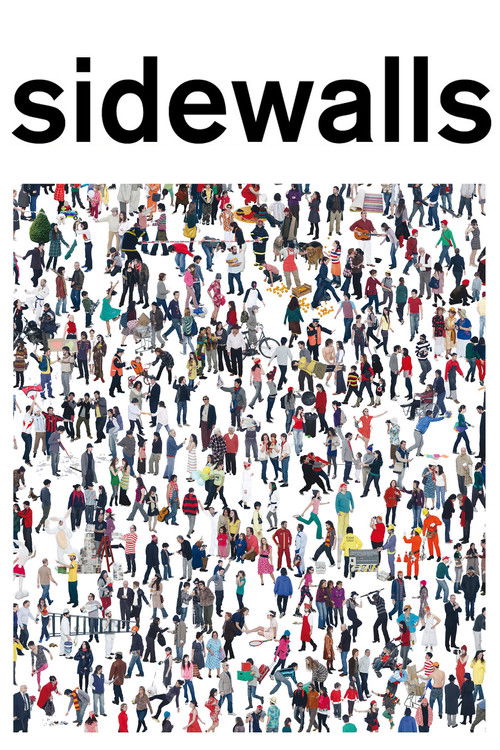
Sidewalls
2011 · Gustavo Taretto
For a cozy night in when you want to fall in love a little — especially if you've ever felt alone in a crowded city. Pure comfort, melancholy but warm, ideal for a quiet solo evening or a low-key date.
What it's about
Martín, a phobic web designer barely venturing beyond his one-room Buenos Aires apartment, and Mariana, an architect-turned-window-dresser recovering from a long relationship, live on the same street in facing buildings — obviously right for each other, and forever failing to meet. The city itself is the third character: a place of blind party walls, tangled wires, and three million people, where the film keeps asking whether a metropolis built to isolate people can still bring two of them together.
The experience
Wistful, witty, and gentle — it moves at a stroll, narrated in his-and-hers voiceovers full of dry observations about apartments, phobias, and modern loneliness. It leaves you tender toward your own city and everyone almost-meeting in it.
Performances
Javier Drolas and Pilar López de Ayala are quietly winning apart — the trick of the film is how fully you root for two people who share almost no scenes.
The craft
Gustavo Taretto, expanding his own acclaimed short, builds the whole film around an architectural metaphor: the windowless walls between buildings, and the tiny illegal windows people punch through them for light. The essayistic voiceover and lovingly photographed Buenos Aires facades make it as much a city portrait as a romance.
Why it matters
A festival favorite that traveled far beyond Argentina, it became a touchstone of the urban-loneliness romance and introduced international audiences to Taretto's essayistic style.
Snapshot
Sidewalls — original title Medianeras — is an Argentine romantic drama written and directed by Gustavo Taretto, expanded from his own acclaimed 2005 short film of the same name. It follows two lonely thirtysomethings, Martín (Javier Drolas) and Mariana (Pilar López de Ayala), who live in facing apartment buildings on the same Buenos Aires street, are self-evidently made for one another, and spend the film almost meeting. The word medianeras refers to the blind party walls between buildings — the windowless flanks that, in Buenos Aires's unregulated growth, sometimes acquire tiny illegal windows punched out for a sliver of light and air. That architectural detail is the film's central metaphor: two people carving small openings toward contact in a city built to keep its inhabitants apart. Essayistic, voiceover-driven, and formally playful, the film is best understood as an urban-alienation romance in the lineage of Woody Allen and Amélie, transposed to the specific density and disorder of Buenos Aires. It premiered in the Panorama section of the 2011 Berlin International Film Festival and traveled widely on the festival circuit.
Industry & production
Medianeras was an international co-production, principally Argentine with Spanish and German partners — a financing structure typical of Latin American art-house features of its era, which routinely stitched together national film-institute support, European co-production funds, and television pre-sales to reach a viable budget. The lead Argentine producer was Rizoma Films (Hernán Musaluppi), with Spanish and German co-producers attached; I am confident of the tripartite Argentine–Spanish–German character of the production but would flag that the exact roster of companies and the budget are details a reader should verify against the film's credits rather than take from memory here. The casting itself encodes the co-production: Drolas is Argentine, while López de Ayala is a prominent Spanish actress, a pairing that gave the film reach into both the Argentine and Spanish markets.
The film's most important production fact is that it did not originate as a feature. Taretto first made Medianeras as a short in 2005, which circulated successfully on the festival circuit and won prizes; he then spent several years developing it into a feature, which is why the finished film has the density of a fully worked-out idea rather than a debut's improvisation. Taretto's feature filmography is slender — Medianeras stands as his signature work — and the long gestation shows in the precision of its design.
Technology
I cannot confirm from the established record whether Medianeras was originated on film or digitally, and I will not guess; readers should treat the capture format as unverified. What is beyond dispute is that technology is the film's subject as much as any tool of its making. Martín is a web designer who conducts most of his life through a screen — he works, shops, dates, and self-diagnoses online, and the film treats the early-2010s internet (instant messaging, online dating, search engines, the accumulation of digital clutter) as both a lifeline and a trap for the socially phobic. The film is a period document of a specific technological moment: the pre-smartphone-saturation internet of chat windows and desktop computers, when "virtual reality," in the synopsis's phrasing, still meant sitting alone at a machine rather than carrying the network in one's pocket. Its anxieties about connection-through-mediation now read as prescient of the smartphone era that immediately followed.
Technique
Cinematography
The cinematography — by Leandro Martínez, whom I believe to be the credited director of photography — is the film's most celebrated element and inseparable from its argument. Buenos Aires is shot as a visual thesis: a torrent of rapid, often static compositions of façades, windows, water tanks, cabling, and the titular sidewalls, frequently organized into grids and rows that stress the city's accreted disorder. The camera repeatedly frames apartment windows as tiny illuminated boxes, each a sealed private world, so that the built environment itself dramatizes isolation. Symmetry and framing-within-framing recur: characters are boxed by doorways, screens, and windows, visually quarantined even when the geometry is beautiful. The palette leans toward the muted grays and browns of the city's concrete, punctuated by the color of interiors, which keeps the film from tipping into whimsy despite its playful voice.
Editing
The editing is brisk and montage-forward, especially in the essayistic passages where the film indexes the city — sequences that catalog buildings, windows, or urban details in quick succession to illustrate a narrating character's thesis. This gives Medianeras an almost illustrated-lecture rhythm in stretches, cutting between Martín's and Mariana's parallel lives to underline how their routines rhyme without intersecting. I am not confident of the credited editor's name and will not invent it; the editing's strategy, however — parallel construction, catalog montage, and a willingness to pause the narrative for a visual essay — is clearly legible on screen.
Mise-en-scène / staging
Production and set design carry unusual weight because the two protagonists' apartments are characterizations. Martín's one-room flat is cramped, screen-dominated, and cluttered with the residue of a life lived indoors; Mariana, an architect who has drifted into designing shop windows and dressing mannequins, inhabits a space marked by her frustrated creative training and her claustrophobia. The recurring motif of the window — the illegal opening cut into a blind wall — is staged as the literal and figurative aperture through which the characters might see out and be seen. Mannequins, shop displays, and the paraphernalia of a designed life fill Mariana's world; screens and cables fill Martín's; the contrast is precise and thematically loaded.
Sound
Sound design foregrounds the ambient churn of the metropolis — traffic, construction, the layered noise of three million people — against which the characters' interior monologues play. Music underscores the melancholy-whimsical tone; I am not certain of the composer's identity and decline to attribute it. The dominant sonic feature is the voiceover: the film is narrated in alternating first person by both leads, and much of its wit and pathos lives in that spoken text rather than in dialogue between the characters, who barely share scenes.
Performance
Javier Drolas plays Martín with a hangdog, self-deprecating interiority suited to a character defined by phobia, therapy, and avoidance; the performance is calibrated to the voiceover, quiet and observational. Pilar López de Ayala brings a wry, restless melancholy to Mariana, an artist recovering from a long relationship and boxed in by her own anxieties. Because the script keeps them apart for most of the running time, both performances are essentially soliloquies in parallel — the actors carry loneliness convincingly enough that the film's central conceit (two people we desperately want to collide) generates real romantic suspense from near-misses alone.
Narrative & dramatic mode
Medianeras operates in an essayistic, digressive romantic-comic-melancholic mode rather than a conventional plot-driven one. Its dramatic engine is dramatic irony: the audience knows from the first minutes that Martín and Mariana belong together, and the film sustains itself on the anguish and comedy of their non-meeting across a crowded city. Structurally it is built on parallelism and voiceover — two lives narrated side by side, converging by inches. Recurring conceits organize the material: Martín's search for Waldo (Wally) in a Where's Waldo? book becomes an explicit figure for finding one person among millions, and the city is likened to a badly played game of Tetris, its buildings jammed together without plan. The mode is confessional and aphoristic, closer to an illustrated personal essay about urban loneliness than to a classical love story, with the romance as both subject and payoff.
Genre & cycle
The film sits at the crossing of romantic comedy-drama and the urban-alienation art film. It belongs recognizably to a transnational cycle of quirky, design-forward, voiceover-narrated romances that flourished in the 2000s — works often compared to Jean-Pierre Jeunet's Amélie (2001) and to indie relationship films like (500) Days of Summer (2009) — while remaining tethered to a more melancholic, essayistic European art-cinema sensibility. Within Argentine cinema it is somewhat atypical: warmer, more stylized, and more overtly romantic than the austere realism associated with the country's most exported art films, which is part of why it found an international audience.
Authorship & method
Medianeras is a strong auteur statement precisely because it is a single sustained idea, developed by one filmmaker across two versions over roughly half a decade. Gustavo Taretto wrote and directed both the 2005 short and the 2011 feature, and the film's fusion of architectural essay and romantic longing is unmistakably his authorial signature — a movie that thinks about cities as fluently as it feels about people. The feature reads as the definitive expansion of a fully formed conceit rather than a compromise, which is rare and speaks to Taretto's control over the material.
Among collaborators, the cinematographer (credited, I believe, to Leandro Martínez) is the decisive creative partner, since the film's argument about urban isolation is carried by images of façades and windows as much as by the screenplay. The two lead performers — Drolas and López de Ayala — function almost as co-authors of tone, given how much of the film rests on their narrated interiority. For the editor and composer I decline to name individuals I cannot verify, but the film's method is clear: script, image-essay, and voiceover were conceived as a single integrated system, with architecture as the organizing metaphor throughout.
Movement / national cinema
The film emerges from Argentine cinema's post-2000 international ascendancy — the broad efflorescence often labeled New Argentine Cinema (Nuevo Cine Argentino), which since the late 1990s had made Buenos Aires filmmaking a fixture on the world festival circuit. Medianeras both belongs to and departs from that context. It shares the movement's attention to the texture of contemporary Buenos Aires life, its middle-class malaise, and its precise sense of place. But where the movement's most canonical works tend toward observational realism and narrative austerity, Taretto's film is stylized, aphoristic, and structured as a designed essay, aligning it as much with a transnational art-house romanticism as with the domestic realist tradition. It is, in effect, a Buenos Aires film in dialogue with world cinema.
Era / period
Medianeras is very much a document of its moment: the turn of the 2010s, when urban life had become saturated by the internet but not yet fully by the smartphone. Its portrait of loneliness mediated by chat windows, online dating, and search engines captures a transitional technological era with unusual specificity. It also reflects a post-crisis Buenos Aires — a city whose chaotic, over-dense construction the film reads as the physical sediment of decades of unplanned growth. The film's anxieties — atomization, screen dependency, the paradox of isolation amid millions — are recognizably those of the early twenty-first-century metropolis, and they have only sharpened with time.
Themes
The governing theme is urban loneliness: the paradox that a city of three million can be the loneliest place imaginable, its very density a barrier to connection. Architecture is the sustained metaphor — the medianeras themselves, the blind walls into which people cut illegal windows, stand for the small, improvised openings through which isolated individuals seek light and contact. Related threads run throughout: technology as both remedy and cause of alienation; phobia and anxiety (Martín's agoraphobic tendencies, Mariana's claustrophobia) as psychological correlates of the built environment; the search for a single soulmate rendered literal in the Where's Waldo? motif; and the tension between the city as designed order and as accreted chaos, figured in the Tetris conceit. Underneath runs a hopeful counter-argument: that connection, however improbable, remains possible, and that the same disorder that isolates might also, by chance, bring two people face to face.
Reception, canon & influence
Critically, Medianeras was warmly received as a distinctive, visually inventive romance, praised especially for its cinematography and its intelligent use of Buenos Aires's architecture as a vehicle for emotion; comparisons to Amélie, to Woody Allen's New York films, and to contemporary indie romances such as (500) Days of Summer recurred in coverage. Its premiere in the Panorama section at the 2011 Berlinale gave it international festival visibility, and it circulated on the festival circuit and in art-house release thereafter. I am aware the film collected festival honors but will not attribute specific award wins I cannot verify, nor cite box-office figures; the safe summary is that it was a well-regarded festival and art-house title rather than a commercial blockbuster.
Looking backward, the influences on the film are legible: Taretto's own 2005 short is its direct progenitor, and its stylistic DNA draws on the Jeunet-style whimsical urban fable, the Allen-esque neurotic-romantic voiceover comedy of alienation, and the essayistic city-symphony tradition of filming a metropolis as a character. Looking forward, its legacy is more modest and specific than sweeping: it stands as one of the defining Argentine international art-house successes of its moment and as a touchstone for films that treat architecture and urbanism as the language of emotional isolation. Because Taretto's subsequent output has been limited, the film's forward influence rests less on a school of followers than on its durability as a beloved, frequently revisited example of how the physical fabric of a city can be made to carry the weight of loneliness and longing — a reputation that has, if anything, grown as its early-internet anxieties have become universal.
Reception
A quiet Berlinale Panorama premiere in 2011 that never got a big release, it's aged into a word-of-mouth treasure — passed hand to hand online as the definitive 'lonely in a big city' movie, especially beloved among Spanish-speaking film Twitter and Letterboxd.
How Sidewalls was received, from release to now →
How to watch Sidewalls: what to notice on a first viewing
- Watch windows framed as small illuminated boxes throughout. The city is shot as rows and grids of facades and lit windows, each one a sealed private world glimpsed from outside. The built environment argues the film's point: a city this dense can still keep everyone boxed apart.
- Notice quick catalog sequences of the city's buildings. Montage passages index facades, water tanks, and cabling in rapid succession, almost like an illustrated lecture rather than a scene. These catalog sequences are doing essay writing with images, instead of narration explaining a point outright.
- Listen for both leads narrating their own lives, in turn. Martin and Mariana each supply first-person voiceover describing their days, and the two narrations run in parallel without the characters actually meeting. The voiceover carries most of the wit and feeling here, since the two leads barely share a scene.
- Notice how differently the two apartments are furnished and lit. His cramped flat is dominated by screens and cables; her space is filled with mannequins and shop displays from her design work. Each apartment works like a small portrait of the person living in it, before either character says a word.
The whole guide to watching Sidewalls, with the keys for a rewatch →
Influences: the films it descends from and the films it influenced
- Medianeras (short) (2005) — The film's direct progenitor: Taretto first built the façade-and-window essay, the catalog montage of urban phobias, and the dual first-person voiceover here, then expanded the identical conceit into the feature.
- Amélie (2001) — Supplies the catalog-montage grammar — quick inventories of characters' likes/dislikes and quirks narrated by an omniscient whimsical voiceover — that Medianeras adopts to introduce Martín and Mariana.
- Annie Hall (1977) — Model for the neurotic direct-address romantic voiceover and the parallel-soliloquy structure that lets two would-be lovers narrate the same stalled connection from split, self-analyzing perspectives.
- Manhattan (1979) — Its opening city-symphony montage treats architecture itself as the romantic subject, the model for Medianeras' essayistic passages that render Buenos Aires's buildings as emotional characters.
- The Apartment (1960) — Establishes the single urban dwelling as a character that shapes and diagnoses its lonely occupant — the anonymous high-rise clerk whose flat is the film's real protagonist.
- Playtime (1967) — Codifies glass façades, grids and windows as the visual grammar of modern alienation, including the framing-within-framing through panes that Medianeras uses to trap its characters in architecture.
- Rear Window (1954) — The apartment window as a frame-within-a-frame narrating strangers' isolated lives across a shared courtyard is the direct precedent for Medianeras' voyeuristic reading of façades and lit windows.
- Berlin: Symphony of a Great City (1927) — Founds the essayistic city-symphony tradition — catalog-montage rhythm that edits the metropolis itself into a character — which underlies Medianeras' architectural interludes.
- Wings of Desire (1987) — Its overlapping interior voiceover of solitary city-dwellers, overheard as private monologue drifting across the urban fabric, prefigures Medianeras' dual, non-communicating soliloquies.
- Chungking Express (1994) — First-person voiceover interiority of two lonely near-missing urbanites, plus fetish objects of mediated connection, is the template for Medianeras' parallel-construction of two people who keep almost meeting.
- Her (2013) — Carries forward the technology-mediated-connection theme and window-lit urban loneliness, staging longing between screens within a softly designed, isolating metropolis.
- Paterson (2016) — Inherits the essayistic daily-rhythm structure that makes a city's ordinary fabric — its walls, routines and repetitions — the film's organizing voice rather than a setting.
- (500) Days of Summer (2009) — Shares the nonlinear parallel construction, chaptered day-card structure and essayistic narration over an architecture-preoccupied romance — a near-contemporary indie built from the same formal kit.
- Lost in Translation (2003) — Same urban-alienation-romance of two isolated souls framed and dwarfed by an overwhelming megacity, connection staged as proximity-without-contact within hostile architecture.
- Frances Ha (2012) — Extends the same craft: monochrome city-as-character portraiture and Allen/Nouvelle-Vague-derived grammar carrying young-adult urban alienation through the physical fabric of the metropolis.
- El hombre de al lado (2009) — The closest Nuevo Cine Argentino kin: a drama literally engineered around a dividing party-wall and a contested window, making architecture the engine of the plot rather than mere backdrop.
Similar films
- Wings of Desire (1987) — influence & lineage
- Her (2013) — influence & lineage
- Lost in Translation (2003) — influence & lineage · same viewing thread
- Chungking Express (1994) — influence & lineage · same viewing thread
- Before Sunrise (1995) — same viewing thread
- Before Sunset (2004) — same viewing thread
- Vive L'Amour (1995) — shared sensibility
- Robot Dreams (2023) — shared sensibility
All the films related to Sidewalls →
Watch it with: curated runs of related films
- Strangers Who Walk and Talk — Watch these back to back for the particular magic of two people, a city, and a few borrowed hours of talk that may not outlast the night.