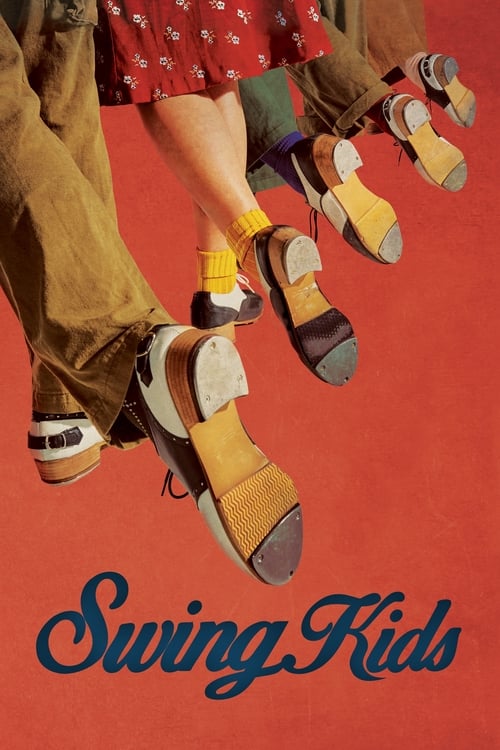
Swing Kids
2018 · Kang Hyoung-chul
For when you want a big-hearted musical with real stakes — something that makes you grin at the choreography and still leaves a lump in your throat. Comfort viewing on the surface, but be ready for it to cut deeper than you expect.
What it's about
In a prisoner-of-war camp on Geoje Island during the Korean War, a hard-line young North Korean prisoner named Ki-soo is stopped cold by the sight and sound of tap dancing. He joins a ragtag dance troupe called the Swing Kids, assembled under an American sergeant who was once a Broadway hoofer, and the group starts to dream past the barbed wire. But the camp is a pressure cooker of ideology — communist and anti-communist prisoners at each other's throats — and dancing in the middle of it is a dangerous act.
The experience
It swings hard between joy and dread: the dance numbers are genuinely exhilarating, all rhythm and release, and then the war keeps crashing back in. You come out of it buzzing and bruised at once — a crowd-pleaser that refuses to stay safe.
Performances
Doh Kyung-soo (D.O. of EXO) carries the film as Ki-soo, selling both the ideological rigidity and the helpless love of dance underneath it, and American tap virtuoso Jared Grimes brings the real thing — his dancing is the film's beating heart.
The craft
The tap numbers are staged and cut with real percussive force — feet as drum solos — and the film's boldest move is laying that American vernacular joy over one of the most fraught spaces of the twentieth century. From the director of Sunny, it has that same gift for tonal whiplash, and the sound design of taps on wood and dirt genuinely rewards good speakers.
Why it matters
Adapted from the Korean stage musical Ro Ki-soo, it became a touchstone example of Korean cinema's willingness to mash genres — musical, war film, tragedy — without apology, and a showcase for idol-turned-actor D.O.'s screen credibility.
Snapshot
Swing Kids is a South Korean musical drama set inside the Geoje Island prisoner-of-war camp during the Korean War, in which a hard-line young North Korean POW discovers tap dance and joins a ragtag troupe assembled under the eye of an American guard. Directed by Kang Hyoung-chul (Kang Hyeong-cheol) — the filmmaker behind the era-crossing hit Sunny (2011) — the picture adapts the Korean stage musical Ro Ki-soo (로기수) and casts pop idol Doh Kyung-soo (D.O. of EXO) in the lead as Ro Ki-soo opposite the American tap virtuoso Jared Grimes as the ex-Broadway dancer turned sergeant Jackson. Its central conceit is a collision of registers: the percussive American vernacular of tap laid over one of the most ideologically fraught spaces of the twentieth century, a camp where communist and anti-communist prisoners were themselves at war. The film is best understood as an attempt to graft the Hollywood-and-Broadway backstage musical onto Korean historical trauma — an ambition that produced both its most electric sequences and the tonal fault lines that divided its reception. It arrived in Korean theaters in December 2018 and is widely remembered as a commercial disappointment relative to its evident scale, even as it retained admirers for its dance set-pieces and its willingness to end in tragedy rather than uplift.
Industry & production
Swing Kids was mounted as a mid-to-large budget commercial release within the mature South Korean studio system, positioned for the competitive year-end holiday corridor — traditionally a prime window for Korean tentpoles. The project's DNA is theatrical: it derives from the creative-musical Ro Ki-soo, itself part of a Korean stage tradition that has repeatedly mined the Korean War and the Geoje camp for drama. Translating a chamber-scaled stage work into a period spectacle with large sets, crowd choreography, and a mixed Korean-and-English-speaking cast represented a significant production undertaking; the recreation of the Geoje camp — watchtowers, barbed-wire compounds, canteen and parade-ground spaces — anchors the film's physical world.
A defining industry gamble was casting. Doh Kyung-soo brought a large idol-driven fanbase (EXO) but had also been building genuine acting credibility, and the role demanded that he learn tap from scratch. Casting Jared Grimes, a working American tap dancer and choreographer rather than a Korean star, in a substantial co-lead role is unusual for a Korean commercial film and signals how central the authenticity of the dance was to the production's conception. On the commercial record, the film is generally described as having underperformed its expectations at the domestic box office; I would flag that precise budget and gross figures should be verified against a reliable box-office database rather than asserted here, as the specific numbers are not something I can state with confidence.
Technology
The film was produced and exhibited within the fully digital pipeline standard for late-2010s Korean commercial cinema — digital acquisition, a digitally graded finish, and Dolby-era multichannel sound delivered to multiplex screens. Its most consequential technological demands were not exotic capture formats but the disciplines of the musical: production sound and synchronization for dance. Tap is a genre in which the sound is the performance — the taps must read cleanly and land on the beat — so the film's soundtrack of foley, recorded taps, and rhythmic music had to be locked to the image with precision, whether captured live or sweetened in post. The other technical throughline is music licensing and arrangement: the score leans on a deliberately anachronistic pop palette (the use of Western pop-rock against a 1951 setting is one of the film's signatures), which places arrangement, rights clearance, and musical staging at the center of the technical work rather than at its margins.
Technique
Cinematography
The camera work serves two masters and switches between them. In the dramatic camp scenes it favors a grounded, period-realist register — earth tones, overcast Geoje light, the drab palette of uniforms and mud — establishing the confinement and menace of the setting. In the dance numbers it opens up: the frame becomes mobile and rhythmic, tracking and craning to keep whole bodies and fast feet legible, because tap must be shot to preserve the line of the dancer and the contact of shoe to floor. The film's signature flourish is to let its musical fantasy periodically overrun the realist frame, so that the camera stages numbers that could not literally occur in the compound. This oscillation between documentary-adjacent grimness and stylized musical space is the visual thesis of the movie.
Editing
Editing is where a dance film lives or dies, and Swing Kids generally respects the choreography by cutting on the music and holding shots long enough to let a step complete — a discipline that distinguishes competent movie musicals from those that dice dance into incoherence. The larger editorial challenge is macro-structural: the film must modulate between comedy, training-montage uplift, romance, and the encroaching brutality of the camp's political violence. The tonal whiplash that some viewers registered is partly an editorial effect — the picture repeatedly cuts from euphoria to atrocity, and the abrupt, unsoftened ending is its most aggressive editorial choice, refusing the reconciliation the musical form conventionally promises.
Mise-en-scène / staging
The production design draws a hard line between the world of confinement and the world of dance. The camp is a machine of ideological sorting — banners, portraits, factional compounds — and the film stages the prisoners' politics spatially. Against this, the dance troupe's rehearsal and performance spaces become zones of provisional freedom. Costuming tracks the same divide: the uniformity of POW dress versus the theatrical getups of performance. Kang stages the numbers with an eye to ensemble geometry, using the barracks, corridors, and open grounds as found stages, so that the choreography feels wrung out of a hostile environment rather than imported into it.
Sound
Sound is arguably the film's true protagonist. Tap makes rhythm visible and audible at once, and the sound design foregrounds the taps as a language that crosses the barriers of nationality and ideology dividing the characters — none of whom fully share a spoken tongue. The film is bilingual by necessity (Korean, English, with the mutual incomprehension itself a subject), and it leans on music to do the communicative work that dialogue cannot. The anachronistic pop needle-drops are the boldest sonic gesture, insisting that the film is a fable about the transhistorical utopia of rhythm rather than a sober reconstruction.
Performance
Doh Kyung-soo's Ro Ki-soo is the film's engine: a doctrinaire young communist whose body is seduced by an American art form before his politics can catch up, a contradiction the performance has to carry physically. The demand that a non-dancer read as a convincing tapper is steep, and the role trades on Doh's expressive intensity and his visible, effortful transformation. Jared Grimes, a genuine tap artist, supplies the authority of real virtuosity as Jackson and grounds every number in credible technique. The ensemble — including Park Hye-su and Oh Jung-se among the troupe and camp figures — provides the comic and pathetic texture around the two leads. The performances collectively bear the film's tonal ambition: they must be light enough to sell the joy of the dance and weighted enough to survive the ending.
Narrative & dramatic mode
Structurally, Swing Kids is a backstage/putting-on-a-show musical — the "let's form a troupe, train against the odds, and perform" template — welded to a war tragedy. Its dramatic mode is therefore a deliberate hybrid: the propulsive optimism of the rehearsal narrative runs on a collision course with the historical determinism of the setting. The troupe is assembled partly as a propaganda instrument (a dance team that projects a benign image of the camp), which laces the uplift with irony from the start. The film's arc withholds the genre's promised catharsis; instead of triumph, it delivers rupture, using the musical's conventions to raise hopes precisely so history can crush them. That refusal is the film's central dramatic statement — and the source of its divisiveness.
Genre & cycle
The film sits at the intersection of the dance musical and the Korean War film, two traditions rarely fused. Korean cinema has a deep war-and-division cycle (the bundan or division genre) and a robust vein of crowd-pleasing period entertainments, but the full-throated musical is comparatively rare in the Korean commercial canon, which makes Swing Kids something of an outlier experiment rather than an entry in an established local cycle. Its closest genre kin are international: the socially conscious dance film in which marginalized people find voice through movement, and the war-set entertainment that smuggles tragedy inside spectacle. Within Kang Hyoung-chul's own body of work it extends his recurring interest in music, youth, and collective euphoria (Sunny) into a far harsher historical key.
Authorship & method
Kang Hyoung-chul is the film's clear author, and its concerns rhyme with his career-long fascination with the way music and group performance bind people across division — the emotional logic that animated Sunny is here transposed onto ideological enemies. Beginning with Speed Scandal (2008) and Sunny (2011), Kang established himself as a director of crowd-pleasing ensembles with a sentimental-but-sharp streak; Swing Kids is his most formally ambitious and tonally risky picture, betting that audiences would follow him from feel-good nostalgia into feel-good-then-devastating tragedy.
On key below-the-line collaborators — cinematographer, composer, editor, and the screenwriting adaptation of the Ro Ki-soo source — I want to be candid: I cannot reliably attribute these specific individuals from memory, and I will not invent names. The one creative collaboration I can speak to with confidence is choreographic: Jared Grimes is not only a lead performer but functions as the film's tap authority, and the credibility of the dance flows from that real-world expertise. The remaining craft credits should be confirmed against the film's official credits or a reliable database before being stated.
Movement / national cinema
Swing Kids belongs to post–New Korean Cinema commercial filmmaking: the confident, well-capitalized industry that emerged after the late-1990s/2000s renaissance and learned to make polished genre entertainments for both domestic and pan-Asian audiences. Thematically it plugs into the enduring national preoccupation with division — the trauma of a partitioned peninsula and the Korean War — which has generated a continuous stream of Korean films across decades. What distinguishes it is its refusal to treat that subject in the earnest realist mode; by importing the American musical, it makes a pointed argument about cultural cross-pollination and the porousness of ideological borders, staged at the very site (a POW camp) where the Cold War drew its hardest line through Korean bodies.
Era / period
The film is set in 1951, at the Geoje Island POW camp, one of the Korean War's most historically charged locations — a place where captured North Korean and Chinese soldiers were held and where violent clashes between pro- and anti-communist prisoners actually occurred. The film mines this setting for its dramatic engine: the camp is a microcosm of the divided peninsula, and the dance troupe is a fragile, doomed utopia inside it. As a production of 2018, the film also reflects its own moment — a year of unusual inter-Korean diplomatic thaw — which lends its fable of reconciliation-through-rhythm a certain contemporary resonance, though the film's tragic ending pointedly declines any easy optimism about the border it depicts.
Themes
The film's governing theme is the universality of art against the particularity of ideology: tap dance, a Black American vernacular form, becomes a language that momentarily dissolves the divisions of nation, race, politics, and tongue among people who share no other common ground. Nested inside this are several sharper ideas. There is the theme of art co-opted by power — the troupe exists as propaganda, so its joy is always already compromised. There is the tragedy of the individual crushed between ideologies, embodied in Ki-soo, who is punished by both sides for the crime of finding meaning outside the binary. And there is a melancholy meditation on freedom as something that can be felt in the body — in rhythm and movement — even when it is politically impossible. The bitter ending converts these themes from feel-good universalism into an elegy: the film asserts the utopian power of dance precisely in order to show history destroying it.
Reception, canon & influence
Critically and commercially, Swing Kids is a divided-legacy film. It is generally remembered as a box-office underperformer relative to its scale and holiday-season positioning — I flag that specific admission and revenue figures should be checked against a reliable source rather than taken on assertion. Critical response tended to split along the film's central seam: admiration for the exhilaration and craft of the dance sequences and for its nerve in ending on tragedy, set against complaints that the tonal shifts between comedy, spectacle, and atrocity were jarring and that the marriage of feel-good musical to war horror never fully cohered. Doh Kyung-soo's committed lead performance and physical transformation were frequently singled out as a highlight, consolidating his standing as an idol with genuine acting range.
On influences on the film (backward): its lineage runs through the classic Hollywood and Broadway backstage musical and through the modern socially engaged dance film, fused with the Korean division-cinema tradition; its proximate source is the Korean stage musical Ro Ki-soo, and its debt to American tap history is embodied in Jared Grimes. On its legacy forward: within a Korean commercial cinema that produces few full musicals, Swing Kids stands more as a distinctive one-off — a demonstration of how much formal risk a mainstream Korean picture could take — than as the seed of a defined cycle. Its clearest ongoing influence is reputational and career-level: it deepened Doh Kyung-soo's transition from idol to actor and it remains a touchstone for the argument, still live in Korean film culture, about whether the American musical can be made to carry the weight of Korean historical trauma. Its longer-term critical standing continues to rest on that unresolved question, which is finally the film's most honest achievement: it refuses to pretend the two halves reconcile.
Reception
A box-office disappointment in Korea in December 2018 — a shock given director Kang Hyoung-chul's track record with hits like Sunny — it has since become a word-of-mouth treasure abroad, the film Letterboxd users keep insisting 'nobody talks about enough.'
How Swing Kids was received, from release to now →
How to watch Swing Kids: what to notice on a first viewing
- Watch the camera switch from grounded to mobile during dance numbers. The camp scenes hold to earth tones and overcast realism, but the moment the troupe dances the frame opens up, tracking and craning to keep whole bodies and fast feet legible. The camera itself tells you when you've crossed from the prison camp into the only free space in it.
- Listen for the tap sounds carrying across the language barrier. None of the characters fully share a spoken language, so the sound design foregrounds the taps themselves as a rhythm that crosses nationality and ideology. The tap becomes the one language every character in the camp can actually understand.
- Watch the edit cut precisely on the rhythm of each step. The film respects the choreography, cutting on the music and holding shots long enough to let a step finish rather than dicing the dance into fragments. You get to actually see the dancing, which is rarer in movie musicals than it should be.
- Notice the banners and factional compounds dividing the camp. Production design stages the prisoners' politics spatially, portraits and banners sorting people by allegiance before anyone speaks a word about ideology. The camp itself is a machine for sorting people, and you can read the sorting straight off the walls.
The whole guide to watching Swing Kids, with the keys for a rewatch →
Influences: the films it descends from and the films it influenced
- 42nd Street (1933) — Supplies the backstage-musical machinery Swing Kids runs on — a ragtag troupe drilled toward a single make-or-break performance, the rehearsal-montage-to-showcase spine transposed onto a POW camp.
- Stormy Weather (1943) — Carries the African-American rhythm-tap tradition (Bill Robinson, the Nicholas Brothers) that Jared Grimes literally descends from and channels, making tap function as an expressive language rather than decoration.
- Singin' in the Rain (1952) — Models the solo joy-tap improvised against an unglamorous everyday environment and cut precisely on the downbeat — the choreography-to-space-and-beat logic behind Do Kyung-soo's numbers.
- Cabaret (1972) — Establishes the diegetic performance venue as a microcosm of a society sliding into political catastrophe, with every number shadowed by encroaching ideology — the camp-as-stage/art-co-opted-by-power structure.
- The Cotton Club (1984) — Frames a glamorous stage where political and criminal power co-opt Black tap performance (Gregory Hines), pairing period jazz-club tap with the theme of art annexed by force.
- Life Is Beautiful (1997) — Pioneers the tonal gamble of yoking broad comedy to wartime atrocity and paying it off with the death of the beloved lead — the tonal-whiplash-into-devastation contract Swing Kids signs.
- Joint Security Area (2000) — Builds soldiers from both sides of the division forging illicit fellowship through shared culture, doomed by the machinery of the state — the anti-cathartic division-tragedy template.
- Billy Elliot (2000) — The socially-engaged dance film in which dance becomes personal transcendence staged directly against a backdrop of bitter political conflict — art transcending ideology through the moving body.
- Moulin Rouge! (2001) — Drops anachronistic pop into a period setting and drives it with hyper-kinetic cut-on-the-music editing and a restlessly mobile camera — the exact sound/edit/camera package of the dance sequences.
- Taegukgi (Brotherhood of War) (2004) — Sets the big-budget Korean War period-realist palette and the emotional architecture of intimate bonds severed by ideology that Swing Kids inherits as its historical register.
- Sunny (2011) — Kang's own template of group performance and shared music binding an ensemble across time and division — the emotional logic transposed here from nostalgic friends onto ideological enemies.
- Jojo Rabbit (2019) — Extends the tonal-whiplash wager of binding farce to fascist atrocity, trusting the audience to follow a comic register straight into wartime devastation and the loss of the beloved.
- Welcome to Dongmakgol (2005) — Also gathers enemy Korean-War soldiers into a fragile utopian micro-community that can only be preserved through tragic self-sacrifice — the reconciliation-microcosm that must end in death.
- Speed Scandal (2008) — The director's own crowd-pleasing comedic-ensemble timing and sentimental-but-sharp streak, the tonal control he later weaponizes for the pivot into tragedy.
- Whiplash (2014) — Cuts image to the rhythm of the performance itself and dramatizes art disciplined and co-opted by tyrannical authority — the cut-on-the-music craft plus the power-over-art theme.
- La La Land (2016) — Deploys long-take mobile dance camerawork and, crucially, an anti-cathartic bittersweet refusal of the feel-good musical ending — the same nerve to deny the audience resolution.
Similar films
- Sunny (2011) — influence & lineage
- Whiplash (2014) — influence & lineage
- Joint Security Area (2000) — influence & lineage
- 12.12: The Day (2023) — shared sensibility
- Tae Guk Gi: The Brotherhood of War (2004) — shared sensibility
- Steel Rain (2017) — shared sensibility
- Escape from Mogadishu (2021) — shared sensibility
- Train to Busan (2016) — shared sensibility