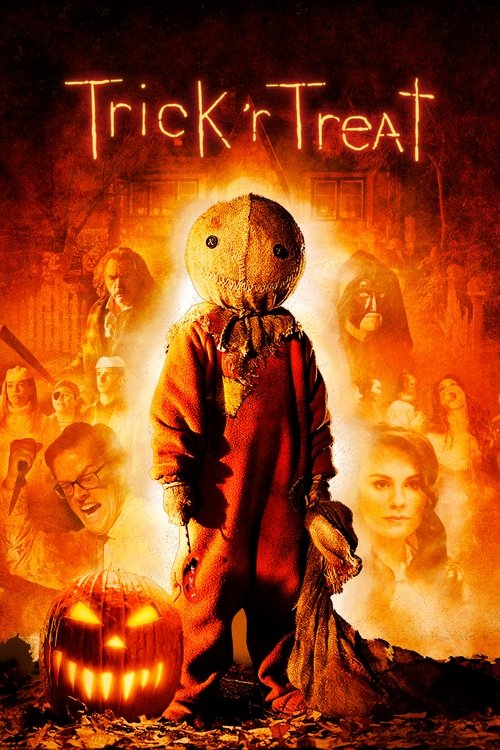
Trick 'r Treat
2007 · Michael Dougherty
The definitive October watch: for when you want Halloween atmosphere itself — candy, costumes, autumn dark — more than pure terror. Cozy-creepy rather than punishing; ideal for kicking off the season.
What it's about
One Halloween night in a small Ohio town, four stories tangle together: a school principal with a murderous hobby, a young woman on the hunt for the right guy, a group of kids pulling a cruel prank at a flooded quarry, and a bitter recluse who gets an uninvited visitor. Weaving through all of it is Sam, a small trick-or-treater in burlap who seems to enforce the holiday's rules.
The experience
Playful and macabre in equal measure — it feels like a great EC comic come to life, full of jack-o'-lantern glow, sharp reversals, and punchlines with teeth. The interlocking structure keeps you leaning forward to see how the stories snap together.
Performances
Dylan Baker is drily hilarious as the principal with a secret life, Brian Cox brings real weight to the besieged recluse, and Anna Paquin plays her red-riding-hood ingenue with a knowing glint.
The craft
Michael Dougherty's debut braids its four tales so their timelines overlap and comment on each other, and the production design is a love letter to Halloween — every frame stuffed with pumpkins, leaves, and amber light. It rewards a dark room and attention; details planted in one story pay off in another.
Why it matters
Shelved for two years and released straight to video, it became one of the great cult rehabilitations — now an annual ritual for horror fans and the reason Sam is a modern Halloween icon.
Snapshot
Trick 'r Treat is a braided horror anthology set across a single Halloween night in the fictional town of Warren Valley, Ohio, in which four stories — a high-school principal who murders as a hobby, a young woman being steered toward her first kill, a cruel prank at a flooded quarry, and a shut-in besieged in his own house — overlap, intersect, and are policed by a small figure in burlap and orange footie pajamas named Sam. Written and directed by Michael Dougherty as his feature debut, produced by Bryan Singer's Bad Hat Harry Productions and Legendary Pictures for Warner Bros., it was finished in 2007, pulled from its announced theatrical date, and left unreleased for roughly two years before arriving on DVD and Blu-ray in October 2009. In the interval it became one of the defining cases of a film whose reputation was built entirely by festival word-of-mouth and genre blogs while the studio that owned it did nothing. It is now, improbably, a fixture of American Halloween ritual: an annual re-watch, a repertory staple, and the source of the first genuinely new horror mascot of the twenty-first century.
Industry & production
The film descends directly from Season's Greetings (1996), a roughly four-minute animated short Dougherty made as a student, which introduced the burlap-sacked child and his abrupt turn from trick-or-treater to predator. Dougherty subsequently built a screenwriting career inside Bryan Singer's orbit, co-writing X2 (2003) with Dan Harris and Superman Returns (2006) with Harris for Singer. That relationship is what got a small, structurally eccentric horror anthology financed at studio scale: Singer produced, Legendary Pictures — then in its early years as a Warner Bros. co-financing partner — backed it, and Warner Bros. held distribution.
Production took place in and around Vancouver, British Columbia, in early 2007, with the town of Warren Valley built out of Canadian locations and standing sets dressed to an almost hallucinatory density of jack-o'-lanterns, leaf piles, and porch decoration. The film was completed in time for a fall 2007 release, which Warner announced and then withdrew.
Why the studio shelved it has never been authoritatively explained, and the record here is genuinely thin: accounts at the time and since have pointed variously to a crowded autumn 2007 horror slate, studio doubts about the commercial viability of anthology films, and the difficulty of cutting a trailer for a movie with no single protagonist — but no official statement ever settled the question, and secondhand recollections from participants conflict. What is documented is the drift: the film premiered at Austin's Butt-Numb-A-Thon in December 2007 and circulated through genre festivals and one-off screenings across 2008 and into 2009, accumulating enthusiastic write-ups and an online constituency agitating for release, before Warner Home Video finally put it out on disc in October 2009. It had no theatrical run and therefore no box office to speak of. A WildStorm graphic-novel companion appeared alongside the home-video release, extending the world into comics — an unusually literal acknowledgment of the film's source idiom.
Technology
Trick 'r Treat is a late artifact of the photochemical studio horror film: shot on 35mm in anamorphic scope by Glen MacPherson, finished through a digital intermediate whose grading is doing enormous expressive work. The DI is the film's most consequential piece of technology — the amber-and-ember palette, the saturated pumpkin oranges pushed against cyan night, the way streetlamps bloom into candy color, is a post-2000 capability applied with a stylist's discipline rather than the desaturated, bleach-bypassed grunge that dominated horror grading in the Saw and remake era.
Effects work is predominantly practical — prosthetic makeup, animatronic and puppet elements, physical creature suits — with digital assistance reserved for augmentation rather than replacement, most visibly in the lycanthropic transformation and in the reveal of what is under Sam's sack. Specific attribution of the effects houses is not something I can state reliably, so I won't.
The film's technological fate is inseparable from its distribution fate. It was finished at the exact moment when the mid-budget genre theatrical release was collapsing and premium home video was ascending; it emerged in the immediate aftermath of the HD-DVD/Blu-ray format war, into a market where a well-mastered disc could function as a legitimate premiere. And it was sustained, during the shelved years, by a different technology altogether: the genre blogosphere of the late 2000s, where Ain't It Cool News, Bloody Disgusting, and Fangoria's online arm could keep a film that literally could not be seen in continuous public discussion.
Technique
Cinematography
MacPherson's photography is the anthology's unifying agent. The scope frame is used laterally and architecturally — porches, streets, quarry banks, the long horizontal of a school bus — so that the town reads as a single continuous space even as the narrative fragments across it. Light sources are motivated and warm: jack-o'-lanterns as practical key, porch bulbs, headlights, a television's flicker, bonfire in the quarry. The recurring compositional idea is a figure framed against a lit pumpkin, so that orange functions as both the film's signature and its threat index.
The camera is notably mobile in the linking passages — craning up from one story to find another already underway across the street — which is the visual mechanism by which the anthology's separate compartments are dissolved. Within scenes, the coverage is patient and classical, holding on faces long enough to let dramatic irony operate.
Editing
Robert Ivison's cutting is the film's structural argument. The stories are not sequenced chronologically; the opening sequence occurs, in story time, near the end, and the film closes by looping back to complete it. Within the body, segments hand off to one another by way of a shared object, a passing figure, or a sound that belongs to the next story — so that the anthology's traditional wraparound is not a frame but a solvent, distributed through the whole. Comic-book-derived transitions and a stylized graphic prologue announce the EC lineage explicitly and license the abruptness of the tonal switches. Crucially, the ordering is built for irony rather than surprise: the audience frequently knows the answer to one story's mystery because a later-shown-earlier scene has already supplied it.
Mise-en-scène / staging
The production design commits to a maximalist Halloween Americana — a saturation of decoration that reads as loving and as slightly deranged, which is precisely the point. Warren Valley is a town that observes the holiday with the intensity of a religion, and the film's supernatural logic simply takes that observance literally. Costume is the central staging device: nearly every character is masked, and the film's recurring gag-turned-thesis is that costume reveals rather than conceals. The principal's suburban-dad ordinariness is the disguise; the werewolf pelt is the face.
The transformation set piece in the quarry woods is staged as a striptease inverted into a flaying — human skin shed to reveal fur — and it is choreographed to Marilyn Manson's cover of "Sweet Dreams (Are Made of This)," a needle-drop that converts a horror sequence into a rite.
Sound
Douglas Pipes's score — he had just written Monster House (2006) for Gil Kenan, and would later reunite with Dougherty on Krampus (2015) — supplies the film's other unifying agent. It is orchestral, waltz-inflected, and carnival-adjacent, drawing on the Herrmann-through-Elfman line of American gothic scoring, with children's-choir textures that make Sam's leitmotif function like a nursery rhyme. Sound design leans on seasonal signifiers — leaves, wind, distant fireworks and children's voices, the mechanical rattle of decorations — and on the near-total absence of speech from Sam himself, whose vocalizations are reduced to breath, chitter, and the scrape of a lollipop.
Performance
The ensemble plays in deliberately mismatched registers, which the structure absorbs. Dylan Baker's Steven Wilkins is the film's comic engine, a fussy, put-upon suburban father whose murders are staged as domestic chores — a performance in evident dialogue with his work in Todd Solondz's Happiness (1998) and its portrait of the monstrous ordinary man. Anna Paquin plays Laurie with a genuine ingenue's diffidence that the story reframes retroactively; the film sat on the shelf long enough that she became a television star on True Blood before most audiences saw it. Brian Cox brings a curdled, wounded weight to Kreeg, the recluse whose siege reads as a Dickensian visitation turned punitive. And Quinn Lord's Sam is a physical performance under a mask — small, unhurried, uncannily patient — that carries the film's mythology without a line of dialogue.
Narrative & dramatic mode
The film's formal move is to take the portmanteau horror film — discrete tales bound by a framing device — and replace the frame with simultaneity. The four stories share a night, a town, and a set of causal spillovers; a corpse in one becomes a decoration in another, a pack of trick-or-treaters passes through several. The hyperlink construction owes an obvious structural debt to the braided, achronological American cinema of the mid-1990s, Pulp Fiction most of all, but the moral machinery is pure EC Comics: transgression, delay, and a punishment that rhymes with the crime.
The dramatic mode is ironic-macabre rather than terrifying. Suspense is generated less by concealment than by the audience's foreknowledge — we watch characters violate rules we have already been taught the cost of breaking. Those rules (wear a costume, hand out treats, never blow out a jack-o'-lantern before midnight, always check your candy) are stated by the film as folk law and enforced by Sam as a kind of seasonal bailiff. The result is a horror film in which the monster is on the side of the tradition, and the victims are, almost without exception, people who have already done something worse than what is done to them.
Genre & cycle
Trick 'r Treat belongs to the horror anthology, a form with a specific institutional history: the EC comics of the early 1950s, the Amicus portmanteau films of the 1960s and '70s (Dr. Terror's House of Horrors, Tales from the Crypt, Asylum), Creepshow (1982), and the television anthologies — Tales from the Darkside, the HBO Tales from the Crypt — that carried the mode through the 1980s. By 2007 the form was commercially dormant in American features, which is a large part of why the film had no obvious marketing slot.
It also belongs to the holiday-horror subgenre inaugurated commercially by Halloween (1978) and Black Christmas (1974), and it functions as something like the first film to treat Halloween itself — the folklore, the etiquette, the decorations — as its subject rather than its setting. Where Carpenter used the holiday as an atmosphere for a slasher, Dougherty uses the slasher as one story among several inside an argument about the holiday.
Authorship & method
Dougherty is a director who came to horror through animation and comics, and Trick 'r Treat is legible as an animator's film: designed in panels, driven by silhouette and color, tolerant of tonal whiplash, and organized around a character conceived as an icon before he was conceived as a plot element. Sam is essentially a cartoon creature imported into live action, and the film's most distinctive quality is the seriousness with which it treats him.
His key collaborators supply the film's coherence across four registers. MacPherson's photography holds the scope geometry and the amber palette constant. Ivison's editing makes the interlock legible without diagramming it. Pipes's score is the connective tissue that persuades an audience that four disparate tones belong to one work — arguably the single most important craft contribution, and the collaboration Dougherty carried forward to Krampus. Dougherty wrote the screenplay himself, and the film's mythology, dialogue, and structure are unusually undiluted for a studio-financed genre picture of the period.
Movement / national cinema
The film is American in setting, folklore, and address — Midwestern small-town Americana of the Norman Rockwell-gone-wrong variety, filtered through the Bradburyan tradition of American autumn as a season with agency (Something Wicked This Way Comes, The Halloween Tree). But it was made in British Columbia, which places it squarely within the runaway-production economy that made Vancouver one of North America's principal horror and genre factories in the 2000s. The specifically Canadian craft base — MacPherson is a Canadian cinematographer, much of the cast and crew local — is a material fact about how American horror looked in this decade: the Pacific Northwest standing in for Ohio, tax credits underwriting the density of practical decoration the film's design depends on.
Era / period
2007 was a peculiarly hostile moment for this film. American horror was dominated by the Saw-descended attrition cycle, the remake boom (Rob Zombie's Halloween arrived that same season), and the tail of the J-horror adaptation wave; found footage was about to reorganize the economics again with Paranormal Activity. A mid-budget, non-franchise, multi-protagonist, tonally comic anthology fit none of these lanes, and the mid-budget theatrical genre release was itself in structural decline as studios bifurcated toward tentpoles and direct-to-video.
The delay years are, in retrospect, the film's most historically interesting period. Trick 'r Treat became a test case for whether reputation could be built without access — whether a fanbase could form around a film almost none of them had seen. It could, and did, through festival reports, convention buzz, and sustained agitation on genre sites. The subsequent disc release into an established Blu-ray market converted that reputation directly into a cult, without a theatrical intermediary. That pathway — shelved studio film, online constituency, home-video vindication — became increasingly common in the 2010s streaming era; this is one of its clearest early instances.
Themes
The film's governing idea is ritual as law. Halloween in Warren Valley is not a commercial event but a surviving observance with enforcement attached, and Sam is its enforcement. The film reaches back past the American candy-and-costume holiday toward Samhain, and stages the modern celebration as a degraded but still-binding version of something older — with the corollary that the people punished are those who treat the ritual as mere consumption.
Second: costume as revelation. Every significant character wears a mask that is truer than the face beneath it, and the film's structure — showing us outcomes before causes — is the formal expression of that idea.
Third: the folklore of Halloween sadism. "Always check your candy" invokes the razor-blade-in-the-apple panic that sociologists (notably Joel Best's work on candy-tampering as urban legend) have shown to be largely mythical. Dougherty's film takes the legend seriously as legend — the danger to children is real in Warren Valley, but it comes from the respectable adults who hand out the candy, not from anonymous strangers. The suburban hypocrisy critique is direct: the principal, the parents, the townspeople who once drowned a busload of disabled children to be rid of the burden of them.
Fourth: buried crime and cyclical return. The quarry massacre and Kreeg's guilt are the same story told twice — a community's atrocity returning annually to collect. The film's looped structure enacts this: it ends where it began, and the implication is that it happens every year.
Reception, canon & influence
Critical response, when the film finally reached an audience, was strongly positive, with the genre press leading — the shelving story became part of the coverage, and reviewers framed the film as a studio's failure of nerve rather than a film's failure of quality. Mainstream critical attention was necessarily limited by the absence of a theatrical release; the film's canonization happened through home video, repertory programming, and annual seasonal re-watching rather than through first-run reviews. It won awards on the genre festival circuit during its shelved period, though I'd note that the full festival itinerary of those years is documented unevenly and I won't reconstruct it precisely.
Backward. The film's debts are explicit and acknowledged in its own form: EC Comics and their poetic-justice morality; Creepshow and Romero and King's affectionate revival of that idiom; the Amicus portmanteau tradition; Halloween (1978) for the holiday's cinematic grammar; Bradbury for the autumnal American register; the braided-chronology cinema of the 1990s for the structure; and, most directly, Dougherty's own Season's Greetings, which the feature expands rather than remakes.
Forward. Three lines of influence are clear. First, the anthology revival: the 2010s saw the form return with unusual vigor — V/H/S (2012), The ABCs of Death (2012), Southbound (2015), Tales of Halloween (2015, explicitly in this film's mold), and eventually Shudder's Creepshow series (2019) — and Trick 'r Treat's cult success is regularly cited as the demonstration that the format still had an audience. Second, holiday horror as a durable commercial category, including Dougherty's own Christmas companion piece Krampus (2015). Third, and most visibly, Sam: a horror mascot who entered the seasonal-merchandise pantheon alongside Michael Myers and Freddy Krueger without the benefit of a franchise, sustained by mask and figure sales, cosplay, and haunted-attraction licensing — Universal's Halloween Horror Nights among the venues that built attractions around the film. Very few post-2000 horror characters have achieved that, and none have done it from a single unreleased movie.
A sequel has been discussed publicly by Dougherty and Legendary on and off since the disc release and has repeatedly failed to materialize; the record on why is anecdotal and I would not want to assert a cause. The film's own status is settled, though: a studio picture that was judged unmarketable, released as an afterthought, and became the thing it was denied — a holiday tradition.
Reception
Warner Bros. shelved it in 2007 and dumped it direct-to-DVD two years later — but festival screenings had already built a rabid following, and it's since climbed from buried studio orphan to consensus Halloween-season essential.
How Trick 'r Treat was received, from release to now →
How to watch Trick 'r Treat: what to notice on a first viewing
- Watch the camera crane from one story into another across the street. MacPherson's mobile camera dissolves the anthology's separate compartments, finding a new story already underway on the same block instead of cutting cleanly between them. The town feels like one continuous space even while the plot keeps jumping between people in it.
- Notice every light source come from something in the scene. Jack-o'-lanterns, porch bulbs, headlights, and bonfire all function as the actual key light, pushing the whole film toward warm amber and pumpkin orange. The light itself makes orange the film's real signature, not just its decoration.
- Notice how many characters are wearing some kind of mask. Nearly every figure in Warren Valley is costumed, the ordinary suburban disguise sitting right alongside literal masks and monster suits without any visual distinction between them. A costume here tells you the truth about a character instead of hiding it.
- Listen for Sam, who never speaks a single word. Douglas Pipes gives Sam a children's-choir leitmotif instead of dialogue, his own sounds reduced to breath, chitter, and the scrape of a lollipop. The score does the talking for a character who never says a word himself.
- Track how many separate stories are unfolding on this one night. Four different tales share the same Halloween night and town, with objects, characters, and sounds passing between them instead of staying inside one story each. Watching for what crosses from one story into another is half the fun of the film.
The whole guide to watching Trick 'r Treat, with the keys for a rewatch →
Influences: the films it descends from and the films it influenced
- Dead of Night (1945) — Established the wraparound that closes into a loop rather than a frame — the anthology whose ending returns you to its first image with new knowledge, which is exactly the architecture of Trick 'r Treat's opening/closing couple on the porch.
- Black Sabbath (1963) — Bava proved an anthology could be unified by a photographic signature rather than a plot — gelled, non-naturalistic single-source color plus a presenter figure — the template for MacPherson holding one amber-orange key across four tonally unrelated stories.
- Tales from the Crypt (1972) — The Amicus portmanteau's EC engine: each protagonist's specific sin dictates the geometry of their punishment, and the segment's runtime is a countdown to that rhyme — the structural logic behind the principal, the bus driver, and the drunk in Trick 'r Treat.
- Halloween (1978) — Codified the holiday's cinematic grammar and the anamorphic frame that leaves dead space where a masked, wholly nonverbal figure will enter — Dougherty inherits both the widescreen negative space and the refusal to give the monster a voice or an explanation.
- Creepshow (1982) — Literal comic-panel transitions and page-turn wipes as segment connective tissue, with saturated gel washes marking the shift from live action into drawn morality play — Trick 'r Treat's panel handoffs and its opening comic-book credit sequence descend directly.
- Something Wicked This Way Comes (1983) — Bradbury's autumnal American register rendered as production design — drifting leaves, small-town October dusk, childhood menace treated with adult gravity — the tonal key Dougherty tunes his maximalist Halloween Americana to.
- The Nightmare Before Christmas (1993) — Character conceived as silhouette-first icon before he is a plot function, designed to survive extraction from the film as a merchandisable holiday mascot — the animator's design method Dougherty applies to Sam, who exists as image before he exists as antagonist.
- Pulp Fiction (1994) — Reordering as an irony machine: a character seen dead in one chapter walks into the next alive, so the audience holds knowledge the characters don't — the exact device by which Trick 'r Treat's chronology converts each strand's outcome into dread inside another strand.
- Season's Greetings (1996) — Dougherty's own animated short is the feature's genome: Sam's burlap-sack silhouette, the sucker weapon, the wordless prowl, and the reveal-by-unmasking beat are transplanted rather than reinvented.
- Happiness (1998) — Dylan Baker's method of playing a suburban predator with flat, uninflected paternal warmth — the horror carried entirely by the absence of performed menace — is the specific performance Dougherty casts for and reuses in the Steven Wilkins strand.
- Magnolia (1999) — The roving crane/Steadicam that physically travels from one simultaneous strand to another within a single geography, with a wall-to-wall score asserting that unrelated stories belong to one weather system — the model for Trick 'r Treat's linking crane moves and Pipes's unifying cue-work.
- Go (1999) — Compresses a braided multi-strand structure into one night with a comic tonal register, rewinding to a fixed shared moment and re-staging it from a new vantage — the same-night, same-town, re-see-the-moment mechanics Dougherty runs on Halloween.
- V/H/S (2012) — Rebooted the commercial anthology on Trick 'r Treat's cult proof-of-concept, retaining the key structural lesson that the wraparound must itself be a horror segment with stakes rather than a narrator's armchair.
- All Hallows' Eve (2013) — Copies the load-bearing pairing — a Halloween-night wraparound plus a silent, mime-expressive mascot monster whose design is fixed before any story exists — producing Art the Clown as a deliberate Sam-class icon.
- Southbound (2015) — Takes the interlocking-handoff edit further than its model: each segment ends by passing a character or a location physically into the next, so the anthology's seams become the story rather than being hidden by a frame device.
- Tales of Halloween (2015) — Built explicitly in this mold — one town, one Halloween night, cross-segment cameos and a radio-host linking device — adopting the single-night unity-of-place conceit as the anthology's organizing rule.
- Krampus (2015) — Dougherty's Christmas companion carries forward the Pipes collaboration and the same creature doctrine — a folkloric enforcer of holiday rules, built practically with animatronics and suits, punishing the season's violators rather than random victims.
- Terrifier (2016) — Extends the post-Trick 'r Treat mascot economy: a nonverbal antagonist whose entire performance is silent-comedy gesture and whose commercial life runs through masks, figures and haunt licensing rather than sequel-driven mythology.
- Godzilla: King of the Monsters (2019) — Dougherty's own authorial root — its votive seasonal iconography and reverent, ritualized treatment of a monster-figure carry into his framing of the Titans as objects of worship.
- Terrifier 2 (2022) — Interlocking single-Halloween-night episodes anchored by Sam, a silent burlap mascot designed as merchandisable icon before he is designed as a character — the same structure-plus-mascot engineering Leone runs on Art.
Similar films
- Halloween (1978) — influence & lineage
- The Nightmare Before Christmas (1993) — influence & lineage
- Scream (1996) — shared sensibility
- Black Christmas (1974) — shared sensibility
- Terrifier 2 (2022) — shared sensibility
- Donnie Darko (2001) — shared sensibility
- Terrifier 3 (2024) — shared sensibility
- Hokum (2026) — shared sensibility