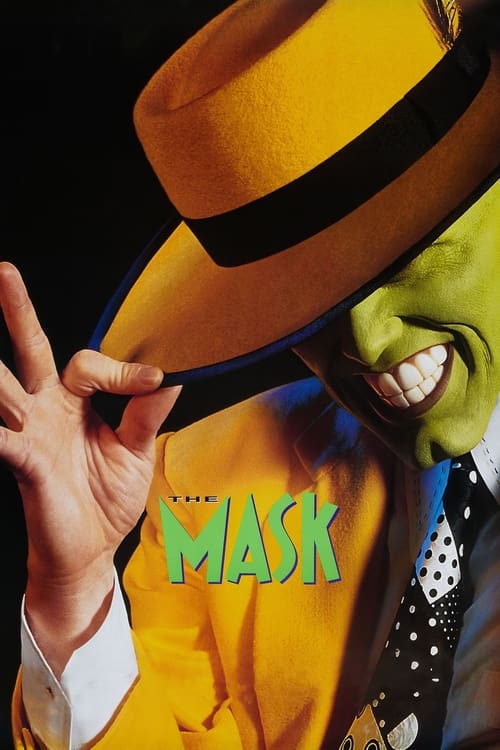
The Mask
1994 · Chuck Russell
For when you want to switch your brain off and laugh — a nostalgic, high-energy crowd-pleaser for family movie night or a comfort rewatch.
What it's about
Stanley Ipkiss is a doormat of a bank clerk until he fishes an ancient wooden mask out of the river. Put it on, and he becomes a green-faced, zoot-suited whirlwind who bends reality like a Saturday-morning cartoon — irresistible, unstoppable, and completely unhinged. His new alter ego wins him the attention of a nightclub singer and the murderous interest of a local mobster, and Stanley has to figure out which self is really him.
The experience
Pure anarchic fun — fast, loud, and gleefully silly, with gags that still land through sheer velocity. It's the sensation of watching a live-action cartoon that refuses to obey physics.
Performances
Jim Carrey at the absolute peak of his rubber-faced powers — the effects amplify what his body was already doing, and no one else could have played it. Cameron Diaz, in her screen debut, walks in fully formed as a star.
The craft
Industrial Light & Magic's effects work was a genuine breakthrough, proving computer imagery could serve broad comedy — eyes bugging out, jaws hitting the floor — with cartoon timing. The whole film moves with the plastic snap of classic animation translated into live action, and the musical numbers still pop on a big screen.
Why it matters
The middle panel of Jim Carrey's astonishing 1994 breakout year, it cemented him as the era's defining comedy star, launched Cameron Diaz, and set the template for effects-driven comic spectacle.
Snapshot
The Mask is a special-effects comedy that fused a live-action star turn with the plastic physics of the classic American animated cartoon. Adapted loosely from a violent Dark Horse Comics property and softened into a PG-13 crowd-pleaser, it arrived in the summer of 1994 as the middle panel of Jim Carrey's breakout triptych — bracketed by Ace Ventura: Pet Detective (February) and Dumb and Dumber (December) — and confirmed him as the year's defining new comic star. The film matters on two axes at once: as a vehicle that translated Carrey's rubber-faced, live-wire physicality into a digitally amplified persona, and as a technical showcase in which Industrial Light & Magic proved that computer imagery could serve broad comedy, not just spectacle and horror. It also gave Cameron Diaz her screen debut. Its lasting cultural residue is disproportionate to its critical standing: the green face, the yellow zoot suit, the catchphrase-ready "Ssssmokin'!", and a jolt of energy that fed the mid-1990s swing revival.
Industry & production
The film was produced and released by New Line Cinema in partnership with Dark Horse Entertainment, the film arm founded by Dark Horse Comics publisher Mike Richardson, with Bob Engelman among the producing team. New Line — still trading on its reputation as "the house that Freddy built" — was in the period when it was expanding from horror franchises toward broader mainstream fare, and The Mask fit that ambition: a comic-book source, a rising comedy star, and a big visual-effects hook.
The source material is central to understanding the production's choices. The original Dark Horse comic (developed by Richardson, writer John Arcudi, and artist Doug Mahnke) was a gruesome, ultra-violent horror-satire in which the mask turns its wearers into homicidal avengers. The decision to reconceive that property as a family-facing comedy was the pivotal creative bet. Carrey was cast on the strength of Ace Ventura, which had over-performed earlier the same year; the role was reshaped around his gifts. The reported production budget sits in the low-to-mid $20-million range, and the film became one of 1994's major commercial successes, grossing in the neighborhood of $350 million worldwide by widely cited figures — an enormous multiple on cost. I flag those numbers as the commonly reported ballpark rather than audited totals. The success established a template New Line would keep chasing and cemented Carrey's leverage over his subsequent deals.
Technology
The Mask is a landmark in the practical application of computer-generated imagery to comedy. ILM, fresh from the morphing breakthroughs of The Abyss (1989) and Terminator 2: Judgment Day (1991), was tasked here with something tonally opposite: making digital distortion funny rather than menacing. Under visual-effects supervisor Scott Squires, the team used CGI to realize the "cartoon" gags the script demanded — eyes ballooning out of their sockets, a jaw unhinging to the floor, a heart pounding cartoonishly through a chest, a tongue rolling out like a red carpet, and the tornado-spin transformation. These effects blended digital animation with practical prosthetic makeup by Greg Cannom, whose sculpted green appliance gave Carrey a physical mask to act through while the extreme deformations were handed to the computer.
The technological argument the film makes is that the elastic "squash and stretch" vocabulary of hand-drawn animation — the Tex Avery grammar of impossible bodies — could now be grafted onto a photographed human being seamlessly enough to read as a single character. That proof of concept was influential: the work earned an Academy Award nomination for Best Visual Effects (losing to Forrest Gump). It sits in a lineage that runs toward later films built on the marriage of live performers and elastic digital gags.
Technique
Cinematography
John R. Leonetti photographed the film in a heightened, saturated register that deliberately courts artifice. The fictional "Edge City" is rendered in comic-book colors — deep noir shadows for the crime plot and the timid-Stanley scenes, giving way to lurid greens, golds, and reds when the Mask takes over. Leonetti stages the Coco Bongo nightclub numbers with a glamorized, old-Hollywood sheen, using pools of colored light and a mobile camera that swings into the musical fantasy. The visual strategy is bifurcated by design: the "real" world is comparatively grounded so that the Mask's eruptions of impossible physics land as ruptures in the film's own reality.
Editing
Arthur Coburn's cutting has to solve a specific problem — integrating discrete visual-effects gags into the rhythm of live performance without letting the seams show or the pacing sag. The comic set-pieces are timed to a cartoon's beat: setup, escalation, and an oversized payoff, frequently punctuated by a hard cut on the "snap" of a gag. The film accelerates whenever the Mask is present and slows for Stanley, and the editing enforces that tempo contrast as a structural device.
Mise-en-scène / staging
The production design leans on a retro-eclectic Americana — 1940s zoot-suit silhouettes, jazz-club interiors, and a period-agnostic city that feels stitched from film-noir and cartoon-short reference. The yellow suit and wide-brimmed hat function as an iconographic costume, instantly legible in silhouette. Staging repeatedly quotes classic animation: the wolfish "wolf whistle" reaction, characters reduced to their appetites, and a musical showstopper ("Cuban Pete") that turns a police standoff into a choreographed dance number, dissolving the diegesis into pure spectacle.
Sound
Sound design is a key comedic instrument here, importing the auditory language of the theatrical cartoon — the boings, whistles, and orchestral stingers that "read" a visual gag for the audience. The music is discussed below; at the level of effects, the film treats sound as a co-author of each gag, synchronizing exaggerated foley to the digital distortions so that the eye and ear confirm the impossible together.
Performance
The film is, finally, a performance showcase. Jim Carrey plays a dual role in a single body: Stanley Ipkiss as a stooped, apologetic naïf, and the Mask as an id unleashed — a manic, hyper-articulated persona that draws on vaudeville, Looney Tunes, and Carrey's own contortionist elasticity. The makeup and effects amplify a physicality that was already extreme; crucially, the digital gags work because Carrey commits to them as an actor, "selling" a popping eye or a dropping jaw with full-body conviction. Cameron Diaz, in her film debut, plays nightclub singer Tina Carlyle as a knowing riff on the femme fatale, and holds the screen opposite Carrey's whirlwind. Peter Riegert grounds the crime plot as a weary detective, Peter Greene supplies genuine menace as mobster Dorian Tyrell, and Richard Jeni and Amy Yasbeck anchor Stanley's ordinary world. Milo the Jack Russell terrier rounds out the ensemble as a scene-stealing accomplice.
Narrative & dramatic mode
Structurally, The Mask is a wish-fulfillment fable in the mold of the Jekyll-and-Hyde transformation tale and the superhero origin story, crossed with a screwball romance and a gangster picture. Its dramatic engine is the gap between Stanley's timidity and the Mask's uninhibited confidence: the mask externalizes desire, aggression, and courage the character cannot access on his own. The film flirts with the darker implication — that the mask is an amoral amplifier as dangerous in a mobster's hands as in a nice guy's — but ultimately resolves toward reassurance: the moral is that "the hero was inside all along," and Stanley chooses to throw the mask away. It is a comedy of disinhibition that stops short of the source material's nihilism, using the crime plot mainly as a chassis for set-pieces and a romance as its emotional throughline.
Genre & cycle
The film sits at the confluence of several cycles. It belongs to the 1990s wave of comic-book adaptations that followed Tim Burton's Batman (1989), and specifically to the strain that treated the medium as license for stylization rather than gritty realism. It is equally a product of the special-effects comedy cycle, in which post-Terminator 2 digital tools were repurposed for family entertainment. And it is a star-vehicle comedy, part of the early-'90s emergence of a new generation of comic leads. Within Carrey's own 1994 run it forms the "high-concept effects" pole, distinct from the pure-character farce of Ace Ventura and Dumb and Dumber.
Authorship & method
Chuck Russell came to the film from horror and genre craft — he had directed A Nightmare on Elm Street 3: Dream Warriors (1987) and the The Blob remake (1988), both effects-forward pictures. That background is legible in his facility with set-piece construction and his comfort integrating practical and digital effects, and it explains why a director not primarily known for comedy could shepherd this hybrid. His method here was essentially one of orchestration: building a controlled environment in which Carrey's improvisatory energy and ILM's technicians could be synchronized. Russell went on to Eraser (1996) and The Scorpion King (2002), remaining a genre journeyman rather than a signature auteur.
Among key collaborators: cinematographer John R. Leonetti (later a director in his own right) supplied the comic-noir palette; editor Arthur Coburn managed the effects-to-performance rhythm; makeup designer Greg Cannom, a multiple Oscar winner, executed the physical mask. The screenplay is credited to Mike Werb (with story contributions rooted in the Dark Horse property), whose principal act of authorship was the tonal transposition from horror to comedy.
Composer Randy Edelman scored the film, but its most consequential musical choices were the source songs. The soundtrack's use of retro jazz and swing — including "Hey Pachuco!" performed by Royal Crown Revue and the Desi Arnaz standard "Cuban Pete" — plugged the film into, and helped popularize, the neo-swing revival that crested later in the decade.
Movement / national cinema
As mainstream Hollywood studio product, The Mask is not part of any art-cinema movement, but it can be located within an American vernacular tradition: the theatrical cartoon of the Warner Bros. and MGM units, and specifically the anarchic sensibility of Tex Avery. The film is best read as a live-action homage to that indigenous animation style — a national-cinema lineage of the cartoon short, resurrected through digital tools inside the framework of the effects blockbuster.
Era / period
The film is a quintessential mid-1990s artifact. It captures the exact moment when CGI became cheap and controllable enough to migrate from prestige spectacle into genre comedy, and when the comic-book adaptation was still a stylized novelty rather than an industrial franchise system. It also documents the arrival of a comedy-star economy built around a handful of bankable leads, and it participates in the decade's nostalgia for pre-rock American popular culture — the zoot suits and big-band music that the swing revival would soon commercialize.
Themes
The film's governing theme is disinhibition — the fantasy of a self freed from social anxiety, and the ambivalence attached to that freedom. The mask literalizes the id, and the film asks, lightly, whether unleashing it is liberation or loss of self. Adjacent to this is a theme of identity and performance: Stanley is only "himself" when wearing another face, a paradox the film resolves by insisting the qualities were his own. There is a strand of class and romantic aspiration — the meek clerk who cannot reach the glamorous singer without magical assistance — and, in muted form inherited from the comic, a meditation on power's corruptibility, since the mask serves villainy as readily as it serves the hero. These darker notes are present but deliberately subordinated to the film's optimistic, crowd-pleasing design.
Reception, canon & influence
Critical reception was mixed-to-positive, with a clear consensus that the film's chief asset was Carrey and its chief novelty the visual effects; reviewers frequently noted that the human comedy of Carrey and Diaz outshone the somewhat rote crime plot. Its craft was validated by the Academy Award nomination for Best Visual Effects. Commercially it was a major hit and a foundation stone of Carrey's stardom.
Looking backward, the film's influences are explicit and eclectic: the Dark Horse comic as narrative source; the Jekyll-and-Hyde and superhero-origin templates as structure; and, most importantly, the classic American cartoon — Tex Avery's exaggerated reaction gags above all — as its aesthetic and comedic grammar. The morphing technology that made it possible descends directly from ILM's earlier work on The Abyss and Terminator 2.
Looking forward, its legacy is threefold. It confirmed CGI as a tool for comedy and helped normalize the seamless integration of digital gags with live actors, a lineage visible in later effects-driven comedies. It launched Cameron Diaz's career and consolidated Carrey's. And it seeded a small franchise: an animated television series (running from the mid-1990s) and a poorly received sequel, Son of the Mask (2005), made without Carrey, which is generally regarded as a commercial and critical failure and, by contrast, underscored how much the original depended on its star. Culturally, the green face, the yellow suit, and the film's cartoon iconography have persisted as durable pop-culture shorthand well beyond the film's critical footprint.
A Deleuzian reading
The jaw hits the floor.
The full Deleuzian reading of The Mask →
Reception
A monster hit in 1994 — the middle panel of Jim Carrey's insane Ace Ventura / Mask / Dumb and Dumber run in a single year — it's since settled into beloved 90s-artifact status, with the ILM cartoon effects regularly cited as holding up better than most CGI a decade younger.
How The Mask was received, from release to now →
How to watch The Mask: what to notice on a first viewing
- Watch Carrey commit his whole body to each impossible gag. The eyes on stalks and the unhinging jaw work because Carrey plays them as an actor, selling the distortion with posture and timing while ILM handles the deformation around him. The joke lands in the body first, and the effect only confirms what the performance already claimed.
- Watch the color change the moment the mask goes on. John Leonetti keeps Stanley's Edge City in deep noir shadow, then floods the Mask's scenes with lurid green, gold and red. The switch happens inside the same city and the same night. The green is not the character's color. It belongs to the condition he is in.
- Look at the green face, which never stops grinning. Greg Cannom's prosthetic holds one fixed expression of delight while the digital deformations run through it. The face cannot change its mind. It can only burst. You get one held feeling and a series of eruptions out of it, inside the same shot.
- Notice the hard cut that lands on each gag's snap. Arthur Coburn times the set pieces like cartoons: setup, escalation, oversized payoff, then a cut. The film accelerates whenever the Mask is present and slows right down for Stanley. The tempo tells you which of the two characters you are with, without a word of dialogue.
- Listen for the boings, whistles and stingers under the gags. The sound design imports the audio language of the theatrical cartoon and synchronizes exaggerated foley to the digital distortions. The swing records carry everything else. Eye and ear confirm the impossible together, which is how a gag on a real body stays believable.
The whole guide to watching The Mask, with the keys for a rewatch →
Influences: the films it descends from and the films it influenced
- Who Framed Roger Rabbit (1988) — Pioneered seamless cartoon-in-live-action compositing and imported Tex Avery's eyes-bulging, heart-pounding reaction-gag grammar onto a live plate — the exact comedic vocabulary The Mask digitizes.
- Willow (1988) — ILM's Dennis Muren executed the first digital morph (goat-to-tiger-to-woman), establishing the transformation-through-successive-forms technique The Mask reuses for its shape-shift gags.
- The Abyss (1989) — ILM's photoreal water pseudopod proved a soft CG element could convincingly interact with live actors in the same frame, the toolset that made the Mask's morphs possible.
- Terminator 2: Judgment Day (1991) — ILM's liquid-metal morphing of the T-1000 is the direct technical parent of the Mask's shape-shifting, stretching body effects.
- A Nightmare on Elm Street 3: Dream Warriors (1987) — Russell's own effects-forward set-piece construction — blending practical transformation FX with dream-logic staging — is the craft he later transposed into the Mask's cartoon-physics environment.
- The Blob (1988) — Russell's orchestration of gooey practical creature-morphing that trained him to synchronize elaborate transformation effects with on-set performers.
- Red Hot Riding Hood (1943) — The wolf's eyes-launching, tongue-unrolling, jaw-slamming lust reaction is quoted almost beat-for-beat by Carrey's nightclub gag — the literal source of the film's comedic grammar.
- The Nutty Professor (1963) — The Jekyll-and-Hyde disinhibition comedy in which one performer splits repressed self from unleashed alter-ego, the structural template for Stanley Ipkiss and the Mask.
- Beetlejuice (1988) — An anarchic, disinhibited trickster rendered through elastic makeup and stop-motion morph gags within a comic-noir palette — the tonal precedent for the Mask's stylized transformations.
- Casper (1995) — A fully CG character sharing frame and comic timing with live actors, extending the Mask's normalization of the seamless digital gag-partner.
- The Nutty Professor (1996) — Prosthetic-plus-CGI transformation comedy where effects let a single star embody a repressed/unleashed dual persona — the Mask's star-plus-morph model applied to Eddie Murphy.
- Space Jam (1996) — Live-action/Looney-Tunes integration built on the same Avery-derived cartoon-physics gags the Mask had proven could be digitized around a live star.
- How the Grinch Stole Christmas (2000) — A Carrey vehicle where full-body makeup and effects enable an anarchic, disinhibited character, extending the Mask's formula of star improvisation orchestrated atop a transformation prosthetic.
- Son of the Mask (2005) — A direct sequel that replicates the CGI-morph gag engine wholesale, inadvertently proving how much the technique depended on Carrey's performance to land.
- Liar Liar (1997) — Codified Carrey's rubber-faced, cartoon-elastic body as the picture's central special effect, the performance idiom Liar Liar weaponizes without prosthetics or CGI.
- Death Becomes Her (1992) — ILM's digital body-horror slapstick (rotated necks, a hole punched through a torso) proved CG could serve physical comedy, a near-contemporaneous sibling to the Mask's morph gags.
- Ace Ventura: Pet Detective (1994) — Carrey's rubber-faced, cartoon-timed physical performance released the same year — the un-augmented human baseline for the elasticity the Mask amplifies with CGI.
- Dumb and Dumber (1994) — Carrey's broad live-action cartoon mugging and gag rhythm, same year, demonstrating the same Avery-derived comic timing without any digital augmentation.
- Hundreds of Beavers (2024) — Puts a live human body through explicit Tex Avery / Looney Tunes cartoon physics (eyes popping, limbs stretching) via effects, the same 'toon-made-flesh gag vocabulary.
Similar films
- Who Framed Roger Rabbit (1988) — influence & lineage
- Minions & Monsters (2026) — shared sensibility
- Ghostbusters (1984) — shared sensibility
- The Truman Show (1998) — shared sensibility
- Spider-Man: Into the Spider-Verse (2018) — shared sensibility
- Liar Liar (1997) — shared sensibility
- The Invisible Man (1933) — shared sensibility
- Spider-Man 2 (2004) — shared sensibility