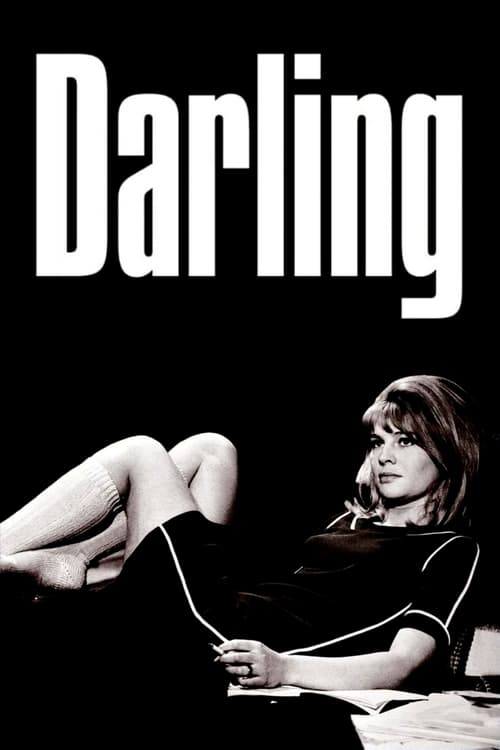
Darling
1965 · John Schlesinger
When you want something stylish and acid — a character study to argue about afterward rather than a warm hug. For viewers drawn to beautiful people making hollow choices.
What it's about
Diana is a beautiful young London model who climbs — through affairs, a television journalist, an advertising executive, Paris fashion shoots, and finally European aristocracy — toward the fame she's sure will complete her. She narrates her own rise with breezy self-justification, and the film watches, in crisp black and white, what her winning actually costs everyone including herself.
The experience
Sharp, chic, and quietly devastating — a satire that seduces you with glamour and then keeps showing you the emptiness underneath. It's witty scene to scene, but the aftertaste is bleak.
Performances
Julie Christie is incandescent as Diana — charming, restless, and self-deceiving all at once — a career-making, Oscar-winning turn that made her the face of her era; Dirk Bogarde brings wounded intelligence as the man who sees her most clearly.
The craft
Frederic Raphael's Oscar-winning screenplay cuts like a razor, using Diana's own unreliable narration against her. Schlesinger shoots Swinging London not in pop color but in austere monochrome, which turns the fashion-magazine world into something colder and more honest.
Why it matters
It caught the exact moment British cinema turned from working-class realism to the celebrity culture of the 1960s, won three Academy Awards, and made Julie Christie an international star.
Snapshot
Darling is the film in which the British New Wave looks up from the kitchen sink, catches its reflection in a fashion-magazine cover, and recoils. John Schlesinger's third feature follows Diana Scott (Julie Christie), a London model who climbs from suburban marriage through serial affairs, a Paris fashion career, and a magazine-manufactured fame to a gilded, loveless title as an Italian principessa — and narrates her own ascent in a voice of practiced, self-exonerating candor. Built around Frederic Raphael's acidulous screenplay and an incandescent Christie performance, the picture is at once a moral fable about affluence, a satire of media celebrity, and a portrait of "Swinging London" rendered, pointedly, in austere black and white. It won three Academy Awards — Best Actress, Best Original Story and Screenplay, and Best Costume Design (Black-and-White) — and helped make Christie an international star almost overnight, in the same year she appeared in Doctor Zhivago. More than a period artifact, Darling is the hinge on which Schlesinger and a strand of British cinema turned from the provincial realism of the early 1960s toward a glossier, more European, more morally ambivalent modernism.
Industry & production
Darling was produced by Joseph Janni, the Italian-born producer who had become Schlesinger's essential collaborator, having shepherded A Kind of Loving (1962) and Billy Liar (1963). The film was an independent British production released in the UK through Anglo-Amalgamated and in the United States through Joseph E. Levine's Embassy Pictures, a distribution arrangement that signals the period's appetite among American distributors for the new, sexually frank, fashionable British cinema. The exact production budget and box-office returns are not something I can state with confidence from the documentary record; I would rather flag that than invent a figure. What is certain is that the film was a critical and commercial success disproportionate to its modest scale, and that its returns came substantially from the American market, where it arrived trailing a faint whiff of scandal owing to its adult subject matter and the censorship debates of the day.
The project's genesis lies in collaboration among Schlesinger, Janni, and Raphael, who together shaped a portrait reportedly assembled from observation of a particular London social milieu rather than from a single source novel — a notable point, since the British realist films around it were so often literary adaptations (Sillitoe, Story, Waterhouse). Darling is an original screenplay, and its Oscar in that category underlines its standing as one of the rare front-rank British films of the period conceived directly for the screen.
Technology
Darling was shot on 35mm black-and-white film at a moment when color was rapidly becoming the commercial default, particularly for anything marketed on glamour and fashion. The choice of monochrome is therefore as much an industrial and rhetorical decision as an aesthetic one: it withholds the very lushness its subject — couture, jet travel, luxury — would seem to demand, and in doing so estranges the spectacle. The production made extensive use of location shooting in London, Paris, and Italy, supported by the increasingly portable camera and sound equipment that had liberated the European art cinema earlier in the decade. The film's montage of advertising imagery, magazine layouts, and photographic stills exploits the era's visual culture of print media as raw material, treating the photograph and the billboard as native textures of Diana's world.
Technique
Cinematography
The cinematography is credited to Kenneth Higgins. His monochrome work is the film's controlling intelligence: high-contrast, often hard, and willing to flatten glamour into something clinical. The camera moves between two registers — an observational, semi-documentary handheld looseness inherited from the New Wave, and a colder compositional formality in the fashion and society sequences, where Diana is framed as an object of display. The black-and-white palette does crucial double duty, lending the early scenes the grain of social realism while turning the later luxury into a chilly, depthless brightness. Faces, especially Christie's, are lit to register the smallest flickers of calculation and boredom.
Editing
Edited by James Clark, Darling is one of the more formally adventurous British films of its moment. The cutting absorbs the nouvelle vague's vocabulary — abrupt transitions, elliptical jumps, freeze-frames, and an ironic counterpoint between image and the heroine's voiceover. The structure is built as Diana's retrospective testimony, ostensibly given to a magazine; the editing repeatedly exposes the gap between what she narrates and what we see, so that the cutting itself becomes the instrument of satire. Montage sequences compress her rise — the fashion shoots, the charity galas, the magazine spreads — into rhythmic bursts that mimic the accelerated, disposable tempo of celebrity culture.
Mise-en-scène / staging
The film's staging tracks Diana's social ascent through a careful escalation of environments: cramped flats and bedsits, advertising studios, smart restaurants, a glittering "Happiness" charity auction, and finally the cavernous, art-stuffed Italian palazzo in which she is immured as a prince's wife. The famous emptiness of that final setting — Diana alone amid servants and Old Masters — is the staging's moral summary: she has acquired everything and possesses nothing. Throughout, the décor of consumer abundance (clothes, objects, surfaces) is foregrounded as both seduction and indictment.
Sound
The score is by John Dankworth, the British jazz composer and bandleader, whose idiom gives the film a cool, urbane, slightly melancholic modernity well suited to its milieu. The most discussed element of the soundtrack, however, is the voiceover. Christie's first-person narration runs across the film as an unreliable confessional — fluent, charming, and continually undercut by the images. This ironic disjunction between the spoken self-account and the visible behavior is central to the film's method and to its satire of self-mythologising celebrity.
Performance
Julie Christie's Diana is the film's engine and its enigma. The performance refuses to resolve into either villain or victim: Diana is shallow, restless, and casually cruel, yet also a creature shaped by a culture that rewards exactly those traits in a beautiful woman. Christie plays the boredom as vividly as the vivacity, and the Academy Award that followed recognized a performance that carries genuine moral complexity beneath its surface glamour. She is partnered by Dirk Bogarde as Robert Gold, the television journalist whose love for Diana is the film's nearest thing to a moral center — a restrained, wounded performance from an actor then deliberately steering toward more serious, ambiguous roles. Laurence Harvey plays Miles Brand, the suave, predatory advertising executive who embodies the world's transactional sexuality. The three-cornered emotional architecture gives the satire its human weight.
Narrative & dramatic mode
Darling operates as ironic moral fable disguised as a glamorous rise narrative. Its dramatic mode is retrospective and confessional: Diana narrates her own story as if for a magazine profile, and the film continually plays her flattering self-presentation against the evidence of her conduct. This is satire built on dramatic irony — the audience is positioned to see through the narrator the narrator cannot see through herself. The episodic structure traces an ascent that is simultaneously a descent, charting the inverse relation between Diana's social elevation and her spiritual impoverishment. The film resists conventional catharsis; its ending is not punishment so much as exposure — she is left trapped in the very success she pursued.
Genre & cycle
The film sits at the junction of two cycles. Behind it is the British "kitchen sink" realism of 1959–1963 — the films of Reisz, Richardson, Anderson, and the early Schlesinger — with their provincial settings, class anatomy, and social-problem seriousness. Ahead of it, and partly inaugurated by it, is the "Swinging London" cycle of the mid-to-late 1960s: glossier, metropolitan, fashion-conscious, sexually liberated, exemplified by films like Blow-Up, Alfie, and Georgy Girl. Darling belongs to both and is reducible to neither. It imports the moral gravity of the realist tradition into the glamorous new milieu, and it is among the earliest films to treat Swinging London not as a celebration but as a subject for critique — affluence as malaise.
Authorship & method
Schlesinger directs with a satirist's eye sharpened by a documentarian's training; his early career in television documentary (notably the BAFTA-winning Terminus) informs the film's observational instinct and its alertness to social surfaces. Darling marks his decisive move away from northern realism toward a cosmopolitan, more stylistically self-conscious cinema, and it consolidated his partnership with Christie, whom he had already used memorably in Billy Liar. The screenplay by Frederic Raphael — verbally brilliant, mordant, attuned to the cant of the affluent — is the film's literary backbone and won the Oscar for Best Original Story and Screenplay; the collaboration with Schlesinger would continue on Far from the Madding Crowd (1967). Producer Joseph Janni provided the continuity of vision and the European sensibility that connect Schlesinger's films of the period. The cinematographer Kenneth Higgins, editor James Clark, and composer John Dankworth complete the core authorial team, and the costume design by Julie Harris — itself Oscar-winning — is integral rather than decorative, since clothing is, for Diana, both currency and identity.
Movement / national cinema
Darling is a British film in conscious dialogue with the European art cinema. Its formal debts run to the French nouvelle vague (the jump cuts, freeze-frames, voiceover irony) and, still more, to the Italian modernism of Antonioni and Fellini — the anomie of L'Avventura and La Notte, the celebrity-and-media satire of La Dolce Vita. In transplanting that continental sensibility of affluent emptiness onto English soil and English class manners, the film occupies a distinctive place in national cinema: it is the point at which British film stopped looking backward and downward, to the industrial north and the working class, and turned to examine the new metropolitan culture of media, fashion, and consumption on its own modern, internationalist terms.
Era / period
The film is saturated in the specific conditions of mid-1960s Britain: post-austerity affluence, the rise of consumer and advertising culture, the loosening of sexual mores, and the new prominence of fashion, photography, and pop celebrity as engines of status. It arrives in the immediate wake of the Profumo affair (1963), with its lurid intersection of sex, society, and publicity, and it shares that scandal's atmosphere of glamorous moral vertigo. Darling both documents and interrogates the emerging myth of "Swinging London" at almost the moment of its birth, which is part of what gives the film its prescience: it diagnoses the disease at the height of the celebration.
Themes
At its core Darling is about the commodification of the self — the way a culture of media and consumption converts a person, especially a beautiful woman, into an image to be marketed, traded, and discarded. Its allied themes are the emptiness underlying material abundance; the transactional nature of sex and love in a status economy; the corrosions of celebrity and self-mythology; and the limited, contradictory freedoms available to a woman who can rise only through her desirability. Diana's restlessness — her compulsive pursuit of the next experience, the next man, the next escape from boredom — functions as the film's metaphor for the appetites of consumer society itself: insatiable, self-defeating, and finally imprisoning. The film is notably ambivalent about its heroine's "liberation," refusing either to moralize her into a cautionary villain or to celebrate her as a free spirit.
Reception, canon & influence
Darling was met with strong critical acclaim and substantial awards recognition. At the Academy Awards it won Best Actress (Julie Christie), Best Original Story and Screenplay (Frederic Raphael), and Best Costume Design, Black-and-White (Julie Harris), with further nominations including Best Picture and Best Director. It was likewise honored at the BAFTAs, where Christie and Bogarde were among those recognized. The film's contemporary reception established Christie as the definitive face of the era's British cinema and confirmed Schlesinger as a director of international stature, paving the way to Far from the Madding Crowd and, ultimately, to his American breakthrough with Midnight Cowboy (1969).
The influences on the film are, as noted, the British realist cycle that formed its makers and the European modernism — Antonioni, Fellini, the nouvelle vague — that reshaped their ambitions. Its influence forward is twofold. Stylistically and thematically, it helped open the Swinging London cycle while simultaneously supplying that cycle's critical conscience, anticipating the disillusioned media-and-image satire that Blow-Up would extend a year later. And in its portrait of a woman destroyed by the very mechanisms of glamour that elevate her, it prefigures a long line of films about celebrity, fashion, and self-fashioning. Over time some critics have come to see the film as very much of its moment — its satire occasionally broad, its attitudes inevitably dated — while others read it as a durable and prescient anatomy of media celebrity whose subject has only grown more relevant. Its secure place rests less on any single innovation than on the rare completeness with which it fused realist seriousness, modernist form, and movie-star glamour into a coherent and unsparing vision of its time.
A Deleuzian reading
The first thing to distrust in Darling is the voice.
The full Deleuzian reading of Darling →
Reception
A sensation in 1965 — three Oscars including Julie Christie's Best Actress, plus a Best Picture nomination — but its stock has fallen further than almost any of its Swinging London peers, with modern viewers often finding its satire of the very scene it embodies smug and dated, even as Christie herself remains luminous.
How Darling was received, from release to now →
Influences: the films it descends from and the films it influenced
- The 400 Blows (1959) — Truffaut's freeze-frame final image is the device Schlesinger borrows to arrest Diana's face mid-flight, fixing emotion as a held photographic still rather than resolving it.
- Breathless (1960) — Godard's elliptical jump-cuts within continuous scenes license Darling's discontinuous cutting across Diana's affairs, compressing time by amputating connective action.
- La Dolce Vita (1960) — Fellini's episodic procession through glamour parties and a press-and-publicity milieu supplies Darling's structure of a hollow protagonist drifting through self-cancelling social tableaux.
- L'Avventura (1960) — Antonioni's de-dramatized observation of bored, affluent figures in alienating architecture is the modernist register Schlesinger adopts to film Diana's emotional vacancy amid luxury.
- La Notte (1961) — The portrait of a marriage dissolving across one drifting day, watched through cool high-contrast monochrome, models Darling's anatomy of relationships emptied from inside.
- Saturday Night and Sunday Morning (1960) — The British New Wave's location-shot, documentary-derived observation of working life is the realist grammar Schlesinger carries upmarket into satire of the affluent.
- A Taste of Honey (1961) — Walter Lassally's handheld, available-light black-and-white street shooting establishes the kitchen-sink visual idiom Darling inherits and turns toward chic surfaces.
- Room at the Top (1959) — Clayton's narrative of a ruthless social climber trading sex for status is the British template Darling rewrites with a woman as its ambitious, self-destroying arriviste.
- Billy Liar (1963) — Schlesinger's own prior film established his fantasy-intercut montage and first cast Julie Christie as a figure of liberated mobility, directly seeding Darling's method and star.
- A Kind of Loving (1962) — Schlesinger extends his unsentimental-but-compassionate gaze and gift for subtle performance from provincial realism into a satirical study of modern aspiration, the same authorial signature in a new milieu.
- Far from the Madding Crowd (1967) — The immediate Schlesinger–Christie–Raphael–Janni continuation, carrying the same authorial team and Christie's image of desired, self-determining womanhood forward.
- Midnight Cowboy (1969) — Schlesinger's American breakthrough develops Darling's fantasy-and-memory intercut montage and freeze-frame instincts into a full associative editing style.
- The Graduate (1967) — Nichols extends Darling's satire of affluent vacancy through montage-driven affairs scored to pop music, mapping ennui via editing rather than dialogue.
- Blow-Up (1966) — Antonioni extends Darling's image-and-media satire into the same Swinging London fashion-photography world, dissecting glamour as surface a year later.
- Alfie (1966) — Gilbert mirrors Darling's episodic chronicle of serial affairs narrated by a self-justifying protagonist, using confessional voice to expose moral hollowness.
- Georgy Girl (1966) — Shares Darling's high-contrast monochrome, jazz-scored Swinging London idiom and its ironic treatment of a young woman negotiating sex and status.
- Petulia (1968) — Lester pushes Darling's fractured, time-scrambling montage further, building character through flash-forward and flashback fragments rather than linear scenes.
- Two for the Road (1967) — Frederic Raphael's screenplay reapplies Darling's mordant dissection of a relationship, now structured as interwoven non-chronological timelines.
Similar films
- Billy Liar (1963) — influence & lineage
- La Dolce Vita (1960) — influence & lineage
- Alfie (1966) — influence & lineage
- Petulia (1968) — influence & lineage
- Breakfast at Tiffany's (1961) — shared sensibility
- Bridget Jones's Diary (2001) — shared sensibility
- All That Heaven Allows (1955) — shared sensibility
- The Portrait of a Lady (1996) — shared sensibility