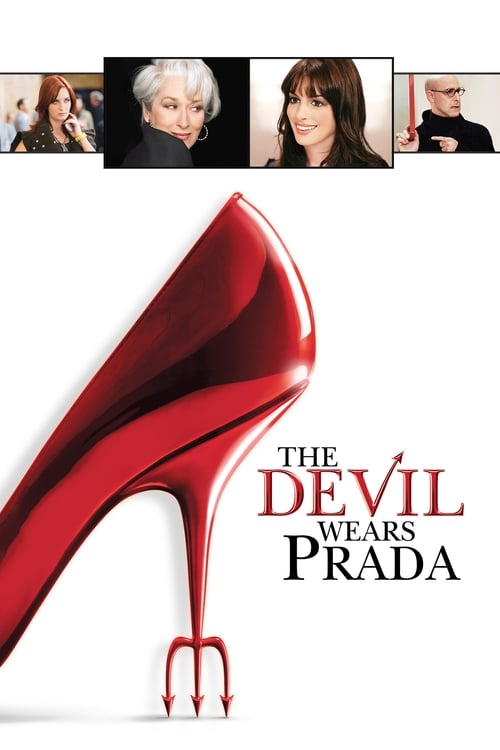
The Devil Wears Prada
2006 · David Frankel
For when you want a smart, stylish comfort watch — a rewatchable classic for a night in, especially if you're in the mood to feel seen about a terrible boss or a job that ate your life.
What it's about
Andy Sachs, a serious-minded aspiring journalist fresh to New York, takes a job she considers beneath her: junior assistant to Miranda Priestly, the quietly terrifying editor-in-chief of the fashion magazine Runway. The gig 'a million girls would kill for' turns out to be a boot camp in taste, power, and impossible demands — and the better Andy gets at it, the more it costs her everywhere else in her life.
The experience
Glossy, quick, and endlessly quotable, with a mean streak that's more delicious than cruel. It plays as a comedy of workplace humiliation, but it keeps asking a sharper question about what excellence demands, so you come away entertained and a little unsettled about your own job.
Performances
Meryl Streep's Miranda Priestly is an all-timer of controlled menace — she never raises her voice, and a whispered 'that's all' lands harder than any tirade. Anne Hathaway holds the center gracefully, and Emily Blunt and Stanley Tucci steal scenes around them.
The craft
Aline Brosh McKenna's screenplay sharpens a beach-read novel into a genuine argument about ambition and taste, studded with monologues people still recite. Patricia Field's costuming does real narrative work — you can track the story arc through the wardrobe alone — and the whole thing gleams with mid-2000s New York glamour.
Why it matters
It became one of the defining workplace movies of its era, minted a villain who entered the cultural vocabulary, and earned Streep an Oscar nomination for what looked on paper like a light comedy role. Nearly every 'assistant to a monster boss' story since lives in its shadow.
Snapshot
The Devil Wears Prada is a mid-2000s American studio comedy-drama that turned a workplace-humiliation narrative into a glossy, widely quoted portrait of ambition, taste, and power. Adapted by Aline Brosh McKenna from Lauren Weisberger's 2003 novel, and directed by television veteran David Frankel, it follows Andy Sachs (Anne Hathaway), an aspiring journalist who takes a job as junior assistant to Miranda Priestly (Meryl Streep), the imperious editor-in-chief of the fictional fashion magazine Runway. What might have been a disposable "chick-lit" adaptation became something more durable, largely on the strength of Streep's performance, Patricia Field's costuming, and a screenplay that sharpened the source material into a genuine argument about the cost of excellence. Released in the summer of 2006 to strong reviews and outsized commercial returns against a modest budget, it earned Streep an Academy Award nomination and has since become one of the most persistently cited studio films of its era, spawning memes, a stage musical, and a long-gestating sequel.
Industry & production
The film was produced by Wendy Finerman for Fox 2000 Pictures, the prestige-adjacent 20th Century Fox label that specialized in literary adaptations and adult-skewing dramas. It was made on a comparatively lean budget (widely reported at roughly $35 million), a figure that mattered enormously to its later reputation as a hit, since its worldwide gross ran many times that. I'll flag that precise final grosses vary by source; the film is consistently described as a major commercial success that far outperformed expectations for a summer counter-programmer aimed at women.
Casting shaped the project decisively. Streep's involvement transformed the film's ambitions; her participation is the subject of a frequently repeated anecdote in which she has said the studio's initial offer was insultingly low and she was prepared to walk — a story she has told in interviews, though the exact figures are not something I can verify. Anne Hathaway was cast as Andy after a well-documented search; Emily Blunt, then relatively unknown to American audiences, landed the role of senior assistant Emily and expanded it into a breakout. Stanley Tucci's art director Nigel was reportedly enlarged and softened from the book. The production is also notable for the involvement of costume designer Patricia Field, fresh from Sex and the City, whose designer wardrobe — assembled partly through industry loans of couture and ready-to-wear — became a genuine marketing and cultural asset in its own right.
Technology
Technologically the film is unremarkable by design: a conventional early-digital-era 35mm studio production with no reliance on visual-effects spectacle. Its "technology," in a cultural sense, is the apparatus of print-magazine publishing at its apex — the physical mock-up boards, the printed "Book" that Andy delivers nightly to Miranda's townhouse, the fax and BlackBerry-era communications that structure the assistant's servitude. The film is a near-perfect artifact of the last moment before smartphones and digital media eroded the glossy monthly's authority, and part of its period charm is how thoroughly its plot depends on tools — landlines, physical proofs, couriered manuscripts — that would be obsolete within a decade.
Technique
Cinematography
Cinematography is by Florian Ballhaus, son of the celebrated Michael Ballhaus (Scorsese's and Fassbinder's collaborator). His approach is polished, bright, and mobile — a commercial-cinema sheen appropriate to a film about surfaces and image-making. Location shooting in New York and a climactic sequence in Paris give the film a documentary gloss of real fashion-world geography, and the camera treats clothing and interiors with the reverence of a magazine spread. The visual grammar is functional rather than showy, prioritizing legible coverage of dialogue and, crucially, the presentational display of costume; the lighting favors the flattering, high-key look of aspirational lifestyle media.
Editing
Editing by Mark Livolsi is the film's most conspicuously "authored" technical layer. The picture is built around montage — most famously Andy's transformation sequence, in which successive costume changes are cut to a driving pop track to compress her stylistic and psychological conversion into a few propulsive minutes. Livolsi's rhythmic, music-forward cutting is essential to the film's energy and to its Cinderella arc, converting the potentially static material of an office job into something kinetic. The editing also manages the film's tonal oscillation between comedy and drama, holding on Streep's quieter beats while accelerating through the workplace farce.
Mise-en-scène / staging
Mise-en-scène is where the film invests most heavily. Patricia Field's costume design functions almost as a second script: character, status, and moral trajectory are legible through wardrobe, from Andy's frumpy "before" sweater to her later runway-ready silhouettes, and from Miranda's armor of white hair and luxury tailoring to Nigel's studied elegance. The Runway offices, Miranda's townhouse, and the Paris fashion-week settings are staged as spaces of intimidation and desire. Streep's Miranda is frequently framed to dominate — approached, waited upon, reacted to — with staging that dramatizes hierarchy before a line is spoken.
Sound
The soundtrack is a defining element: an aspirational pop-and-dance song score threads through the film, most memorably KT Tunstall's "Suddenly I See" over the opening and Madonna and other artists across the makeover and Paris sequences. Theodore Shapiro's original score supplies connective tissue and the more emotional underscoring, but the film's sonic identity is bound up with its curated needle-drops, which reinforce the montage-driven momentum and the fantasy of metropolitan glamour.
Performance
Performance is the film's center of gravity. Meryl Streep's Miranda Priestly is a landmark of controlled menace: rather than shout, she famously lowers her voice, and Streep has spoken in interviews about deriving Miranda's soft, unanswerable authority partly from male models of power — an approach that produces a villain who never raises her voice and is never contradicted. Anne Hathaway anchors the film as an audience surrogate whose earnestness slowly hardens into competence and complicity. Emily Blunt's brittle, panicked Emily and Stanley Tucci's warm, wry Nigel provide comic texture and, in Nigel's case, the film's clearest articulation of fashion as a serious vocation. The ensemble's chemistry — especially the Streep–Hathaway dynamic of terror curdling into mutual recognition — is what elevates the material.
Narrative & dramatic mode
The film operates in a hybrid mode: broadly comic in its texture, but structured as a coming-of-age drama and a moral fable. Its spine is the classic apprenticeship-and-corruption arc — an innocent enters a glamorous, punishing world, is transformed by it, ascends within it, and must finally decide what she has traded away. The screenplay meaningfully departs from and sharpens the novel, adding the celebrated "cerulean" monologue in which Miranda demolishes Andy's assumption that she stands outside fashion — a scene that reframes the entire enterprise as an argument about how taste and power actually work. The dramatic mode is ultimately reconciliatory rather than satirical to the bone: it grants Miranda genuine dignity and Andy a considered exit, refusing to reduce either to caricature.
Genre & cycle
The film sits within the women's picture and the workplace comedy, and more specifically within the mid-2000s cycle of "chick-lit" adaptations — glossy, female-centered studio films drawn from popular novels aimed at young professional women. It also belongs to the makeover/Cinderella lineage and to a durable subgenre of "tyrannical boss" comedies. Field's presence and the film's magazine-world milieu link it explicitly to the Sex and the City moment of aspirational metropolitan femininity. Within that cycle, Prada is generally regarded as the class act — the entry that took the formula seriously enough to invest it with real dramatic weight and a genuine ideas-driven set piece.
Authorship & method
David Frankel came to the film from prestige television, having directed episodes of Sex and the City (and later Entourage), and his method here is one of tasteful, actor-forward studio craftsmanship rather than authorial signature; his key contribution was steering tone and giving Streep the latitude to build Miranda. The most authorial voice in the writing is screenwriter Aline Brosh McKenna, whose adaptation restructured the novel, deepened supporting characters, and supplied the film's sharpest thematic statements. Among collaborators, costume designer Patricia Field is arguably co-author of the film's meaning, so central is wardrobe to its storytelling. Cinematographer Florian Ballhaus, editor Mark Livolsi, and composer Theodore Shapiro round out a craft team whose work is unshowy but precisely calibrated to a commercial, character-driven register. The through-line of the film's method is subordination of technique to performance and to the legibility of style-as-story.
Movement / national cinema
This is mainstream American studio filmmaking of the classical-commercial type — a Hollywood literary adaptation produced within the specialty-label ecosystem of the mid-2000s. It participates in no avant-garde or national-cinema movement; its lineage is the Hollywood women's picture and the studio comedy of manners. What national-cinema specificity it has is thematic: it is a distinctly American fantasy of self-invention through metropolitan ambition, set in the industry capitals of New York and Paris, and it treats those cities as arenas of aspiration in a recognizably Hollywood idiom.
Era / period
The film is deeply of its moment: the mid-2000s pre-financial-crisis high tide of aspirational consumer culture and of the print fashion monthly's institutional power. Its assumptions — that a magazine editor commands near-absolute cultural authority, that a job in publishing is a coveted prize, that physical couture and printed pages are the currency of status — mark it as a period piece almost in spite of itself. It arrived just before the smartphone, social media, and digital media disruption hollowed out the world it depicts, which is part of why it now reads as an elegiac snapshot of an industry at its peak.
Themes
Its central theme is the tension between ambition and integrity — the question of what one surrenders in the pursuit of excellence and access. Adjacent to this is a serious meditation on taste and power: the "cerulean" monologue insists that fashion is not frivolous but a system that structures desire and labor, and that no one, however superior they imagine themselves, stands outside it. The film also explores mentorship and its dangers, female authority in a world that punishes it, the erotics and cruelty of aspiration, and the corrosion of personal relationships by professional obsession. Its final movement turns on self-recognition and the possibility of choosing a life rather than a career — though the film is honest enough to make Miranda's ruthlessness legible as competence, not merely villainy.
Reception, canon & influence
Critical reception was strong, with particular and near-universal praise for Streep, whose performance is widely regarded as one of the finest of her later career; she received an Academy Award nomination for Best Actress and won the Golden Globe for Best Actress in a Musical or Comedy. Emily Blunt's and Anne Hathaway's profiles rose substantially on the film's success. Commercially it was a significant hit that far exceeded its budget, cementing the viability of adult, female-driven studio comedy-dramas.
Its influences run backward to the women's picture and the "monstrous boss" comedy, to the Cinderella and makeover archetypes, and, more immediately, to the real-world fashion-publishing milieu: the source novel was written by Weisberger, who had worked as an assistant at Vogue, and Miranda has long been read as informed by that magazine's culture — a connection the film itself never states and which I present as widely observed interpretation rather than documented fact. Streep has been careful in interviews to describe Miranda as a synthesis rather than an impression of any single figure.
Its forward legacy is unusually large for a commercial comedy. The film has proved enduringly quotable and meme-generative, with lines and gestures from Miranda's dialogue circulating for years afterward; the "cerulean" monologue in particular is frequently cited well beyond film culture as a lesson about taste and systems. It helped establish Hathaway and Blunt as major stars and reaffirmed Streep's late-career dominance. The property has extended into a stage musical (developed in the early 2020s with music associated with Elton John and staged in Chicago and subsequently in London's West End), and a feature sequel has been in active development in the mid-2020s with principal cast returning — details of which I'll leave general, since specifics were still emerging at the time of writing. Two decades on, The Devil Wears Prada endures as both a beloved crowd-pleaser and a genuinely intelligent film about work, taste, and the price of ambition.
Reception
A solid hit in 2006 that critics filed under 'elevated chick flick' (with an Oscar nod for Streep as the exception), it's since climbed into the modern-classic tier — a rewatch staple whose reputation has only grown as the internet re-litigates every scene.
How The Devil Wears Prada was received, from release to now →
How to watch The Devil Wears Prada: what to notice on a first viewing
- Listen for how quietly Streep speaks when everyone else is panicking. Streep never raises her voice. She drops it, so the room has to lean in. Nobody contradicts her, and nobody finishes a sentence she hasn't invited. You hear power as a volume level: the person who commands most is the one who never has to shout.
- Notice who walks toward Miranda and who is already waiting. Frankel stages the Runway floor around arrivals. Assistants stand, phones drop, bodies clear a path. The hierarchy is blocked into the room before anyone speaks a line. The office tells you the pecking order through movement alone, so the dialogue only confirms what your eyes already know.
- Track Andy's sweaters, shoes and coats from her first day onward. Patricia Field's wardrobe runs as a second script. Andy's frumpy knitwear gives way to sharper silhouettes, while Miranda stays in white hair and luxury tailoring and Nigel in studied elegance. You can read status and change of heart off clothing, which means every outfit is a plot point.
- Count how fast the cuts go when a pop song starts. Livolsi accelerates into music-driven montage, stringing costume changes and errands to needle-drops like KT Tunstall and Madonna. Then the film slows and holds on Streep's face. The rhythm does the persuading. Speed makes the job look thrilling before you get a quiet shot to weigh it.
- Look at how evenly bright the offices, clothes and interiors are lit. Ballhaus keeps the high-key, flattering light of lifestyle advertising. Fabric, hair and surfaces are photographed with the care of a magazine spread, even during humiliation. The film shoots this world the way the world sells itself, so you feel the pull before you question it.
The whole guide to watching The Devil Wears Prada, with the keys for a rewatch →
Influences: the films it descends from and the films it influenced
- All About Eve (1950) — Supplies the apprenticeship-corruption engine: an ambitious ingénue orbiting a formidable older woman, her moral erosion tracked through insider backstage argot and the slow transfer of power from mentor to protégée.
- Funny Face (1957) — Establishes the imperious fashion-magazine editrix (Kay Thompson's Maggie Prescott, modeled on Diana Vreeland) and the 'Think Pink' fashion-spread montage that renders couture layouts as kinetic musical spectacle — the direct forerunner of Prada's runway-and-office montages.
- Sabrina (1954) — Codifies the Cinderella makeover reveal — the plain girl restyled abroad into elegance (Hepburn's Paris return) — the exact structural beat Andy's mid-film wardrobe transformation replays.
- The Women (1939) — Pioneers the all-female fashion-society milieu with an in-film couture fashion-show set piece, treating costume as social weaponry and status signal — the costume-as-script grammar Patricia Field inherits.
- Nine to Five (1980) — Fixes the tyrannical-boss office-comedy template, building laughs and tension from a subordinate's dread of a domineering superior — the 'monstrous boss' machinery Miranda perfects in a quieter register.
- Working Girl (1988) — Delivers the makeover-driven female-ascent workplace picture anchored by a glamorous monstrous female boss (Weaver), where the assistant literally restyles herself to out-class her mentor.
- Broadcast News (1987) — Dignifies the ambition-vs-integrity media workplace, dramatizing the ethics of selling out with adult specificity — the moral spine Aline Brosh McKenna grafts onto a fashion comedy.
- Sex and the City (1998) — Direct collaborator debt: Patricia Field's costume-as-character method — label-legible, narrative-bearing wardrobe that telegraphs desire and status — is carried wholesale into Prada, where Frankel himself directed episodes.
- Breakfast at Tiffany's (1961) — Builds its whole arc on costume-as-character — the provincial reinventing herself in Manhattan through clothes — the Givenchy-sheath logic of Tiffany's made the film's central device.
- Bridget Jones's Diary (2001) — A direct product of the chick-lit adaptation wave Bridget consolidated—single professional woman, costume-as-character-arc, confessional first-person source novel transposed to screen.
- 27 Dresses (2008) — Aline Brosh McKenna screenplay: the author's chick-lit-adaptation craft reapplied, structuring the film around a wardrobe-montage conceit and a heroine defined by service to others' style.
- Morning Glory (2010) — Aline Brosh McKenna's most direct authorial sequel-in-spirit: a green woman navigating a media workplace and taming an impossible, imperious star — the same apprenticeship-under-a-difficult-legend architecture.
- Confessions of a Shopaholic (2009) — Chick-lit fashion-magazine adaptation greenlit on Prada's proven template, replicating the aspirational New York publishing milieu, needle-drop shopping montages, and label-fetish visual grammar.
- The Proposal (2009) — Reworks the monstrous-female-boss/beleaguered-assistant comedy as rom-com, inheriting Prada's power-differential setup where a subordinate's servitude to a tyrannical superior drives the plot.
- Cruella (2021) — Reprises the taste-and-power dynamic as origin story: an ambitious protégée under a tyrannical fashion doyenne (the Baroness), with costume-as-narrative doing the heavy storytelling and needle-drop montage pacing.
- Late Night (2019) — Updates the imperious-woman-boss/green-assistant pairing (Emma Thompson's exacting star and her new hire), replaying the apprenticeship-corruption arc and workplace-ethics stakes in a media-industry setting.
- The Devil Wears Prada 2 (2026) — The direct source: Prada 2 reruns its comic-dramatic engine of the mentor-antagonist boss, its wardrobe-transformation montage, and the fashion-label-as-character costume grammar Patricia Field established.
- Ugly Betty (2006) — Same-year twin: the fashion-magazine-assistant-versus-monstrous-editor world styled in the identical Field-derived costume idiom, mining an unglamorous protagonist inside a glossy print-magazine ecosystem.
- Phantom Thread (2017) — Pushes costume-as-script to its art-cinema extreme, making garment construction the film's central language and the medium of a mentor-protégée power struggle — the same taste-as-power dynamic in couture-atelier form.
Similar films
- Phantom Thread (2017) — influence & lineage
- All About Eve (1950) — influence & lineage
- The Devil Wears Prada 2 (2026) — shared sensibility
- American Psycho (2000) — shared sensibility
- Network (1976) — shared sensibility
- Bridget Jones's Diary (2001) — shared sensibility
- Doubt (2008) — shared sensibility
- The Hours (2002) — shared sensibility