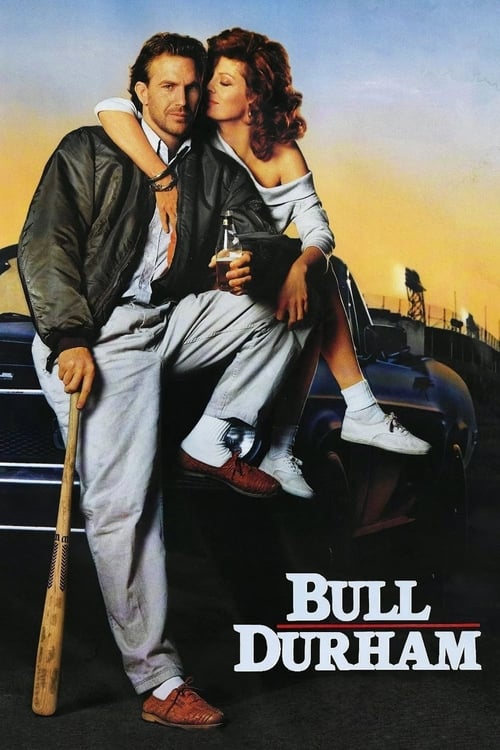
Bull Durham
1988 · Ron Shelton
For a date night or a summer evening when you want smart, adult romance with laughs — pure comfort, but comfort with a brain. The rare sports movie for people who don't care about sports.
What it's about
A veteran minor-league catcher — smart, weathered, and running out of seasons — is assigned to babysit a rookie pitcher with a million-dollar arm and a five-cent head. Complicating the education is Annie Savoy, the Durham Bulls' resident romantic and self-appointed baseball guru, who chooses one player a season to take under her wing and finds herself caught between the two men. It's a love triangle played out over a summer of bus rides, batting slumps, and bar arguments.
The experience
Warm, talky, and genuinely sexy — a comedy where the pleasure is in the language, delivered at the easy rhythm of a long season. It's funny about baseball the way only an insider can be, and romantic in a grown-up, clear-eyed way that never turns syrupy.
Performances
Kevin Costner has never been better than as Crash Davis — wry, bruised, carrying twelve years of bus rides in his posture. Susan Sarandon makes Annie a screwball heroine with a soul, and Tim Robbins is hilarious as the gifted, empty-headed rookie.
The craft
Ron Shelton wrote and directed from lived experience — five seasons in the minors himself — and it shows in every detail: the roster math, the mound conferences, the locker-room superstitions. The script is one of the most quotable in American comedy, and the film treats baseball as a job, not a myth, which is exactly why it feels romantic.
Why it matters
It set the modern standard for the American sports movie and made the case that the genre's best subject is work, not winning — remaking Costner as a star and launching Shelton's career.
Snapshot
Bull Durham is the film that taught American movies how to talk about baseball as a job. Ron Shelton's directorial debut — written from the inside by a former Baltimore Orioles farmhand who spent five seasons in the minors without reaching the majors — reframes the national pastime away from myth and toward labor: bus rides, meal money, roster math, and the narrow window in which a body is worth a paycheck. Its three-cornered structure is a screwball inheritance dressed in polyester road grays. Kevin Costner's Crash Davis is a career minor-league catcher assigned to shepherd a pitcher with "a million-dollar arm and a five-cent head"; Tim Robbins's Ebby Calvin "Nuke" LaLoosh is that arm; and Susan Sarandon's Annie Savoy is the Durham Bulls' resident aesthete, a community-college English instructor who takes one player per season as lover and pupil, and who narrates the film as an act of comparative theology.
The film's durability rests on two achievements. First, its dialogue: profane, aphoristic, and unusually literate about craft, it made speech itself the film's principal pleasure at a moment when American comedy was drifting toward high-concept premise. Second, its adult sexual intelligence. Annie is not a prize to be won but the film's presiding intelligence and its most articulate character, and the romance she and Crash arrive at is built on mutual recognition between two people who have both read the game and read each other. Released in the summer of 1988 by Orion Pictures, it became a sleeper success, launched Shelton as American cinema's foremost writer of sport, and consolidated Costner as a star in the specific register — rueful, verbal, self-deprecating — that would define his best work. It also stands as the pivot in a two-year run that remade the baseball film: Bull Durham in 1988, Field of Dreams in 1989, the one profane and material, the other pastoral and metaphysical, together reopening a genre that had lain largely dormant for a generation.
Industry & production
Bull Durham is an Orion Pictures film, and that matters. Orion in the mid-to-late 1980s occupied a distinctive niche: a mini-major built by executives out of United Artists, distributing modestly budgeted, director-driven American pictures with a tolerance for adult content and idiosyncratic voices that the majors were beginning to lose to franchise economics. The same company handled work by Jonathan Demme, Woody Allen, and the Coen brothers in this period. A first-time director working from his own script, shooting on location in North Carolina with a cast whose biggest name was not yet a guaranteed opening-weekend draw, was a comprehensible bet for Orion in a way it would not have been at a major studio. The film was produced by Thom Mount — a former Universal executive with North Carolina roots and, notably, an ownership stake in the actual Durham Bulls franchise — and Mark Burg, under Mount's company banner. That proprietary connection to the club is one reason the film's access to Durham Athletic Park and the texture of a working Carolina League operation feels unbrokered.
Shelton's route to the chair was unusual and consequential. He had played five seasons in the Orioles organization, reaching Triple-A Rochester, then left the game, took an MFA, and worked as a screenwriter — including on Roger Spottiswoode's Under Fire (1983) and The Best of Times (1986), the latter a sports comedy that gave him a working relationship with actors and material adjacent to what became his signature. The credited condition on which he made Bull Durham was, by all consistent accounts, that he would direct his own script; the film's specificity is inseparable from that insistence. What arrived on screen is essentially unmediated firsthand testimony about a stratum of professional sport that American movies had never bothered to depict: the minor leagues not as a stop on a hero's journey but as a destination most players never leave.
Casting had real consequences for the film's tone. Costner had come off The Untouchables (1987) and No Way Out (1987) — a rising star, not yet the post-Dances with Wolves figure — and brought genuine athletic credibility, which Shelton exploited by shooting baseball action with actors who could plausibly perform it. Sarandon, then in her early forties, was cast in a leading romantic role of a kind Hollywood was already reluctant to write for women that age, and the film's willingness to make her the erotic and intellectual center is one of its quiet acts of defiance. Robbins was the least established of the three and the discovery of the picture. Production took place largely in Durham and surrounding North Carolina locations, with the ballpark itself — a small, cramped, wooden-feeling park — functioning as the film's principal set.
Commercially, the film performed as a summer sleeper rather than an event picture: strong reviews, word of mouth, and a long tail on home video and cable, where its quotability made it a perennial. Precise grosses are widely tabulated but vary by source, and I won't assign numbers here; the meaningful industrial fact is that it was profitable enough to make Shelton a bankable writer-director of sports pictures and to establish that adult comedy about work could still find an audience.
Technology
Bull Durham is not a technologically ambitious film, and its restraint is a stylistic position. It was shot on 35mm color negative and finished for standard anamorphic-era theatrical presentation, with no significant optical or effects program. There is no visible use of the era's emergent toys — no motion control, no extensive process work, no reliance on the video-assist-driven coverage strategies that were reshaping television-influenced shooting.
The relevant technical question in any baseball film is how to photograph the pitch, and Shelton's answer is essentially pre-technological: cast performers who can throw and hit, put the camera close, and cut. Robbins and Costner do plausible baseball, and the film accordingly avoids the two standard evasions of the genre — the ball inserted in post, and the cutaway that hides the athlete's incompetence. Where the film does use a technique, it is simple and dramatic rather than showy: the low camera behind or beside the catcher, the tight framing on the pitcher's release, and sound design that gives the ball weight. The film's most discussed "effect" — the sequence in which we hear the interior monologue of a batter being fed pitches, or Crash tipping a hitter to what is coming — is achieved through editing and voice, not apparatus.
One period technology does appear as content rather than tool: the small-market minor-league operation itself, with its hand-operated scoreboard business, its promotions, its P.A. announcer. The film treats the park's low-tech charm as an economic fact, not nostalgia — this is what a Class A operation could afford.
Technique
Cinematography
Bobby Byrne shot the film. Byrne's background — he had photographed Jonathan Demme's Melvin and Howard (1980) and, in a very different register, Airplane! (1980) — suited a picture that needed both regional naturalism and clean comic staging. The photographic scheme is warm, largely available-light-inflected in interiors, and unfussy: medium shots that let two or three actors occupy the frame together, so that verbal comedy can play in continuous space rather than in shot-reverse-shot ping-pong.
Two visual registers coexist. Daytime and night-game baseball is photographed with a documentary attentiveness — dust, sweat, the sodium wash of small-park lighting, the grain of a park that has not been rebuilt for television. The romance, by contrast, is shot with a candlelit, tactile warmth: Annie's house is the film's one aestheticized interior, hung with images and lit like a shrine, which is precisely the joke and the point. Byrne keeps the camera at human height and mostly still; the film's kinetic energy comes from performance and cutting, not from movement. That plainness has aged well. Because the film never reaches for a signature look, it never dates itself to 1988 the way more stylized contemporaries do.
Editing
Robert Leighton cut the film. Leighton is best known for his long collaboration with Rob Reiner — This Is Spinal Tap (1984), The Princess Bride (1987), When Harry Met Sally... (1989) — and that lineage is legible here in the handling of comic dialogue. Leighton's instinct is to hold a shot until a line has fully landed and then cut on the reaction, which is why the film's set pieces breathe.
The famous mound conferences — the whole team gathering to discuss a teammate's wedding-gift crisis while a game waits — work because the cutting treats the huddle as an ensemble scene with its own internal rhythm rather than as a gag to be dispatched. Elsewhere the editing does structural work: the film's season is conveyed through montage sequences of bus travel, at-bats, and hotel rooms, which compress a long campaign without ever suggesting that individual games matter as sport. The pitch-by-pitch coverage is cut for comprehension — sign, wind-up, release, contact, reaction — building a small suspense grammar the film can then subvert for jokes. Notably, the film declines the genre's default climax: there is no championship game structured as a final act, and the editing never builds toward one.
Mise-en-scène / staging
The film's spatial logic is a triangle of enclosures: the ballpark, the bus, and Annie's house. Each is cramped, and the crampedness is thematic — this is a world of people packed too close, professionally and erotically. Shelton stages the locker room and dugout with a documentary indifference to hierarchy, letting bodies and equipment clutter the frame; the ballpark's dimensions are never flattered.
Annie's house is the film's most deliberate design statement, a bricolage of literary and devotional objects that establishes her syncretic "Church of Baseball" as a genuine aesthetic system rather than a quirk. Costume works similarly: the players' uniforms are ill-fitting and sweat-stained, the road grays genuinely gray, and Crash's off-field clothes read as a man who has packed the same bag for a decade. Shelton's blocking favors the two-shot and the group, and he repeatedly stages conversations while people are doing something physical — taping, dressing, driving, throwing — so that exposition never sits still. The tying-to-the-bed scene, in which Annie reads Whitman aloud to a bound Nuke, is exemplary staging: an erotic setup converted into a pedagogical one, with the composition holding both readings at once.
Sound
Michael Convertino composed the score, which is restrained and largely deployed to lubricate montage rather than to instruct emotion. The film's more distinctive sonic strategy is its use of source and regional music — a Southern, roadhouse-inflected soundtrack that locates the story geographically and keeps the register earthy rather than elegiac. This is worth naming as a contrast: Field of Dreams the following year would use a swelling orchestral score to make baseball numinous. Bull Durham mostly refuses that, and the refusal is a thesis.
Effects work is precise where it counts: the specific crack of a bat, the pop of a ball in a mitt, the murmur of a few hundred people rather than fifty thousand. Voice-over is the film's boldest sound decision. Annie's opening narration — a first-person credo built on the analogy between baseball and religious faith — assigns the film's interpretive authority to her before we have met either man, and returns at intervals to frame the season. Interior monologue is also used for comedy, most memorably in giving us a batter's thoughts as Crash quietly dismantles him.
Performance
The acting is the film's principal technical achievement. Costner plays Crash as a man whose competence is his tragedy: he knows more about baseball than anyone in the film and that knowledge is worth nothing at the major-league minimum. Costner's choice is to underplay the bitterness and let it surface only in flashes — the flat delivery of his career statistics, the weariness in his instruction. His much-quoted "I believe in" monologue is delivered as an exit line rather than a seduction, which is what makes it work: the character wins by leaving.
Sarandon's Annie is the film's structural center and the source of its adultness. She plays intelligence as appetite — reciting poetry, dispensing instruction, entirely without apology for wanting what she wants. Crucially, Sarandon plays Annie as someone who understands her own arrangement is a defense against time, and lets that knowledge show late without ever asking for pity. Robbins builds Nuke almost entirely from physical comedy and mismatched rhythm: the loose-limbed windup, the vacant confidence, the parroting of clichés he does not understand. The three-way chemistry is real, and Shelton's method — extensive rehearsal of baseball as well as dialogue, and a willingness to let actors overlap — produces an ensemble that feels like a clubhouse. Supporting work by Trey Wilson as the manager and Robert Wuhl as the pitching coach supplies the film's institutional comedy, and Wilson's exasperated profanity is among its most-quoted material.
Narrative & dramatic mode
The film's mode is picaresque romantic comedy organized by a season rather than by a plot. There is no antagonist, no championship, no scouted-and-signed climax staged as triumph. What structures the narrative is the calendar: a minor-league season begins, players arrive and are released, and the film ends with the roster reshuffled and two people finally aligned.
Beneath that looseness sits a rigorously classical device — the erotic triangle of screwball comedy, in which a woman chooses between an experienced man and a callow one, and in which the real subject is education. Annie's stated project is to teach Nuke; the film's actual project is the mutual education of Annie and Crash, both of whom are older than their arrangements admit. Shelton runs the triangle with an unusual honesty: sex happens, it is discussed, and it does not resolve character.
The dramatic engine is instruction. Nearly every major scene is a lesson: Crash teaching Nuke about pitch selection, breathing, and what to say to reporters; Annie teaching Nuke about Whitman and breathing of a different kind; the manager teaching by profane fiat. Dialogue accordingly does the narrative work — the film advances through aphorism, and its most memorable sequences are arguments about craft. Two structural choices deserve note. First, the film's climax is not athletic but vocational: Crash's release and his subsequent minor-league home-run record are treated as bittersweet bookkeeping, not glory. Second, Nuke's promotion to the majors is handled almost offhandedly, denying the audience the payoff a conventional sports film would build toward. Shelton's implicit argument is that the interesting story is not who gets called up but what happens to everyone who doesn't.
Genre & cycle
Bull Durham sits at the junction of two genres and revitalizes both. As a baseball film it enters a genre that had been, for decades, either hagiographic biopic (The Pride of the Yankees, 1942; The Jackie Robinson Story, 1950) or elegiac allegory (The Natural, 1984). Shelton's intervention is materialist: he replaces destiny with employment. As a romantic comedy it revives the screwball triangle and the fast, competitive, sexually frank dialogue of the 1930s and 40s at a moment when the American romantic comedy was being rebuilt around a different template — When Harry Met Sally... would arrive a year later — and it does so with a raunchier vocabulary than the Code-era models permitted.
Its immediate cycle position is precise. Bull Durham (1988), Eight Men Out (1988), Field of Dreams (1989), and Major League (1989) constitute a two-season baseball revival, each taking a different tack: Shelton's labor comedy, Sayles's political history, Robinson's pastoral metaphysics, and Ward's broad ensemble farce. Major League in particular is unimaginable without Bull Durham's clubhouse ensemble template, and the two are often paired precisely because they share a register while differing wildly in ambition.
Shelton then generated a cycle of his own. White Men Can't Jump (1992), Cobb (1994), Tin Cup (1996), and Play It to the Bone (1999) extend the same method into basketball, biography, golf, and boxing: trash-talking professionals, work as identity, aging bodies, and dialogue as the primary event. The Shelton sports film became a recognizable subgenre — the sport-as-vocation comedy — and its influence extends well past his own filmography into television, where the workplace-comedy treatment of athletics (from Eastbound & Down through Ted Lasso) draws on the premise that the locker room is a workplace.
Authorship & method
Bull Durham is a writer's film directed by its writer, and Shelton's authorship is primarily verbal and experiential. His method, consistent across the sports films, has three components. First, autobiography as research: he writes from stratum-specific firsthand knowledge, which is why the film knows about meal money, bus etiquette, and the exact humiliation of a release. Second, dialogue as action: his scripts privilege verbal competition — instruction, insult, seduction — over plot mechanics, and his direction is organized to serve it, with staging and cutting subordinated to letting actors talk. Third, athletic verisimilitude: he casts and trains for plausible physical performance and shoots it without cheating.
His key collaborators here are worth naming precisely. Bobby Byrne's photography supplies the unglamorous regional naturalism that keeps the film's talk grounded. Robert Leighton's editing, formed in Rob Reiner's comedies, supplies the comic timing — the film's rhythm is a cutter's achievement as much as a writer's. Michael Convertino's score stays deliberately out of the way, leaving the film's emotional register to performance and source music. And the cast functions as collaborators in the authorial sense: Sarandon in particular is credited across the film's reception with making Annie an intelligence rather than a fantasy, and the film's tonal balance depends on her.
Shelton's subsequent career confirms the pattern and its limits. He is a superb writer of male vocational milieux and of women who see through them; he is a functional rather than visually distinctive director. That combination has meant his films are remembered as scripts and performances — which is, in Bull Durham's case, more than sufficient.
Movement / national cinema
The film belongs to no movement, but it sits legibly within two American currents of the 1980s. The first is the mini-major/independent-adjacent production culture — Orion, and to a lesser degree the specialty arms of larger companies — that sustained mid-budget, adult, director-driven American film in the decade before the indie boom of the 1990s. Bull Durham is a mainstream studio comedy in shape but its financing, scale, and content freedom belong to that ecology.
The second is regionalism. The film is emphatically Southern in a specific, unromanticized way: North Carolina locations, Carolina League geography, roadhouse music, and a milieu of small cities defined by their ballparks and their bars. This aligns it loosely with an 1980s American interest in place-specific storytelling that runs through work as different as Demme's and Sayles's, and it distinguishes Bull Durham from the deliberately placeless Midwest-as-myth iconography of The Natural and Field of Dreams. It is a film about the American provinces treated as a real economy rather than a symbol.
Era / period
The film is set in its own present, and 1988 is a meaningful date. American baseball was in a period of institutional tension over labor — the collusion findings against owners in the mid-1980s, the residue of the 1981 strike, and an escalating gap between major-league salaries and everything below it. Bull Durham never argues politics, but its entire premise is a labor premise: a man who is very good at his job, at the wrong level, is worth almost nothing, and a man who is bad at his job with a live arm is worth a great deal. That asymmetry is the film's economics and its comedy.
Culturally, the film arrives at the end of the Reagan decade with a notably unyuppie sensibility: nobody in it is accumulating anything. It also arrives at a specific moment for screen sexuality — after the frankness of the 1970s, alongside the erotic thriller cycle, and just before the 1990s. Its treatment of sex is neither punitive nor titillating, which was remarked on at the time and is more unusual in retrospect. And it precedes by a year the Field of Dreams wave of baseball-as-American-sacrament, which means Bull Durham is often read backward as the corrective to a film it actually preceded.
Themes
Work, not destiny. The film's governing idea is that baseball is a job performed by employees. Careers are contingent, bodies depreciate, and institutions release people without ceremony. This is the film's most consequential contribution to the genre.
Craft knowledge and its uselessness. Crash's expertise is total and unmonetizable. The film is fascinated by the gap between knowing and being able — Nuke can do what Crash understands, and Crash understands what Nuke can do. Instruction is the film's central action, and its melancholy is that teaching is what you do when you can no longer play.
Faith as an aesthetic choice. Annie's "Church of Baseball" is presented as a considered syncretism — a woman who has surveyed available belief systems and selected the one with the most beautiful liturgy. Crash's "I believe in" credo answers hers with a materialist litany. The film sets sacred and profane registers against each other and does not adjudicate.
Sex as conversation. Desire in the film is verbal and reciprocal. Annie's authority is erotic and intellectual at once, and the film's romantic resolution is reached through argument. It is a rare American comedy in which the sexual dynamic is genuinely negotiated between adults.
Aging. All three principals are positioned against time: Nuke has it, Crash has run out of it, and Annie is calculating how much of it her arrangement can survive. The film's ending is less a union than a truce with the calendar.
The ritual of the ordinary. Superstition, routine, the mound conference, the bus — the film treats the repetitive texture of a season as its real subject, and finds in the repetition both comedy and something close to devotion.
Reception, canon & influence
Critical reception in 1988 was strong and specifically praised the writing and the performances. Reviewers singled out the dialogue's literacy and profanity, Sarandon's Annie as an unusually intelligent adult heroine, and the film's refusal of sports-movie uplift; Shelton's insider knowledge was widely treated as the source of its authority. Shelton received an Academy Award nomination for Best Original Screenplay, the film's principal industry recognition, and Sarandon's performance drew significant critical attention and awards-season notice. The film's reputation grew steadily on video and cable, where its quotability made it a staple, and it has since been widely canonized as the best American baseball film — a judgment repeated often enough in critics' polls, Sports Illustrated–style rankings, and retrospective criticism that it functions as consensus. It was selected for the Library of Congress's National Film Registry, an institutional confirmation of that standing.
Influences on the film (backward). Three lineages converge. From 1930s–40s screwball comedy comes the erotic triangle, the fast overlapping talk, and the premise that romance is an argument between equals — Hawks is the relevant ancestor, particularly in the treatment of professional competence as sexual currency. From the American baseball-book tradition comes the film's documentary interest in the minors: Jim Bouton's Ball Four (1970) had already broken the omertà on clubhouse profanity and the tedium of the professional season, and Mark Harris's Henry Wiggen novels and Bernard Malamud's The Natural (1952) established the literary frame Shelton is arguing with. From the 1970s American cinema of deflated masculinity — Altman's ensembles, and sports films like Slap Shot (1977) and North Dallas Forty (1979), both of which treat sport as a brutal workplace — comes the film's tone and its refusal of triumph. Slap Shot is the closest formal antecedent: profane, ensemble-driven, minor-league, and interested in labor.
What it shaped (forward). The film's legacy is broad. It established Shelton's own cycle and, with it, the sports-as-vocation genre; it made the clubhouse ensemble comedy a viable commercial form (Major League directly, and much subsequent television); and it durably shifted how baseball could be depicted, licensing the material, profane, unmythologized register that runs through later work about the game's lower rungs and business (Bennett Miller's Moneyball, 2011, is a distant descendant in its treatment of baseball as an argument about value). For Costner it created a persona and a subgenre — he returned to baseball in Field of Dreams (1989) and For Love of the Game (1999), and Bull Durham is the film that established him as the era's baseball actor. For Sarandon it marked a turn toward the run of assertive adult leading roles that culminated in Thelma & Louise (1991) and Dead Man Walking (1995). For Robbins it was the breakout.
Its deepest influence, though, is linguistic. Bull Durham proved that an American mainstream film could be built almost entirely on how professionals talk to each other about their work — that jargon, insult, and instruction could carry a two-hour picture — and a great deal of subsequent American screen comedy about workplaces, athletic or otherwise, operates on that permission.
A Deleuzian reading
The whole team is standing on the pitcher's mound in the middle of a game, and the subject under discussion is a wedding gift.
The full Deleuzian reading of Bull Durham →
Reception
A sleeper hit in the summer of '88 that critics loved immediately — it earned Ron Shelton an Oscar nomination for the screenplay — and its stock has only risen since: Sports Illustrated crowned it the greatest sports movie ever made in 2003, and it's still the default answer to 'best baseball film.'
How Bull Durham was received, from release to now →
How to watch Bull Durham: what to notice on a first viewing
- Notice how many conversations play in one unbroken medium shot. Byrne keeps the camera at human height and mostly still, wide enough to hold two or three people at once. Leighton waits until a line has fully landed before cutting to the reaction. The talk is the event, so the film gives it room. Nobody gets chopped into shot and reverse shot while a joke is working.
- Watch the whole team gather on the mound to discuss a gift. Nine men take up the ceremonial shape of a baseball strategy session and use it to sort out their actual lives. The game waits. Shelton plays the huddle as an ensemble scene with its own weather. The posture belongs to the sport and the conversation belongs to the workplace. Both are true at once, which is the film's argument.
- Look at the uniforms, the bus, and the motel rooms. The road grays are genuinely gray and sweat-stained. Crash packs the same bag he has packed for a decade. Shelton played five years in the Orioles system and the film knows about meal money and roster math. Baseball here is employment. Bodies depreciate, contracts run out, and nobody gets a ceremony on the way out of the league.
- Listen to who is speaking before you meet either man. Annie opens with a first-person credo comparing baseball to faith and returns at intervals to frame the season. Later the film drops into a batter's thoughts while Crash quietly works him. The source music is roadhouse Southern. Interpretive authority belongs to Annie from the first minute. The film hands its meaning to the woman rather than to either player.
- Watch Costner's face while he recites his career statistics. Crash knows more baseball than anyone in the film and that knowledge is worth nothing at the major-league minimum. Costner keeps the bitterness flat and lets it surface only in the occasional line reading. The competence is the trouble. Teaching is what you do once you can no longer play, and Costner plays that without underlining it.
The whole guide to watching Bull Durham, with the keys for a rewatch →
Influences: the films it descends from and the films it influenced
- Only Angels Have Wings (1939) — Establishes the template Shelton runs on: a closed professional enclave where shop talk is the only language, and an outsider woman earns erotic standing by demonstrating she understands the work — Annie's mound-visit authority is Bonnie Lee's piano-bar authority transposed to the Carolina League.
- His Girl Friday (1940) — Source of the overlapping, jargon-dense verbal duel in which courtship and professional argument are the same scene; Shelton's Crash/Annie exchanges are cut on reaction rather than on the line's end, the Hawks rhythm that lets insult read as foreplay.
- Fat City (1972) — The bush-league vocation film — athletes as itinerant wage laborers in Stockton gyms and onion fields, shot in unglamorous available light — supplying Bull Durham's premise that the interesting story is the circuit nobody escapes, not the one that ends in the majors.
- Bang the Drum Slowly (1973) — From Mark Harris's Henry Wiggen books, it built a baseball picture around the pitcher-catcher battery as its central relationship and rendered clubhouse tedium — card games, bus rides, tobacco juice — as texture; Crash-and-Nuke is that battery structure rewritten as pedagogy.
- The Bad News Bears (1976) — Licensed profanity and comic ensemble deflation inside a baseball frame, and — decisively — lost the championship game, giving Shelton the precedent for a season-shaped structure that withholds the trophy and ends on a demotion and a promotion instead.
- Slap Shot (1977) — The closest formal antecedent: Nancy Dowd's script mined a relative's actual minor-league hockey life, making obscenity a workplace dialect rather than shock, and structured the film as a bus-league season about a failing franchise — precisely Shelton's insider-autobiography method and its scale.
- Semi-Tough (1977) — Transposes the screwball triangle into a pro-sports workplace — two teammates and one woman sharing quarters, the rivalry conducted through locker-room needling — which is the exact configuration Shelton inherits for Crash, Nuke, and Annie.
- North Dallas Forty (1979) — Adapted from Peter Gent's insider novel, it made the training room and the front office the real settings and the athlete a depreciating asset with a shelf life — the sport-as-labor grammar behind Crash's meal-money economics and the flat cruelty of a release.
- The Natural (1984) — The mythic baseball film Bull Durham is explicitly arguing with: Caleb Deschanel's backlit, exploding-lights transcendence answered by Bobby Byrne's overcast, sodium-lit bush-league parks and in-camera play staged from actors who could actually throw.
- Major League (1989) — Takes Bull Durham's commercial proof directly: a clubhouse ensemble comedy built on position-player types and bullpen insult routines, with the veteran catcher again functioning as the roster's translator and moral center.
- A League of Their Own (1992) — Adopts the season-as-structure and the drilled in-camera athleticism — cast trained to real playing competence so games could be staged in continuous coverage rather than cut around doubles — plus the catcher-as-field-general instruction comedy.
- White Men Can't Jump (1992) — Shelton's own cycle pushing his thesis to its limit: trash talk is not decoration but the entire mechanism of action, with hustling playgrounds treated as a wage economy and the verbal duel replacing plot as the source of suspense.
- Tin Cup (1996) — Reruns the structure exactly — a stalled minor-circuit professional, a smarter woman attached to the rising rival, instruction as seduction — and again refuses the win, ending on the willful 12 rather than the trophy.
- Jerry Maguire (1996) — Operates on the permission Bull Durham established — a two-hour mainstream picture carried by how professionals talk about their work, with contract jargon and negotiation patter doing the comic and romantic labor a plot would normally carry.
- Sugar (2008) — The bus-league labor portrait taken to documentary extremity — a Dominican pitcher in the Midwest League, real ballplayers cast for their bodies rather than actors trained to fake it, and an ending that leaves the game entirely instead of resolving the season.
- The Wrestler (2008) — Extends the Slap Shot/Bull Durham labor line: the arena as a shift job with a deli counter attached, the aging body priced as equipment, and a climax that withholds the outcome of the match because the match was never the point.
- Moneyball (2011) — Rebuilds baseball drama as talk between professionals arguing about value — scouting-room and phone-trade scenes carrying the picture — and keeps Shelton's structural nerve by ending on a first-round playoff loss and a job offer declined.
- Long Gone (1987) — Made a year earlier from Paul Hemphill's novel and set in the same 1950s Carolina low minors — profane, sexual, bus-and-boarding-house realism with a player-manager at its center — arriving independently at the identical unmythologized register.
Similar films
- Moneyball (2011) — influence & lineage
- Jerry Maguire (1996) — influence & lineage
- Broadcast News (1987) — shared sensibility
- Rushmore (1998) — shared sensibility
- Silverado (1985) — shared sensibility
- Butch Cassidy and the Sundance Kid (1969) — shared sensibility
- The Notebook (2004) — shared sensibility
- Moonstruck (1987) — shared sensibility