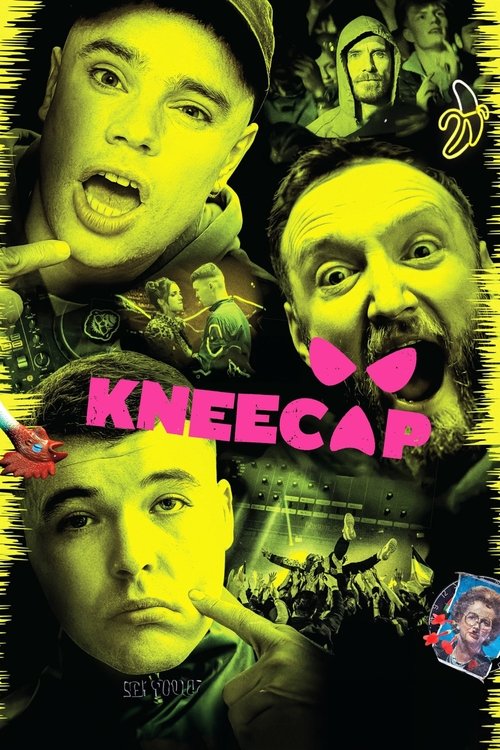
Kneecap
2024 · Rich Peppiatt
For when you want something loud, funny, and alive — a Friday-night watch with swagger that still leaves you with something to think about. Not one for a quiet, gentle evening.
What it's about
In post-Troubles Belfast, two self-described low-life scum and a mild-mannered schoolteacher form a hip-hop act that raps entirely in Irish — and accidentally become the spearhead of a language-revival movement. It's a fictionalized origin story for the real trio Kneecap, with the actual band playing versions of themselves, caught between drug-fuelled chaos, furious politicians, and a mother tongue fighting for its life.
The experience
Fast, filthy, and electric — a riot of subtitled wordplay, anarchic visual energy, and bangers, with a genuine political fire burning under all the mischief. It plays like a party that keeps sneaking real feeling past your defenses.
Performances
The three band members, playing themselves in their first acting roles, are shockingly natural and charismatic, and Michael Fassbender brings gravity to the film's story of fathers and legacies.
The craft
Rich Peppiatt's debut directs like the music sounds: kinetic editing, playful onscreen text that turns Irish subtitles into part of the joke, and a soundtrack that hits hard on good speakers. The script does the rare trick of making a language-politics argument through comedy rather than lecture.
Why it matters
The first Irish-language film to premiere at Sundance, it became a cultural phenomenon that supercharged both the real band's career and the wider conversation about the Irish language's survival.
Snapshot
Kneecap is a fictionalized origin story for the real Belfast trio of the same name — the Irish-language hip-hop act Kneecap — with the three musicians playing versions of themselves. Liam Óg Ó hAnnaidh (Mo Chara), Naoise Ó Cairealláin (Móglaí Bap) and JJ Ó Dochartaigh (DJ Próvaí) star in a rowdy, drug-laced comedy-drama that reframes the band's formation as a language-revival parable: rapping in Irish becomes an act of cultural survival in a post-Troubles city where the tongue is both weaponized and endangered. Written and directed by the English former tabloid journalist Rich Peppiatt in his narrative-feature debut, the film premiered at the Sundance Film Festival in January 2024 — the first Irish-language film to screen there — and became one of the most-discussed British-Irish independent films of the year, capped by Peppiatt's BAFTA win for Outstanding Debut. It is significant less for formal invention than for the audacity of putting a minority-language subculture on screen with the velocity and self-mythologising bravado of a music biopic.
Industry & production
The film is a British-Irish co-production, developed and financed through the ecosystem that sustains lower-budget Anglophone-and-minority-language cinema: Northern Ireland Screen (including the Irish Language Broadcast Fund), Screen Ireland, the British Film Institute, and independent producers, with distribution handled by Sony Pictures Classics in the United States and Curzon in the UK/Ireland. Fine Point Films, a Belfast documentary house, is central to the production's identity — a reminder that Peppiatt and his collaborators came to this material from a non-fiction, regionally-grounded milieu rather than from studio drama.
One production detail is genuinely important to the film's meaning and is well-documented: a development grant of roughly £14,000 from a UK government fund was initially refused on the grounds that it did not represent value for money, a decision the production challenged; the money was subsequently awarded. The episode — a state body balking at funding an Irish-language project about Irish-language rights — became part of the film's real-world political texture and its marketing. Beyond that, the film's budget was modest by feature standards, and its commercial performance was strong relative to that scale, though precise budget and grosses should be treated cautiously here rather than asserted to the pound.
Casting the actual band members in the leads was the defining production gamble. It bound the film's authenticity to non-professional performers and shaped everything downstream — schedule, coaching, the decision to build scenes around their real cadences and Belfast Irish. The presence of Michael Fassbender, raised in Kerry and a bankable international name, as the republican father Arló provided the production with a marquee anchor and a bridge to art-house and awards attention.
Technology
Kneecap was shot digitally, in the register of contemporary handheld independent filmmaking rather than of any bespoke technical experiment. The film's distinctive "technology" is textual and graphic: it makes aggressive use of on-screen typography, animated and color-coded subtitles, kinetic titling, and inserted graphic flourishes to handle its bilingual reality. Because much of the dialogue is in Irish for an audience that mostly cannot read or speak it, the subtitle track is not a neutral utility but an expressive layer — words appear, pulse, and shift color to distinguish Irish from English and to editorialise. This is a lineage that runs through Trainspotting, Scott Pilgrim vs. the World, and Slumdog Millionaire: the screen surface itself made comic and rhythmic. The specifics of the post-production pipeline (grading, VFX house, subtitle-animation vendor) are not something the public record documents in detail, and I won't invent them.
Technique
Cinematography
The cinematography, by Ryan Kernaghan (an Irish DP with a strong television and feature background), favours energy over composure: handheld coverage, saturated and often nocturnal color, neon and sodium palettes drawn from clubs, chip shops, taxis and Belfast back streets. The camera behaves like a fourth band member — restless, close, willing to break the fourth wall. Drug sequences and reveries license a looser, more subjective visual grammar (smeared light, altered speed, canted energy), while the more sober republican-family material is shot with comparatively steadier, warmer intimacy. The overall look is deliberately unpolished-but-vivid, aligning the film with the music-video and gig-poster aesthetics of its subjects rather than with the muted naturalism common to Troubles-era drama.
Editing
Editing is the film's true engine. It is cut fast and associatively, montage-forward, structured around beats and drops as much as around scenes — needle-drops, freeze-frames, direct-address asides, and rapid intercutting between the band's escapades and their consequences. The rhythm mimics a track's build-and-release, and the comic timing depends on hard, punchy cuts and the interplay of image with animated text. The pacing is propulsive to the point of breathlessness, a choice that carries the exposition of an unfamiliar political and linguistic context on momentum. I can characterize the editing style with confidence; I'd rather not overstate the specific editor credit than risk misattribution.
Mise-en-scène / staging
The staging is grounded in a recognizable working-class West Belfast: murals, tricolours, GAA and republican iconography, house parties, dole offices, police interview rooms. Production design leans into the band's real visual brand — DJ Próvaí's tricolour balaclava is the single most legible image the film owns, a mask that reads simultaneously as paramilitary echo, pop-star gimmick, and protection of a teacher's day-job identity. Costume and set dressing are contemporary and lived-in, with sporadic eruptions into stylized or fantastical space during the drug and performance sequences. The film consistently frames Irish-language signifiers (graffiti, chalked words, printed text) as physical objects in the world, making the theme of language visible in the décor.
Sound
Sound is, appropriately, the center of gravity. The band's own hip-hop — abrasive, funny, profane, bilingual — is the film's musical spine, and the sound design foregrounds the friction and music of spoken Irish itself, treating a marginalized language as sonically thrilling rather than reverent or dusty. The mix privileges beat-driven propulsion, with dialogue, rap and effects woven into the montage rhythm. On the question of a dedicated score composer and the precise music credits, the public record is thinner than the film's musical prominence would suggest, and I won't attribute a name I can't stand behind; what is unambiguous is that Kneecap's own catalog and performances do the heavy scoring work.
Performance
The performances are the film's biggest risk and biggest payoff. The three musicians, untrained as actors, play heightened versions of themselves with a loose, charismatic naturalism; the film is smart enough to build its blocking, comedy and direct address around their real presence rather than demanding conventional dramatic range. Around them, professional actors provide ballast: Michael Fassbender as the absent, mythologized republican father lends gravity and a melancholic counterweight to the comedy, and supporting players (including the mother figure and the band's romantic and antagonist orbit) supply the dramatic scaffolding the leads' energy plays against. The tonal management — keeping non-actors credible inside a stylized, fast comedy — is the direction's quietest achievement.
Narrative & dramatic mode
The dominant mode is the music-origin myth, told with an unreliable, self-aware swagger: voiceover narration, direct address, and an explicitly subjective, embellished account of "how the band came to be." It fuses the beats of the biopic (formation, first gig, breakthrough, threat of self-destruction) with the picaresque energy of a hangout comedy and the political stakes of a resistance narrative. Tonally it oscillates hard — anarchic farce, drug comedy, romance, and sudden gravity around the legacy of the Troubles and a father's disappearance. The film wears its fictionalization openly, signaling that this is legend-building rather than documentary, which both licenses its excesses and insulates it from being read as literal history.
Genre & cycle
Kneecap sits at the intersection of the music biopic, the youth-subculture comedy, and the regional political film. Its most obvious generic cousins are the stylized, needle-drop-driven British and Irish youth pictures — the Trainspotting lineage of kinetic, drug-adjacent, working-class energy — crossed with the hip-hop origin film (8 Mile, Straight Outta Compton) transposed onto a minority-language, post-conflict setting. Within a specifically Northern Irish cycle, it is a pointed departure: where much post-Troubles cinema is somber and elegiac, Kneecap is raucous and forward-facing, using comedy and pop culture to metabolize sectarian history rather than mourning it. It thus reads as part of an emerging cycle of confident, genre-literate Irish and Northern Irish films that treat national and linguistic identity as material for pop entertainment.
Authorship & method
The authorship is unusual and worth stating plainly: the film is a collaboration between an outsider director and his subjects. Rich Peppiatt, English and a former tabloid journalist turned documentarian, wrote and directed; the band are credited creative participants whose real biographies, music and personae are the raw material. The method — embedding with the subjects, then fictionalizing and heightening their story with their participation and performance — is closer to a hybrid documentary-fiction practice than to conventional screenwriting, which fits Peppiatt's and Fine Point Films' non-fiction roots. Among key collaborators, cinematographer Ryan Kernaghan is the most clearly identifiable technical author of the film's look; the music is authored, in effect, by the band. For other department heads — editor and composer especially — I've described the work's evident technique rather than assert credits I'm not certain of, in keeping with the brief. The governing sensibility is Peppiatt's outsider's zeal married to the insiders' voice: a film about reclaiming a language, made in part by someone who came to that language from the outside, which is itself thematically apt.
Movement / national cinema
The film belongs to contemporary Irish and Northern Irish national cinema at a moment of unusual international visibility, and specifically to the small but growing body of Irish-language (Gaeilge) feature filmmaking that gained momentum around the same period as An Cailín Ciúin (The Quiet Girl). Where An Cailín Ciúin offered a hushed, rural, art-house Irish-language cinema, Kneecap offers its urban, profane, pop opposite — together they mark Irish-language film's arrival as a range rather than a single register. Institutionally it is a product of the cross-border screen infrastructure (Northern Ireland Screen, Screen Ireland, the BFI) and of the Belfast production scene. Its politics are inseparable from its national-cinema status: it dramatizes the real campaign for Irish-language rights in the North (the long fight over an Irish Language Act), making the film an intervention in, not merely a depiction of, a live cultural-political struggle.
Era / period
Produced and released in the mid-2020s, Kneecap is a thoroughly post–Good Friday Agreement work: it looks back at the Troubles through the eyes of a generation born into the peace, treating paramilitary history as inherited myth, trauma and iconography rather than lived war. Its present-tense is the streaming-and-social era of music careers, and its stylistic vocabulary — animated subtitles, meme-speed editing, direct address — is native to that moment. The film's period specificity lies in this double exposure: contemporary youth culture superimposed on the unfinished business of the conflict, with the language question standing as the live wire connecting the two.
Themes
The central theme is language as survival and resistance — the idea that a mother tongue is a battleground, and that rapping in Irish is simultaneously play, provocation and preservation. Around it cluster: inherited republicanism and the weight of fathers (Fassbender's absent patriarch as living history); the tension between hedonism and cause, drugs and discipline; class, marginalization and the dole-queue economy of West Belfast; identity as performance (the balaclava, the personae, the self-mythologising narration); and the comedy of authenticity — who gets to claim a culture, and how. Crucially, the film argues for irreverence itself as a political stance: that a language is best kept alive not by piety but by making it cool, funny, obscene and young.
Reception, canon & influence
Critically, Kneecap was among the best-received British-Irish independent films of 2024. It launched from Sundance with a strong reception — winning the NEXT Audience Award — and carried that momentum through the year's festival and awards circuit, praised for its energy, humor, political nerve and the charisma of its non-professional leads, with some critics noting the familiar biopic scaffolding and breakneck tone as the cost of that energy. It performed well on the British and Irish awards circuit, and Rich Peppiatt won the BAFTA for Outstanding Debut by a British Writer, Director or Producer; the film drew multiple further nominations across the BAFTAs and British Independent Film Awards. It was selected as Ireland's submission for the Academy Award for Best International Feature Film — a notable choice given its substantial English content and its subject — and advanced to that award's shortlist stage, an achievement in itself; readers should check the exact final tally against the record rather than rely on memory here.
Its influences run backward to the stylized Anglophone youth cinema of Danny Boyle, the hip-hop origin film, and the direct-address, subtitle-as-style tradition; and to the specific documentary-hybrid instincts of its Belfast production milieu. Looking forward, its most concrete legacy is as a proof of concept: that a minority-language subculture film can travel internationally, win major awards, and reach mainstream audiences without softening its politics or its profanity. For Irish-language cinema specifically, it helped establish, alongside An Cailín Ciúin, that Gaeilge on screen can be commercial and cool as well as lyrical and elegiac — a shift whose full downstream influence is still emerging and shouldn't be overstated this close to the film's release.
Reception
An instant word-of-mouth hit out of Sundance 2024 — where the Irish-language underdog charmed its way to the NEXT Audience Award — it rode the wave through Ireland's Oscar campaign and a BAFTA. Watching it now is a different experience: the band's real-world controversies in 2025 turned a scrappy crowd-pleaser into one of the most politically charged rewatches of the decade.
How Kneecap was received, from release to now →
Influences: the films it descends from and the films it influenced
- A Hard Day's Night (1964) — Established the template of a real pop group playing anarchic, fictionalized versions of themselves, with jump-cut energy and cheeky self-awareness that Kneecap inherits wholesale for its band-as-cast.
- Ferris Bueller's Day Off (1986) — Its charismatic, complicit direct address — flattering the viewer into siding with the rule-breaker — is the register Kneecap uses to make its narrator's unreliable to-camera bragging feel seductive rather than expository.
- Goodfellas (1990) — Wall-to-wall needle-drop scoring married to first-person voiceover that drives a rise montage — the build-and-release biopic rhythm Kneecap borrows for its origin story.
- The Commitments (1991) — Cast real working-class Irish musicians as non-professional leads and made band-formation the plot inside a specific vernacular Dublin milieu — the direct Irish precedent for Kneecap's method.
- Trainspotting (1996) — Freeze-frame direct-address character intros, propulsive needle-drop montage and drug-culture youth energy form the explicit stylistic blueprint Kneecap's own facets name as its lineage.
- Human Traffic (1999) — Fourth-wall-breaking weekend-drug-culture direct address that translates subcultural argot for outsiders, prefiguring how Kneecap performs its slang and rituals to the camera.
- 8 Mile (2002) — The hip-hop origin film built around a real MC playing a heightened version of himself, with the rap-battle set piece staged as narrative climax — Kneecap's core genre chassis.
- City of God (2002) — Non-professional cast drawn from the actual community it depicts, filmed in kinetic chaptered montage — the casting-and-cutting ethic behind Kneecap's non-pro leads and needle-drop editing.
- 24 Hour Party People (2002) — An unreliable, self-mythologizing direct-address narrator who mixes real music-scene figures with open fabrication — the docu-fiction hybrid voice that Kneecap, made by a documentarian, runs on.
- Man on Fire (2004) — Pioneered animated, expressive on-screen subtitle typography as an active design element rather than passive translation — the technique Kneecap extends to render Irish speech as visual texture.
- This Is England (2006) — Regional non-professional youth casting placed inside a charged political working-class subculture, letting real accents and milieu carry the politics — the model for Kneecap's West Belfast staging.
- Slumdog Millionaire (2008) — Carried integrated animated subtitles and non-professional local leads through a stylized minority-language-inflected story all the way to global awards — the same travel-without-softening path Kneecap later took.
- Attack the Block (2011) — Fronts a non-professional multicultural estate cast speaking hyperlocal slang as texture inside a genre frame, treating vernacular as an asset rather than a subtitle burden, as Kneecap does with Gaeilge.
- Straight Outta Compton (2015) — The hip-hop group-origin biopic scaffolding — performers channeling real artists through a formation-to-fame arc — that Kneecap adopts and critics flagged as its familiar structure.
- Sing Street (2016) — An Irish band-formation origin film where music becomes escape and identity within a precisely observed local milieu, a contemporary sibling in the Irish music-origin mode.
- Rocketman (2019) — A music biopic that abandons literal realism for heightened, subjective fantasy staging of the artist's mythology — the same license Kneecap takes to fictionalize and exaggerate its subjects' real lives.
- An Cailín Ciúin (The Quiet Girl) (2022) — The other Irish-language film to break through to major international awards, jointly proving Gaeilge on screen can travel — the commercial-viability sibling Kneecap is explicitly paired with.
Similar films
- Sing Street (2016) — influence & lineage
- 8 Mile (2002) — influence & lineage
- I Love Boosters (2026) — same viewing thread
- Hunt for the Wilderpeople (2016) — shared sensibility
- Rap World (2024) — shared sensibility
- The Banshees of Inisherin (2022) — shared sensibility
- The Ballad of Wallis Island (2025) — shared sensibility
- RRR (2022) — shared sensibility
All the films related to Kneecap →
Watch it with: curated runs of related films
- Genre as Trojan Horse — Watch these together when you want the pleasures of a genre picture — a buddy-cop case, a heist crew, a monster in the sky — that turns out to be secretly arguing about who America polices, prices, and erases.