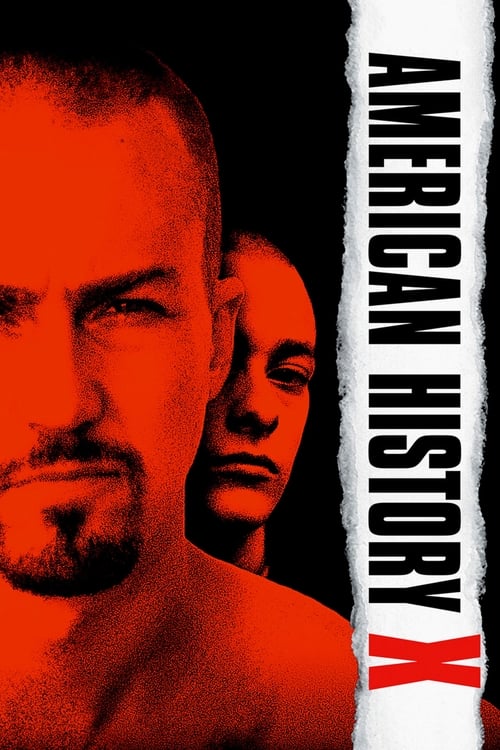
American History X
1998 · Tony Kaye
When you want to be shaken, not soothed — a challenge, not a comfort watch. Reach for it when you're ready for a film that stares at something ugly in America and doesn't blink.
What it's about
Derek Vineyard, once the magnetic young leader of a violent white-supremacist gang in Venice Beach, comes home from three years in prison a changed man — and finds his adoring teenage brother Danny following exactly the path he carved. Told through Danny's eyes, the film cuts between the present and the past that made Derek, tracing how hatred gets taught at the dinner table, performed on the street, and paid for in blood. Derek has one urgent job: get his brother out before the bill comes due again.
The experience
Harrowing and confrontational — the violence is brief but lands like a physical blow, and the film gives its racists real charisma precisely so you feel how seductive the poison is. It's a gut-punch drama that sits heavy for days.
Performances
Edward Norton is ferocious as Derek — physically transformed, terrifyingly articulate as the true believer and raw as the man trying to unmake him — in one of the great performances of the decade. Edward Furlong gives Danny a wounded, hero-worshipping softness that makes the stakes personal.
The craft
The film's signature move is visual: the past plays in stark, high-contrast black-and-white while the present unfolds in color, so you always know which Derek you're watching and feel the distance between them. Tony Kaye, who also shot the film, gives the violence a horrible, slowed-down clarity that refuses to let you look away.
Why it matters
It became the touchstone American film about how extremism is inherited and whether it can be unlearned — still cited whenever the subject surfaces — and cemented Edward Norton as one of his generation's most fearless actors, even as a famously bitter director-studio battle over the final cut became Hollywood legend.
Snapshot
American History X is a film whose ferocity on screen was matched only by the ferocity of the battle over its making. A drama about neo-Nazi skinhead culture in Venice Beach, Los Angeles, it follows Derek Vineyard (Edward Norton), a charismatic young white supremacist whose intelligence and rage make him a leader of a violent racist gang, through the three years he spends in prison for a brutal racially motivated killing and his attempt, on release, to pull his adoring younger brother Danny (Edward Furlong) back from the same path. Structured as a reckoning that moves between a present rendered in color and a past rendered in stark black-and-white, the film stages the making and the painful unmaking of a hatred that is taught, inherited, and performed. It became notorious for the unflinching brutality of its violence — above all a "curb-stomp" murder that remains one of the most disturbing images in mainstream American cinema of the decade — and for the towering, physically transformed performance by Norton that earned him an Academy Award nomination for Best Actor. Behind the camera, the film's British director Tony Kaye, a celebrated commercials auteur making his feature debut, waged a public and ultimately self-destructive war against New Line Cinema over the final cut, disowning the released version even as it became a touchstone of late-1990s American social drama. The result is one of the era's most powerful and most contested films about American racism.
Industry & production
American History X was produced by New Line Cinema, the independent-minded studio then enjoying a period of expansion, and it carried a relatively modest budget for a studio drama of its time. The screenplay was written by David McKenna, and the producing credit went to John Morrissey. The picture's most consequential production decision was the hiring of Tony Kaye to direct. Kaye was a British advertising and music-video director of formidable reputation and equally formidable temperament — a visual stylist who had won numerous awards for commercials and who approached his first feature with the conviction that he was an artist of singular vision. He also served as the film's cinematographer, an unusual concentration of authority that reflected both his self-image and his background as an image-maker.
The casting of Edward Norton proved central to the film's identity and, ultimately, to its troubled post-production. Norton, who had broken through only two years earlier in Primal Fear (1996), undertook a dramatic physical transformation for the role of Derek, building substantial muscle to embody the character's intimidating skinhead physicality. The supporting cast was deep and accomplished: Edward Furlong as the impressionable Danny; Beverly D'Angelo as the brothers' mother; Stacy Keach as Cameron Alexander, the older ideologue who grooms young men into the movement; Avery Brooks as Dr. Bob Sweeney, the African-American teacher and principal who becomes Danny's potential salvation; Elliott Gould, Fairuza Balk, Ethan Suplee, and Guy Torry in significant roles.
The production's defining drama, however, unfolded in the editing room and the trade press. Kaye, dissatisfied with a cut that the studio and Norton had refined, mounted an extraordinary public campaign against New Line, reportedly taking out advertisements in industry papers, granting inflammatory interviews, and seeking to remove his name from the film. Denied the use of a generic "Alan Smithee" credit by the Directors Guild, he is reported to have sought the pseudonym "Humpty Dumpty," and he litigated and editorialized against the studio in ways that severely damaged his own directing career in Hollywood. The released film bears Kaye's name, but he repudiated it. This conflict is among the best-documented director-studio ruptures of the 1990s, and it forms an inescapable part of the film's history.
Technology
American History X is a conventionally produced 35mm feature of the late 1990s, and its technological interest lies not in any apparatus but in its disciplined exploitation of the most fundamental resource of the medium: the contrast between black-and-white and color photography. The film alternates between color sequences set in the dramatic present and black-and-white sequences depicting the past — Derek's radicalization, the killing, the family history of resentment that produced him. This is a photochemical and design strategy rather than a technical innovation, but it is deployed with rigor, and because Kaye shot the film himself, the look bears the imprint of a director-cinematographer accustomed to the high finish and controlled lighting of commercial work. Beyond this organizing chromatic scheme, the record offers no basis for claims of unusual technical methods, and it would be invention to assert otherwise.
Technique
Cinematography
Tony Kaye photographed the film himself, and the cinematography is its most immediately striking formal element. The black-and-white past is rendered with a glossy, high-contrast, almost monumental beauty — bodies sculpted by hard light, compositions arranged with the graphic confidence of a master advertising image-maker. This deliberate aestheticization is morally pointed: the seductiveness of the imagery mirrors the seductiveness of the ideology, lending Derek's hatred a dangerous charisma that the film then forces the viewer to confront. The color present, by contrast, is comparatively naturalistic, the visual register cooling toward something more ordinary and chastened as Derek tries to live in the aftermath of his violence. Kaye's commercial pedigree is visible throughout in the precision of the lighting and the muscular framing, and the film's images of skinhead iconography — the swastika tattoo on Derek's chest, the shaved heads, the postures of menace — are composed with a clarity that makes them both repellent and impossible to look away from.
Editing
The editing is the most fraught aspect of the film's authorship, and it cannot be discussed apart from the dispute that produced it. The released cut — which interweaves the color present and black-and-white past into a structure of memory, confession, and consequence — emerged from a contested process in which New Line and Edward Norton shaped a version that Kaye rejected as a betrayal of his intentions. Kaye has claimed the final film was reworked against his wishes; the studio maintained it had the contractual right to deliver a coherent picture. Whatever the merits, the released edit is effective on its own terms: the cross-cutting between timelines builds a tragic architecture in which the past relentlessly explains and indicts the present, and the film's central day-and-night structure — Danny's last night and the following morning — gives the accumulated flashbacks the force of a reckoning. Specific editorial choices should be attributed to this collaborative-adversarial process rather than to any single hand, given the well-documented conflict over credit and control.
Mise-en-scène / staging
The film's staging maps a specific Southern California social geography: the Venice Beach boardwalk and basketball courts, the working-class home of a family shadowed by the death of a firefighter father, the grocery store and the suburban street that become sites of racial violence, and the prison yard and laundry where Derek's convictions are tested and broken. The production design renders skinhead subculture with documentary specificity — the clothing, the body modification, the parties, the propaganda — in a manner calculated neither to glamorize nor to caricature, though the film's vivid embodiment of that world has at times been read against its intentions. Key set-pieces are staged for maximum confrontation: the dinner-table argument in which Derek's racism erupts at his family; the nighttime driveway killing; and the prison sequences in which Derek's assumptions about racial solidarity collapse. Staging consistently isolates Derek as both the magnetic center of his world and, increasingly, a man trapped by what he has built.
Sound
The score is by Anne Dudley, the British composer who had won an Academy Award for The Full Monty the previous year. Her music for American History X is somber and elegiac, frequently choral and lamenting in character, and it functions as a moral and emotional counterweight to the violence on screen — mourning the human cost of the hatred the images depict rather than amplifying their aggression. The contrast between the brutality of certain scenes and the gravity of the music is among the film's most affecting tonal strategies. The sound design otherwise serves the realism of its milieus, from the ambient life of the boardwalk to the enclosed tension of the prison, and the film leans on Danny's first-person narration — the voice of his assigned essay — as an organizing aural thread that frames the story as confession and self-examination.
Performance
The film is, above all, a showcase for Edward Norton, whose performance as Derek is its enduring achievement and the basis of its critical reputation. Norton charts the full arc of the character — the seething, articulate menace of the radicalized Derek, capable of delivering racist rhetoric with terrifying conviction and charm, and the hollowed-out, frightened man who emerges from prison having had his certainties destroyed. The physical transformation lends the early Derek a genuinely intimidating presence, while the later scenes find Norton playing exhaustion, shame, and desperate love for his brother. The performance earned him an Academy Award nomination for Best Actor and is widely regarded as among the finest of his career. Edward Furlong's Danny supplies the film's pathos and its tragic hinge, an adolescent caught between worship of his brother and the possibility of a different life. The supporting work is strong throughout — Avery Brooks's grave, patient Sweeney; Stacy Keach's quietly poisonous Cameron; Beverly D'Angelo's grieving mother; and Guy Torry as the prison inmate whose ordinary humanity begins Derek's undoing.
Narrative & dramatic mode
American History X operates in the mode of tragic moral drama, and its narrative engine is the relationship between the two timelines. The present-tense story occupies roughly a single day and night: Derek, newly released and renounced of the movement, races to keep Danny from completing his own descent, while Danny writes the school essay — titled "American History X" — that becomes the film's narrating frame. Into this present the film cuts the black-and-white past, which reconstructs how Derek was made: the death of his firefighter father, the father's casual racism, the seduction by the ideologue Cameron, the rise to leadership, the killing, and finally the prison experience that shattered his beliefs. The dramatic structure is therefore one of explanation and consequence — each flashback both accounts for the present and tightens the noose of its outcome. The film is explicitly a tragedy of cycles: it argues that hatred is transmitted, that Danny is being shaped exactly as Derek was, and it drives toward an ending whose devastating irony insists that violence, once set in motion, is not so easily called back even by a redeemed man. The confessional voice-over, the day-and-night compression, and the recurrent return to a founding trauma give the film the shape of a reckoning rather than a conventional plot.
Genre & cycle
The film belongs to the genre of the American social-problem drama, and specifically to a 1990s cycle of films confronting race, masculinity, and violence in the contemporary United States. Its closest kin are the urban dramas of the period that examined cycles of violence among young men, and it can be set beside films about gang life and racial conflict that share its concern with how a community reproduces its own destruction. It also participates in the narrower tradition of films attempting to dramatize extremism and hate from the inside — to understand the appeal of a hateful ideology without endorsing it — a tradition that includes earlier and later pictures about white supremacism and radicalization. Within that cycle, American History X is distinguished by its formal ambition and by the intensity of its central performance, and it has become perhaps the most widely referenced fiction film about American neo-Nazism, frequently invoked in discussions of how cinema should, or should not, depict the seductiveness of hatred.
Authorship & method
The authorship of American History X is genuinely and famously divided, and this is the central fact of its method. Nominally it is a Tony Kaye film: he directed it, photographed it, and brought to it the high-finish visual sensibility of an award-winning commercials director, and the film's most distinctive formal gambit — the black-and-white past against the color present — bears his stamp. Yet Kaye repudiated the released version, claiming it had been taken from him and recut by the studio with the involvement of his star. Edward Norton's contribution thus extends, by most accounts, beyond his performance into the shaping of the final cut, making the film a rare case in which a lead actor's influence over the finished work became a matter of public dispute. Screenwriter David McKenna supplied the script's structure and its incendiary subject; composer Anne Dudley provided the mournful conscience of its soundtrack; and the contested editing produced the timeline-weaving architecture audiences ultimately saw. The honest account is that the film has no single, undisputed author — it is the product of a collaboration that curdled into conflict, and its power coexists uneasily with the fact that the man credited as its director has spent decades insisting it is not the film he made. Kaye's subsequent career, including the documentary Lake of Fire, unfolded largely outside the Hollywood system the dispute had alienated.
Movement / national cinema
The film is a work of mainstream American independent-studio cinema of the late 1990s, produced within New Line Cinema's orbit at a moment when that studio occupied a distinctive position between independent and major-studio production. It does not belong to a formal film movement, but it is an artifact of a particular American conversation — the late-1990s reckoning with persistent domestic racism and the resurgence of organized hate groups — and it sits within the long tradition of American social-issue filmmaking that uses individual drama to address national wounds. The presence of a British director-cinematographer lends the film an outsider's eye, and Kaye's European art-and-advertising sensibility is part of what gives its images their unusual gloss; but in subject, setting, and concern the film is thoroughly American.
Era / period
American History X is firmly of the late 1990s, a period of relative prosperity in the United States shadowed by anxieties about racial division, immigration, and the visibility of organized white-supremacist movements. Its Venice Beach setting and its portrait of disaffected young white men drawn to racist subculture register specific period concerns — the recruitment of the young and economically precarious into hate movements, the rhetoric of grievance and scapegoating directed at immigrants and minorities, and the persistence of racism across generations of a single family. The film arrived in the same cultural moment that would soon be marked by high-profile hate crimes, and its urgency derived from a sense that the violence it depicted was neither historical nor marginal. Its concerns have, if anything, proven durable, which accounts for much of its continued circulation.
Themes
The film's governing theme is the transmission of hatred — the argument that racism is learned, modeled, and inherited rather than innate, dramatized through the way Derek absorbs his father's prejudice and the ideologue's recruitment, and then passes the same poison to his worshipful younger brother. Bound to this is the theme of the cycle of violence: the film insists that violence begets violence and that its momentum can outrun even genuine repentance, a conviction its ending renders with brutal finality. There is the theme of redemption and its limits — Derek's authentic change, catalyzed by his prison experience and by the patient counsel of Dr. Sweeney, is real, but the film refuses to grant that personal redemption can undo the consequences already set in motion. There is the theme of charisma and seduction, embodied formally in the beauty of the black-and-white imagery and dramatically in Derek's magnetism, which forces the audience to feel the pull of what they are meant to reject. And there is the family, presented as the crucible in which all of this is forged: grief, masculinity, loyalty, and resentment intertwined so that hatred wears the face of love for one's own. Beneath these runs an inquiry into responsibility — for what we teach, for whom we lead, and for the harm that cannot be taken back.
Reception, canon & influence
American History X received considerable critical attention on its 1998 release, and the response divided along a now-familiar line: nearly universal acclaim for Edward Norton's performance, alongside debate over whether the film's vivid, aestheticized depiction of skinhead culture risked glamorizing the very hatred it sought to condemn, and over whether its redemptive arc was too neat for its harrowing subject. Norton's work was singled out as a tour de force and earned him an Academy Award nomination for Best Actor. The film's reputation grew substantially after its theatrical run, and it became, through home video and later streaming, a widely seen and frequently cited work — a fixture of conversations about cinematic depictions of racism and a film often assigned and discussed in educational and social contexts. I will avoid citing specific box-office figures, as I cannot verify exact numbers, but the film's commercial profile was modest relative to the size of its eventual cultural footprint.
Influences on the film run backward to the American social-problem drama and to the 1990s cycle of films about urban violence and racial conflict, and its formal contrast of black-and-white and color participates in a long tradition of using monochrome to signify memory, history, and moral weight. Its concern with radicalization and its inside-the-movement perspective connect it to earlier attempts to dramatize extremism on screen. Its influence forward is most visible in its standing as the reference point for fictional treatments of neo-Nazism and racist radicalization — a film routinely invoked when later works attempt similar terrain, and a frequent touchstone in public discussion of how to portray hate without amplifying it. For Edward Norton, the role consolidated a reputation for intense, transformative performance. For Tony Kaye, paradoxically, the film became both his most celebrated work and the occasion of his estrangement from Hollywood, a cautionary case study in the politics of final cut that is still taught alongside the film itself. American History X endures as one of the most powerful and most argued-over American films about racism of its era — admired for its central performance and its formal command, debated for the moral hazards of its method, and impossible to dismiss.
A Deleuzian reading
Start with the tattoo.
The full Deleuzian reading of American History X →
Reception
In 1998 the film arrived half-buried under its own making-of drama — director Tony Kaye publicly disowning the cut — and got mixed reviews even as Edward Norton earned an Oscar nomination. Since then it's become a permanent audience favorite (an IMDb Top 250 fixture for decades), while critics have grown, if anything, more skeptical of it.
How American History X was received, from release to now →
Influences: the films it descends from and the films it influenced
- Raging Bull (1980) — Establishes the postwar template of high-contrast black-and-white as the register of memory and moral reckoning, paired with a lead's extreme physical transformation (De Niro's body) — the exact two-part method Norton and Kaye fuse onto the past-tense skinhead sections.
- Schindler's List (1993) — Codifies the monochrome-as-historical-conscience grammar within a single contemporary film, using the absence of color to mark moral weight — the prestige-cinema precedent for Kaye's choice to shoot Derek's hatred in silver and his redemption in color.
- If.... (1968) — Pioneers the alternation of black-and-white and color passages within one narrative as a formal device rather than a transition gimmick, the structural ancestor of Sightlines' past/present chromatic split.
- A Clockwork Orange (1971) — Originates the aestheticized-menace mode — beautifully composed, design-forward framing of a violent youth subculture narrated in confessional first person — that the film inherits in its glamour-vs-condemnation tension and Derek's voice.
- Do the Right Thing (1989) — Models the single-day social-problem drama in which simmering racial tension is rendered through saturated, heat-stylized images and a swelling score building to lethal eruption — the day-compression-plus-aestheticized-conflict architecture.
- Boyz n the Hood (1991) — Fixes the Southern-California-geography social-realist template — neighborhood as moral map, an older brother trying to break a cycle of violence, elegiac framing — that Sightlines transplants from South Central to Venice Beach.
- Menace II Society (1993) — Supplies the retrospective confessional voiceover narrating one's own doom inside a violent subculture, plus the commercials-trained high-gloss surface applied to ghetto realism — the tragedy-of-cycles narration Danny's essay structure echoes.
- Romper Stomper (1992) — The direct precedent for dramatizing neo-Nazi skinhead culture from the inside through a charismatic, physically imposing lead, establishing the subcultural-documentary specificity (boots, tattoos, ritual) the film catalogs.
- Mississippi Burning (1988) — Demonstrates the award-winning-commercials-director's high-finish visual command applied to an incendiary American-racism social-problem drama — the director-as-stylist lineage Kaye, himself a top adman, extends as his own cinematographer.
- Fight Club (1999) — Re-deploys Norton himself as an unreliable confessional voiceover narrator amid male-identity violence the very next year — the same actor's intense, transformation-ready presence channeled into another stylized interrogation of masculine rage.
- The Believer (2001) — Directly extends the extremism-from-inside method — long ideological monologues that let a neo-Nazi articulate his worldview persuasively before the film dismantles it — the same moral-hazard tightrope of giving hate eloquent screen time.
- 25th Hour (2002) — Reunites Norton with the day-compression structure — a man's last free hours before incarceration, rendered through confessional reckoning and a specific city's geography — the same countdown-to-consequence architecture in a major-key register.
- This Is England (2006) — Carries forward the subcultural-documentary specificity of skinhead radicalization seen through a vulnerable younger initiate pulled toward an older mentor — Meadows mapping onto Thatcher's England what Kaye mapped onto Venice.
- Imperium (2016) — Inherits the inside-the-movement immersion, embedding a protagonist within white-nationalist organizing to anatomize its rhetoric and rituals — the procedural descendant of the film's status as the reference point for fictional neo-Nazism.
- Skin (2018) — Most literally extends the redemption-from-hate arc built on physical transformation, foregrounding the painful erasure of racist tattoos as the bodily inverse of Derek's chest swastika — the leaving-the-movement story Sightlines made canonical.
- La Haine (1995) — Shares the high-contrast monochrome rendering of disaffected young men over a compressed day-into-night, treating urban racial violence as a formally controlled, almost monumental black-and-white object rather than gritty reportage.
- Once Were Warriors (1994) — A commercials/music-video director applying glossy, high-contrast surface beauty to brutal domestic and social violence — the same strategy of wrapping social-realist content in commercial-cinema sheen that defines Tamahori's method.
Similar films
- Boyz n the Hood (1991) — influence & lineage · same viewing thread · often watched together
- Do the Right Thing (1989) — influence & lineage · same viewing thread · often watched together
- Menace II Society (1993) — influence & lineage · same viewing thread
- Raging Bull (1980) — influence & lineage · often watched together
- 25th Hour (2002) — influence & lineage
- The Birth of a Nation (1915) — same viewing thread · often watched together
- Malcolm X (1992) — same viewing thread
- BlacKkKlansman (2018) — same viewing thread
All the films related to American History X →
Watch it with: curated runs of related films
- Reckoning with the Color Line — A run through a century of American film on race — from the movie that industrialized screen racism to the ones that talk back to it — best watched in rough chronological conversation.