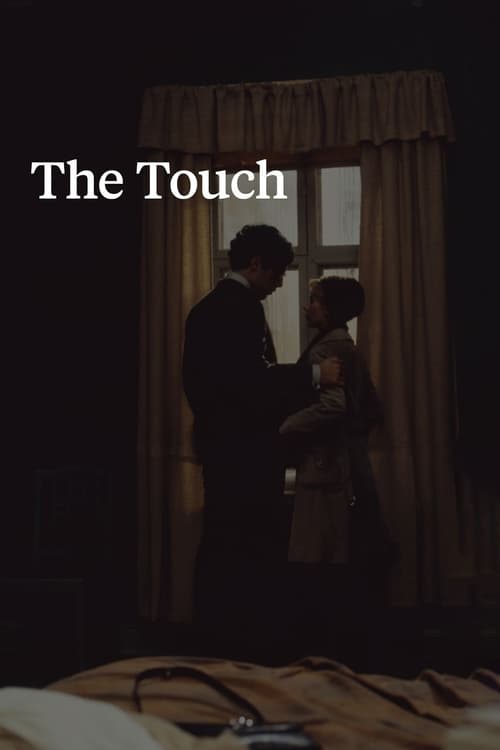
The Touch
1971 · Ingmar Bergman
For when you want grown-up emotional honesty about love's messier ledger — the affair movie without the gloss. One for a contemplative solo evening, not date night.
What it's about
In a quiet Swedish town, Karin has a comfortable life — a decent doctor husband, children, a well-kept home — until an American archaeologist working on a dig at the local church pulls her into an affair. He is volatile and wounded in ways she doesn't understand at first, a Holocaust survivor carrying damage that keeps breaking the surface, and what begins as awakening becomes something much harder to survive. It's a close-up study of a marriage, a passion, and a woman caught between safety and feeling.
The experience
Intimate, raw, and emotionally uncomfortable — less a romance than an autopsy of one, played in long, exposed close-ups. It's quiet on the surface and turbulent underneath.
Performances
Bibi Andersson is extraordinary as Karin, letting you read every flicker of desire, guilt, and doubt on her face; Max von Sydow does subtle, wrenching work as the husband whose decency becomes its own kind of pressure, and Elliott Gould is an unsettling, jagged presence as the lover.
The craft
Ingmar Bergman's first film substantially in English, it applies his trademark chamber-drama intensity — faces studied at close range, silences that say more than the dialogue — to an ordinary adultery story. The friction between Swedish restraint and Gould's raw American energy is built into the film's very texture.
Why it matters
Coolly received in its day and long treated as an odd detour between two of Bergman's most admired works, it has since drawn reappraisal as one of his most vulnerable and underrated films.
Snapshot
The Touch (Beröringen) is Ingmar Bergman's first feature shot substantially in English, an international co-production undertaken at the height of his European prestige and almost universally received as a falling-off from it. The film follows Karin Vergérus (Bibi Andersson), a settled bourgeois wife and mother in a provincial Swedish town, who is drawn into a destabilizing affair with David Kovac (Elliott Gould), an American-Jewish archaeologist working on a dig in the local church. Her husband, Andreas (Max von Sydow), is a doctor whose decency and emotional reticence form the placid surface the affair ruptures. Made between two of Bergman's most admired works — The Passion of Anna (1969) and Cries and Whispers (1972) — The Touch has long carried the reputation of an awkward hinge: a chamber drama of adultery and psychic damage stretched onto an Anglophone, commercially oriented frame that suited neither Bergman's idiom nor his temperament. Bergman himself came to regard it harshly. Yet the film has been partially rehabilitated since the restoration of its original bilingual cut, which restores nuances of language and alienation that the once-standard all-English version flattened.
Industry & production
The Touch was produced in collaboration with the American company ABC Pictures, the film division of the television network, through Bergman's own production entity Cinematograph. The arrangement reflected a particular moment: in the late 1960s and early 1970s, Hollywood studios courted prestige European auteurs in the hope of replicating the unexpected art-house crossover successes of the era. For Bergman, the deal promised a wider audience and resources, and — through the casting of Elliott Gould, then a rising American star fresh from MASH (1970) and Bob & Carol & Ted & Alice* (1969) — a bridge to the American market. The decision to shoot in English was central to that calculus and proved to be the film's most contested creative compromise.
Principal photography took place largely on and around Gotland, with the medieval town of Visby and its churches supplying the archaeological and ecclesiastical settings, alongside Stockholm interiors. Bergman was working with his established Fårö-era unit and crew, so production was, on the technical level, continuous with his late-1960s practice even as the financing and language marked a departure. The film underperformed critically and commercially relative to expectations, and the ABC venture did not inaugurate the Anglophone phase of Bergman's career that the partnership implied; he returned promptly to Swedish-language production with Cries and Whispers. Precise budget and box-office figures are not something I can responsibly state here, but the consensus account is that the film disappointed on both fronts.
A crucial production fact shapes the work's later history: Bergman shot the film bilingually, with the Swedish characters speaking Swedish to one another and English to David, so that language itself dramatizes Karin's movement between worlds. For decades, the version in circulation — particularly in the United States — was an all-English cut, which erased this design. The original bilingual version was long difficult to see and was restored and made widely available again only in the 2010s (notably through its inclusion in the Criterion Collection's large Bergman box set). Much of the film's modern reassessment depends on this restoration.
Technology
Technologically, The Touch is unremarkable by design: a 35mm color production using the equipment and stock standard to early-1970s European art cinema. Its significance lies less in any apparatus than in Bergman's continued commitment to color, which he and cinematographer Sven Nykvist had begun exploring seriously only a few years earlier. After a career largely defined by black-and-white, Bergman shot All These Women (1964) in color and then committed to it with The Passion of Anna; The Touch belongs to this transitional color period, preceding the saturated, controlled palette that would reach its apex in Cries and Whispers. There is no evidence of technical experimentation with format, lenses, or process here of the kind associated with, say, Persona; the innovations are tonal and compositional rather than instrumental.
Technique
Cinematography
Sven Nykvist's photography is the film's most consistently praised element, and it operates in his characteristic register of restrained naturalism: soft, even, often frontal light; close attention to the human face; an unfussy handling of domestic and outdoor space. Working in color, Nykvist favors a muted, cool palette appropriate to the Scandinavian provincial setting, reserving warmth for the charged intimacy of the affair. The camera tends to hold rather than chase, framing Andersson in particular with the patient, searching attention that Bergman and Nykvist had refined across a decade of collaboration. Where the film's drama is uncertain, the image rarely is; critics who found the script wanting frequently exempted Nykvist's work from the verdict.
Editing
The editing — credited to Siv Lundgren, who cut several Bergman films of this period — follows the director's late style of unhurried, scene-driven assembly built around performance and the human face rather than montage effect. Cutting is motivated by emotional beat and glance; the rhythm is deliberate, with scenes allowed to extend toward discomfort. There is little of the rupturing, modernist editing of Persona; The Touch is constructed as a relatively linear chamber narrative, and its cutting serves legibility and intimacy.
Mise-en-scène / staging
Bergman stages the film as a study in contrasted environments: the ordered, well-appointed Vergérus home as an emblem of bourgeois security, against the more provisional, disordered spaces of David's life and lodgings. The most celebrated piece of staging is the archaeological subplot: David's dig uncovers a centuries-old wooden Madonna sealed within a church wall, beautifully preserved — until it is found to be hollowed out from inside by insect larvae quietly devouring it. The image functions as the film's governing metaphor, an object lesson in how something can be eaten away beneath an intact surface, and Bergman's decision to literalize the theme in a tangible artifact is the work's boldest mise-en-scène gesture. The medieval Gotland settings lend this material a weight of historical depth against which the contemporary triangle plays out.
Sound
Bergman's late-1960s and early-1970s films moved increasingly away from non-diegetic scoring toward a stripped, naturalistic soundscape, and The Touch sits within that tendency: it foregrounds spoken language, silence, and ambient sound over musical underscoring. The most distinctive sonic dimension is linguistic. In the original bilingual cut, the alternation between Swedish and English is itself an expressive sound design — marking insider and outsider, comfort and exposure — and the flattening of that texture in the all-English version was a genuine loss. I won't attribute a specific musical score here, as the record on any composer credit is thin and the film's effect is overwhelmingly carried by voice and quiet rather than music.
Performance
The performances are uneven by near-universal agreement, and the unevenness is bound up with the language problem. Bibi Andersson, working in Swedish and English, gives the performance critics single out — a finely modulated portrait of a woman discovering appetites and capacities that her settled life had foreclosed, neither sentimentalized nor condemned. Max von Sydow's Andreas is a study in contained decency, the wronged husband rendered without melodrama. The contested center is Elliott Gould. His contemporary American naturalism, effective in his Hollywood vehicles, sat uneasily inside Bergman's deliberate, interiorized framework, and David's volatility — meant to register the displaced anguish of a Holocaust survivor — frequently read to critics as merely abrasive. Whether this is a failure of casting, conception, or the English-language demand is precisely the question the film's reception has never settled.
Narrative & dramatic mode
The Touch is a chamber drama of adultery, structured around the classical triangle but pitched as psychological case study rather than social melodrama. Its dramatic mode is interior and accretive: it accumulates the costs of the affair — on Karin's sense of herself, on the marriage, on the lovers' capacity for tenderness — rather than building toward conventional plot reversal. David's identity as a Jewish Holocaust survivor supplies the buried trauma that drives his cruelty and need, situating the romance within Bergman's recurring concern with how private suffering deforms intimacy. The film resists offering the affair as either liberation or simple ruin; Karin's arc is the gradual, painful enlargement of her self-knowledge, and the drama's mode is one of erosion — the wooden Madonna again — rather than catastrophe.
Genre & cycle
Generically, the film is an art-cinema relationship drama, kin to the European adultery films of the period but filtered through Bergman's metaphysical seriousness. Within his own output it belongs to the loose cycle of intimate marital and erotic studies that runs from The Passion of Anna through to the later Scenes from a Marriage (1973), films preoccupied with the impossibility and necessity of human contact. The Touch can be read as a transitional entry in this cycle: it anticipates the unsparing anatomy of a relationship that Scenes from a Marriage would render definitive, while lacking that work's formal confidence. It also stands, more awkwardly, within the brief cycle of European-auteur-meets-Hollywood-financing projects of its moment.
Authorship & method
The film is unmistakably authored — written and directed by Bergman, photographed by his indispensable collaborator Sven Nykvist, and performed by the core company (Andersson, von Sydow) he had built over years. In that sense its method is continuous with his Fårö-period practice: original screenplay, small ensemble, location and interior shooting, the human face as primary subject, sustained collaboration with a trusted technical team. What breaks the pattern is the external pressure of the ABC partnership and the English-language mandate, which introduced a foreign element — Gould — and a foreign tongue into a working method predicated on intimacy and shared idiom.
Bergman's own retrospective assessment is part of the authorship record. In his writings and interviews he was notably severe about the film, treating it as a misjudgment and accepting much of the blame himself. That candor has colored the work's standing: it is one of the films its maker effectively disowned, which has both depressed its reputation and lent the later restoration the character of a quiet rescue. Among collaborators, Nykvist's contribution is the one consistently held apart from the film's perceived failures.
Movement / national cinema
The Touch belongs to Swedish national cinema and to the broader European art-film tradition of which Bergman was, by 1971, the most internationally recognized figure. It is not the product of a movement in the programmatic sense; Bergman stood apart from collective tendencies. But the film is legible against the backdrop of the period's pressures on national art cinemas — the lure of international co-production and English-language production as European industries sought audiences beyond their borders. In Bergman's case the experiment was anomalous and largely unrepeated, which itself says something about the durability of his rootedness in Swedish language and the Fårö milieu.
Era / period
The film is a document of the early 1970s, a hinge moment both for Bergman and for the international art film. The countercultural energies that had briefly made foreign auteurs marketable in America were cresting, and the studio appetite for prestige co-productions that produced the ABC deal would soon recede. Within Bergman's chronology, The Touch sits at the threshold between the bleak, war-haunted island films of the late 1960s and the chamber masterworks of the early-to-mid 1970s. It registers, however imperfectly, the era's loosening of sexual mores and its preoccupation with the authenticity of feeling, themes Bergman would treat with far greater assurance immediately afterward.
Themes
The film's central theme is the destructiveness and necessity of intimate contact — the "touch" of the title as both gift and wound. Around it cluster Bergman's perennial concerns: the inadequacy of bourgeois security as a defense against emotional need; the way historical trauma (David's survival of the Holocaust) lives on as private cruelty; the gap between surface composure and interior decay, crystallized in the larvae-eaten Madonna. Language and foreignness become thematic in their own right: Karin's movement between Swedish and English mirrors her movement between a known self and an estranging passion, and David's outsider status — American, Jewish, rootless — marks him as the intrusion that exposes the hollowness within the seemingly intact marriage. The film is finally about self-knowledge bought at ruinous cost, and about whether contact between damaged people can be anything but mutually harmful.
Reception, canon & influence
Contemporary reception was disappointed and often dismissive. Reviewers tended to grant the film's craft — Nykvist's images, Andersson's performance — while faulting the central conception, the casting of Gould, and the strained English dialogue; the result was widely judged minor or failed Bergman. The director's own subsequent disavowal reinforced this consensus, and for years The Touch occupied a low rung in his canon, frequently omitted from accounts of his major work and difficult to see in its intended form. I'll avoid attributing specific quotations or figures to individual critics, as the precise record varies, but the overall verdict of its moment was clearly unfavorable.
Looking backward, the film draws on Bergman's own established preoccupations rather than external sources — the marital anatomies of his prior work, the Holocaust and historical violence that had haunted films like Shame (1968), and the chamber-drama form he had made his own. Looking forward, its influence is best understood internally: The Touch reads in hindsight as a rougher draft of the relationship cinema that Scenes from a Marriage would perfect two years later, and its failures arguably clarified for Bergman the conditions under which his method worked — Swedish, intimate, with his own company — and those under which it did not. Its most consequential afterlife, though, is the restoration of the bilingual version, which has prompted a modest critical reassessment. Seen as Bergman intended — with language itself doing dramatic work — the film looks less like a botched commercial gambit and more like a flawed but legible entry in his ongoing study of how people fail to reach one another. It remains a minor Bergman, but the restored cut has at least returned it to the conversation on terms closer to its maker's design.
A Deleuzian reading
Pull a centuries-old wooden Madonna out of a church wall on Gotland.
The full Deleuzian reading of The Touch →
Reception
Savaged on release in 1971 — critics treated Bergman's Hollywood-financed experiment as a rare outright misfire, and for decades it was the Bergman film even his admirers skipped. The 2018 centenary restoration of his intended bilingual (Swedish/English) cut, long unseen after the all-English release version, kicked off a genuine reappraisal.
How The Touch was received, from release to now →
Influences: the films it descends from and the films it influenced
- The Silence (1963) — Establishes the untranslated-foreign-tongue sound design that dramatizes non-communication — the device The Touch extends by making the Swedish/English bilingual mismatch itself carry the drama of two people failing to reach each other.
- Persona (1966) — Nykvist's stark, near-abstract close-up of the female face as the primary dramatic surface, and Bibi Andersson's interiorized two-hander performance, are the exact tools redeployed on Andersson in The Touch.
- Shame (1968) — Model for embedding a marriage's collapse inside historical/wartime trauma, with von Sydow as the brittle husband — the template The Touch reworks via David's Holocaust-haunted past and the buried Madonna.
- Winter Light (1963) — Sets the sparse, naturalistic, near-musicless sound field and the scene-driven deliberate tempo — long takes of faces in near-real-time — that govern The Touch's chamber rhythm.
- The Passion of Anna (1969) — Bergman and Nykvist's first sustained desaturated-color chamber drama on Fårö, originating the muted cool palette and color-as-restraint approach The Touch directly continues.
- Brief Encounter (1945) — The restrained, guilt-laden middle-class adultery structure — an affair anatomized through suppression rather than spectacle — that The Touch inherits as genre scaffold.
- Journey to Italy (1954) — Pioneers anatomizing a marriage through location, dead time, and gesture rather than plot, the modernist couple-in-crisis grammar Bergman's relationship cinema absorbs.
- Scenes from a Marriage (1973) — The perfected version of The Touch's project — marital anatomy built from discrete, dialogue-driven scenes shot in close-up by Nykvist; The Touch reads as its rough draft.
- Autumn Sonata (1978) — Carries forward the Nykvist-lit chamber two-hander of wounding intimacy, where one sustained confrontation between two faces becomes the entire dramatic architecture.
- Interiors (1978) — Explicit transposition of Bergman's chamber method — muted palette, faces held in silence, family/marital rupture staged as still tableaux — to American art cinema.
- Another Woman (1988) — Shot by Nykvist himself, it imports his muted naturalistic available-light palette and face-centered framing straight from the Bergman chamber dramas into Allen's interiors.
- Faithless (2000) — Directed from Bergman's own screenplay, it dissects an adultery through memory and confession using the same scene-driven chamber dramaturgy, a direct lineal continuation by his collaborator.
- Before Midnight (2013) — The extended real-time marital argument, sustained in unbroken dialogue scenes, descends directly from Scenes from a Marriage's scene-as-unit dramaturgy seeded here.
- A Separation (2011) — Builds a moral drama from deliberate, scene-driven domestic confrontations with naturalistic sound and no score — the Bergman chamber method applied to a marriage and a class divide.
- Marriage Story (2019) — Explicitly modeled on Scenes from a Marriage, anatomizing a divorce scene by scene through long two-hander confrontations shot tight on faces.
- Bergman Island (2021) — Takes Bergman's Fårö location practice and his relationship-cinema method as its very subject, restaging the intimate-couple chamber form on the same ground.
- Cries and Whispers (1972) — Made with Nykvist immediately after, it pushes the same desaturated color experiment further and shares the touch-as-comfort and Pietà/Madonna staging of bodies offered and withheld.
Similar films
- Cries and Whispers (1972) — influence & lineage
- Shame (1968) — influence & lineage
- The Silence (1963) — influence & lineage
- Autumn Sonata (1978) — influence & lineage
- Persona (1966) — influence & lineage
- Winter Light (1963) — influence & lineage
- Bergman Island (2021) — influence & lineage
- Journey to Italy (1954) — influence & lineage