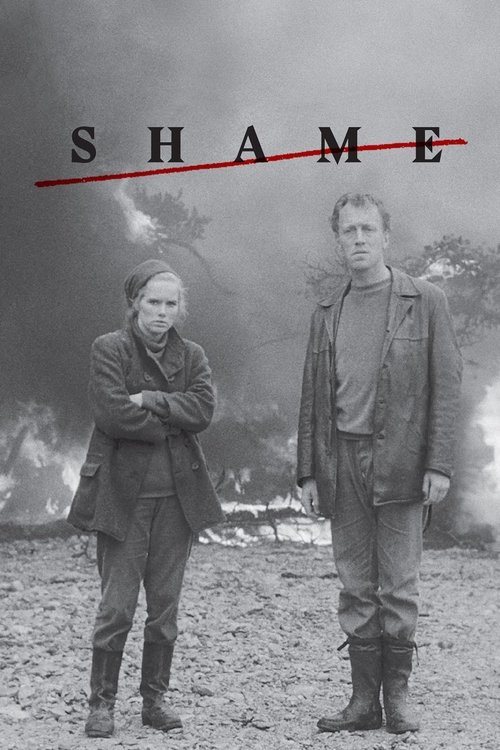
Shame
1968 · Ingmar Bergman
For when you want to be challenged, not comforted — a night when you're ready to stare at something true about war and character and sit with the discomfort afterward. Absolutely not a casual watch.
What it's about
Jan and Eva are married ex-violinists who have retreated to a small farm on a rural island, growing lingonberries and bickering while a civil war rages somewhere else. Then the war arrives — soldiers, interrogations, shifting occupiers — and two people who only wanted to be left alone discover there is no such thing as staying out of it. The film follows what fear does to a marriage when survival becomes the only remaining project.
The experience
Cold, gripping, and genuinely harrowing — not through battle spectacle but through the slow stripping-away of decency from two ordinary people. It leaves you shaken and arguing with yourself about what you'd have done.
Performances
Liv Ullmann and Max von Sydow are devastating as a couple whose roles reverse under pressure — Ullmann especially, watching her tenderness curdle into hollow endurance is the film's real battlefield.
The craft
Bergman shoots war as chaos glimpsed at kitchen-table scale: stark black-and-white, no triumphant score, violence that erupts and recedes without explanation, which makes it far more frightening than any war epic. The island setting turns the whole world into a trap with no offscreen safety.
Why it matters
Made amid the upheavals of 1968, it stands as one of cinema's great anti-war statements precisely because it refuses politics for moral anatomy — a touchstone for filmmakers depicting civilians in wartime ever since.
Snapshot
Shame (Swedish: Skammen) is Ingmar Bergman's coldest and most unsparing anti-war film — a chamber drama that watches an unnamed civil war engulf two apolitical people who have spent their lives hoping the world would leave them alone. Jan and Eva Rosenberg (Max von Sydow and Liv Ullmann), former violinists in an orchestra disbanded by the fighting, keep a small farm on an island, growing lingonberries and squabbling. When the front reaches them, the film charts not heroism but corrosion: how fear strips away tenderness, how the weak turn brutal and the strong turn hollow, and how "shame" — complicity, cowardice, the humiliation of mere survival — becomes the only remaining moral fact. Made in the year of the Tet Offensive, the Prague invasion, and worldwide upheaval, it was Bergman's rebuke both to political cinema and to his own reputation as a maker of metaphysical interiors. It is one of a tightly linked cluster of late-1960s films Bergman shot on the Baltic island of Fårö with Ullmann, von Sydow, and cinematographer Sven Nykvist, and it remains a touchstone for the intimate, apocalyptic war film.
Industry & production
Shame belongs to the most self-directed phase of Bergman's career. By the late 1960s he had consolidated an extraordinary degree of authorial control: a stable repertory company of actors, a permanent cinematographer in Nykvist, and increasingly his own means of production. The film was made in association with Svensk Filmindustri, Bergman's long-standing studio home, during the period in which he was establishing his own production entity, Cinematograph. (The precise corporate arrangements of the individual island films are the sort of detail on which popular sources are inconsistent; the safe statement is that these were low-budget, tightly controlled productions built around a small unit and a familiar crew rather than large studio undertakings.)
Practically, Shame was shot on Fårö, the sparsely populated island off Gotland that Bergman had discovered while making Through a Glass Darkly (1961) and where he would eventually make his home. The island's stony fields, low farmhouses, and flat sea gave Bergman a landscape that could stand in for an anonymous nation — nowhere in particular, which is the point. The production is contemporaneous and thematically twinned with Hour of the Wolf (also 1968) and immediately precedes The Passion of Anna (1969); all three use the same principal players and the same island, and are often discussed as a Fårö trilogy of marriage, art, and dread. Working with a compact crew on real locations kept costs and infrastructure minimal, which suited both Bergman's economy and the film's stripped-down aesthetic.
Technology
Shame was photographed on 35mm black-and-white film in the standard Academy-era aspect ratio Bergman favored for his chamber work, a nearly square frame that concentrates attention on faces and forces the war to intrude from the edges. Bergman and Nykvist shot in monochrome deliberately at a moment when color was becoming the commercial default — Bergman would make his first color feature, A Passion (The Passion of Anna), the following year — and the choice reads as a stylistic commitment to austerity and documentary grayness rather than a technical limitation.
The film's technological signature is its use of available and naturalistic light and of the mobile camera. The war sequences — soldiers moving through the farm, an aerial attack, an interrogation, a chaotic roundup — exploit the lightweight, handheld shooting that 1960s equipment made practicable, lending a newsreel volatility that contrasts sharply with the composed stillness of the domestic scenes. Sound was recorded and constructed to emphasize the shock of modern warfare — engines, gunfire, explosions bursting into a soundscape that had been almost pastorally quiet — a contrast the film's technical design exploits repeatedly.
Technique
Cinematography
Sven Nykvist's photography is central to the film's meaning. In the early, "peacetime" passages he uses a soft, even, almost documentary grayscale — the flat northern light on stone and skin — establishing a world of ordinary, unglamorous texture. As the war arrives, the camera loosens: handheld movement, jolting reframings, and a rougher immediacy take over, so that the visual grammar itself enacts the collapse of order. Nykvist's celebrated attention to the human face — the way he modeled light to register the smallest shifts of feeling — is deployed here not for beauty but for exposure, catching cowardice, calculation, and numbness as they cross Ullmann's and von Sydow's features. The film is famous for withholding conventional spectacle: the war is rendered less through wide vistas of battle than through faces reacting, close and unprotected.
Editing
Cut by Ulla Ryghe, Bergman's editor of the period, Shame is built on a structural contrast between two rhythms. The first movement — the marriage, the farm, the petty domestic quarrels — unfolds in longer, patient takes and a measured pace. The war sequences fracture that calm with faster, more disorienting cutting, so that the editing dramatizes the difference between a life one can compose and a chaos one can only be swept through. Bergman himself, in his later reflections on the film, expressed reservations about its shape — a sense that its second half did not fully sustain the first — and the film's back half, tracking the couple's moral disintegration in fits and lulls, is indeed looser and more episodic than its taut opening, a widely noted feature of its construction.
Mise-en-scène / staging
The staging is organized around confinement and exposure. The farmhouse, the boat, the truck, the improvised prison — enclosed spaces in which the couple are trapped with each other and with intruders — alternate with barren open ground on which they have no cover. Bergman blocks the two-handers between Ullmann and von Sydow with his characteristic tension, bodies turned toward and away, meals and beds and small chores serving as the arena of a marriage. The recurring props are pointedly ordinary — wine, a broken car, a greenhouse, lingonberries, a telephone that no longer works — the debris of a domestic life being ground down. As the film proceeds, the environment degrades from cultivated to ruined, and the final movement strands the characters in a boat among floating corpses, an image of civilization dissolved into a gray, directionless sea.
Sound
Bergman's sound design is one of the film's sharpest instruments. He famously moved away from conventional musical scoring in this period, and Shame has essentially no orchestral underscore to guide or console the viewer. The irony is acute: the protagonists are professional musicians, and music is repeatedly invoked in dialogue as the beautiful, ordered thing the war has taken from them — but we are given almost none of it. Instead the track is built from silence, wind, and the sudden violence of mechanized war. That refusal of music leaves the emotional scenes exposed and unsupported, forcing the audience to sit inside the characters' fear without the cushioning that a score would provide.
Performance
The performances are the film's core. Liv Ullmann's Eva begins as the more clear-eyed and morally alert of the two — impatient with her husband's self-pity, capable of feeling — and is worn down into despair. Max von Sydow's Jan traces an even more disturbing arc: a squeamish, weepy, ineffectual man who faints at the sight of a slaughtered animal early on and who, by the end, has hardened into someone capable of cold cruelty and murder. The film's central psychological argument is carried in this reversal — the notion that "shame" and weakness are not the opposite of brutality but a reservoir for it. Gunnar Björnstrand, another Bergman regular, plays Colonel Jacobi, the occupying officer whose patronage and desire draw the couple into moral compromise, and his performance supplies the pivot on which the couple's corruption turns.
Narrative & dramatic mode
Shame is structured as a two-part tragedy of character rather than a plot of events. The dramatic mode is that of the Bergman chamber play — a small cast, unity of place, dialogue as combat — grafted onto the war film. The first half is domestic realism edging toward the theatrical; the second half is closer to a nightmare of dissolution, as external catastrophe and internal collapse become indistinguishable. Bergman deliberately withholds the usual coordinates of the war film: we never learn which side is which, what the war is about, or who wins. That refusal of political legibility is the point — the film is about what war does to private moral life, not about causes or victories. The narrative resists catharsis; there is no rescue and no redemptive meaning, only a drift toward exhaustion and moral death.
Genre & cycle
The film sits at the intersection of the war film and the intimate European art drama, and it belongs to a specific cycle: Bergman's late-1960s Fårö films with Ullmann and von Sydow (Hour of the Wolf, Shame, The Passion of Anna), unified by island setting, players, and a mood of encroaching dread. Within the broader war genre it is an anti-war film of the "home front" or "occupation" type — closer to the tradition of neorealist and post-war European films about civilians under fire than to the combat picture. It is also a marriage-in-crisis drama, a genre Bergman had refined across Winter Light, Persona, and others, here subjected to the ultimate external stress test.
Authorship & method
Shame is a work of near-total single authorship: Bergman wrote the screenplay, directed, and shaped every element around his repertory collaborators. His method by this point was intensely personal and place-bound — writing on Fårö, casting from a company he trusted implicitly, and working scene by scene toward emotional truth rather than spectacle. The film is legible as Bergman's response to a specific pressure of the moment: critics who charged that his cinema was solipsistic and indifferent to politics. His answer was characteristically oblique — a film that engages war precisely by refusing ideology and insisting that the real subject is the individual conscience. In his own later writings on his films, Bergman treated Shame with a measure of dissatisfaction about its execution while remaining committed to its intent.
Key collaborators define the work as much as its author. Sven Nykvist, cinematographer, gives the film its documentary-grave visual language and its unflinching faces. Ulla Ryghe, editor, builds the calm-to-chaos structure. There is, tellingly, no composer of a traditional score — the absence of music is itself an authorial decision. And the film is unimaginable without Liv Ullmann and Max von Sydow, whose paired performances carry the moral argument; von Sydow's transformation and Ullmann's erosion are the film's true text.
Movement / national cinema
Shame is a landmark of Swedish national cinema and of the broader European art-film movement of the 1960s, in which auteurs used small-scale, personal production to make morally and formally serious work outside Hollywood conventions. Bergman was by 1968 the most internationally visible figure of Swedish film, and the island films represent the mature, stripped-down phase of his art. The film also participates in the international modernist tendency — shared with directors such as Antonioni and Resnais — toward ambiguity, psychological interiority, and the refusal of clean narrative resolution, though Bergman's rootedness in theatrical performance and in a Nordic Protestant moral seriousness keeps his work distinct within that field.
Era / period
The film is inseparable from 1968. It was released into a year of the Vietnam War at its height, the Soviet invasion of Czechoslovakia, and student and political revolt across Europe — a moment when many artists felt obligated to make explicitly political art. Shame is Bergman's contribution to that atmosphere, and its power comes partly from its dissent within it: rather than take a side, it insists that ordinary people cannot escape war's moral contamination no matter how apolitical they claim to be. The film's vision of neutral civilians ground down by an incomprehensible conflict resonated as a parable for a decade in which the line between civilian and combatant, home front and battlefield, was being publicly interrogated.
Themes
The governing theme is shame in its several registers: the shame of cowardice, of complicity with power, of survival at others' expense, and of the humiliating discovery of what one is capable of under pressure. Bound to it is the collapse of the illusion of neutrality — the couple's belief that they can opt out of history, decisively refuted. A third is the reversal of moral roles: weakness curdling into cruelty, so that the gentle, squeamish husband becomes a killer while the stronger wife is emptied out. The film meditates on art and civilization as fragile veneers — the musicians who can no longer make music — and on the dehumanization that war effects not through a single atrocity but through the steady erosion of empathy. Running beneath all of it is Bergman's persistent concern with the absence of consolation: no God, no cause, no meaning arrives to redeem the suffering, only a gray sea and a drifting boat.
Reception, canon & influence
Shame was received as a major work by one of world cinema's foremost directors and drew serious critical engagement on release, particularly among American and European critics who took Bergman as an essential modern artist. It figured in the film-critical awards conversation of 1968–69 as one of the year's significant foreign-language releases; the exact tally of prizes is the kind of detail that popular sources report inconsistently, so it is better to say plainly that the film was widely and seriously reviewed and has retained a strong critical standing than to attach specific awards I cannot verify. Bergman himself was ambivalent about the result, judging the first half more successful than the second — an assessment many later critics have echoed.
Influences on the film (backward): Shame draws on the European tradition of the civilian war film that runs through Italian neorealism's accounts of ordinary people under occupation and bombardment, and on the collective memory of the Second World War that shaped Bergman's generation. Within Bergman's own oeuvre it extends the chamber-drama method of Winter Light and Persona and the marital anatomies of his earlier work, now placed under the extreme pressure of war. Its refusal of a musical score and its documentary handheld texture reflect the broader 1960s modernist move toward austerity and immediacy.
Legacy (forward): Shame helped consolidate a durable model — the intimate, apocalyptic war film that dramatizes catastrophe through a couple or a family rather than through armies. Its DNA is visible in later European films of civilian collapse and moral disintegration under war and disaster; Michael Haneke's Time of the Wolf (2003), with its family adrift in an unexplained societal breakdown, is frequently cited as sharing its bleak, deglamorized vision, and the broader lineage of films that treat war as a solvent of private morality owes something to Bergman's example. More generally, Shame remains a reference point for filmmakers and critics thinking about how cinema can address war without spectacle, ideology, or comfort — a film whose refusal to console is precisely the source of its enduring authority.
A Deleuzian reading
Early in *Shame*, Jan Rosenberg faints at the sight of a slaughtered animal.
The full Deleuzian reading of Shame →
Reception
Abroad it landed instantly — the National Society of Film Critics named it 1968's best film — but in Sweden's radicalized '68 climate Bergman was attacked for making a war film that refused to take a political stand on Vietnam. Now it's routinely called his great overlooked masterpiece.
How Shame was received, from release to now →
How to watch Shame: what to notice on a first viewing
- Notice the picture loosen into handheld movement as war nears. Nykvist shoots early scenes in soft, even, documentary-style grayscale, then lets the camera go handheld and jolting once the fighting reaches the island. The visual grammar itself performs the collapse of order the story describes.
- Listen for the almost total absence of any musical score. Bergman gives the film essentially no orchestral underscore, so emotional scenes play out in wind, silence, and the sudden noise of engines and gunfire. Nothing cushions you. The fear has to reach you unsupported by music.
- Watch Jan faint at the sight of a slaughtered animal. Von Sydow plays Jan early on as squeamish and easily undone, a man too soft, it seems, for farm work or violence. His squeamishness shows you where the couple starts, before the war reaches the island.
- Watch how rarely the couple share an uncluttered, open space. Bergman alternates the farmhouse, boat, and truck with barren open ground where the couple have no cover, staging their isolation as a fact of geometry. Their loneliness is built into where the camera puts their bodies, not just what they say.
The whole guide to watching Shame, with the keys for a rewatch →
Influences: the films it descends from and the films it influenced
- Persona (1966) — Nykvist's unblinking close-up regime — faces held past comfort in high-contrast black-and-white — is the interrogative visual grammar Shame reapplies to a marriage under fire.
- Winter Light (1963) — Establishes Bergman's scoreless chamber method, where the only 'music' is ambient sound and silence, which Shame extends by replacing the church's stillness with mechanized war noise.
- The Silence (1963) — Sets the template of intimate figures trapped in a space menaced by an incomprehensible external war (tanks in the streets), the same political illegibility Shame makes total.
- Rome, Open City (1945) — Neorealism's rough, quasi-documentary handling of ordinary civilians under occupation is the tradition Shame inherits for its grainy, on-location immediacy and refusal of heroics.
- Germany Year Zero (1948) — Rossellini's account of moral collapse amid rubble — survival eroding conscience — is the exact narrative engine (war as solvent of private morality) that drives von Sydow's transformation.
- Forbidden Games (1952) — Pioneers the war film told entirely from the margins — no armies, only civilians dislocated by a bombing raid — the deglamorized, off-battlefield vantage Shame adopts wholesale.
- Fires on the Plain (1959) — Strips war of ideology and spectacle to depict soldiers reduced to appetite and shame in stark monochrome, prefiguring Shame's insistence on degradation over combat.
- Cries and Whispers (1972) — Continues the Bergman–Nykvist chamber project, isolating a handful of figures in a single confined interior where the camera reads erosion of the self through the face.
- The Sacrifice (1986) — Shot on Bergman's home ground (Gotland/Fårö) by Sven Nykvist with Erland Josephson, it literalizes the Shame lineage: nuclear apocalypse dramatized through one household's disintegration.
- Come and See (1985) — Extends the anti-spectacle war film by tracking a single face's psychic ruin under mechanized violence, using immersive sound design where Shame used the roar of engines and gunfire in place of score.
- The Turin Horse (2011) — Radicalizes the austere, near-scoreless chamber apocalypse — two people and an unexplained external catastrophe in monochrome — that Shame modeled, stripping event down to endurance.
- Time of the Wolf (2003) — The most direct heir: a family adrift in an unexplained societal breakdown, refusing exposition or comfort, reproducing Shame's political illegibility and deglamorized despair.
- Children of Men (2006) — Carries forward the handheld, embedded-with-civilians camera and diegetic-only soundscape to render societal collapse as lived chaos rather than staged battle.
- Melancholia (2011) — Openly Bergmanesque: stages the end of the world as a chamber drama within a single estate, filtering global apocalypse through the psychological state of a couple/family.
- The Road (2009) — Builds its post-collapse world around a single family unit's moral survival in a desaturated, scoreless-feeling landscape, extending Shame's 'catastrophe through the couple/family' structure.
- The Touch (1971) — Model for embedding a marriage's collapse inside historical/wartime trauma, with von Sydow as the brittle husband — the template The Touch reworks via David's Holocaust-haunted past and the buried Madonna.
- Minotaur (2026) — Bergman staged war at the edge of a marriage, so that a couple's private decay registers a national emergency, the template for making jealousy mirror conscription.
- The Battle of Algiers (1966) — Deploys handheld, newsreel-textured black-and-white to make conflict feel unstaged and immediate — the same documentary-grave texture Nykvist gives Shame's chaos passages.
Similar films
- The Silence (1963) — influence & lineage
- Cries and Whispers (1972) — influence & lineage
- Persona (1966) — influence & lineage
- Winter Light (1963) — influence & lineage
- Hour of the Wolf (1968) — shared sensibility
- Scenes from a Marriage (1974) — shared sensibility
- Face to Face (1976) — shared sensibility
- Autumn Sonata (1978) — shared sensibility