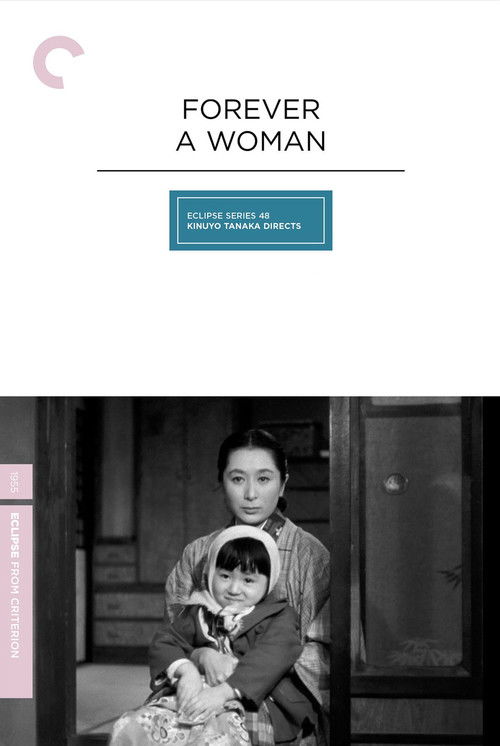
Forever a Woman
1955 · Kinuyo Tanaka
For when you need a good cry that respects you — a film about illness and love that's more alive than mournful. A rewarding pick when you want to be moved by someone's refusal to shrink.
What it's about
Fumiko is a mother of two married to an unfaithful man, writing poetry in the margins of her family life. As her literary career finally ignites, her marriage ends and she's diagnosed with breast cancer — and in her final stretch, a young Tokyo journalist arrives wanting to tell her story. Drawn from the life of the real tanka poet Fumiko Nakajō, it's about a woman who writes her fiercest work while everything else is being taken away.
The experience
Tender and startlingly frank — a melodrama that keeps earning its emotion honestly, allowing its heroine vanity, appetite, and anger right to the end. It will move you without ever begging you to cry.
The craft
Kinuyo Tanaka — already a legendary actress — brings a frankness about the female body, desire, illness, and surgery that no male filmmaker of 1950s Japan approached; the hospital scenes are shot without pity or prurience. Working from Sumie Tanaka's screenplay, she lets the poetry surface on the soundtrack as a second voice, so the verse isn't decoration but survival.
Why it matters
Made by only the second Japanese woman ever to direct, it stands as her masterpiece and a landmark of women's filmmaking in classical Japanese cinema — long overlooked and now being rediscovered.
Kinuyo Tanaka was already immortal as an actress — the face of Mizoguchi's greatest tragedies, a star for Ozu and Naruse — when she did something almost unthinkable in 1950s Japan: she stepped behind the camera, becoming only the second Japanese woman to direct. Her third feature is her masterpiece, drawn from the life of tanka poet Fumiko Nakajō, who wrote her fiercest verse while dying of breast cancer. Working from a screenplay by Sumie Tanaka (no relation), the director brings a frankness about the female body — desire, illness, mastectomy, the gaze of others — that no male filmmaker of the era approached; the hospital scenes are shot without pity or prurience, and the heroine is allowed vanity, appetite, and anger right to the end. Poetry is not decoration here but survival: verses surface on the soundtrack as the film's second bloodstream. Tanaka's directorial career lasted only six films before the industry closed ranks against her, and for decades this work was nearly invisible. Its restoration and international touring in the 2020s restored her to her rightful place — not as a star who dabbled, but as one of Japanese cinema's essential directors.
Reception
Barely seen outside Japan for over half a century, it was rediscovered when the 2021–22 Kinuyo Tanaka restoration retrospective toured Cannes and cinematheques worldwide — it emerged as the consensus masterpiece of her directing career and a jewel of the female-director rediscovery wave.
How Forever a Woman was received, from release to now →
Influences: the films it descends from and the films it influenced
- The Life of Oharu (1952) — Tanaka's own lead role under Mizoguchi's long-take, unblinking chronicle of a woman's bodily degradation trained her in the sustained, non-melodramatic framing she reapplies to the mastectomy ward as a director.
- Repast (1951) — Sumie Tanaka's screenplay dramatizes a wife's discontent through mundane domestic gesture rather than speeches — the same writer's method of oblique female interiority feeding directly into Forever a Woman.
- Sound of the Mountain (1954) — Another Sumie Tanaka adaptation routing a woman's inner life through restraint and elision, the literary-adaptation technique she carried into the Fumiko Nakajō material.
- Late Chrysanthemums (1954) — Sumie Tanaka's episodic portrait of aging women handling money and desire without pathos supplied the unsentimental female-ensemble writing Tanaka the director inherited.
- Ikiru (1952) — Its terminal-cancer protocol — a dying body confronted through banality rather than tearjerking — set the 1950s Japanese template for filming mortality clinically that Tanaka extends to a female subject.
- Outrage (1950) — A fellow actress-turned-director staging a taboo woman's-body subject with documentary plainness — the transnational precedent for a female star directing forbidden material from behind the camera.
- Love Letter (1953) — Tanaka's own directorial debut rehearsed the exterior-location realism and restrained framing of postwar female longing she deepens here into illness and desire.
- Cléo from 5 to 7 (1962) — A near real-time portrait of a woman awaiting a cancer verdict, extending Tanaka's female-gaze framing of a body under medical threat rather than male desire.
- Jeanne Dielman (1975) — Durational, affect-withholding observation of a woman's body and routine — the feminist formalization of Tanaka's refusal to pity or eroticize her subject.
- Wanda (1970) — Another actress-turned-director rendering female autonomy in stripped, non-judgmental realism, continuing the lineage of women filming women from inside the profession.
- Safe (1995) — A clinical, distanced study of a woman's failing body and the medical gaze upon it, inheriting Tanaka's unsentimental hospital observation.
- Sweet Bean (2015) — A Japanese woman director filming a diseased, socially stigmatized body with tactile tenderness and no melodrama — a direct heir to Tanaka's female-authorship line on illness.
- The Ascent (1977) — A woman director confronting bodily suffering and mortality through an austere, unsentimental gaze that dignifies the flesh without exploiting it, echoing Tanaka's clinical compassion.
- Floating Clouds (1955) — Same-year Naruse chronicle of a woman physically wasting toward death, framing decline with the identical refusal of uplift or eroticization.
- The Bigamist (1953) — Actress-turned-director staging morally messy melodrama through unglamorous close observation, a parallel authorship model to Tanaka's directing career.
- The Moon Has Risen (1955) — Her same-year film, from an Ozu screenplay, shows the low, static interior composition she carries into the hospital rooms of Forever a Woman.
Similar films
- Floating Clouds (1955) — influence & lineage
- The Life of Oharu (1952) — influence & lineage
- Ikiru (1952) — influence & lineage
- When a Woman Ascends the Stairs (1960) — shared sensibility
- Yearning (1964) — shared sensibility
- The Ballad of Narayama (1958) — shared sensibility
- The Last 10 Years (2022) — shared sensibility
- Moving (1993) — shared sensibility