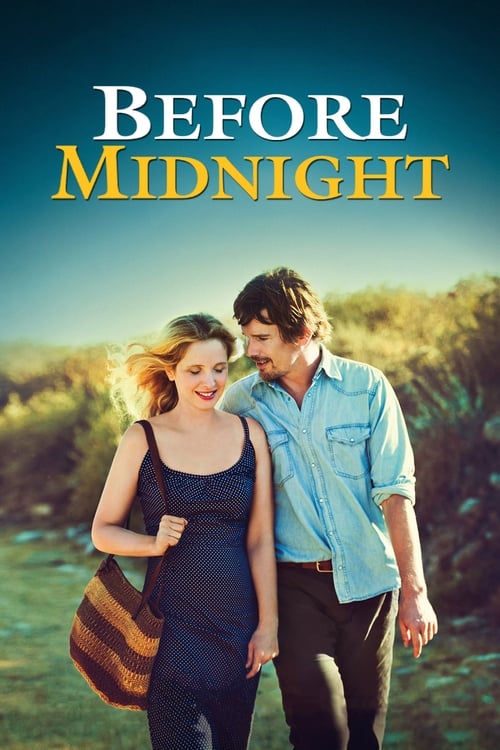
Before Midnight
2013 · Richard Linklater
For when you want the truth about love rather than the fantasy — a film to watch with a partner you can talk to afterward, or alone when you're ready to think hard about what staying together actually costs. Challenge, not comfort, but deeply rewarding.
What it's about
Eighteen years after they first met on a train, Jesse and Céline are in their forties, long partnered, raising twin daughters, and finishing a summer in Greece. When Jesse puts his teenage son from his first marriage on a plane home, old guilt surfaces — and over one afternoon and evening of walking, dinner with friends, and a hotel room meant for romance, the couple finally says everything they've been not-saying for years.
The experience
Talky, funny, then bruising — the easy charm of their conversation keeps tilting into real argument, and the film watches a long relationship fight for its life without ever raising the volume. It's romantic in the hardest, most adult sense, and it stays with you.
Performances
Ethan Hawke and Julie Delpy, who also co-wrote the script, are so lived-in after eighteen years in these roles that the arguing feels eavesdropped rather than acted — affection and grievance layered in every exchange.
The craft
Richard Linklater builds the film from long, unbroken conversations — including a car ride and a hotel-room fight staged in extended takes that give the actors nowhere to hide — and the Oscar-nominated screenplay was written collaboratively by all three. The Greek light does a lot of quiet work: paradise as the setting for a reckoning.
Why it matters
It completed one of cinema's most singular experiments — the same actors and director checking in on the same couple every nine years — and reset the bar for how honestly a mainstream film can depict long-term love.
Snapshot
Before Midnight is the third film in Richard Linklater's Before series, arriving nine years after Before Sunset (2004) and eighteen after Before Sunrise (1995). The nine-year interval is itself the film's central formal fact: the series has, without ever announcing itself as an experiment, become one of cinema's most sustained records of two performers aging in character. Jesse (Ethan Hawke) and Céline (Julie Delpy) are now in their early forties, unmarried but long partnered, parents of twin daughters, at the close of a summer in the Greek Peloponnese. The romantic question that structured the first two films — will they meet, will they choose each other — has been answered, and the film's subject is what comes after the answer.
The result is the series' most abrasive entry and its most formally confident. Where Sunrise offered a night of mutual discovery and Sunset a compressed eighty minutes of unresolved longing, Midnight stages domesticity, resentment, professional envy, and the asymmetric costs of parenthood, culminating in a hotel-room argument that runs, in its central movement, without release. The film retains the series' signature apparatus — long walk-and-talks, real-time or near-real-time construction, a screenplay co-written by Linklater with his two leads — but turns it toward material the earlier films could only anticipate. It was nominated for the Academy Award for Best Adapted Screenplay (the shared Linklater–Hawke–Delpy credit, classified as adapted because it draws on characters from the prior films), matching Before Sunset's nomination in the same category.
Its place in Linklater's filmography is inseparable from Boyhood (2014), shot over twelve years and released the following year: the two works are the culminating statements of a career-long preoccupation with duration as a filmable substance rather than a narrative convenience.
Industry & production
Before Midnight was produced independently on a modest budget and distributed in the United States by Sony Pictures Classics, which had also handled Before Sunset; the film premiered at the Sundance Film Festival in January 2013 and screened at the Berlin International Film Festival the following month before a spring theatrical release. Detroit Bar Productions/Faliro House and Venture Forth were among the entities involved, with Greek production support reflecting the location; Christos V. Konstantakopoulos, a Greek producer with a track record in international arthouse financing, was a key production partner and the Peloponnese shoot benefited from that connection. The specifics of the financing structure are not extensively documented in accessible sources, and I won't reconstruct numbers I can't verify.
The production model matters more than the balance sheet. The Before films are made cheaply relative to their reputation, on short schedules, with small crews, in a single location cluster, and with a cast dominated by two actors who are also the writers. Rehearsal is the expensive part: Linklater, Hawke, and Delpy have described a process of extended workshopping in which scenes are talked through, argued over, and drilled well before the camera runs, so that the shoot itself becomes an execution of material the three of them have already stress-tested. This front-loads the cost into time rather than money, which is precisely what makes a nine-year sequel cycle economically viable — the films do not depend on a market window, only on the availability of three people who want to keep doing it.
The sequels also occupy an unusual commercial position. None of the three was a substantial box-office performer by studio standards; the series' value has accrued through critical standing, home video, repertory programming, and the accumulating novelty of its longitudinal design. Sony Pictures Classics' specialty-label patience is the enabling industrial condition. In a studio system organized around franchise cadence, a trilogy whose installments arrive at nine-year intervals and whose third entry is a marital argument is legible only within the arthouse distribution economy.
Technology
The film was shot on 35mm — a choice that by 2013 had become a deliberate holdout rather than a default, with digital acquisition already dominant at this budget level. Cinematographer Christos Voudouris and Linklater worked in widescreen with available and lightly supplemented light, favoring the long summer afternoon and the extended Mediterranean dusk that the Greek location supplies for free. The Before films have always used the diurnal cycle as their production clock: Sunrise runs from evening to dawn, Sunset across a single late afternoon, and Midnight from midday to nightfall. Shooting on film, in long takes, against a moving sun imposes a discipline that digital's tolerance would have relaxed.
The film's most technologically demanding sequence is also its least conspicuous: the extended two-shot inside a moving car, with Jesse driving, Céline in the passenger seat, and the twins asleep in the back, held in an unbroken take of roughly fourteen minutes. Car interiors are notoriously difficult to shoot cleanly — sightlines, rig noise, changing light, and the need for the actors to genuinely drive — and the sequence's apparent effortlessness is the product of careful camera placement on a process rig and a landscape chosen so that the passing light stays consistent enough to sustain the take.
Elsewhere the technology is deliberately unobtrusive. There are no digital effects of note, no aggressive grading, no coverage-heavy multi-camera setups. The film's technical program is subtractive: remove everything that would let an editor cut away from a face.
Technique
Cinematography
Voudouris — a Greek cinematographer whose work includes films for Athina Rachel Tsangari and Yorgos Lanthimos — was new to the series, following Lee Daniel on Sunrise and Daniel with Lee Daniel/Sunset's team on the second film. His contribution is a slightly warmer, more landscape-conscious image than the earlier entries. The camera work is built around the sustained walking two-shot: a Steadicam or dolly holding both actors in frame, tracking backward or laterally as they move through olive groves, village lanes, and ruins, with cuts withheld far past the point where conventional coverage would intervene.
The refusal to cut is the whole grammar. When two people are held in the same frame for minutes at a time, the frame itself becomes the record of their relation — proximity, drift, the moment one falls a half-step behind. Sightlines are the operative unit: whether they are looking at each other, past each other, or in the same direction. In the hotel room, the film's most extended sequence, the camera adopts a more static, observational stance, and the blocking does the work the editing would normally do — Céline crossing the room, Jesse repositioning himself between her and the door, the half-dressed vulnerability of an argument that begins as sex and curdles.
The Greek light is doing thematic labor too. The film opens in the flat glare of a Mediterranean afternoon and ends in the artificial warmth of a taverna's evening lamps. The trilogy's arc from Vienna's night, to Paris's golden hour, to Greece's full-day exposure is a legible progression: the couple is no longer protected by the flattering half-light of a chance encounter.
Editing
Sandra Adair, Linklater's editor since the early 1990s and his most durable collaborator, cut the film. The editing's virtuosity is negative — its achievement is the cuts it declines to make. The film comprises relatively few shots for its runtime, and its major sequences are effectively single takes: the airport goodbye, the car ride, the lunch table with the extended ensemble, the walk to the hotel, the hotel-room argument.
The lunch scene is the exception that clarifies the method. It is the film's only genuine ensemble sequence, with three generations of couples around a table discussing love, memory, and mortality, and Adair cuts it more conventionally — reaction shots, table geography, comic timing. The contrast makes the two-hander sequences feel even more exposed: when the world of other people is present, the film breathes normally; when Jesse and Céline are alone, the editing stops offering relief.
Adair's control of duration in the hotel-room fight is the film's decisive editorial act. The sequence is allowed to run long past the point of comfort, through multiple false resolutions, so that the audience experiences the argument's exhausting recursiveness rather than a summary of it.
Mise-en-scène / staging
The staging is the film's most underdiscussed technical achievement. Because the camera doesn't cut, the actors' movement through space is the primary expressive instrument. In the walking sequences, the choreography of who leads, who lags, who turns to face whom carries the emotional information. In the hotel room, the geography of the space — bed, window, bathroom, the door — becomes a map of escalation and retreat, and the actors move through it with the precision of stage blocking while sounding entirely improvised.
The Peloponnese setting is also mise-en-scène in the fullest sense. The writers' retreat, the ruins, the olive groves and the small coastal town supply a landscape of ancient continuity against which a mid-life crisis plays out at very small scale — a deliberate irony the film never underlines. The presence of the twins, the older writer and his companions, the younger couple, and Jesse's departing son places Jesse and Céline in a visible sequence of life stages rather than in the trilogy's earlier condition of two people alone in a city.
Sound
The soundscape is almost entirely diegetic: cicadas, wind, car interior, dishes, footsteps on stone, the ambient noise of a taverna. The series has never used non-diegetic score to steer emotion, and Midnight is the most austere of the three in this respect. Music enters as source — a song on a device, music in a room — rather than as commentary, which means that in the argument sequences there is nothing between the audience and the voices.
The dialogue recording carries an unusual burden. In long takes with two moving actors in exteriors, capturing intelligible, performance-quality sound without visible booms or radio-mic compromise is difficult; the film's clarity in the walking scenes is a technical accomplishment that the film's naturalism is designed to make invisible.
Performance
Hawke and Delpy are doing something no other performances quite parallel: playing the same characters across eighteen years of their own lives, having also written the words. The performances are legible as accumulated rather than constructed. Delpy's Céline in particular carries the film's hardest material — the essayistic rage about domestic asymmetry, the professional frustration, the mockery that turns cruel, the "I don't think I love you anymore" that the film neither retracts nor forgives on demand. Hawke's Jesse plays defensiveness, charm deployed as evasion, and the guilt of a father living on the wrong continent from his son.
The supporting ensemble at the lunch table — including Walter Lassally, the veteran cinematographer of Zorba the Greek and A Taste of Honey, appearing as the elder writer Patrick — supplies the film's other register. Lassally's non-professional presence, an actual figure from film history sitting at the table talking about a dead wife, gives the scene a documentary weight that no actor could counterfeit.
Narrative & dramatic mode
The film is structured in five long movements: the airport farewell to Jesse's son, the car ride, the lunch, the walk to the hotel, and the hotel-room argument with its coda in the taverna. This is closer to a five-act stage structure than to conventional screen narrative, and the film's affinities are theatrical — Bergman's chamber works, the American two-hander tradition of Albee and Mamet, and the marital anatomies of Scenes from a Marriage.
Where the earlier films drew tension from a deadline (a train, a plane), Midnight has no clock. Its engine is instead the excavation of grievance: each movement pushes further into material the couple has evidently been circling for years. The film's dramatic mode is essentially forensic — it wants to know what has actually happened to these people, and it lets them argue their way toward it in real time rather than dramatizing it.
The ending is the series' most contested formal gesture. Jesse arrives at the taverna and improvises a bit — a letter from Céline's future self — and Céline, resistant, partly relents. The film cuts to credits without confirming whether the reconciliation holds. Following Sunrise's "will they meet again?" and Sunset's "will he miss the plane?", the third open ending shifts register: the question is no longer whether the romance survives an event, but whether two people can keep choosing a life that has already disappointed them.
Genre & cycle
Nominally a romance, Before Midnight functions as a marriage drama and, at moments, as a comedy of manners. The film belongs to a lineage of talk-driven relationship cinema — Rohmer's moral tales above all, whose influence on the series Linklater has acknowledged, along with the walking-and-talking European art film of the 1960s and '70s — but its third-entry status places it in a different generic conversation: the sequel that revises rather than repeats.
Compared to the American romantic comedy's structural promise of resolution, Midnight is a systematic dismantling. It takes the meet-cute mythology the first film generated and asks what the myth costs the people who have to live inside it. Jesse's story about their meeting has become his professional material; Céline's identity has become partly a character in his novels. The film is, among other things, about the extraction of a private life into public narrative — a self-reflexive move that the series' own existence makes unavoidable.
The relevant cycle is less a genre than a small group of longitudinal fiction projects: Michael Apted's Up documentaries as the ancestral model, Linklater's own Boyhood as sibling, and François Truffaut's Antoine Doinel films (1959–1979), the closest fictional precedent — a recurring character played by the same actor across two decades, ending, as it happens, in marital disillusion.
Authorship & method
The Before films are the strongest available argument that authorship can be genuinely tripartite without dissolving into committee work. Linklater, Hawke, and Delpy share the screenplay credit on both sequels; Delpy and Hawke received Oscar nominations alongside Linklater for Sunset and again for Midnight. The method, as the three have described it in interviews across the years, involves extended collaborative writing sessions in which each brings material, characters are argued about, and the dialogue is refined through performance until the seams disappear. The film is not improvised in the shooting sense — the scripts are tight and largely fixed by the time of filming — but it is improvised in the writing sense, generated out of talk.
Linklater's own signature is duration. From Slacker (1991) through Waking Life (2001), Tape (2001), the Before films, and Boyhood, his consistent project is the filming of time passing — real time within a scene, and biographical time across a career. He is a director with unusually little interest in visual bravura and unusually strong interest in the conditions under which an audience will simply watch people talk.
The key collaborators are few and durable. Sandra Adair has edited nearly all of Linklater's features since Dazed and Confused (1993), and the trust implied by leaving a fourteen-minute take intact is the product of that relationship. Christos Voudouris brought a Greek New Wave sensibility to the photography. Graham Reynolds, Linklater's frequent composer, provided the film's spare musical material — the series has never wanted a score in the conventional sense, and the restraint here is a compositional decision as much as a directorial one. Producers Christos V. Konstantakopoulos and Sara Woodhatch enabled the Greek shoot. The absence of a large crew is itself part of the method: the films are made by people who can fit in a room.
Movement / national cinema
Linklater emerged from the American independent surge of the early 1990s — the Austin, Texas regional scene, Sundance-adjacent, contemporaneous with Soderbergh, Hartley, and the early Coens — and the Before films retain that movement's core economics: small money, few people, talk over spectacle. But the series' aesthetic parentage is European. The debt to Rohmer is explicit and formal: the moral-tale structure, the erotic tension routed entirely through conversation, the willingness to let philosophical argument carry dramatic weight without apology.
Before Midnight complicates the national question by being, in production terms, a Greek film as much as an American one. Shot in the Peloponnese with Greek producers, a Greek cinematographer, and Greek supporting players, it arrived at the moment when the "Greek Weird Wave" — Lanthimos's Dogtooth (2009), Tsangari's Attenberg (2010) — had made Greek arthouse production internationally visible. Voudouris's presence is the direct link. The film shares nothing of the Weird Wave's affect, but it shares its infrastructure.
Era / period
2013 sits at the hinge of the digital transition, and Before Midnight's 35mm origination reads in retrospect as a late instance of a nearly closed practice. The same year saw the theatrical-exhibition ecosystem for mid-budget adult drama continuing to contract, with prestige television absorbing much of the audience for sustained character work. Midnight's release into that environment — an unhurried two-hander about a couple's disillusionment — was possible largely because the specialty distribution sector still functioned.
The film's own temporal position is its subject. The trilogy now spans 1995 to 2013: from the pre-internet, pre-mobile world of Sunrise, where a missed reunion could be permanent, through Sunset's early-2000s Paris, to a present in which Jesse's laptop and phone are visible parts of the domestic landscape and long-distance parenting is technologically mediated but no less painful. The films inadvertently document how romance's material conditions changed — the impossibility, now, of losing someone the way Jesse and Céline lost each other in 1995.
Themes
The cost of the romantic myth. The series has spent two films building a love story that became genuinely iconic, and the third asks who pays for it. Jesse has monetized their meeting into novels; Céline has become a character. The film treats the mythologizing of a relationship as itself a form of harm.
Asymmetric domestic burden. Céline's central grievance — that career sacrifice, childcare, and geographic accommodation have fallen disproportionately on her — is the film's most political material, and it is presented without a director's thumb on the scale. Delpy's co-authorship is essential to why it lands as argument rather than complaint.
Parenthood as division. Jesse's separation from his son Hank is the film's inciting pressure, and it establishes the impossible arithmetic: any move toward one child is a move away from another, and any move toward Jesse's guilt is a move against Céline's life.
Mortality and duration. The lunch scene's discussion of a dead spouse, Lassally's presence, the ruins, and the older generation at the table all place the couple's quarrel against geological time. The film is aware that its own nine-year gaps are a memento mori.
Talk as both intimacy and weapon. The conversation that made these two fall in love is the same instrument they now use to wound each other. The film's continuity of method across three entries makes this thematic reversal available in a way no standalone film could achieve.
Reception, canon & influence
Critical reception was strongly positive, with the film widely treated as the series' finest entry and a rare case of a third installment deepening rather than diluting its predecessors. It appeared on numerous year-end critics' lists for 2013 and earned the Academy Award nomination for Best Adapted Screenplay for Linklater, Hawke, and Delpy — the second such nomination for the series. Critical praise concentrated on the writing, the two central performances, and the audacity of the hotel-room sequence; the most substantive reservations concerned whether the ending's conciliatory turn was earned or a softening.
Influences on the film (backward). Rohmer is the dominant ancestor — the moral tales' conversational eroticism and their refusal of dramatic incident. Bergman's Scenes from a Marriage (1973) is the clear model for the hotel-room sequence's forensic patience with marital combat, and the comparison was widely drawn on release. Truffaut's Doinel cycle supplies the longitudinal-character precedent. Closer to home, the film descends from Linklater's own Slacker and Waking Life in its treatment of speech as the primary cinematic event, and from the specific 1995 accident of Sunrise's own influences — Rohmer again, and the European romantic-encounter film.
Legacy (forward). Before Midnight's most immediate effect was on Linklater's own work: it functions as a preparatory statement for Boyhood, released a year later, which took the duration experiment to its logical extreme and brought Linklater his Best Director and Best Picture nominations. Together the two films made "time as a filmed material" a legible critical category rather than a curiosity.
More broadly, the trilogy's completion consolidated the Before films as the reference point for talk-driven relationship cinema in the twenty-first century, invoked constantly — sometimes lazily — in discussion of subsequent two-handers and long-take romantic dramas. Its influence is visible in a generation of independent films willing to trust dialogue and duration over incident, and in the increasing critical seriousness accorded to the sequel as a form capable of revision rather than repetition. Richard Linklater has periodically suggested the possibility of a fourth entry without committing to it; the trilogy's status as complete or provisional remains genuinely open, which is itself an unusual afterlife for a finished work.
A Deleuzian reading
A man is driving.
The full Deleuzian reading of Before Midnight →
Reception
Acclaimed on arrival at Sundance 2013 as the trilogy's bravest chapter, it's since hardened into the consensus pick for the series' best — the entry that retroactively made the whole project look like a masterpiece in three movements.
How Before Midnight was received, from release to now →
How to watch Before Midnight: what to notice on a first viewing
- Watch how long the camera holds two people talking, uncut. Linklater and editor Sandra Adair let walking two-shots and the car ride run in unbroken takes minutes long. The frame itself becomes the record of their closeness, drift, and distance.
- Notice the light shift from flat noon glare to lamplight. Cinematographer Christos Voudouris moves the film across a single Greek day, from harsh midday sun to a taverna's warm evening light. The couple loses the flattering half-light that protected earlier films' romance.
- Listen for any music that isn't playing from a visible source. The soundtrack stays diegetic throughout: cicadas, wind, footsteps, dishes, a song from a device, never a score commenting on the scene. Nothing tells you how to feel, so the voices carry the whole weight.
- Track who walks ahead and who falls half a step behind. During the walking scenes, Jesse and Céline's relative positions shift constantly, one leading, one lagging, one turning back to check on the other. Their footwork quietly maps the state of the relationship before any word does.
- Watch Hawke's and Delpy's faces for the weight of years, not makeup. The actors have played these same characters for eighteen years and wrote this dialogue themselves, so age and fatigue in their bodies are real, not performed. This is what the reading calls a crystal-image: the fictional couple and the real performers become impossible to separate.
The whole guide to watching Before Midnight, with the keys for a rewatch →
Influences: the films it descends from and the films it influenced
- Before Sunrise (1995) — Establishes the series' core grammar — a dolly/Steadicam two-shot held at conversational distance that follows a walking couple for minutes at a time, making uninterrupted talk the only plot event, which Midnight repeats and then confines to a car and a hotel room.
- Before Sunset (2004) — Introduces the near-real-time construction and the escalating take-length strategy (culminating in the unbroken car ride) plus the tripartite Hawke/Delpy/Linklater screenplay credit that Midnight inherits wholesale.
- Scenes from a Marriage (1973) — The direct model for the hotel-room sequence: a fixed domestic interior, sustained two-shots and slow reframes, and a refusal to cut away as a couple's accusations escalate past the point of audience comfort.
- Saraband (2003) — Returns to the same actors and characters three decades later and lets their physical aging carry the exposition — the precedent for a sequel as revision rather than repetition, with performance history doing the narrative work.
- My Night at Maud's (1969) — A night-long conversation in a single room, played close to real time in available light with no score, where erotic and moral stakes are advanced solely by argument rather than by incident.
- The Green Ray (1986) — Rohmer generated the dialogue in workshop with Marie Rivière, crediting the actress as effective co-author — the methodological ancestor of the Before films' extended collaborative writing sessions refined through performance.
- Bed and Board (1970) — The Doinel cycle's marriage installment: the same actor tracked across films from romantic encounter into domestic disenchantment, supplying the longitudinal-character architecture the trilogy is built on.
- Journey to Italy (1954) — A marriage corroding across a Mediterranean tourist itinerary — ruins, lunches, drives shot on location — ending in an abrupt reconciliation whose earned-ness critics still dispute, precisely the charge leveled at Midnight's final scene.
- Contempt (1963) — The half-hour apartment sequence in which a marriage curdles in near-real time, the couple's circling movement through the rooms doing the work a cut would otherwise do — blocking-as-editing on a Mediterranean location.
- Slacker (1991) — Linklater's founding proposition that speech is the primary cinematic event, with a roving camera handing off between talkers and no dramatic incident to justify the listening.
- Tape (2001) — A real-time, single-room chamber piece sustained on duration and performance alone — the laboratory in which the endurance of the Midnight hotel-room sequence was tested.
- Certified Copy (2010) — A couple walk, drive and argue through a single Tuscan day in extended takes and frontal two-shots, with the reality of their marriage left formally undecidable — talk-and-duration used as the sole structuring device.
- Boyhood (2014) — Shot in parallel and cut by the same editor, Sandra Adair, it extends Midnight's aging-in-character premise from three sequels to twelve continuous years, converting time itself into the film's material.
- 45 Years (2015) — Applies the same forensic patience to a long marriage: a single revelation metabolized across held takes and unbroken domestic two-shots, ending on a withheld resolution rather than a resolution.
- Marriage Story (2019) — The apartment argument is choreographed as blocking-as-editing — the camera holds while the actors traverse the room and the cut is deliberately withheld until the scene has exhausted itself.
- Past Lives (2023) — Revisits the same pair across decades and stages its reunions as walking conversations in sustained two-shots, closing on an unresolved open ending that declines to adjudicate the relationship.
- Weekend (2011) — A two-hander assembled almost entirely from available-light conversation in cramped interiors, with dialogue developed through actor workshop and scenes allowed to run past their dramatic usefulness.
- Blue Valentine (2010) — Gosling and Williams lived in character before shooting so the motel-room combat could be generated out of rehearsal rather than plotted — actor-authored dialogue sustained through a long confined sequence.
Similar films
- Before Sunset (2004) — influence & lineage · same viewing thread · often watched together
- Before Sunrise (1995) — influence & lineage · same viewing thread · often watched together
- Boyhood (2014) — influence & lineage
- Past Lives (2023) — influence & lineage
- Ocean's Twelve (2004) — often watched together
- Blue Moon (2025) — shared sensibility
- Blue Is the Warmest Color (2013) — shared sensibility
- Nouvelle Vague (2025) — shared sensibility
All the films related to Before Midnight →
Watch it with: curated runs of related films
- Strangers Who Walk and Talk — Watch these back to back for the particular magic of two people, a city, and a few borrowed hours of talk that may not outlast the night.