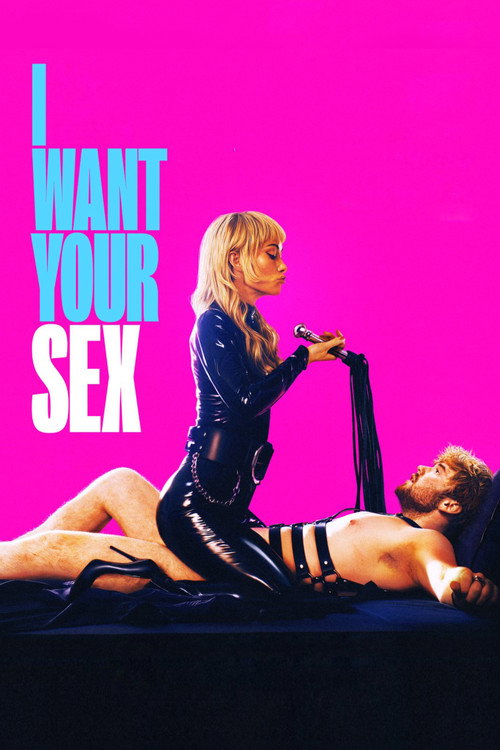
I Want Your Sex
2026 · Gregg Araki
For a late-night watch when you want something sexy, transgressive, and wickedly funny — ideally with someone you don't mind squirming next to. Absolutely not a comfort watch for the easily embarrassed; that's the point.
What it's about
Elliot, a fresh-faced young art handler, lands a job with Erika Tracy — a famous artist, icon, and professional provocateur — and can't believe his luck when she taps him to be her sexual muse. Inside her world of galleries, mansions, and staged desire, the line between art project and real life starts to dissolve, and Elliot finds himself deep in a game of obsession, power, and betrayal with a body count.
The experience
Horny, funny, and increasingly sinister — a candy-colored satire of the art world that plays like a comedy until the noir underneath starts to show. It's explicit, playful, and knowingly outrageous.
Performances
Cooper Hoffman is winningly out of his depth as Elliot, all eager naïveté, while Olivia Wilde goes big and sharp as Erika, playing a woman who treats seduction as a medium.
The craft
Gregg Araki's first feature in twelve years, co-written with sex columnist Karley Sciortino, fuses his candy-colored provocation with a genuine noir structure — it opens on a body and rewinds to find out how we got there. Shot fast and cheap in Los Angeles, it's ninety lean minutes with the saturated, poppy look Araki made his signature.
Why it matters
A comeback for one of American independent cinema's great provocateurs, and a rare current example of the erotic comedy released when mainstream movies have largely abandoned sex altogether.
Snapshot
Gregg Araki's first feature in twelve years is an erotic comedy built on a noir skeleton: a body in a swimming pool, a title card rewinding "9½ weeks ago," and a flashback that delivers a wide-eyed art-handler named Elliot (Cooper Hoffman) into the orbit of Erika Tracy (Olivia Wilde), a contemporary artist who conscripts him as her sexual muse. Co-written with Karley Sciortino — the Vogue "Breathless" columnist who co-created Araki's Starz series Now Apocalypse (2019) — it premiered at Sundance on 23 January 2026 and was released in the United States by Magnolia Pictures on 31 July 2026. It runs ninety minutes, was produced by Black Bear Pictures, and was shot in Los Angeles across four weeks in October 2024.
The film reads as a deliberate reconciliation of Araki's two registers: the candy-colored provocation of the Teen Apocalypse pictures and the tonal control of Mysterious Skin (2004). Araki has described it as "a sex-positive love letter to Gen Z." That framing is not marketing gloss; it is the film's argument, and the crime plot is the delivery mechanism.
Industry & production
The project's development history is unusually legible. Araki has said the script began as a spec around 2012–13, conceived in the commercial wake of Fifty Shades of Gray with the conventional polarity — female submissive, male dominant. After #MeToo he inverted it, and the inversion is what made the film. Erika Tracy is not a Christian Grey with the pronouns swapped; making the dominant a woman with institutional power, and the submissive a young man with none, relocates the story's tension from fantasy to labor.
Financing followed Araki's long-established method. He has been explicit that he has "never made the $20 million quasi-studio movie," and has repeatedly cited low budgets as a creative-control instrument: The Doom Generation (1995) was made for roughly $750,000, Mysterious Skin for a little over a million. I Want Your Sex is a Black Bear Pictures production, with Teddy Schwarzman and Michael Heimler producing alongside Araki, Seth Caplan, Courtney L. Cunniff and Sciortino. Magnolia — a specialty distributor, not a studio — handled the U.S. release.
The twelve-year gap was not idleness. Araki spent it in television, creating Now Apocalypse and directing episodes across a range of series including Riverdale, 13 Reasons Why, Heathers and Red Oaks. Returning to features, he chose Sundance deliberately, telling the premiere audience some version of a sentiment he has expressed for decades: "I owe my entire life and career to Sundance." His path runs through the festival from The Living End (1992) forward, and the 2026 premiere functioned as a homecoming narrative that the festival itself amplified.
One production detail signals the era: the film employed an intimacy coordinator, Yehuda Duenyas. Araki, who made explicit sex central to his work long before the role existed, has spoken warmly about the cast being "extraordinarily fearless" and about shooting demanding material early in the schedule — a scheduling choice that only makes sense with a protocol in place.
Technology
The film was shot digitally on a compressed independent schedule (2–27 October 2024) in and around Los Angeles. Araki has spoken generally about the sensitivity of contemporary digital cameras enabling the kind of low-light, high-saturation work the film attempts on a small budget; a detailed published breakdown of camera bodies, lenses or aspect ratio was not available at the time of writing, and I will not invent one.
More documented — and more interesting — is the film's use of machine-learning tools in post. Araki has said he is "not a big supporter of AI in terms of replacing actors and writers," but described post-production applications on this film as genuinely enabling. The example he gives is a mini-golf sequence shot beside a freeway: unusable in rough cut for traffic noise, and salvaged by source-separation tools to the point where, in the mix, crickets became audible. He called the result "literally insane the way these things can work." This is a small anecdote with real historical weight. It marks the point at which AI-assisted audio repair became a routine budget-stretching instrument for independent production — a democratizing tool at the exact moment the same technologies were being contested as a labor threat. Araki's position, drawing a line between post-production repair and creative replacement, is a fairly precise articulation of where much of the independent sector landed in 2025–26.
Technique
Cinematography
Tucker Korte, a new collaborator rather than a returning one, shoots in a mode critics consistently described as candy-colored and fluorescent — Brian Eggert in Deep Focus Review called it "a sensory explosion." The strategy is not naturalistic coverage of a heightened world but a saturation that indexes subjectivity: reviewers noted that when Elliot's desire spikes, the light blows past pleasant into near-blinding, an oversaturation that functions as a wink at the character's own fantasy-projection. Deep focus and crisp, hard-edged images dominate; the film refuses the shallow, honeyed haze that has become the default grammar of the contemporary erotic drama. Framing of two-handers was singled out as inventive — Araki and Korte work to keep even flat conversational scenes compositionally alive, a discipline inherited from Araki's early films, on which he served as his own cinematographer and production designer.
Editing
Araki cuts his own films and has since the beginning; here he shares credit with Victor de la Parra. The cutting is fast and openly playful — fast-forwards, dream inserts, animated interpolations — what Eggert termed "zippy maneuvers." Structurally the film is a retrospective noir: it opens on the corpse, drops the "9½ weeks ago" card (an unmistakable nod to Adrian Lyne's 9½ Weeks), and runs the romance forward toward the death we have already seen. The device is as old as Sunset Boulevard, and Araki is using it for the same reason Wilder did — to convert a seduction into a tragedy in advance. Not everyone found the machinery well-oiled: several critics faulted a late twist for undercutting the character work, and the film's stacked closing sequences for diffusing the ending.
Mise-en-scène / staging
Angelique Clark's production design is the film's most legible satire. Erika's studio was described by one reviewer as "a Pee-Wee's Playhouse of sorts for the sexually liberated," with oversized ball gags and anal beads suspended from the ceiling — kink rendered as blue-chip installation, which is precisely the joke about a market that absorbs transgression as inventory. Costume, by Arianne Phillips (a three-time Academy Award nominee, for Walk the Line, A Single Man and Once Upon a Time in Hollywood) with Monica Chamberlain, does the character work: Erika's wardrobe reads simultaneously as danger and as liberation, which is exactly the ambiguity the plot needs to sustain.
Sound
James Clements provides the score, but the film's sonic identity — as always with Araki — is curatorial. The needle-drop roster reported by critics runs deep into the 4AD/Creation lineage that has defined his soundtracks since the early nineties: multiple Slowdive tracks ("Avalyn II," "Golden Hair," "Dagger"), Cocteau Twins, The Jesus and Mary Chain, Red House Painters, The Psychedelic Furs, Depeche Mode, Blur, Radiohead, Aphex Twin, alongside contemporary artists including Tamaryn and Boy Harsher. The title borrows George Michael's 1987 single; whether the track itself appears in the film is not something the available record establishes. Notably absent is Robin Guthrie, who scored Mysterious Skin (with Harold Budd), contributed to Kaboom and worked on Now Apocalypse — a genuine break in Araki's longest-running musical partnership, even as the shoegaze sensibility persists in the licensed music.
Performance
Wilde's Erika is the film's engine and the near-unanimous point of critical agreement: variously described as "deliciously magnetic," manic, and — the more useful adjective — "insatiable but surprisingly fragile." She is playing a dominant whose dominance is itself a performance requiring constant maintenance. Hoffman, in his first nude and sex scenes, plays Elliot with an earnestness that some critics found the film's emotional anchor and others found miscast; The Playlist argued the pair lacked chemistry outright, while DiscussingFilm called it "white-hot." Chase Sui Wonders, as Elliot's roommate Apple, drew the strongest supporting notices. Araki also stocks the film with his own repertory: James Duval (Totally F\\\ed Up, The Doom Generation, Nowhere), Nathan Bexton (Nowhere, Splendor) and Roxane Mesquida (Kaboom, Now Apocalypse*) all appear, alongside Mason Gooding, Daveed Diggs, Charli XCX, Johnny Knoxville and Margaret Cho.
Narrative & dramatic mode
The film operates in two modes at once and knows it. The A-plot is an education narrative — innocent enters the house of the sophisticate, is remade, discovers the cost — descended from the muse/patron story and from the erotic-initiation film. The B-plot is a crime procedural, with Knoxville and Cho as detectives working the death that opens the picture. The braid is comic rather than suspenseful: Araki uses the investigation less to generate dread than to keep an ironic frame around the romance, so that every escalation of intimacy is shadowed by the audience's knowledge that someone ends up in the pool.
The dramatic mode is closer to satirical romance than to thriller. Wilkes-style pulp mechanics are present but detuned; the tension the film actually cultivates is between two readings of the same relationship — mutual, negotiated kink versus straightforward exploitation of a subordinate — and it declines to resolve that question until very late, which is where the contested twist lands.
Genre & cycle
I Want Your Sex arrives inside a well-documented mid-2020s revival of the erotic thriller and the dominance/submission narrative — a cycle that includes Sanctuary (2022), Fair Play (2023), Babygirl (2024) and Pillion. Araki's intervention is tonal. Where most of that cycle plays the material with clinical seriousness, he plays it as comedy, and reviewers repeatedly used the contrast: this is the entry that finds the subject funny without finding it trivial. Within his own filmography, the film sits between the pop-apocalyptic Teen Apocalypse cycle (Totally F\\\ed Up, The Doom Generation, Nowhere) and the underrated stoner comedy Smiley Face* (2007), sharing the former's chromatic aggression and the latter's willingness to be silly.
Authorship & method
Araki is one of American independent cinema's most complete auteurs in the literal, credit-list sense: he began by writing, directing, shooting, production-designing and editing features made for a few thousand dollars, and he has retained the writer-director-editor-producer cluster ever since. What is new here is shared authorship on an original screenplay. His previous features either originated with him alone or adapted novels (Scott Heim's Mysterious Skin, Laura Kasischke's White Bird in a Blizzard); I Want Your Sex is written with Sciortino, whose journalism on contemporary sexual culture supplies the film's vocabulary and, plausibly, its sociological accuracy about the generation it addresses.
The craft team is largely new — Korte, Clements, de la Parra, Clark — where earlier Araki films clustered around Jim Fealy (The Doom Generation, Nowhere, Splendor, Mysterious Skin) and later Sandra Valde-Hansen (Kaboom, White Bird in a Blizzard, Now Apocalypse). Araki has cited Godard's Masculin Féminin as a formative influence, particularly its non-diegetic playfulness, and the interpolations here — cards, animation, direct address of the audience's expectations — sit in that lineage.
Movement / national cinema
Araki is a founding figure of New Queer Cinema, the movement B. Ruby Rich named in 1992, when The Living End screened alongside Poison, Swoon, Tongues Untied, Paris Is Burning and My Own Private Idaho. That cohort's defining move — refusing positive-image respectability in favor of anger, formal aggression and unapologetic desire — remains Araki's operating principle thirty-four years later, redirected from the HIV-era fury of The Living End toward what he now calls queer joy.
He is also, persistently, a Los Angeles filmmaker. Where the American indie scene of the nineties was heavily New York-inflected, Araki's cinema is built from strip malls, freeways, apartment complexes and — here — the gallery circuit, treating LA not as backdrop but as a native color palette. He is a Japanese-American director whose work has almost never taken ethnic identity as subject, a fact worth noting precisely because it complicates the categories usually applied to him.
Era / period
The film is legible as a direct response to a specific mid-2020s discourse: the widely reported decline in sexual activity among young adults, the retreat of sex from mainstream studio filmmaking, and a consent culture that Araki treats with affection rather than contempt. Eggert's review framed the argument bluntly — the film confronts what he called Gen Z's "retro-sex negativity," touching pandemic-era isolation, housing precarity and screen-mediated substitutes for physical intimacy. Araki's counter-thesis, delivered through Erika, is that exploring one's limits rather than avoiding risk is a condition of a full life. He has also been explicit that centering joy was a political choice made against the darkness of the American moment for queer people. The film's arrival in a period of intense pressure on LGBTQ+ life in the United States is part of its meaning.
Themes
The governing tension is between kink and exploitation, and the film's structural intelligence lies in refusing to let institutional power and erotic power line up neatly: Erika is dominant in bed and dominant as an employer, and the film asks whether consent negotiated across that gap can be real. Adjacent to it: performance versus authenticity, staged in an art world where transgression is inventory and a provocateur's persona is her product; the economics of the muse, which is to say unpaid or underpaid creative labor dressed as access; and precarity as the thing that makes Elliot's compliance rational. Running underneath is Araki's oldest theme, sex as simultaneously annihilating and redemptive — nihilistic in The Living End, catastrophic in Mysterious Skin, and here, at last, offered as something like a way out.
Reception, canon & influence
Critical reception at Sundance and on release was broadly warm but genuinely split. Aggregators recorded strong numbers — 90% positive across 125 reviews on Rotten Tomatoes, average 7.3/10, with the site's consensus calling it "one of indie stalwart Gregg Araki's most accessible works yet," and 68/100 across 35 critics on Metacritic. The Hollywood Reporter judged Araki "back in vintage form"; Deep Focus Review gave it 3.5 stars with reservations about the twist and the multiple endings; DiscussingFilm was enthusiastic. Dissent clustered on the central pairing and on the film's daring: The Playlist found Hoffman miscast and the chemistry absent, and The Guardian's Benjamin Lee dismissed it as a "tame dom-sub romp" saved only partly by Wilde. Commercially it opened at specialty scale; the roughly $635,000 gross on record is an early figure from the film's first days in wide release, not a final total.
Backward, the film's debts are legible: Fifty Shades of Gray as the template it was written against; Lyne's 9½ Weeks cited by title card; the corpse-first noir architecture of Sunset Boulevard; the late-eighties and nineties erotic thriller as the genre it comedically detunes; Godard's essayistic playfulness; and the 4AD/shoegaze soundworld that has been Araki's emotional register since The Doom Generation. The gallery-as-playhouse design invites comparison to the Factory-era conflation of scene, studio and sexual economy, though that resonance belongs to the critic rather than to any stated intention.
Forward, it is too early to speak of legacy in any serious sense — the film has been in wide release for roughly a week at the time of writing, and any claim about what it shaped would be speculation. What can be said is that it re-establishes Araki as an active feature filmmaker after a twelve-year absence, that it is by aggregate measure among the best-received work of his career, and that it stakes a distinct position within the 2020s erotic-thriller revival: the argument that this material is better served by comedy than by solemnity. Whether that position finds imitators is a question the next few years will answer.
Reception
Premiered at Sundance 2026 — Araki's first feature in over a decade — to genuinely split notices: raves from Variety and Deadline, a 2/5 from the Guardian. It only hit theaters (via Magnolia) at the end of July 2026, so its long-term reputation is still being written.
How I Want Your Sex was received, from release to now →
How to watch I Want Your Sex: what to notice on a first viewing
- Notice the light blow out during Elliot's most heated scenes. Korte pushes the color into near-blinding saturation at moments of heightened want, an oversaturation that functions like a wink at Elliot's own fantasy projecting onto the scene. The light literally tells you when you're inside someone's fantasy instead of plain reality.
- Notice the oversized objects suspended from the studio's ceiling. Erika's studio is designed like a gallery installation, kink rendered as blue-chip art object, which is the film's visual joke about a market that absorbs transgression as inventory. The production design makes the satire visible before either character says a word about the art world.
- Watch for fast-forwards and animated inserts breaking up scenes. Araki cuts his own film with playful zippy maneuvers, dream inserts, animated interpolations, cards, keeping the style closer to comedy than to the clinical seriousness of most erotic thrillers. The playful editing is the tonal signal that this is meant to be funny as much as it is charged.
- Listen for the wall of shoegaze guitars under every scene. Araki's soundtrack runs deep into the same 4AD and Creation lineage he has used since the early nineties, Slowdive, Cocteau Twins, The Jesus and Mary Chain, tying this film to his whole career. The music links a very 2026 story to Araki's own decades-old signature sound.
The whole guide to watching I Want Your Sex, with the keys for a rewatch →
Influences: the films it descends from and the films it influenced
- Sunset Boulevard (1950) — The corpse-first architecture is lifted whole — a dead narrator opens the film and converts everything after into a flashback whose destination is pre-spoiled, moving the tension from 'what happens' to 'how this got here,' which is exactly what lets Araki play the crime frame ironically.
- Masculin Féminin (1966) — Araki has named it as the model for his non-diegetic apparatus: numbered/aphoristic intertitle cards, abrupt direct address, and essayistic interview digressions that puncture the fiction without abandoning it — the structural permission for the film's animated interpolations.
- Belle de Jour (1967) — Buñuel's method of staging fetish scenarios as discrete, brightly-lit, formally composed tableaux played with total deadpan — no sweat, no jazz saxophone — is the precedent for kink presented as installation art rather than as erotic-thriller heat.
- Chelsea Girls (1966) — The Factory conflation of gallery, soundstage and sexual economy: art space doubles as set, performers play scene-adjacent versions of themselves, and the production design is simply the milieu — the design logic behind the film's gallery-as-playhouse.
- Body Double (1984) — De Palma builds an erotic thriller out of conspicuously artificial sets and a film-within-a-film apparatus so the genre's voyeurism is indicted by its own staging — the same self-aware artifice Araki uses to detune the form comedically.
- 9½ Weeks (1986) — Cited by title card; Lyne's grammar of the ritualized set-piece (blindfold, food, dress-up) shot in gelled, hard-shadowed apartment light and cut to song-length pop rather than to dialogue beats is the sequence template being rewritten.
- Basic Instinct (1992) — Verhoeven's structural gag — the suspect is an artist who already authored the crime, and the interrogation is blocked as a seduction — supplies the ironic crime frame Araki inherits and plays for laughs instead of dread.
- The Doom Generation (1995) — Establishes the 4AD/shoegaze needle-drop as non-diegetic emotional score rather than source cue (Cocteau Twins, Slowdive, Curve) laid over a deadpan crime-spree frame — the exact sound-and-tone pairing the new film revives with cleaner stems.
- Nowhere (1997) — Jim Fealy's oversaturated fluorescent palette with wide deep-focus lenses and flat frontal blocking turns LA interiors into primary-colored stage boxes; the absurdist non-sequitur interruptions here prefigure the animated interpolations.
- Mysterious Skin (2004) — Robin Guthrie and Harold Budd score it directly, making the shoegaze soundworld authored rather than licensed, and it proves Araki's candy palette can carry an unironic dramatic register — the tonal control the new film's twist depends on.
- Fifty Shades of Gray (2015) — The template written against: the contract-negotiation scene, the purpose-built playroom as production design, and the instruction-arc pacing are all reproduced beat-for-beat structurally, then recut so the solemnity reads as the joke.
- Now Apocalypse (2019) — The immediate dry run — Karley Sciortino in the writers' room supplying contemporary sexual vocabulary, Araki's repertory faces, LA as erotic comedy, and an episodic sexual-education structure that the feature compresses into one arc.
- Sanctuary (2022) — Stages a dom-sub session as single-location chamber comedy where the negotiated roleplay script *is* the dialogue, and the power reversal is the plot mechanism — kink treated as theater with visible blocking rather than as transgression.
- Fair Play (2023) — Rebuilds the nineties erotic thriller's set-piece skeleton around a power inversion inside a professional hierarchy, keeping the genre's escalation structure while swapping noir fatalism for contemporary consent politics.
- Passages (2023) — New Queer Cinema descendant that shoots sex in long unglamorous takes under plain apartment daylight and lets the choreography carry the power negotiation with no score at all — the ascetic inverse of Araki's needle-drop maximalism, same lineage.
- Poor Things (2023) — A chapter-carded education plot in which sexual apprenticeship is the literal narrative spine, staged in deliberately artificial hyper-saturated design — the closest contemporary match to the film's card-and-episode pedagogy structure.
- Babygirl (2024) — The nearest sibling: a dom-sub relationship played for comic discomfort rather than danger, with needle-drops doing the tonal heavy lifting and an explicit structural rewrite of the 9½ Weeks / Fifty Shades instruction sequence.
- Love Lies Bleeding (2024) — Queer noir shot in oversaturated period-neon whose crime frame keeps tipping into deadpan absurdity and outright unreality — the same wager that a genre is better served by tonal derangement than by solemnity.
Similar films
- Babygirl (2024) — influence & lineage
- Basic Instinct (1992) — influence & lineage
- Nowhere (1997) — influence & lineage
- Strange Darling (2024) — shared sensibility
- The Invite (2026) — shared sensibility
- Blue Film (2026) — shared sensibility
- Anora (2024) — shared sensibility
- Teenage Sex and Death at Camp Miasma (2026) — shared sensibility