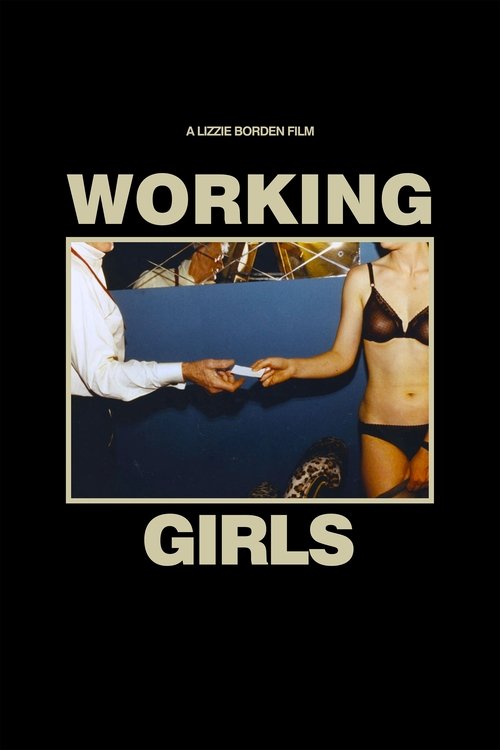
Working Girls
1987 · Lizzie Borden
For when you want a film that upends how a subject is usually shown — clear-eyed, unsentimental, and conversation-starting. A challenge in the best sense, not a comfort watch.
What it's about
One working day inside an upscale Manhattan brothel, seen through the eyes of Molly — a Yale-educated photographer who lives with her girlfriend and turns tricks to bankroll the career the straight economy won't fund. The film follows appointments, small talk, hygiene rituals, and the ledger kept by a penny-pinching madam, treating sex work as exactly that: work.
The experience
Dry, matter-of-fact, and quietly radical — it strips away every ounce of melodrama and titillation until what's left is the texture of a shift job: boredom, routine, gallows humor between coworkers, and the slow grind of clock-watching. It makes you think more than it makes you feel, and that's the point.
Performances
Louise Smith plays Molly with wry, unglamorous intelligence — watchful and matter-of-fact, she makes the film's whole demystifying project feel lived-in rather than argued.
The craft
Lizzie Borden shoots the brothel like a workplace — flat light, repeated routines, an almost procedural attention to money changing hands — and the deliberate refusal of spectacle becomes its own kind of style. The writing is sharp on class and economics without ever turning into a lecture.
Why it matters
A defining work of 1980s American feminist independent cinema, it reframed how movies could depict sex work — as labor rather than tragedy or fantasy — and remains a touchstone for filmmakers taking on stigmatized subjects without sensationalism.
Snapshot
Working Girls is Lizzie Borden's second feature, a spare, deliberately unsensational account of a working day inside an upscale Manhattan brothel. Its protagonist, Molly (Louise Smith), is a Yale-educated photographer, a lesbian who lives with her partner and turns tricks to fund a life and a career the "straight" economy will not underwrite. Where popular cinema had long framed prostitution through melodrama, punishment, or titillation, Borden films it as labor: a matter of appointments, hygiene, hourly rates, small talk, and clock-watching, presided over by a cost-conscious madam. The film is a materialist study disguised as a slice of life, and it remains one of the defining works of 1980s American feminist independent cinema — the more accessible companion to Borden's incendiary Born in Flames (1983). Its lasting reputation rests on a single, radical formal decision: to strip sex work of both glamour and tragedy and observe it as a job among jobs.
Industry & production
Working Girls emerged from the downtown New York independent scene of the early-to-mid 1980s, the milieu that also produced Borden's Born in Flames. It was made cheaply and outside the studio system, on the model of artist-driven, grant- and deferral-funded independent production that characterized that world. Borden co-wrote the screenplay with Sandra Kay and produced the film herself, exercising the near-total authorial control typical of the New York independent feature at that scale.
The film's institutional trajectory ran through the festival circuit that was, in these years, consolidating into the apparatus that would define American independent cinema. It played the Directors' Fortnight at Cannes in 1986 and the US Film Festival at Park City — soon to be renamed Sundance — where its cinematography was recognized with an award. That festival exposure led to theatrical distribution; the film was handled in the United States by Miramax, then an ascendant specialty distributor building its reputation on exactly this kind of provocative, critically viable independent title. The precise budget figure is not something I can state with confidence, and I will not invent one; what is clear from every account is that the film was made for very little, with a small crew, a largely single-location shoot, and a cast blending trained and untrained performers.
Technology
Working Girls is a product of pre-digital, artisanal 16mm production. It was shot on 16mm film — the standard acquisition format for independent features of its budget and generation — with sync sound recorded on location, and enlarged to 35mm for theatrical projection. This is technologically unremarkable for its moment, and that ordinariness is the point: the film's realism depends on the plain, available-light-inflected look that 16mm and a compact crew made possible inside a real apartment set. The confined interior, the reliance on practical and softened sources, and the intimate handling of the camera are all consistent with the constraints and affordances of the format. The film has since been restored and reissued in improved video and theatrical presentations in recent years, part of a broader rediscovery of Borden's work; I will not overstate the specifics of any single restoration beyond noting that it has been made newly available to contemporary audiences.
Technique
Cinematography
The cinematography is by Judy Irola, whose work here was singled out on the festival circuit and is central to the film's achievement. Irola's approach is observational and unglamorous: even, naturalistic lighting; a restrained palette keyed to the domestic-institutional beige of the brothel; and framing that treats the space as a genuine workplace rather than a stage for erotic display. The camera watches rather than caresses. Bodies are shown matter-of-factly — the film is frank without being pornographic — and the visual grammar consistently declines the conventions of the "sexy" prostitution picture. Interiors are shot to emphasize thresholds and rooms: the front room where clients wait, the bedrooms where transactions occur, the kitchen where the women decompress. The result is a coherent, claustrophobic geography built from a modest number of setups.
Editing
The film's editing sustains a rhythm of routine and repetition: arrivals, negotiations, appointments, cleanups, departures, all cycling across a single compressed timeframe. Cutting is functional and unshowy, serving the documentary-adjacent realism rather than generating suspense; the accumulation of small procedural beats — money counted, condoms and towels managed, appointments logged — is itself the film's structuring device. I am not confident of the editor's identity and will not attribute the cut to a specific hand I cannot verify; Borden was closely involved in the editing of her films, but the credited editor is a detail I would want to confirm rather than assert.
Mise-en-scène / staging
Mise-en-scène is where the film's argument is most fully embodied. The brothel is rendered as an ordinary bourgeois apartment — tasteful, a little bland, indistinguishable from a therapist's office or a small business — and this deliberate ordinariness is the film's central visual thesis: sex work is naturalized as work by being staged in the vocabulary of the everyday. Props do enormous thematic labor: money, appointment books, lingerie treated as uniform, and above all the paraphernalia of hygiene, which the film foregrounds insistently. Staging emphasizes the choreography of the workday — who is waiting, who is occupied, who is resting — and the social hierarchy of the house, with the madam's office as its command center.
Sound
The soundscape is naturalistic and dialogue-driven, built on the texture of overlapping talk, telephones, and domestic ambience rather than on an assertive musical score. Scored music is sparse; the film largely trusts location sound and conversation to carry mood. I am not certain of a credited composer and will not name one speculatively — the honest characterization is that music is minimal and subordinate to the film's talky, observational realism.
Performance
Performances are pitched toward understatement and ensemble naturalism. Louise Smith anchors the film as Molly with a watchful, dry, faintly detached presence — an intelligent woman managing her labor and her boundaries. Ellen McElduff's Lucy, the madam, supplies the film's sharpest comic and ideological edge: a petty-capitalist boss whose penny-pinching and euphemistic management make the brothel legible as a business. The supporting women register as distinct workers with distinct strategies rather than as types. The acting style — flat, unheightened, closer to behavior than to "scenes" — reinforces the film's refusal of melodrama.
Narrative & dramatic mode
Working Girls adopts a "day in the life" structure, compressing its action into roughly a single extended workday (with Molly pulled toward a second shift). This is anti-melodrama by design: there is no fallen-woman arc, no rescue, no punishment, no rock-bottom catharsis. The dramatic mode is procedural and cumulative, closer to observational realism than to plotted narrative, and its tensions are workplace tensions — a difficult client, a scheduling squeeze, a boss's exploitation, the fatigue of a shift that will not end. The film's low-key climax is a matter of labor and refusal rather than moral revelation. By organizing itself around the rhythms of a job, the film makes its politics structural rather than declaimed.
Genre & cycle
The film sits at the intersection of the realist workplace drama and the feminist independent film. It belongs to a 1980s cycle of American independent cinema that used low-budget realism to interrogate gender, sexuality, and labor from the vantage of the political left. Within the narrower cycle of prostitution films, Working Girls is a self-conscious corrective: it answers a long generic tradition — from noir victims to glossy "hooker with a heart of gold" romances — by reclassifying its subject from vice to occupation. It is also legible within lesbian and queer independent cinema, given Molly's sexuality and domestic life, though the film treats her queerness as a lived fact rather than a subject of crisis.
Authorship & method
Lizzie Borden is the film's decisive author. A former painter and art critic — she wrote on art before turning to film, and adopted the name "Lizzie Borden" — she came to cinema through the conceptual, politically charged downtown avant-garde. Born in Flames (1983), her breakthrough, was a fractured, near-future feminist science-fiction film assembled over years in a collaged, agitational style. Working Girls represents a striking methodological pivot: from speculative montage to sustained naturalism, from many voices to a single house, from the future to the procedural present. What carries across is Borden's materialist-feminist commitment to representing women's labor and the economics of gendered life. Her method here is research-driven realism — the film's authority derives from its granular attention to the mechanics of the trade — and collaborative, co-written with Sandra Kay.
Among key collaborators, cinematographer Judy Irola is the most important, translating Borden's conception into the film's unglamorous, observational look; the two share credit for the film's realist texture. On the composer, editor, and other technical collaborators, the reliable record available to me is thin, and I would rather flag that than assign credits I cannot substantiate. The screenplay credit to Borden and Kay, the lead performances by Louise Smith and Ellen McElduff, and Irola's cinematography are the collaborations for which the attribution is secure.
Movement / national cinema
Working Girls is a work of American independent cinema, specifically the New York feminist and downtown-artist wing of that movement in its formative 1980s phase. It belongs to the moment just before "independent film" hardened into a commercial category via Sundance and Miramax — both of which appear in this film's own history. It is frequently placed within the lineage of feminist counter-cinema, the project (theorized across the 1970s and 1980s) of building filmic forms that resist the male-gaze conventions of mainstream narrative. Borden's naturalism is a different tactic from the reflexive experimentation associated with that theoretical tradition, but it shares the political aim: to make women's experience — here, women's labor — visible on its own terms.
Era / period
The film is very much of the mid-1980s. Its production coincides with the rise of the festival-and-specialty-distributor ecosystem, and its politics engage the decade's debates over sexuality, work, and feminism — including the intra-feminist "sex wars" over pornography and sex work, in which Working Girls' non-condemnatory, labor-centered stance was itself an intervention. Set in a recognizably contemporary Reagan-era New York, the film reads the period's entrepreneurial rhetoric with irony: the brothel is a small business, the madam a small-business owner, and Molly a freelancer monetizing herself in an economy that offers her few better options.
Themes
The film's governing theme is sex work as labor — commodified, alienated, managed, and taxed by a boss — and, through it, the broader condition of women's work under capitalism. Borden draws a deliberate equivalence between the brothel and any other workplace, so that the film becomes a Marxist-feminist parable about the sale of the self. Related themes cluster around this core: the performance of intimacy as a service; the porous, hypocritical boundary between "respectable" and "disreputable" labor; class and education (Molly's Ivy League degree cannot buy her out of economic precarity); exploitation from within, as the madam extracts value from the women; and autonomy and its limits, dramatized in Molly's negotiation of time, money, and consent across an over-long shift. The film's treatment of hygiene and money as recurring motifs literalizes its thesis that this is a business of bodies and cash.
Reception, canon & influence
Critically, Working Girls was received as a serious and provocative feminist intervention, praised for its unglamorous frankness and its refusal of both moralism and exploitation — though its very matter-of-factness also generated debate about whether it romanticized or de-dramatized its subject. Its cinematography award at the Park City festival marked early institutional recognition, and it has been a fixture of feminist film scholarship and of critical histories of independent cinema; the critic B. Ruby Rich, among others, has been an important voice situating Borden's work within the feminist film culture of the period. Over time the film has been canonized as a landmark in the screen representation of sex work.
Looking backward, the influences on the film are legible in Borden's own formation: the observational, documentary-inflected realism of politically engaged independent cinema; the theoretical currents of 1970s–80s feminist film culture; and Borden's prior practice, whose materialist concerns Working Girls refines into naturalism. Looking forward, its legacy lies less in a school of direct imitators than in a durable model: it helped legitimize the depiction of sex work as labor rather than as pathology or spectacle, an approach that recurs across later independent and festival cinema and in the scholarship and activism around sex-work representation. The film's recent restoration and reissue have renewed its visibility and confirmed its standing as a foundational text — the work in which American feminist independent cinema treated the world's oldest profession as, simply, work.
Reception
Released in 1987 to a marketing campaign that sold it as titillation and to critics who didn't know what to do with its deadpan matter-of-factness, it spent decades as a whispered-about rarity — then the 2021 Criterion restoration turned it into one of the great rediscoveries of that era, now routinely called the most honest film ever made about sex work.
How Working Girls was received, from release to now →
Influences: the films it descends from and the films it influenced
- Wanda (1970) — 16mm handheld observation that drifts after a passive working-class woman through her economic dependency, using flat non-dramatic performance and a refusal of moral framing that Borden's naturalism inherits.
- Jeanne Dielman, 23 quai du Commerce, 1080 Bruxelles (1975) — Real-time routine-repetition editing that files a housewife's afternoon prostitution among her peeling-potatoes chores, establishing the treatment of sex work as one procedural task in a woman's labor day.
- Faces (1968) — Ensemble understatement and naturalistic, dialogue-driven long takes staged in ordinary interiors — the American-independent performance grammar Borden builds her brothel scenes from.
- Girlfriends (1978) — Low-budget 16mm American-feminist day-in-the-life realism about young women's work and money, modeling the unglamorous procedural register Borden adopts.
- High School (1968) — Observational institutional method that watches a single bounded space's routines and transactions with no narration or judgment — the documentary look Judy Irola translates onto the apartment-brothel.
- Riddles of the Sphinx (1977) — Feminist counter-cinema's program of representing women's waged and unwaged labor while refusing classical identification — the theoretical current Borden converts into procedural realism.
- Born in Flames (1983) — Borden's own materialist-feminist accounting of women's labor and gendered economics, here refined from agitational collage-montage into sustained single-house naturalism.
- Wendy and Lucy (2008) — Pared-down observational day-in-the-life realism that dramatizes a woman's economic precarity through small procedural detail and anti-melodramatic restraint.
- Frozen River (2008) — Research-driven realist workplace drama treating a woman's illicit trade as economic labor rather than moral fall, with ensemble understatement and money/logistics as recurring props.
- Starlet (2012) — Embeds porn performance in ordinary day-to-day texture as simple labor, extending Borden's refusal of pathology or spectacle around sex work.
- Tangerine (2015) — Renders street sex work as everyday work through documentary-inflected naturalism and ensemble understatement across a single compressed day.
- American Honey (2016) — Observational, near-documentary attention to precarious feminized gig labor, using naturalistic non-actor performance and a day-to-day episodic drift over plot.
- Support the Girls (2018) — Single-workday structure inside a gendered service workplace, foregrounding the economics of feminized labor through naturalistic dialogue and ensemble understatement.
- Cam (2018) — Depicts camming as skilled digital labor with granular procedural attention to its mechanics and money, refusing the moral-pathology frame Borden rejected.
- Never Rarely Sometimes Always (2020) — Observational naturalism and anti-melodrama applied to women's bodily and economic experience, withholding sensational framing in favor of procedural attentiveness.
- Anora (2024) — Non-moralizing procedural depiction of sex work as labor and transaction, with the granular attention to the trade's mechanics and money that echoes Borden's research-driven realism.
- Variety (1983) — Downtown-NY feminist counter-cinema examining the sex industry as a woman's workplace from an observational vantage, sharing Borden's no-wave milieu (Kathy Acker, Nan Goldin) and its cool anti-exploitation gaze.
Similar films
- Born in Flames (1983) — influence & lineage
- Wanda (1970) — influence & lineage
- Jeanne Dielman, 23, quai du Commerce, 1080 Bruxelles (1976) — shared sensibility
- High Art (1998) — shared sensibility
- Belle de Jour (1967) — shared sensibility
- sex, lies, and videotape (1989) — shared sensibility
- Bound (1996) — shared sensibility
- Blue Film (2026) — shared sensibility