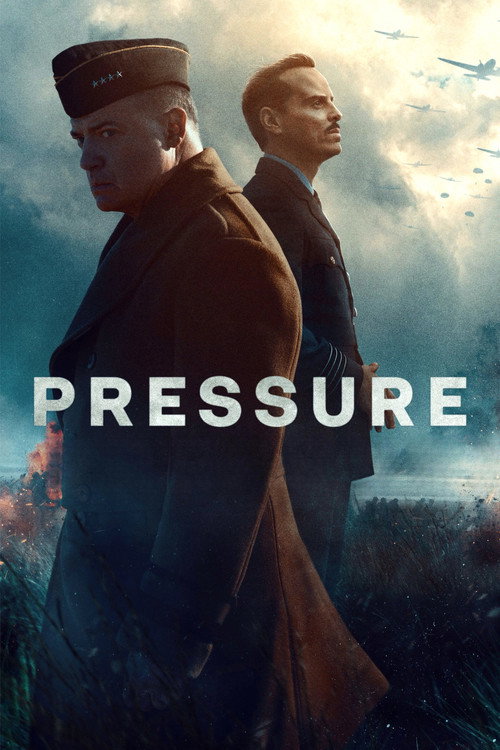
Pressure
2026 · Anthony Maras
When you want a smart, grown-up nail-biter — a film to lean into rather than veg out to, perfect for a night when conversation and stakes beat car chases. Rewards your full attention.
What it's about
Seventy-two hours before D-Day, one man has to tell Eisenhower that the beautiful June weather is about to break. Group Captain James Stagg, the Allies' chief meteorologist, argues that the largest seaborne invasion in history must wait — while every hour of delay risks the whole war. It's a thriller where the battlefield is a weather chart and the enemy is a low-pressure system nobody can see yet.
The experience
Taut, talky, and gripping in the way a great courtroom drama is gripping — the tension comes from arguments, forecasts, and the terrible weight of a decision that can't be unmade. You know history's outcome and it still winds you tight.
The craft
Anthony Maras adapts David Haig's stage play into a chamber thriller that wrings suspense from rooms, charts, and clocks rather than combat. The confinement is the point: history's biggest military gamble reduced to a handful of people in a country house, arguing about the sky. Direction this disciplined makes stillness feel like action.
Why it matters
Released to mark the anniversary of the Normandy landings, it puts a little-known figure — the forecaster behind D-Day — into the popular memory of the war, and confirms Maras as a director of high-pressure true stories.
Snapshot
Pressure is a chamber thriller about a forecast. Over the 72 hours before the Normandy landings, Group Captain James Stagg — the Scottish meteorologist serving as chief weather adviser to Supreme Headquarters Allied Expeditionary Force — tells Dwight D. Eisenhower that the fair June weather outside the window is about to break, and that the largest amphibious operation ever attempted must be postponed. Anthony Maras's second feature, adapted with David Haig from Haig's 2014 stage play, is a film in which the antagonist is a low-pressure system and the action consists almost entirely of men in a Victorian country house arguing about charts.
Working Title produced, StudioCanal financed, and Focus Features released it in North America on 29 May 2026, timed to the anniversary of the invasion, with UK, Irish and French openings following in September. Made for a reported $30 million and running 100 minutes, it earned roughly $20.2 million worldwide — a soft commercial result against strong notices (87% on Rotten Tomatoes from 97 reviews; 69 on Metacritic; an "A" CinemaScore). The film is best understood as the meeting point of two lineages: the British war-room prestige drama that Working Title has cultivated since Darkest Hour, and a documentary-adjacent archival practice that Maras borrows openly from Peter Jackson.
One correction worth making at the outset, since it propagates through catalogue copy: Stagg held the RAF rank of Group Captain, not Captain. The film's own credits have it right.
Industry & production
Pressure came together fast by British prestige standards. Andrew Scott was attached as Stagg and Brendan Fraser as Eisenhower in July 2024; Kerry Condon joined as Kay Summersby in August; principal photography began in the UK in September 2024 and ran roughly nine weeks. Tim Bevan, Eric Fellner and Lucas Webb produced for Working Title, with StudioCanal executives among the executive producers. StudioCanal handled distribution internationally, Focus Features took North America, and Universal took Latin America, the Middle East, North Africa and pan-Asia — the now-standard split for a mid-budget English-language title with an awards-adjacent lead performance and a subject that travels.
The film did not take the festival route. Rather than a Telluride or Toronto launch — the path Maras took with Hotel Mumbai — it opened wide in late May, positioned as counterprogramming against the summer slate and anchored to the D-Day anniversary. That decision is legible in the result: an A CinemaScore indicates the audience that showed up liked it a great deal, while a $5.8 million opening in seventh place indicates not many did. The $30 million budget is unusually high for what is structurally a five-room play, which tells you where the money went — cast, period build, and the archival restoration programme described below.
Production centred on Mentmore Towers in Buckinghamshire, the 1850s Rothschild pile that stood in for Southwick House, the requisitioned Hampshire mansion where Eisenhower's commanders actually met. The real Southwick House remains an active military site and was unavailable; press reporting indicates the production auditioned a large number of period houses before settling on Mentmore, and that scenes were reworked to exploit its central atrium. Additional UK locations have been reported at RAF Halton, Chatham Historic Dockyard and Camber Sands.
Technology
The technological argument of Pressure is its most distinctive feature, and it is an argument about archive rather than about capture. Maras and his team licensed and restored more than 49 hours of 35mm original material from United States government archives and the Imperial War Museum — negative-scanned frame by frame, up-resolutioned, and colourised for integration with the new photography. Maras has been explicit that the model was Jackson's They Shall Not Grow Old (2018), and equally explicit about the reasoning: he had no interest in competing with Saving Private Ryan, remarking that it would be "kind of crazy maybe to attempt it, given that Spielberg did it so masterfully." Restored actuality footage, in his account, reads as present rather than as "history."
This choice then dictated the capture format. Cinematographer Jamie D. Ramsay BSC SASC tested extensively and settled on the original ARRI Alexa Mini with Cooke S4/i primes — deliberately a small-sensor camera rather than large format, so that the new material would not sit in the shallow-focus register of contemporary cinema while the archive sat in deep focus. Lighting was a hybrid of modern LED and legacy tungsten: Vortex and Nanlux units with Astera bulbs dressed as period practicals for interiors, ArriMax 18Ks as the daylight backbone outside, supplemented by 20K Molebeams and older tungsten heads for low, warm afternoon angles. Public documentation of the sound and post pipeline is thin; vendors, mixers and grading house are not well recorded in accessible sources, and it would be invention to name them.
Technique
Cinematography
Ramsay's scheme proceeds from a single historically grounded decision: he stopped down. Working at roughly T5.6, he kept most of the frame sharp, reasoning that "war photographers generally shot at a very closed stop because they didn't have the luxury of a focus puller." The effect is double — it matches the depth characteristics of the archival plates, and it refuses the modern grammar of isolating a face in a bokeh field. Everyone in the map room stays legible. In a film about collective judgment, that is a dramaturgical choice as much as an optical one.
Mentmore's south-facing windows posed the central problem, since roughly a third of the film takes place inside the house and four-page scenes were shot across two days in unstable autumn weather. Ramsay pre-lit the building as a continuous system, allowing unbroken takes to travel from room to room and holding a constant "sense of penetrating summer sun infiltrating the building, creating a hot claustrophobia." The heat is the point: the oppressive fair weather of early June 1944 is staged as something close to unbearable, so that the coming depression registers as release and catastrophe at once. Ramsay is one of the more accomplished cinematographers of the current British scene — Moffie, Living, All of Us Strangers, the last of which paired him with Scott — and Pressure is his most self-effacing work, which is clearly deliberate: Maras asked for images that were "clean" and unromanticised.
Editing
Maras cuts his own films; he co-edited Hotel Mumbai and takes the editing credit here alone. This matters because the film's principal formal task is the seam — moving between staged deliberation and restored actuality without letting either read as illustration of the other. Critics broadly agreed he manages it; Empire's Ian Freer credited him with "skilfully blending combat sequences with archival footage." The rhythm is that of a procedural under a clock: forecast conferences at fixed intervals, the barometric trace as a ticking device, and cutaways to the invasion fleet that function less as spectacle than as the stake being wagered. At 100 minutes, the film is tight to the point of austerity, which is where the mixed reception lives — the same efficiency that reviewers admired also left some feeling the drama had been streamlined past friction.
Mise-en-scène / staging
The production design (credited to Daniel Taylor, with costumes by Liza Bracey) renders the Southwick House world as plush and provisional at once: a banker's palace filled with folding tables, plotting boards and men who do not belong in it. Maras's staging keeps returning to the same few rooms, and the film's use of the atrium — a vertical, light-filled space in a story otherwise conducted at table height — gives him an axis for isolating Stagg among the brass. The play's chamber logic survives intact; what the film adds is the ability to step outside it, which it does sparingly and mostly through archive.
Sound
Volker Bertelmann's score is the film's chief atmospheric instrument, and its assignment is unusual: it must dramatise a pressure gradient. Bertelmann — who scored Hotel Mumbai, and whose textural, prepared-piano-and-strings idiom won him an Academy Award for All Quiet on the Western Front and a nomination for Conclave — works here in a mode of accumulating unease rather than martial statement. Maras framed the problem directly: "How do you create the atmosphere of absolute wire-type tension, when really the threat is not something that you can directly see or feel?" The answer, in practice, is that weather is heard before it is seen — wind in the eaves, rain against glass, the Channel on the soundtrack long before it is on screen. Detailed credits for the sound team are not well documented publicly, and I will not guess at them.
Performance
Scott's Stagg is the film's engine and the near-unanimous critical verdict: prickly, officious, physically contained, and — as Maras put it — possessed of a quality whereby "he can be reading a phone book, and you can't look away." The performance is built on withheld temper rather than released temper, which is the correct reading of a man whose only weapon is his own credibility. Fraser plays Eisenhower in a broader register — Freer's description of him as "big and blustery" against Scott's "subdued personality" is fair, and whether the mismatch of registers is a flaw or the film's central friction is the most interesting open question about it. Condon's Summersby supplies what Empire called "common sense and emotional weight," drawn in part from Summersby's own memoirs, which Haig has described as extremely informative and moving. Messina's Irving Krick, Damian Lewis's Montgomery, Con O'Neill's Leigh-Mallory and Robert Portal's Ramsay fill out a command structure in which every man has a different reason to want the forecast to be wrong.
Narrative & dramatic mode
This is a deliberation drama: unity of time (72 hours), near-unity of place, and a plot whose events are all speech acts. Its ancestor is Twelve Angry Men by way of Thirteen Days — the sub-genre in which history is decided by argument in a room and suspense is generated by the audience's foreknowledge of the outcome. Haig's play solved the dramatic problem by giving Stagg a private counterweight (his wife's difficult pregnancy) and a public antagonist (Krick), and the film retains both. The mode is what Freer memorably called "competency porn of the highest order": smart people reasoning under duress. Its risk is the genre's standing risk — that a film about being right becomes a film about being vindicated.
Genre & cycle
Pressure sits at the intersection of three live cycles. The first is the D-Day film, which has run from The Longest Day (1962) through Saving Private Ryan (1998) to television's Ike: Countdown to D-Day (2004) — and which Pressure deliberately approaches from behind the lines. The second is the British war-room prestige picture, of which Working Title's own Darkest Hour (2017) is the immediate commercial precedent. The third is the science-under-political-pressure drama that The Imitation Game (2014) and, at a far larger scale, Oppenheimer (2023) have made bankable. The film's specific novelty is its subject: meteorology has almost never carried a feature-length dramatic argument.
Authorship & method
Maras is an Adelaide-born filmmaker who arrived through three award-winning shorts — Azadi (2005), Spike Up (2007) and The Palace (2011), the last premiering at Telluride — all of them concerned with civilians inside historical catastrophe. Hotel Mumbai (2018), which he directed, co-wrote with John Collee and co-edited, established his method: heavy research, tight scripting, and an editorial control that extends into the cutting room. He described his approach on Pressure as extensive pre-visualisation in service of presence on set — "your canvas is the world, and it's painted by your collective cast and crew together."
The key continuities are Bertelmann, returning from Hotel Mumbai, and Maras's own editing hand. The key new collaborators are Ramsay, whose restraint here is a marked departure from the expressive camera of All of Us Strangers, and Haig, who wrote the play, originated the role of Stagg on stage in 2014 opposite Malcolm Sinclair's Eisenhower, and shares the screenplay credit. Haig's authorship over more than a decade — Royal Lyceum Edinburgh, Chichester, a national tour, the Ambassadors Theatre in 2018 — makes this an unusually seasoned adaptation; the material had been stress-tested in front of audiences long before a camera saw it.
Movement / national cinema
Formally this is British studio filmmaking of the Working Title house style, shot in England with a largely British and Irish cast. But its authorship is diasporic in a way worth noting: an Australian director of Greek descent, a South African cinematographer, a German composer, an Irish lead. Maras's recurring subject across his whole filmography — Afghan refugees in Australian detention, the 1974 invasion of Cyprus, the 2008 Mumbai attacks — is the individual caught inside a historical machine, and Pressure inverts it for the first time by putting his protagonist near the controls.
Era / period
The film is set in the first week of June 1944 and is scrupulous about the meteorological politics of that week. Stagg, the son of a plumber from outside Edinburgh, sat between two incompatible schools: the Met Office team at Dunstable, including C. K. M. Douglas and the Norwegian Sverre Petterssen, who read the synoptic charts and saw a depression arriving; and Irving P. Krick at the US Strategic Air Forces headquarters at Widewing, who favoured "analogue" forecasting from historical weather patterns and read the same data as benign. The 5 June launch was postponed; Stagg identified a narrow window in the early hours of the 6th; the invasion went. The compression the film performs is to focus on those 72 hours and to consolidate a messy committee of forecasters into a two-man duel between Stagg and Krick — a legitimate dramatic economy, but one that flattens the genuinely collaborative and multinational character of the forecast.
Themes
Three concerns run through the film. The first is speaking truth to power — Maras has said what drew him was a man "compelled to tell someone something that they don't want to hear," and that "the world needs more of that." The second is epistemic humility: the film's most interesting scenes are about the difference between confidence and certainty, and Maras frames the moral question as "how do you have the humility to acknowledge when you don't know something?" The third is nature's indifference to strategy — an entire war-making apparatus, assembled over years, made contingent on an Atlantic depression that answers to nobody. The film's implicit contemporary address, on expertise and its reception, was picked up by reviewers on release and is plainly intended.
Reception, canon & influence
Reception was warm but not rapturous: 87% on Rotten Tomatoes, whose consensus called it "a brainy war film that derives most of its thrills from Andrew Scott's simmering performance"; 69 on Metacritic. Empire's Ian Freer judged it "small, smart and perfectly formed," Variety called it "a handsome, efficient WWII drama" and credited Scott with "formidable magnetism," and the RogerEbert.com review described "a serious film in the best sense of the term, a thoughtful film about people facing the direst problems with honor, intelligence, and courage." The dissent clustered around temperature rather than craft — the Guardian's reviewer, notably, thought it destined to induce "armchair naps once it hits streaming." Audiences graded it A; not enough of them turned up for the film to recoup theatrically.
Backward, the lines of influence are unusually easy to trace because the filmmakers named them. They Shall Not Grow Old supplied the archival method outright. Less acknowledged but structurally closer is Stuart Cooper's Overlord (1975), which cut Imperial War Museum footage against newly shot material photographed by John Alcott — the precedent for exactly the seam Pressure attempts, and the film against which its archival work should be measured. Saving Private Ryan is present as the thing consciously avoided. Darkest Hour and Thirteen Days supply the deliberation-drama template, and Haig's play supplies everything else.
Forward, the record does not yet exist. The film opened in North America under four months ago and in the UK within the past week; there has been no awards cycle, no critical reappraisal, no visible imitators. Any claim about its legacy at this date would be speculation. What can be said is that it establishes two things worth watching: that Maras's interest in ordinary competence under catastrophe survives the move from victim to decision-maker, and that restored-and-colourised archive is becoming a usable dramatic material rather than a documentary curiosity. Whether Pressure is remembered as the film that normalised that technique, or simply as the one containing Andrew Scott's Stagg, is not yet determinable.
A Deleuzian reading
A room in an English country house, early June 1944.
The full Deleuzian reading of Pressure →
Reception
How Pressure was received, from release to now →
Influences: the films it descends from and the films it influenced
- Overlord (1975) — John Alcott shot the new material on period lenses and lower-contrast stock so that Imperial War Museum footage and staged footage share a grain structure and gamma — the archive/live-action seam solved photographically in-camera rather than in the grade, which is the precise problem Pressure inherits.
- They Shall Not Grow Old (2018) — The named source for the restoration pipeline: frame-rate interpolation, de-flicker, hand-referenced colourisation and forensically rebuilt sound that converts archive from evidentiary document into present-tense photography a fiction film can cut directly against.
- Twelve O'Clock High (1949) — Cuts genuine gun-camera and captured Luftwaffe combat footage into staged studio material while keeping its commander permanently on the ground — the founding template for a command drama whose battle exists only as inserted archive.
- Fail Safe (1964) — Gerald Hirschfeld's wide-angle deep focus in a scoreless war room, with faces held against black voids so the offscreen catastrophe is carried entirely by shots of men listening to a voice on a line.
- Dr. Strangelove or: How I Learned to Stop Worrying and Love the Bomb (1964) — Ken Adam's War Room — a circular table under a ring light in a triangular void — establishes the map-room set as a blocking armature in which seating position and distance from the table are themselves the argument.
- 12 Angry Men (1957) — Boris Kaufman's systematic progression from wide lenses above eye level to long lenses below it, tightening a single room across one continuous session — the chamber-deliberation grammar Pressure runs under a meteorological clock.
- Das Boot (1981) — The antagonist is rendered exclusively as sound — sonar pings, hull stress, distant screws — with the reaction shot of men listening as the film's primary image, the same contract by which Pressure scores weather that is never shown arriving.
- All the President's Men (1976) — Gordon Willis stops down hard to hold foreground figures and the far end of the room in one plane, so the institution stays legible behind the people arguing inside it, while total audience foreknowledge of the outcome converts procedure into suspense.
- Thirteen Days (2000) — Supplies the ExComm template of technical argument staged as action, and alternates colour with black-and-white passages to rhyme the dramatised material against newsreel texture — an early, cruder version of Pressure's archive seam.
- Darkest Hour (2017) — Bruno Delbonnel's shafted, smoke-carried light through map rooms and bunkers, inside a deliberation structure purpose-built to hold one withheld-then-released star performance as its principal engine.
- Saving Private Ryan (1998) — The 45-degree shutter, ENR-desaturated handheld combat idiom that became the default grammar for depicting D-Day; Pressure's craft position is legible only as a refusal of it, keeping the landing entirely offscreen and audible.
- Hotel Mumbai (2018) — Maras's own method established here — sets pre-lit as continuous mapped spaces so takes can run uninterrupted across them, Bertelmann on score, and ordinary professional competence rather than heroism as the unit of dramatic interest.
- All Quiet on the Western Front (2022) — Volker Bertelmann's three-note harmonium blast treats score as an offscreen mechanical threat rather than emotional commentary — the same device he transfers to Pressure's approaching front.
- Conclave (2024) — Bertelmann again, over a sealed-chamber procedural on a fixed clock where balloting protocol carries the suspense and the outside world intrudes only as sound breaking through a window.
- Oppenheimer (2023) — The Trinity weather-hold — a storm, a forecaster, and an irreversible order deferred — staged as a countdown with sound deliberately withheld; the nearest contemporary treatment of meteorology itself as suspense mechanism.
- Apollo 11 (2019) — Scanned 65mm and 16mm archive cut as a scored narrative running under a mission clock, with no narration — the proof case that restored footage can carry dramatic tension as material rather than as illustration.
- All of Us Strangers (2023) — Jamie D. Ramsay's practice of lighting interiors as whole fields from practical and window sources rather than as discrete setups, which is what permits Pressure's atrium to be pre-lit and played continuously along its axis.
Similar films
- Saving Private Ryan (1998) — influence & lineage · often watched together
- Darkest Hour (2017) — influence & lineage
- Twelve O'Clock High (1949) — influence & lineage
- Fail Safe (1964) — influence & lineage
- Thirteen Days (2000) — influence & lineage
- All Quiet on the Western Front (2022) — influence & lineage
- The Longest Day (1962) — shared sensibility
- Dunkirk (2017) — shared sensibility