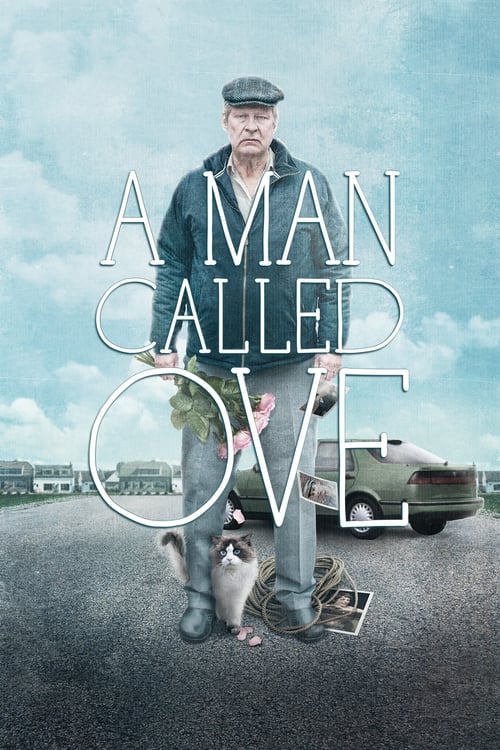
A Man Called Ove
2015 · Hannes Holm
For when you need a good cry and a good laugh in the same evening — a cozy, big-hearted film for a night in, ideally with someone to pass the tissues to. Pure comfort, honestly earned.
What it's about
Ove is fifty-nine, recently widowed, forced out of his job, and determined to be done with life — he's even deposed as president of his housing association, though he still patrols the neighborhood enforcing rules nobody else cares about. Then a pregnant Iranian-born neighbor, Parvaneh, backs her trailer into his mailbox, and her chaotic, warm-hearted family keeps interrupting his carefully planned exits. Flashbacks gradually reveal the marriage, and the losses, that made him this way.
The experience
It swings between laugh-out-loud grumpy-neighbor comedy and genuinely wrenching grief, and somehow the tonal whiplash works — you're chuckling one minute and blinking back tears the next. Warm at its core despite the darkness it handles.
Performances
Rolf Lassgård is wonderful as Ove, playing the bluster thin enough that you always see the heartbreak underneath; his scenes opposite Bahar Pars's warm, no-nonsense Parvaneh give the film its pulse.
The craft
Hannes Holm's adaptation of Fredrik Backman's bestseller braids present-day comedy with flashbacks so smoothly that the film's structure becomes its emotional engine — each return to the past deepens the joke or sharpens the ache. Unshowy, precise filmmaking in service of feeling.
Why it matters
One of the biggest domestic box-office successes in Swedish history and an Oscar nominee for Best Foreign Language Film, it carried Backman's novel to a global audience and later inspired an American remake.
Snapshot
A Man Called Ove (En man som heter Ove) is a Swedish tragicomedy adapted from Fredrik Backman's blockbuster 2012 debut novel of the same name. Directed and adapted for the screen by Hannes Holm, it centers on Ove, a rigid, grieving widower in his late fifties who patrols his terraced-housing enclave enforcing rules no one else observes, and whose repeated, thwarted attempts at suicide are interrupted by the noisy arrival of a new neighbor, the pregnant Iranian-born Parvaneh, and her family. The film braids present-day comedy of manners with extended flashbacks reconstructing Ove's life — his boyhood, his father, and above all his marriage to Sonja, whose death frames his despair. Released in Sweden in late 2015, it became one of the most commercially successful domestic films in the country's history and carried Swedish cinema to an unusually broad international art-house audience. It earned two Academy Award nominations at the 2017 ceremony — Best Foreign Language Film and Best Makeup and Hairstyling — a rare double for a Nordic comedy-drama, and was subsequently remade in Hollywood as A Man Called Otto (2022) with Tom Hanks. The film's cultural signature is its fusion of broad, almost slapstick misanthropy with a sentimental humanism that critics alternately praised for warmth and faulted for calculation.
Industry & production
The film was produced by Tre Vänner Produktion, the Stockholm company associated with Holm's work, with backing that reflects the standard Swedish public-private financing model: support from the Swedish Film Institute layered atop broadcaster and distributor investment, with Nordisk Film handling Swedish distribution. Its production logic was rooted in pre-sold intellectual property. Backman's novel had been a phenomenon — a long-running domestic bestseller that also became one of the most widely translated Swedish books of its generation — and the adaptation arrived with an unusually secure audience already primed. This is a defining industrial fact about the project: it was greenlit into a market that had proven appetite for the material, which shaped both its financing and its marketing as a national event picture rather than a speculative art film.
Commercially, the film was an exceptional performer at home, drawing one of the largest Swedish theatrical audiences of the decade; precise admission and gross figures circulate in trade reporting, but I will not assert a specific number I cannot verify here. Its international trajectory was equally notable for a subtitled comedy: a sustained art-house run in North America and elsewhere, unusual longevity for a foreign-language release, and the eventual Oscar nominations that consolidated its visibility. The clearest downstream industrial signal was the American remake rights being acquired and realized as A Man Called Otto, produced through Tom Hanks's Playtone with Sony's Columbia — a transaction that speaks to how legibly the property's emotional architecture translated across markets.
Technology
A Man Called Ove is, technologically, a conventional mid-2010s digital production, and its craft ambitions lie in period reconstruction rather than technical novelty. It was shot digitally, in keeping with standard Scandinavian practice by 2015, and its visual program is naturalistic: available-light-styled interiors, muted seasonal exteriors, and a restrained palette. The one domain where technology becomes genuinely central is prosthetic and cosmetic makeup. The film's structure demands that its characters be rendered across a span of decades — Ove as an old man and as a younger husband are played by different actors (Rolf Lassgård and Filip Berg), while other figures are aged within a single performer's arc — and the makeup and hairstyling work by Eva von Bahr and Love Larson was substantial enough to earn the Academy nomination. That recognition situates the film's key "technology" not in camera or post-production but in the physical, tactile craft of aging and transformation, an area in which von Bahr and Larson had already built a reputation in Swedish cinema.
Technique
Cinematography
The cinematography favors clarity and legibility over stylization, a fitting choice for a film whose emotional effects depend on the audience reading faces and small domestic gestures. The present-day material tends toward cool, overcast Nordic light and tidy, orderly framings that mirror Ove's compulsion for order; the flashbacks are handled with a warmer, softer register that marks them as memory and as the emotional home the present has lost. This tonal split between timelines is the camera's principal expressive device. Compositions are generally stable and unshowy, built around the terraced-house geography that organizes the story spatially. I am not able to confirm the director of photography's name with certainty from memory, and rather than misattribute the credit I flag it as a detail to verify against the film's titles.
Editing
Structurally, the film's most consequential craft decision belongs to the editing: the interleaving of present-tense comedy with chronological flashback. Each of Ove's suicide attempts becomes a narrative hinge that triggers a plunge into memory, so that the cutting pattern itself performs the story's central idea — that the impulse to die keeps summoning the life that was worth living. The editing must therefore manage tonal whiplash, sliding from near-farce (a botched hanging, an interrupted attempt) into grief without letting either mode curdle the other. Whether one finds the film manipulative or moving largely comes down to how one judges these transitions. The rhythm is measured and accessible rather than elliptical, prioritizing emotional readability.
Mise-en-scène / staging
Production design does quiet, precise work. Ove's home and the housing association's shared roadways are rendered as spaces of enforced order — no cars where cars are forbidden, correct recycling, closed gates — and this environment functions as an externalization of character. The flashbacks reconstruct earlier Swedish decades through cars, clothing, and interiors; the recurring motif of a specific automobile marque (Ove's brand loyalty and his contempt for those who drive otherwise) is a staging detail lifted from the novel that carries real characterological and comic weight. The neighborhood is effectively a single set-piece organism, and the blocking repeatedly returns to thresholds — doorways, gates, mailboxes — as sites where Ove's isolation is breached.
Sound
The score, which I believe is credited to composer Gaute Storaas (a credit worth confirming against the titles), works in a warm, melodic idiom that leans toward the film's sentimental pole, underscoring the flashbacks and the reconciliations. The sound design is otherwise naturalistic and domestic. Music is deployed to guide feeling fairly overtly, which is consistent with the film's populist emotional strategy rather than any impulse toward restraint.
Performance
Performance is the film's engine, and Rolf Lassgård's Ove is its decisive achievement. Lassgård — long established in Swedish cinema and television, including as an earlier screen Kurt Wallander — plays Ove's misanthropy as a brittle carapace over grief, letting the comedy of his rudeness and the pathos of his loss coexist in the same weathered face. The role depends on withholding: the audience must sense the tenderness he refuses to show. Bahar Pars, as Parvaneh, provides the counterweight — warmth, persistence, and an outsider's refusal to be intimidated — and their odd-couple dynamic supplies the film's forward motion. Filip Berg plays the young Ove and Ida Engvoll the young Sonja in the flashbacks, and the film's success hinges on the audience accepting the continuity between the younger and older selves, a bridge the makeup and the performances build together.
Narrative & dramatic mode
The dramatic mode is the redemptive tragicomedy: a curmudgeon softened by community, a grief-frozen man thawed by unexpected connection. Its formal spine is the counterpoint of two timelines — a present in which Ove is dismantling his life, and a past that reconstructs why that life mattered. The suicide attempts, played partly for dark comedy, are the structural device that keeps opening the door to the past; each failure returns him, and us, to Sonja. This is melodrama in the precise sense — a mode organized to produce and legitimize strong feeling — but leavened throughout by genuine comic timing. The film is unembarrassed about its emotional aims, and its narrative withholds and then releases the full weight of Ove and Sonja's story (including the losses that hardened him) as its culminating movement.
Genre & cycle
The film sits at the intersection of two recognizable cycles. The first is the international "grumpy old man redeemed" comedy-drama, a durable populist form. The second, and more locally specific, is the mid-2010s wave of Swedish comic literary adaptations pitched at global feel-good audiences — a cycle in which Backman's fiction and the earlier hit The Hundred-Year-Old Man Who Climbed Out the Window and Disappeared (2013) loom large. Notably, makeup artists von Bahr and Larson worked in that adjacent space as well, underscoring how a cluster of Swedish crackpot-humanist adaptations shared craft personnel and a commercial sensibility. Ove refined the formula toward sentiment more than absurdism, and its success helped define the exportable "Scandinavian heart-warmer" as a marketable category.
Authorship & method
The controlling authorship is doubled: Fredrik Backman as source author and Hannes Holm as writer-director. Holm — a filmmaker with a long background in Swedish popular comedy, including the Sunes films — adapted the screenplay himself, and the film bears the marks of a comedy craftsman's instinct for timing applied to melodramatic material. His method here is fundamentally one of faithful, audience-conscious adaptation: preserving the novel's structure of alternating past and present, its comic set pieces, and its emotional beats, while translating Backman's interior narration into the external business of performance and staging. Among key collaborators, Lassgård is effectively a co-author of the film's meaning through performance, and the makeup team of von Bahr and Larson are indispensable to the two-timeline conceit. I have flagged above the cinematography, editing, and music credits that I cannot state with full confidence; the honest scholarly position is that the film's technical authorship should be confirmed against its titles rather than asserted from memory, but its creative authorship plainly belongs to the Holm–Backman axis realized through Lassgård.
Movement / national cinema
The film belongs to contemporary Swedish popular cinema rather than to any avant-garde or auteurist movement. It is worth situating against the international image of Swedish film shaped by the austere art cinema of Ingmar Bergman on one hand and the globally successful Nordic-noir crime adaptations (the Millennium films, Wallander) on the other. Ove represents a third, commercially dominant strand: the domestically produced, broadly humanist crowd-pleaser, often literary in origin, that sustains the Swedish industry at the box office. Its reliance on Swedish Film Institute–style public support combined with strong national theatrical performance is characteristic of how a small-nation cinema funds and sells work that is simultaneously local in texture and universal in appeal. Its inclusion of Parvaneh's immigrant family also situates it, gently, within a multicultural contemporary Sweden.
Era / period
Produced and released in 2015, the film is a product of the streaming-transitional, digitally-shot mid-2010s, and of a moment when foreign-language crowd-pleasers could still achieve meaningful theatrical life abroad. But its imaginative center is retrospective: much of its running time reconstructs earlier postwar and late-twentieth-century Sweden through Ove's memories. The film thus operates on two period registers — a present of condominium associations, recycling rules, and laptops, and a past of railways, older automobiles, and a vanished working-class domesticity. Its nostalgia is not incidental; the contrast between an ordered, colder present and a warmer remembered past is the film's organizing emotional logic.
Themes
The dominant theme is grief and its ossification into anger: Ove's rudeness is legible throughout as unmetabolized mourning, and the arc traces the slow reopening of a man who has sealed himself off. Around this sit the film's other concerns — the redemptive power of community and chosen family against isolation and old age; the tension between rigid rule-following and human generosity (Ove's rules are both a comic flaw and a genuine, if misdirected, form of care); masculinity and its inarticulacy, particularly the inability to express love except through competence and repair; and, through Parvaneh's family, immigration and cross-cultural neighborliness in contemporary Sweden. Loyalty — to a spouse, to a brand of car, to a code of conduct — recurs as both punchline and moral value. The film ultimately argues that a life is redeemed not by grand acts but by being needed by the people next door.
Reception, canon & influence
Critical reception was broadly warm but not uncritical. The film was widely praised for Lassgård's central performance and for its skillful management of tonal shifts, and it connected powerfully with audiences, as its commercial performance attests. A recurring critical reservation, however, was that its sentiment could feel engineered — that the alternation of dark comedy and bereavement was a reliable machine for producing tears more than a searching examination of grief. This split verdict — crowd-pleasing warmth versus calculated manipulation — is the through-line of its critical record. Institutionally, the two Oscar nominations (Foreign Language Film and Makeup and Hairstyling) marked its high-water moment of prestige recognition.
Looking backward, the film's influences are primarily literary and generic: Backman's novel above all, and the broader tradition of the redemptive-curmudgeon comedy and of Swedish literary crowd-pleasers, with the near-contemporary Hundred-Year-Old Man as a clear sibling in tone, personnel, and commercial ambition. Looking forward, its most concrete legacy is twofold. First, it helped establish Fredrik Backman as a screen-adaptation property and cemented the international viability of the Swedish feel-good adaptation as an export category. Second, and most tangibly, it generated a Hollywood remake, A Man Called Otto (2022), directed by Marc Forster with Tom Hanks in the lead — a transfer that testifies to how cleanly the original's emotional architecture read to American producers, and that has since become the film's most visible point of reference for English-language audiences. Within the canon, A Man Called Ove is remembered less as a formal landmark than as a defining example of the twenty-first-century Scandinavian humanist crowd-pleaser at its most commercially and emotionally effective.
Reception
A blockbuster at home — one of the most-watched Swedish films ever in Sweden — it traveled abroad as a beloved crowd-pleaser, then got a second life in 2022 when the Tom Hanks remake (A Man Called Otto) sent people back to the original, usually with the verdict 'watch the Swedish one.'
How A Man Called Ove was received, from release to now →
How to watch A Man Called Ove: what to notice on a first viewing
- Notice the present look cooler than the flashback scenes. Holm shoots Ove's present in cool, overcast Nordic light and shifts to a warmer, softer register whenever the film drops into memory. The color alone tells you which timeline you're in before any date or context does.
- Watch how many scenes happen at a gate or doorway. Ove's confrontations and small connections keep happening at thresholds, doorways, gates, the mailbox, rather than inside any home. The thresholds mark exactly where his walled-off routine keeps getting interrupted by other people.
- Notice which car brand Ove drives and who he judges. Ove's loyalty to one car brand and his contempt for neighbors who drive anything else recurs across the film as a small, specific obsession. A tiny, stubborn loyalty stands in for everything else he can't say directly.
- Watch Ove's face right after he snaps at someone. Lassgard plays Ove's rudeness as a brittle shell, letting a flicker of something softer surface right after the outburst, then vanish again. You're meant to sense the tenderness before any character or flashback explains where it comes from.
- Track what triggers each jump back into Ove's past. Certain present-day moments keep opening a door straight into memory, cutting from Ove's routine into scenes of his younger life with Sonja. The past keeps interrupting the present, as if the life he once had won't stay buried.
The whole guide to watching A Man Called Ove, with the keys for a rewatch →
Influences: the films it descends from and the films it influenced
- Wild Strawberries (1957) — The Swedish forebear for interleaving an aged, emotionally calcified man's present-day journey with dramatized flashbacks in which he watches his own younger self and lost love.
- Harold and Maude (1971) — Codifies the deadpan staging of repeated suicide attempts as recurring comic set pieces rather than tragedy — the exact tonal maneuver Ove runs with its interrupted hangings and gassings.
- Terms of Endearment (1983) — The prototype tearjerker-machine whose calibrated oscillation between broad comedy and terminal bereavement is the 'tonal-whiplash-management' Ove inherits wholesale.
- Cinema Paradiso (1988) — Cross-cuts a bereaved present against a warmly-lit, score-saturated past so a sentimental melodic theme does the emotional lifting across the timeline split.
- Driving Miss Daisy (1989) — Uses progressive age makeup to carry a prickly protagonist's decades-long thaw within one continuous performance and dual-era structure.
- Scent of a Woman (1992) — Builds its redemption arc around a bitter man's rehearsed suicide, using the loaded weapon as the shared fulcrum of comedy and dread.
- As Good as It Gets (1997) — The rule-bound, routine-obsessed misanthrope whose rigid daily rituals are themselves the comic engine of his softening — Ove's association-policing pedantry descends from Melvin's.
- About Schmidt (2002) — The retired widower whose grief ossifies into fussy, letter-writing rigidity, released only through unglamorous incidental connection — Ove's 'grief-ossified-into-anger' template.
- Iris (2001) — Casts two actors as one person and cross-cuts radiant youth against aged decline to dramatize a marriage and its loss — the dual-actor-aging conceit Ove uses for young and old Ove.
- Gran Torino (2008) — Supplies the threshold-policing blocking: an armed, bereaved man surveilling his street from porch and driveway who ends up adopting the immigrant family next door.
- Up (2009) — The compressed, near-wordless marriage-and-loss montage that stakes a rigid old man's anger in specific grief before the present-day comedy is allowed to begin.
- Britt-Marie Was Here (2019) — The follow-on Fredrik Backman screen adaptation extending Ove's pipeline of externalizing an interior curmudgeon's narration into performance business and small-community staging.
- A Man Called Otto (2022) — The direct Hollywood remake that transplants Ove's flashback-interleaved architecture and thwarted-suicide comic structure intact onto a star lead, proving how cleanly the emotional blueprint travels.
- The Hundred-Year-Old Man Who Climbed Out the Window and Disappeared (2013) — Near-contemporary Swedish literary crowd-pleaser deploying the same prosthetic old-age makeup and flashback-interleaved structure around a deadpan elderly protagonist, sharing personnel and commercial ambition.
- Nebraska (2013) — The stubborn, near-mute elderly man whose fixed obstinacy is mined simultaneously for deadpan comedy and buried filial pathos — the same tragicomic register on a curmudgeon lead.
- St. Vincent (2014) — Pairs the abrasive old misanthrope with a young neighbor child as the precise mechanism of his thaw, mirroring Ove's disarming by Parvaneh's daughters.
- The Best Exotic Marigold Hotel (2011) — Contemporary silver-audience export crowd-pleaser engineering warmth from an elderly ensemble and gentle comedy — the same commercial category Ove exemplifies in Scandinavia.
Similar films
- A Man Called Otto (2022) — influence & lineage
- Sorry, Baby (2025) — same viewing thread
- All of Us Strangers (2023) — same viewing thread
- Twinless (2025) — same viewing thread
- How to Make Millions Before Grandma Dies (2024) — same viewing thread
- Rental Family (2025) — same viewing thread
- Sentimental Value (2025) — shared sensibility
- My Life as a Dog (1985) — shared sensibility
All the films related to A Man Called Ove →
Watch it with: curated runs of related films
- Funny Because It Aches — A run of tender, deadpan dramedies where love, grief, and the panic of becoming yourself all get metabolized through jokes — watch these when you want to laugh and cry in the same scene.