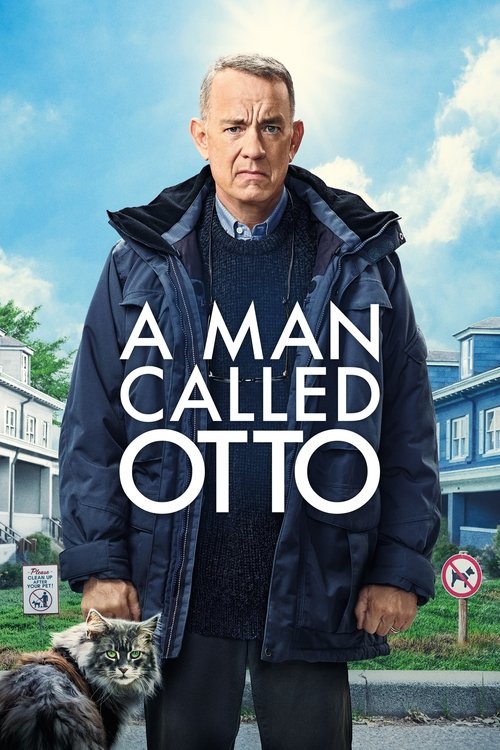
A Man Called Otto
2022 · Marc Forster
For a cozy, low-risk night when you want to laugh a little, cry a little, and end up feeling better about people — ideal for watching with parents or anyone who loves a grump-with-a-golden-heart story.
What it's about
Otto Anderson is a recently widowed retiree in a small Pittsburgh townhouse community, policing parking permits and recycling bins while privately deciding he's done with life. Then a young family moves in across the street, and Marisol — pregnant, sharp-tongued, and immune to his rudeness — simply refuses to leave him alone. What follows is an unlikely friendship story, with flashbacks slowly revealing the love and losses that made Otto who he is.
The experience
A gentle seesaw between chuckles and lump-in-throat moments — it's openly sentimental and knows it, handling heavy material (grief, despair) with a soft, reassuring touch. You can see where it's going, and that's part of the comfort.
Performances
Tom Hanks works against his warm persona as the bristling Otto, but it's Mariana Treviño who steals the film — her Marisol is funny, fast, and genuinely moving, and their chemistry is the engine of the whole thing.
The craft
Marc Forster keeps the tone carefully balanced, letting comedy defuse the story's darkest thread — Otto's despair — without trivializing it, while flashbacks to Otto's younger years give the present-day story its emotional foundation. It's handsome, unfussy filmmaking designed to serve the performances.
Why it matters
A remake of a beloved Swedish hit drawn from Fredrik Backman's bestselling novel, it became a word-of-mouth crowd-pleaser and a staple recommendation for viewers who want mainstream drama with heart.
Snapshot
A Man Called Otto is an English-language remake of the Swedish film A Man Called Ove (En man som heter Ove, 2015, dir. Hannes Holm), which was itself adapted from Fredrik Backman's best-selling 2012 novel of the same name. Directed by Marc Forster from a screenplay by David Magee, the film relocates Backman's story of a rigid, grief-stricken widower to a small townhouse community in Pittsburgh, Pennsylvania. Tom Hanks plays Otto Anderson, a recently widowed retiree whose meticulously enforced neighborhood rules and repeated, interrupted suicide attempts are gradually undone by the arrival of Marisol (Mariana Treviño), a pregnant, warm, unstoppably persistent new neighbor. The film sits at the intersection of gentle comedy and bereavement drama, using flashbacks to reconstruct Otto's love story with his late wife Sonya. It functions both as a late-career Hanks star vehicle produced through his own Playtone banner and as a mainstream American translation of a Scandinavian sentimental-comic property that had already proven internationally durable.
Industry & production
The film was produced by Hanks and Gary Goetzman's Playtone in partnership with SF Studios — the Swedish company that had backed the original Ove — along with Stage 6 Films, Artistic Films, and 2DUX², with Rita Wilson (Hanks's wife) among the producers. Columbia Pictures/Sony handled distribution. This ownership structure is significant: SF Studios' involvement kept the remake tethered to the rights-holders of the source material, while Playtone gave Hanks direct creative stewardship over a role clearly conceived as a fit for his persona. Hanks's son Truman Hanks was cast as the younger Otto seen in flashback, a piece of casting that doubles as a family-resemblance economy — the younger and older Otto read as continuous largely because they are literally related.
The production is a mid-budget adult drama of a kind that had become increasingly rare in theatrical release by the early 2020s, dependent on a bankable star rather than franchise IP. It opened in limited release in December 2022 to qualify for awards and expanded wide in January 2023. Precise budget and gross figures should be treated cautiously here; the reliable characterization is that it was a modest, adult-skewing commercial performer that outpaced the muted expectations for a sentimental remake, an outcome consistent with the counter-programming niche it occupied. I won't assign specific dollar figures, as I cannot verify them precisely.
Technology
A Man Called Otto is a conventionally produced digital feature with no notable technological innovation — nor did it aspire to any. It was shot digitally (the Pittsburgh production used practical suburban and townhouse locations), and its craft investment lies in performance, production design, and score rather than in visual-effects spectacle. The one technically demanding element is the film's staging of Otto's suicide attempts — a hanging rope, a car in a closed garage, a train platform — which required careful, safe mechanical setups and editing to render dark material as tonally survivable comedy-drama. Beyond this, the film's technology is unremarkable by design; it belongs to the tradition of the human-scaled studio drama for which invisible technique is the point. Specific camera and lens details are not something I can confirm without inventing them.
Technique
Cinematography
The cinematography, credited to Matthias Koenigswieser, favors a clean, warmly lit realism appropriate to the material. The visual scheme draws a deliberate contrast between two registers: the present-day sequences, keyed to Otto's constricted, gray, orderly world, and the flashbacks to his courtship of Sonya, which are rendered in noticeably warmer, softer, more golden light. This chromatic split does narrative work, letting the image itself carry the film's argument that Otto's severity is grief calcified over lost warmth. Framing tends toward the tidy and symmetrical in Otto's domain — visual correlatives of his rule-bound temperament — loosening as Marisol's chaos infiltrates his routines.
Editing
Matt Chessé, a longtime Forster collaborator, edited the film. The central editorial task is the interleaving of past and present: the flashback structure must deliver Sonya's story in fragments timed to deepen the present-day emotional beats without stalling the comedy. The cutting also has to manage a delicate tonal problem — the suicide attempts are structured as recurring interruptions, each begun in earnest and then broken off by a neighbor's intrusion, so the editing must land the gag rhythm without trivializing the despair beneath it. The film's pacing is deliberate and unhurried, trusting accumulation over momentum.
Mise-en-scène / staging
Production design centers on the townhouse row and its shared lanes, a contained community that operates almost as a single set — a stage on which Otto polices boundaries, sorts recycling, and confronts the encroaching outside world (represented by a predatory real-estate company). The domestic interiors register Sonya's absence as much as Otto's presence: the house is preserved as a shrine to a marriage. Marisol's household, by contrast, is staged as spillover and color, a visual antithesis to Otto's control. The staging repeatedly places Otto at thresholds — doorways, fences, curbs — literalizing a man guarding the perimeter of his grief.
Sound
Thomas Newman's score is the film's most distinctive sonic element (discussed further below). Beyond the music, the sound design is naturalistic and restrained, built around the quiet of a solitary house and the intrusive bustle of neighborhood life. The film also foregrounds a closing original song, "Til You're Home," performed by Rita Wilson and Sebastián Yatra, which was promoted during awards season; I'd flag that the songwriting credits and campaign details, while I'm fairly confident of Wilson's involvement, are worth verifying against primary sources rather than taking on my summary alone.
Performance
Performance is the film's true medium. Hanks calibrates Otto as curmudgeonly but legible, his gruffness always transparently a membrane over sorrow — a reading that some critics found too softened relative to Rolf Lassgård's flintier turn in the Swedish original. The film's discovery is Mariana Treviño as Marisol, whose comic timing, warmth, and refusal to be rebuffed give the movie its engine; much of the critical praise singled her out. Truman Hanks plays young Otto in flashback opposite Rachel Keller's Sonya, and the ensemble of neighbors fills out the community texture. The chemistry between Hanks and Treviño — antagonistic, then tender — is the relationship on which the entire film rests.
Narrative & dramatic mode
The film operates in the mode of the redemptive character comedy-drama: a closed, embittered protagonist is thawed through the persistent intervention of others. Structurally it is a dual-timeline narrative, cross-cutting Otto's present-day arc with the retrospective reconstruction of his marriage, so that the audience learns the origin of his rigidity in step with his tentative re-entry into life. The recurring suicide attempts supply the story's grim spine and its most unusual formal device — each attempt is framed as a would-be ending repeatedly deferred by the demands of the living, so that the community's neediness literally keeps Otto alive. The dramatic mode is fundamentally sentimental and consolatory: it moves toward reconciliation, chosen family, and the transmission of care. Its risk, which reviewers noted, is that the sentimentality can tip into the schematic, with obstacles (an intrusive developer, an estranged friend, a marginalized teenager, a stray cat) arranged as tidy occasions for Otto's rehabilitation.
Genre & cycle
A Man Called Otto belongs to the "grumpy old man redeemed" cycle — a durable strain of comedy-drama running from Gran Torino (2008) through St. Vincent (2014) and The Mule (2018), and, in its Scandinavian variant, the source Ove. These films pair a hardened, often bereaved older man with a younger, ethnically or generationally "other" figure whose warmth breaks him open; Otto's pairing of an aging white widower with a Mexican-immigrant neighbor sits squarely in this lineage. It also participates in the broader Hollywood cycle of English-language remakes of successful foreign-language films, and in the late-2010s/early-2020s tradition of grief-driven adult dramas built around a legacy star. Its comedy is character comedy rather than situation farce, and its drama is domestic melodrama, making it a hybrid squarely aimed at older mainstream audiences underserved by franchise cinema.
Authorship & method
Marc Forster's direction is best understood as adaptive and star-serving rather than authorial in a signature-stylist sense. Across a varied filmography — Monster's Ball (2001), Finding Neverland (2004), Stranger than Fiction (2006), The Kite Runner (2007), Quantum of Solace (2008), World War Z (2013), and Christopher Robin (2018) — Forster has repeatedly gravitated to stories of grief, whimsy, and emotional restoration, and Otto fits that thematic through-line more than any stylistic one. His method here is one of tasteful transposition: preserve the beats of a proven property, calibrate them to an American setting and an American star, and trust the actors.
The key collaborators reinforce this. Screenwriter David Magee, an experienced adapter of literary and sentimental material (Finding Neverland, Life of Pi, Mary Poppins Returns), was a logical choice to Americanize Backman via Holm's film. Composer Thomas Newman — who had scored Forster's Finding Neverland — brings his characteristic delicate, minor-key piano-and-strings idiom, lending the film emotional coherence and a recognizable sonic pedigree. Editor Matt Chessé is a recurring Forster partner, and cinematographer Matthias Koenigswieser executed the two-register visual design described above. The controlling authorial intelligence, arguably, is Hanks-as-producer-star: the project was shaped through Playtone to fit his persona, and its choices consistently soften the source material toward his register of decency.
Movement / national cinema
The film has no meaningful relationship to any avant-garde or aesthetic movement; it is a mainstream Hollywood studio production. Its most interesting national-cinema dimension is transnational: it is an American remake of a Swedish film, co-produced with the Swedish rights-holder SF Studios, and thus a case study in the flow of sentimental-comic properties from Scandinavian to Hollywood cinema. The original Ove was itself an unusually successful export — nominated for two Academy Awards (Best Foreign Language Film and Best Makeup and Hairstyling) — and Otto represents Hollywood's absorption of that success into the American idiom, complete with the addition of an immigrant-integration subplot that reframes the material around U.S. multicultural anxieties.
Era / period
A Man Called Otto is very much a film of its early-2020s moment. It arrived as theatrical exhibition was reorganizing around franchise tentpoles, with the mid-budget adult drama pushed increasingly toward streaming; the film's release strategy — an awards-qualifying December bow followed by a January wide expansion — reflects the narrowing theatrical window for such work. Its counter-programming success signaled a persistent, underserved appetite among older audiences. Thematically it also reflects post-pandemic preoccupations with isolation, loneliness, and the recovery of community, even though its story is not explicitly about the pandemic. Its handling of suicide, foregrounded rather than euphemized, likewise reflects a period of greater cultural willingness to depict mental-health crisis directly in mainstream entertainment.
Themes
The film's governing themes are grief and its calcification into anger; the persistence of the living against the pull of despair; and the reconstitution of family by choice rather than blood. Otto's rigidity is presented as love with nowhere to go after Sonya's death, and the narrative's therapeutic logic holds that connection — being needed — is what makes continued life bearable. Secondary themes include community versus corporate encroachment (the developer subplot pits neighborly solidarity against real-estate predation), immigration and cross-cultural friendship, and intergenerational care. Disability and inclusion surface through Sonya's story and through a marginalized young character Otto comes to protect. Underlying all of these is a broadly humanist creed: that decency, patience, and small acts of maintenance — quite literally the fixing of broken things — are how a life and a community are held together.
Reception, canon & influence
Critical reception was mixed-to-positive. Reviewers broadly praised the film's craft and its performances while questioning whether the remake justified itself against the Swedish original. The most consistent line of praise went to Mariana Treviño, widely regarded as the film's breakout and its comic and emotional lifeblood; Hanks drew respectful notices, though some critics felt his innate likability blunted Otto's abrasiveness and that the film sanded down the original's rougher edges into calculated warmth. A recurring critical reservation was the material's sentimentality and its schematic assembly of obstacles for the protagonist to overcome.
The influences on the film are direct and traceable: Backman's 2012 novel; Hannes Holm's 2015 Oscar-nominated adaptation, which supplied the structural template; and the broader "redeemed misanthrope" genealogy (Gran Torino and its kin). Forster's own recurring interest in grief and restoration, and Thomas Newman's established scoring idiom, further shaped its texture.
Its forward influence is more modest. As a late-career Hanks vehicle and a commercially viable adult drama, it offered evidence — alongside a handful of contemporaneous titles — that star-driven, non-franchise dramas could still find a theatrical audience, a data point of some interest to an industry debating the form's survival. It is unlikely to be canonized as a landmark; its lasting significance is better located in Treviño's raised international profile and in the film's status as a clean example of transnational sentimental-property adaptation. Where the longer-term record of its influence is genuinely thin this soon after release, it is honest to say so rather than overstate a legacy that has not yet had time to form.
A Deleuzian reading
The rope is up.
The full Deleuzian reading of A Man Called Otto →
Reception
Critics shrugged at it in January 2023 as a softened American remake of A Man Called Ove, but audiences turned it into a sleeper hit — it quietly grossed over $100 million worldwide and became one of the rare recent wins for a mid-budget, star-driven adult drama.
How A Man Called Otto was received, from release to now →
How to watch A Man Called Otto: what to notice on a first viewing
- Watch the present-day scenes stay gray and orderly. Otto's world is shot in cool, tidy, symmetrical light while the flashbacks to his courtship glow warmer and softer, marking two different periods through color alone. You can tell which timeline you are in before a single date or caption tells you.
- Notice Otto standing at doorways, fences, and curbs. The staging keeps placing him at the edge of his own property, guarding a boundary rather than standing inside a room with other people. The line he keeps guarding is a stand-in for the grief he won't let anyone cross into.
- Track when the film cuts back to his younger years. The editing interleaves Sonya's courtship story in fragments, each one timed to land right after a present-day beat it deepens. You learn the reason for his rigidity in step with watching him let it go, not before.
- Watch Marisol refuse to take no for an answer. Treviño plays her with constant forward momentum, warmth and comic timing that keeps pushing into Otto's routines no matter how many times he shuts a door on her. Her persistence, not any single speech, is the actual engine changing him scene by scene.
- Listen for the piano entering during quiet, ordinary scenes. Thomas Newman's minor-key piano and strings arrive gently under small domestic moments rather than only at obviously dramatic ones. The music treats an ordinary morning as worth the same care as any big scene, which tells you what kind of story this is.
The whole guide to watching A Man Called Otto, with the keys for a rewatch →
Influences: the films it descends from and the films it influenced
- A Man Called Ove (2015) — The direct source: supplies Otto's exact structural engine — a suicide attempt repeatedly interrupted by a nosy new neighbor, each aborted death cueing an interleaved childhood/marriage flashback in a warmer register.
- Gran Torino (2008) — Codifies the bigoted-widower-redeemed-by-immigrant-neighbors template Otto inherits, including the porch/threshold blocking where the curmudgeon polices his property line before being pulled across it into community.
- Up (2009) — Models the wordless married-life-to-widowhood montage that lets a grieving old man's backstory play as a parallel bright-lit timeline against his desaturated present — Otto's two-register flashback logic in miniature.
- About Schmidt (2002) — Establishes the deadpan portrait of a retired widower adrift in routine and hostile to the world, the calcified-grief-as-anger characterization Otto softens toward Hanks's register of decency.
- As Good as It Gets (1997) — The template for a rigid misanthrope thawed by a vivacious outsider whose warmth carries the comedy — the Treviño-to-Hanks dynamic descends directly from this comic-abrasion-melting-into-care structure.
- Harold and Maude (1971) — Pioneers staging suicide as recurring deadpan comic set-piece rather than tragedy, the deferred-suicide gag logic Otto adopts each time a neighbor's knock interrupts the noose or the exhaust hose.
- Finding Neverland (2004) — The Forster–Newman–Magee collaboration originates here: Thomas Newman's minor-key piano-and-strings idiom and David Magee's sentimental literary adaptation method are the exact craft toolkit reused on Otto.
- Road to Perdition (2002) — Pairs Thomas Newman's elegiac scoring with Hanks cast against his likability into a grief-stricken, closed-off man — the same Newman-texture-plus-Hanks-against-warmth calibration Otto performs.
- Stranger than Fiction (2006) — Forster's other film built around a man rehearsing his own death, using symmetrical, controlled framing of a routine-bound loner as the visual grammar of emotional restriction Otto reprises.
- The Straight Story (1999) — A restrained elderly-grief drama whose patient, unironic sentiment toward an old man reckoning with mortality is the tonal-modulation Otto aims for beneath its comedy.
- St. Vincent (2014) — Extends the grumpy-old-man-redeemed genre through the same device — a hostile aging man softened by a child/single-parent household next door — mid-budget adult dramedy built on abrasion yielding to chosen family.
- The Mule (2018) — Eastwood again mines the estranged elderly patriarch whose gruffness masks unprocessed loss, the calcified-grief characterization Otto shares, staged around neighborhood and community obligation.
- Nebraska (2013) — Deploys a taciturn, difficult old man whose interiority surfaces through flashback and a younger caretaker's persistence — the interleaved-past-reveals-tenderness method Otto uses on Treviño.
- A Beautiful Day in the Neighborhood (2019) — A contemporaneous mid-budget adult drama engineered entirely around Hanks's persona of radiant decency thawing a hardened man — the Hanks-as-emotional-solvent casting logic Otto inverts by making him the one thawed.
- Sully (2016) — Evidence, alongside Otto, that a star-driven non-franchise Hanks vehicle could still be sold theatrically as a restrained, craft-forward adult drama — the same mid-budget commercial proposition.
- The Upside (2019) — Another American remake of a European sentimental crowd-pleaser about a closed-off man reopened by an unlikely companion — the transnational-property-Americanized-for-a-star adaptation model Otto exemplifies.
Similar films
- A Man Called Ove (2015) — influence & lineage
- Road to Perdition (2002) — influence & lineage
- Remarkably Bright Creatures (2026) — same viewing thread
- The Son of a Thousand Men (2025) — same viewing thread
- Touch (2024) — same viewing thread
- Rental Family (2025) — shared sensibility
- Fatherland (2026) — shared sensibility
- Ghostlight (2024) — shared sensibility
All the films related to A Man Called Otto →
Watch it with: curated runs of related films
- The Quiet Thaw of Grief — A run of hushed, big-hearted films where a widow, a widower, or a withdrawn child is coaxed back toward life by one unlikely bond — watch them near each other when you want to be moved, not wrung out.