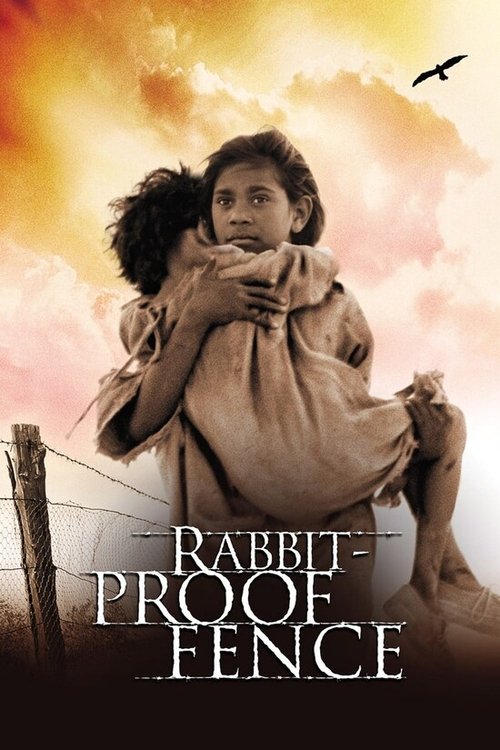
Rabbit-Proof Fence
2002 · Phillip Noyce
For when you want a true story that moves you and means something — a film to watch with your heart in your throat and talk about after. It's emotionally demanding but never punishing, and it earns every tear.
What it's about
In 1931 Australia, three Aboriginal girls — fourteen-year-old Molly, her little sister Daisy, and their cousin Gracie — are taken from their families under government policy and shipped to a settlement to be trained as domestic servants. They escape and set out to walk home across 1,500 miles of Outback, using the country's endless rabbit-proof fence as their guide, with an expert tracker and a determined bureaucrat on their trail. It's a survival story drawn from a true chapter of the Stolen Generations.
The experience
Spare, quiet, and steadily gripping — the tension comes not from chases but from distance, heat, and the girls' sheer stubbornness. It's heartbreaking without being manipulative, and the injustice of it burns slowly under everything.
Performances
Everlyn Sampi, a first-time actor, carries the film as Molly with a watchfulness and resolve that feel completely unperformed; Kenneth Branagh plays the government official with chilling, soft-spoken conviction rather than cartoon villainy.
The craft
Christopher Doyle shoots the Outback as both vast beauty and vast threat — shimmering horizons, red earth, heat you can feel — while Peter Gabriel's score hums underneath like the land itself. Phillip Noyce keeps the storytelling lean and unsentimental, trusting faces and landscape over speeches. It rewards a big screen for the sheer scale of the country the girls cross.
Why it matters
Arriving amid Australia's fierce public debate over the Stolen Generations, it put that history in front of audiences worldwide and became one of the defining Australian films of its era, marking Noyce's return home after a decade in Hollywood.
Snapshot
Rabbit-Proof Fence dramatizes a true episode from the history of Australia's Stolen Generations: the 1931 removal of three Aboriginal girls — Molly, her younger sister Daisy, and their cousin Gracie — from their families at Jigalong in Western Australia, and their subsequent escape from the Moore River Native Settlement and roughly 1,500-mile walk home, navigating by the great rabbit-proof fence that bisects the state. Adapted by Christine Olsen from Doris Pilkington Garimara's book Follow the Rabbit-Proof Fence, the film is at once an intimate survival narrative and a quiet indictment of a state bureaucracy of assimilation. It marked Phillip Noyce's deliberate return to Australian filmmaking after more than a decade in Hollywood, and arrived in the thick of Australia's "history wars" over how the nation should reckon with its treatment of Indigenous people. Spare, landscape-driven, and emotionally restrained, it became one of the most internationally visible Australian films of its era and a touchstone in popular understanding of the Stolen Generations.
Industry & production
The film was produced through Australian channels — Noyce's own involvement alongside writer-producer Christine Olsen and producer John Winter, with backing from the Australian Film Finance Corporation and other domestic agencies, and international distribution that carried it well beyond Australia (Miramax handled the U.S. release). It was, by the standards of Australian production, a substantial but not blockbuster-scale undertaking: its ambitions lay in landscape and authenticity rather than spectacle.
The project's defining production challenge was casting. The three central roles required Aboriginal girls who could carry an almost wordless, physically punishing film, and the production conducted an extensive search across Indigenous communities. Everlyn Sampi (Molly), Tianna Sansbury (Daisy), and Laura Monaghan (Gracie) were non-professionals, and the shoot was organized around protecting and supporting them through demanding location work in the Western Australian interior and at Bon Bon Station and other outback sites. Noyce has spoken in interviews about the difficulty of sustaining the girls' performances and the welfare considerations the production built around them; the on-set realities of working with child first-time actors in remote conditions shaped both schedule and method.
Crucially, the film was made in consultation with the people whose history it tells. Doris Pilkington Garimara — Molly's daughter and the book's author — and surviving family connections lent the production its claim to authenticity, and the participation of Aboriginal communities was central to the film's standing. This was a film acutely aware that it was handling living memory and contested national history.
Technology
Rabbit-Proof Fence was shot photochemically on 35mm film, the standard for theatrical features of its moment, and conceived as a widescreen landscape picture. Its technological signature is less about novel apparatus than about the expressive use of conventional tools: anamorphic-scale compositions, natural and available light, and the manipulation of color and exposure to render the outback as both beautiful and hostile. Cinematographer Christopher Doyle, working far from the neon interiors that made his reputation, treated the Australian light as the film's primary instrument. The production also leaned on Peter Gabriel's score, built substantially from electronic textures, sampled and world-music sources, and processed vocal sound — a sonic technology that sits in productive tension with the period setting. Beyond this, the record of the film's technical pipeline is not the subject of extensive documentation, and I will not speculate about specifics that aren't well established.
Technique
Cinematography
The casting of Christopher Doyle is one of the film's most intriguing creative decisions. Doyle, Australian-born but globally identified with the restless, saturated handheld style of his Hong Kong collaborations with Wong Kar-wai, here works in an almost opposite register. The film favors wide, patient framings that set the small figures of the girls against vast, indifferent country — salt pans, scrub, sky — and uses the horizontal line of the fence as a compositional and narrative spine. The palette runs to bleached ochres, dust, and hard light, with the landscape rendered as simultaneously gorgeous and punishing. There are moments of Doyle's characteristic intimacy — close attention to faces, to texture, to the children's exhaustion — but the dominant gesture is one of scale, the human story dwarfed by the geography it must cross. The cinematography does much of the film's emotional and political work without dialogue.
Editing
John Scott's editing privileges duration and restraint. The film's central act is essentially a long walk, and the cutting allows the journey to register as ordeal — measured rhythms, a sense of distance accumulating — rather than collapsing it into montage. The film cross-cuts between the girls on their trek and the apparatus pursuing them: A.O. Neville in his Perth office, the tracker Moodoo, the telegraph and police network that hunts them. This parallel structure builds tension while drawing a clear line between the bodies on the land and the bureaucracy that claims authority over them. The editing resists melodramatic acceleration, trusting the situation's inherent stakes.
Mise-en-scène / staging
The staging consistently opposes two worlds: the open, unbounded country the girls belong to, and the institutional spaces of removal — the settlement dormitory, Neville's office with its filing systems and photographs, the church and schoolroom of forced assimilation. The Moore River settlement is staged as a place of order and confinement, and the film stages the machinery of policy — the measuring of skin color, the classifying of children — with a chilling matter-of-factness. Against this, the outdoor staging is loose, exposed, governed by weather and terrain. The fence itself is the film's central object, a line of human engineering that the girls turn from an instrument of colonial control into a means of homecoming.
Sound
Peter Gabriel's score, released as the album Long Walk Home: Music from the Rabbit-Proof Fence, is among the film's most discussed elements. It blends electronic ambience, percussion, and vocal textures into something deliberately non-naturalistic, evoking emotion and journey rather than period detail. Beyond the score, the film's sound design draws on the acoustic emptiness of the outback — wind, distance, the relative absence of human noise — to reinforce isolation. Dialogue is sparing, particularly among the girls, and the sound mix lets silence and landscape carry weight. The contrast between the organic environmental sound and Gabriel's processed score is part of the film's texture.
Performance
The film rests on three non-professional child performers, and its achievement is largely theirs. Everlyn Sampi, as Molly, anchors the film with a performance built on watchfulness, determination, and physical endurance rather than spoken eloquence; the role demands she communicate resolve and fear across a near-wordless arc. Tianna Sansbury and Laura Monaghan complete the trio. Against these unschooled, naturalistic presences, Kenneth Branagh plays A.O. Neville with deliberate, soft-spoken conviction — not a cartoon villain but a self-assured administrator certain of his benevolence, which makes the character more disturbing. David Gulpilil, the foundational figure of Aboriginal screen acting since Walkabout (1971), brings gravity and ambivalence to Moodoo, the Aboriginal tracker conscripted to hunt the very children he might identify with. The friction between professional and non-professional performance styles is part of the film's design.
Narrative & dramatic mode
The film operates as a survival-quest narrative grafted onto a historical-testimony mode. Its forward engine is simple and elemental — children trying to get home — and it deploys the classic structures of the chase and the journey: pursuit, hardship, the threat of recapture, the kindness and betrayal of strangers along the way. But this genre scaffolding is in service of bearing witness. The film frames itself explicitly as true history (it opens and closes with framing that grounds it in the real lives behind the story), and its dramatic mode is one of restraint rather than catharsis. It withholds easy sentiment and refuses to soften the institutional violence at its center, while also declining to wallow in atrocity. The emotional climax is homecoming, but the closing material — connecting the film to the women's actual later lives — denies the audience a clean triumph, insisting on the long shadow the policy cast.
Genre & cycle
Rabbit-Proof Fence sits at the intersection of several traditions. It is a historical drama and a "based on a true story" testimony film; it is an outback survival/journey film, drawing on Australia's deep cinematic relationship with landscape; and it belongs to a cycle of Indigenous-themed Australian cinema that runs from Walkabout (1971) and The Chant of Jimmie Blacksmith (1978) through to later works like Australia (2008), Samson and Delilah (2009), and Sweet Country (2017). Within that lineage it is part of a turn-of-the-millennium wave of films and public reckonings addressing the Stolen Generations directly, following the watershed Bringing Them Home report of 1997. It can also be read against the international cycle of post-colonial reckoning films of its period.
Authorship & method
Phillip Noyce's career gives the film a particular charge. Having begun in the politically engaged Australian New Wave (Newsfront, 1978) before becoming a reliable Hollywood craftsman of thrillers (Dead Calm, Patriot Games, Clear and Present Danger, The Saint, The Bone Collector), Noyce used 2002 to return to smaller, more personal, politically pointed filmmaking, releasing both Rabbit-Proof Fence and The Quiet American the same year. Rabbit-Proof Fence reflects a thriller director's command of suspense and pursuit applied to a story of moral seriousness.
His key collaborators shape the result decisively. Christine Olsen wrote the screenplay and championed the adaptation of Doris Pilkington Garimara's book, and her script's spareness is central to the film's effect. Christopher Doyle's cinematography reframes the outback through an unexpected sensibility. Peter Gabriel's score provides the film's emotional through-line. Editor John Scott controls its rhythm. And the film is, finally, co-authored in a real sense by the Aboriginal community and family members whose history it represents — a collaboration that is part of its claim to authority. The source author, Doris Pilkington Garimara, telling her own mother's story, is the originating voice behind the whole enterprise.
Movement / national cinema
The film is a significant entry in Australian national cinema and specifically in the strand of that cinema concerned with Indigenous history and the moral foundations of the settler nation. Australian film has long been preoccupied with landscape and with the white relationship to "the bush"; Rabbit-Proof Fence pointedly recenters that landscape as Aboriginal country and the white presence as one of administrative violence. It is part of the broader project, gathering force from the 1990s onward, of Indigenous self-representation and of mainstream Australian cinema confronting the Stolen Generations. While not itself an Aboriginal-authored film in the way of later Indigenous-directed works, it was a high-profile bridge toward greater Indigenous visibility and centrality in the national screen culture.
Era / period
Set in 1931, the film depicts the operation of Western Australia's assimilation policies under the real-life A.O. Neville, "Chief Protector of Aborigines," and the legal regime that authorized the removal of "half-caste" children to be trained for domestic and manual labor and absorbed into white society. It renders the Depression-era apparatus of settlements, trackers, telegraph lines, and protectors with documentary attention. But the film's "era" is double: made in 2002, it speaks directly to its own moment of national debate. It appeared amid the so-called history wars, the controversy over whether and how Australia should acknowledge and apologize for the Stolen Generations — a debate that would culminate, years after the film, in the federal apology of 2008. The film is thus both a period reconstruction and an intervention in a live contemporary argument.
Themes
At its core the film is about belonging — to family, to country, to a way of life — and the violence of severing those bonds in the name of "protection" and "uplift." It dramatizes the bureaucratic rationalization of cultural destruction: Neville is the embodiment of a paternalism that believes it is doing good, which the film treats as more insidious than mere cruelty. Race and the policing of blood and color are explicit subjects — the classifying gaze that sorts children by skin tone. The fence itself becomes a rich symbol: a colonial imposition on the land repurposed as a thread of return, an emblem of how Indigenous knowledge and orientation can turn the colonizer's structures to its own ends. Maternal love and memory frame everything; the film is finally a daughter's testimony to her mother's endurance. Survival, navigation, and the relationship between people and land are its connective tissue.
Reception, canon & influence
Rabbit-Proof Fence was widely praised on release, particularly for the performances of its young leads, Doyle's cinematography, and its restrained handling of charged material; it won the Australian Film Institute Award for Best Film and figured prominently in that year's domestic honors. Internationally it reached audiences far beyond the usual range of an Australian historical drama, helped by its distribution and by Branagh's and Gabriel's involvement. It also drew criticism within the history wars: some commentators disputed elements of the historical record and the film's framing, and these contestations became part of its public life — a sign of how directly it touched a national nerve. The participation and later reflections of the real Molly Craig and the film's relationship to the documented history were debated in the press.
Looking backward, the film draws on a deep tradition of Australian landscape cinema and on the lineage of Indigenous-themed films running back to Walkabout — a connection underscored by David Gulpilil's presence, linking 2002 to 1971. It also belongs to the post-Bringing Them Home climate of reckoning.
Looking forward, its legacy is twofold. As popular history, it became one of the principal means by which audiences inside and outside Australia came to understand the Stolen Generations, frequently cited in the lead-up to the 2008 national apology and used widely in education. As cinema, it reinforced the viability and visibility of Indigenous-centered Australian storytelling, contributing to a climate in which later films — from Australia to the Indigenous-directed work of the following decade — could reach mainstream audiences. For Noyce, it stands as the film that reconnected a globalized thriller director to the politically committed cinema of his origins. Its lasting standing rests on the rare combination of a gripping, elemental story and a serious moral and historical reckoning, carried by three children walking home along a fence.
A Deleuzian reading
A single wire runs to the horizon, and a girl puts her hand on it.
The full Deleuzian reading of Rabbit-Proof Fence →
Reception
Acclaimed on release and a winner of the AFI Best Film prize, it immediately became a flashpoint in Australia's 'history wars,' with conservative columnists attacking its accuracy while much of the country embraced it. Two decades on it's settled into the canon as THE Stolen Generations film — required viewing in Australian classrooms.
How Rabbit-Proof Fence was received, from release to now →
Influences: the films it descends from and the films it influenced
- Lion (2016) — Contemporary Australian precedent for lost children traversing vast terrain to return home, using aerial/wide landscape photography of the child against enormous distance as the film's central formal gesture.
- Walkabout (1971) — The direct ancestor in casting and image-grammar — it launched David Gulpilil, whose presence Noyce uses to bridge 1971 to 2002, and established the template of children crossing the outback with the land framed as an active force rather than backdrop.
- Picnic at Hanging Rock (1975) — Models the staging opposition Noyce inherits: a starched colonial institution (school/orphanage) set against an inscrutable, sacred Australian landscape, sustained by duration restraint and environmental sound instead of plot.
- The Chant of Jimmie Blacksmith (1978) — The New Wave precedent for dramatizing assimilation-era racial policy and Aboriginal experience on screen, establishing that Australian historical cinema could indict the national record directly.
- Newsfront (1978) — Noyce's own origin in politically committed, documentary-inflected national-history filmmaking — the 'true-history framing' instinct he returns to here after two Hollywood decades.
- The Searchers (1956) — Supplies the abduction-and-pursuit architecture staged across monumental landscape, which Rabbit-Proof Fence inverts — the abducted children become the searchers, walking home along the fence rather than being hunted by a white avenger.
- In the Mood for Love (2000) — The immediate showcase of Christopher Doyle's method — natural light, expressive handheld intimacy, saturated framing of faces — the sensibility Doyle transplants onto the outback to 'reframe' it.
- The Last Temptation of Christ (1988) — Peter Gabriel's 'Passion' score pioneered the ambient world-music idiom — ethnographic textures and wordless emotional drone — that Gabriel reprises to carry Rabbit-Proof Fence's through-line.
- Dead Calm (1989) — Where Noyce honed the suspense-and-pursuit craft — sustained tension, the relentless chaser — that he repurposes here so a child's walk home plays with thriller momentum.
- The Tracker (2002) — A 2002 sibling: another Gulpilil-anchored outback pursuit film centering Indigenous experience, sharing the moment's turn toward landscape as moral terrain.
- Beneath Clouds (2002) — Sibling in performance and form — Indigenous youth on a cross-country journey carried by non-professional leads and unforced natural-light landscape framing.
- Whale Rider (2002) — Contemporary sibling built on the same gamble Noyce makes — an Indigenous child protagonist whose emotional authority rests entirely on a non-professional young performer.
- The Quiet American (2002) — Noyce's twin 2002 release and the other half of his return to political cinema, applying genre command to morally serious, historically grounded material.
Similar films
- Walkabout (1971) — influence & lineage
- The Proposition (2005) — influence & lineage
- Picnic at Hanging Rock (1975) — influence & lineage
- Meek's Cutoff (2011) — shared sensibility
- The Nightingale (2018) — shared sensibility
- All That's Left of You (2025) — shared sensibility
- Kannathil Muthamittal (2002) — shared sensibility
- The Quiet Girl (2022) — shared sensibility
All the films related to Rabbit-Proof Fence →
Watch it with: curated runs of related films
- Bearing Witness — Watch these when you want cinema as testimony — ordinary people caught between armies, borders, prisons, and markets, filmed close to the ground and close to documentary.