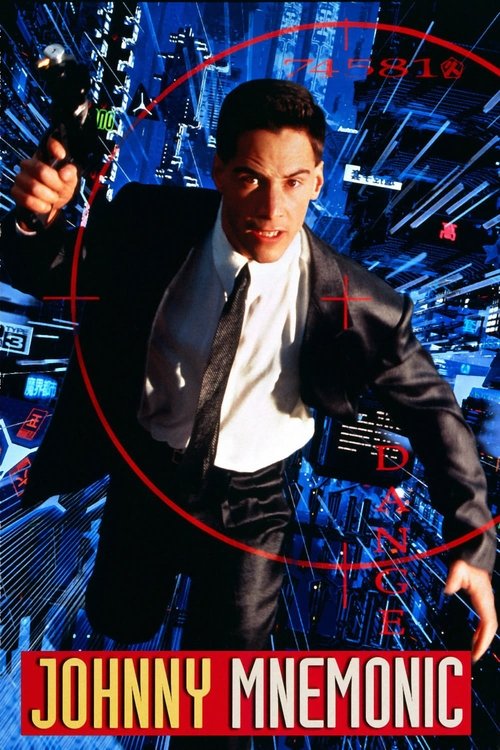
Johnny Mnemonic
1995 · Robert Longo
For a popcorn night when you want retro-future cheese with real ideas buried inside — pure comfort for cyberpunk nostalgics, not for anyone craving subtlety.
What it's about
In a corporate-ruled 2021, Johnny is a courier who smuggles sensitive data inside a storage implant in his own skull. He accepts a payload far over his safe limit — one that will kill him if it isn't extracted in time — and discovers it's information powerful people will slaughter to recover, sending him on a frantic run through an underworld of hackers, street rebels, and hired killers.
The experience
Pulpy, breakneck, and gloriously dated — chrome, neon, VR gloves, and growling villains. It plays best as a fast, campy ride: half thriller, half time capsule.
The craft
Directed by visual artist Robert Longo from William Gibson's own script, it renders 'cyberspace' in gleaming mid-'90s computer graphics — a sincere, now-charming attempt to put the internet on screen before most audiences had ever seen it. The production design piles on cyberpunk texture: data cartels, back-alley surgeons, a world sick from its own technology.
Why it matters
The first film adapted from Gibson, the writer who codified cyberpunk; a flop on release, it has been reclaimed as a cult artifact whose data-smuggling, information-plague future looks eerily prophetic.
Snapshot
Johnny Mnemonic is the first feature film directed by the American visual artist Robert Longo, and the first theatrical adaptation of the work of William Gibson, the novelist whose 1980s fiction had effectively codified the cyberpunk genre. Adapted by Gibson himself from his own 1981 short story, it casts Keanu Reeves as a near-future "mnemonic courier" who smuggles data inside a surgically implanted brain storage device, and who takes on a payload so large it threatens to kill him unless he can have it extracted in time. Around this race-against-the-clock thriller the film assembles a dense cyberpunk world: a corporate-dominated 2021 of information cartels and street resistance, a population afflicted by a technology-borne plague, and a virtual-reality "cyberspace" rendered in the early computer graphics of the mid-1990s. The result is one of the most ambitious attempts to put Gibson's imagined future on screen and, simultaneously, one of the more conspicuous commercial and critical misfires of its moment — a film whose reach exceeded its grasp at the time, but which has since accrued interest both as a cyberpunk artifact and as a curious node in Keanu Reeves's career, arriving four years before The Matrix would realize many of the same ideas to vastly greater acclaim. It is best understood as a fascinating, uneven object: an art-world director and a foundational genre writer collaborating on a studio science-fiction picture, with all the friction that implies.
Industry & production
Johnny Mnemonic was a Canadian–American production, financed and distributed in the United States by TriStar Pictures (a Sony/Columbia label) and produced through Canadian channels with Alliance Communications involvement; the producer of record was the prolific Don Carmody. It was shot largely in Toronto and Montreal, whose architecture and infrastructure stand in for a generic, deteriorated near-future metropolis — a practical economy typical of Canadian-based genre production of the period. The reported budget, commonly cited in the region of the mid-twenty-millions of dollars, was substantial without being blockbuster scale, and the film's spending is visibly concentrated in its production design, effects, and a roster of cult-recognizable performers.
The project's origins lie in the friendship and artistic affinity between Gibson and Longo. Longo, a leading figure of the New York "Pictures Generation" of the late 1970s and 1980s — best known for the Men in the Cities series of large charcoal drawings of contorted figures in business dress — had moved into directing music videos (including work for R.E.M. and New Order) before this feature. The two had reportedly developed the idea over time, and Gibson wrote the screenplay, expanding his compact short story into a feature-length narrative with new characters, a larger plot, and a sustained world.
A significant industrial fact shapes the film: the existence of two materially different versions. The filmmakers' preferred cut, which circulated in Japan, is generally reported to be longer, differently scored, and tonally distinct from the version TriStar released in North America. The American studio is widely understood to have recut the film for domestic release — including the imposition of a more conventional, expository shape — over the objections of its makers. This divergence is central to the film's later reputation, with advocates arguing that the Japanese cut better represents Longo and Gibson's intentions. The precise contractual and editorial history is murkier than fan accounts sometimes suggest, and claims beyond the broad fact of two distinct cuts should be treated cautiously.
Technology
Technologically, Johnny Mnemonic is notable chiefly for its ambitious, period-bound attempt to visualize cyberspace — the consensual data-network "matrix" that Gibson's fiction had described in prose but which no film had yet seriously rendered. The film depicts Johnny "jacking in" via VR headset and wired data-gloves to navigate a three-dimensional graphical internet, realized through mid-1990s computer-generated imagery. This places the film at the leading edge of a brief cycle of CGI-cyberspace movies (alongside The Lawnmower Man and Hackers), and its virtual sequences are very much of their technological moment: blocky, luminous, abstract geometries that read today as a dated but historically important snapshot of how the digital realm was imagined before the actual World Wide Web's iconography had settled. The film's production used the era's emerging digital compositing and CG tools rather than any single proprietary breakthrough; the record does not support claims of a landmark technical innovation, and its interest is less in what it pioneered than in how vividly it embodies a specific instant in the popular visualization of the net.
Technique
Cinematography
The cinematography is by François Protat, a veteran lensman of Canadian and international productions. The film's visual scheme is the familiar cyberpunk register of the period — wet streets, sodium and neon, hard fluorescent interiors, and the contrast between sterile corporate environments and the cluttered, improvised spaces of the underclass. Longo's background as a visual artist is legible in the compositions, which favor strong graphic shapes and a certain frontal, poster-like staging, though the studio recut and the demands of the action genre work against any sustained pictorial program. The look is competent and atmospheric rather than revelatory; where it is most distinctive is in the deliberately artificial, high-contrast handling of the virtual-reality material against the grimier photography of the physical world.
Editing
The editing is credited to Ronald Sanders, long associated with David Cronenberg's films — a notable pedigree for a body-and-technology story of this kind. The released North American version is, however, the most contested aspect of the film's construction: it carries the marks of studio reshaping, including expository framing that narrows the narrative's ambiguities. The pacing of the domestic cut is widely felt to be uneven, lurching between exposition-heavy passages and action set-pieces, and the divergence from the longer Japanese version suggests that the editing we mostly see is not fully the editor's or director's preferred shape. This makes the film a genuine case where editorial authorship is clouded by post-production intervention.
Mise-en-scène / staging
The production design is the film's most fully realized element, constructing a layered near-future world: the gleaming, oppressive spaces of the information cartels and the pharmaceutical corporation Pharmakom; the neon street-level chaos of "Newark" and the city; and above all the LoTeks' lair, a ramshackle community built atop a derelict bridge, assembled from salvage and improvised technology. This vertical social geography — corporate heights against scavenger margins — is standard cyberpunk iconography, executed here with conviction. Longo stages the world as a series of distinct, strongly characterized environments, and the costuming and set dressing do a great deal of the storytelling work, sketching a stratified society of black-shake sufferers, street resistance, yakuza enforcers, and corporate functionaries.
Sound
The score is by Brad Fiedel, best known for his synthesizer-driven music for The Terminator and its sequel — an apt choice for a hard-edged technological thriller. (The Japanese version is reported to use different music, one of the notable differences between the cuts, so generalizations about "the score" should be qualified by which version is meant.) The sound design leans on the genre's repertoire of electronic textures, machine noise, and the percussive impacts of its action; the aural world reinforces the film's vision of an environment saturated by technology to the point of sickness.
Performance
The performances are heterogeneous, partly by design and partly as a function of an eclectic cult cast. Keanu Reeves plays Johnny in a deliberately affectless, somewhat brittle register; the much-quoted "I want room service!" outburst is the film's emblematic acting beat, and Reeves's mannered delivery has long divided viewers — read by detractors as wooden and by defenders as suited to a hollowed-out information mule. Around him the film deploys a striking gallery of supporting players: Dolph Lundgren as a deranged cyborg "Street Preacher" assassin; the Japanese filmmaker and actor Takeshi Kitano as the conflicted yakuza-aligned executive Takahashi; the rapper Ice-T as J-Bone, leader of the LoTeks; Dina Meyer as the bodyguard Jane; the musician and spoken-word artist Henry Rollins as the underground doctor Spider; and Udo Kier in a characteristically arch supporting turn. The acting styles do not always cohere into a single tonal world — another consequence of the film's competing impulses toward genre seriousness and comic-book broadness.
Narrative & dramatic mode
The dramatic mode is the cyberpunk action-thriller built on a literal ticking clock: Johnny has overloaded his cranial implant with a data package whose volume exceeds the device's safe capacity, and unless the data is extracted he will die from the strain. This biological countdown drives a chase structure as he is pursued by yakuza assassins and corporate killers who want the data, while he seeks the means and the key to download it safely. The MacGuffin proves to be more than commercially valuable: the stolen data contains the cure for "Nerve Attenuation Syndrome" (NAS, the "black shakes"), a pandemic caused by the very technological saturation the film depicts, suppressed by the pharmaceutical corporation that profits from treating rather than curing it. The narrative thus folds a corporate-conspiracy thriller into the body-horror premise, and resolves toward the liberation of the cure to the people. Even allowing for the studio recut, the storytelling is overloaded — dense with world-building exposition and competing plot strands — and the film's reach toward thematic seriousness sits awkwardly atop its pulp-action chassis.
Genre & cycle
Johnny Mnemonic is a foundational-text adaptation within the cyberpunk film cycle of the late 1980s and 1990s — a wave that includes RoboCop, Total Recall, The Lawnmower Man, Hackers, Strange Days, and, looming over the genre, the earlier Blade Runner and the Japanese animation Akira and Ghost in the Shell. Within that cycle it occupies a special position as the most direct Hollywood encounter with William Gibson, the writer who had supplied the genre much of its vocabulary (including the term "cyberspace"). It also belongs to the narrow sub-cycle of films attempting to literalize the internet as a navigable virtual space, a brief vogue rendered quickly obsolete by the actual development of the Web. Generically it hybridizes the chase thriller, the dystopian science-fiction film, and the comic-book actioner, and its tonal instability is partly a product of straddling these modes.
Authorship & method
Authorship here is genuinely divided and contested. On one axis stands Robert Longo, for whom this was a singular venture: a major gallery artist making his only theatrical feature, bringing a fine-artist's compositional sensibility to a commercial genre picture. On another stands William Gibson, adapting his own seminal fiction and lending the project its conceptual authority and its world. The collaboration of an art-world figure and a genre-defining novelist is the film's most interesting creative premise — and also a source of its difficulty, since neither was a seasoned studio feature-maker, and the apparatus of a TriStar action release exerted its own pressures, culminating in the studio's recut. Key collaborators inflect the result: cinematographer François Protat supplied the noir-tech surface; editor Ronald Sanders, a Cronenberg veteran, cut a film whose final domestic shape was nonetheless altered by the studio; and composer Brad Fiedel brought the synth-driven idiom of The Terminator. The honest account is that Johnny Mnemonic's authorship is fractured — between artist-director, source-author-screenwriter, and studio — and that this fracture is visible on screen.
Movement / national cinema
As a production, the film belongs to the substantial Canadian runaway-and-co-production sector of the 1990s, shot in Toronto and Montreal under Canadian financing partnerships even as it was steered by an American studio and an American director for the US market. Aesthetically it sits within an international cyberpunk imaginary that is conspicuously transnational — a future city that is generically global, and a narrative that pointedly incorporates Japanese corporate and yakuza elements (with Takeshi Kitano's casting underscoring the genre's debt to and fascination with Japan). It is not the product of a coherent film "movement" so much as of cyberpunk as a cross-media literary and visual movement migrating into mainstream cinema; its truest lineage is to Gibson's "Sprawl" fiction and to the broader cyberpunk current spanning American, British, and Japanese work.
Era / period
The film is a precise period piece of mid-1990s technological anticipation, made at the threshold of the public internet's explosion and visibly straining to imagine a networked future from the vantage of 1995. Its 2021 — corporate-dominated, plague-ridden, drowning in data — distills the era's mingled excitement and dread about digital saturation. The conceit of "Nerve Attenuation Syndrome," a sickness caused by the omnipresence of technology, channels period anxieties about information overload and electromagnetic environment that were circulating as the wired world arrived. Watched from the actual 2020s, the film's specific predictions are inevitably dated, but its underlying intuition — that pervasive networked technology would carry social and bodily costs, and that corporations would control the informational commons — reads as characteristic of its moment and, in broad strokes, prescient.
Themes
The film's controlling theme is the commodification and control of information: data as the era's most valuable and dangerous substance, smuggled in human flesh, hoarded by corporations, and weaponized against the public good. From this flow its other concerns. There is the cyberpunk theme of the body invaded and augmented by technology — Johnny's literal sacrifice of memory and brain capacity to serve as a storage medium dramatizes the human reduced to hardware. There is the motif of corporate malfeasance against the social body, embodied in a pharmaceutical giant suppressing a cure to protect its market in treatment. There is the recurrent cyberpunk opposition of high-tech and low-life — the LoTeks' improvised resistance against the cartels — and the genre's ambivalence about whether technology liberates or enslaves. And, beneath the action, there is a melancholy about memory and identity: a courier who has erased his own childhood memories to make room for other people's secrets, a man emptied out to carry information he cannot even access. These themes are Gibson's, faithfully transplanted, even where the film's execution blunts them.
Reception, canon & influence
On its 1995 release Johnny Mnemonic was met with largely negative reviews and disappointing commercial performance; it was widely judged a misfire, with criticism directed at its pacing, its tonal unevenness, Reeves's performance, and the gap between its ambitions and its execution. Specific box-office figures are not asserted here, but the consensus that the film underperformed relative to its budget and expectations is well established. It did not enter the canon as a success.
Influences on the film run, most obviously, to Gibson's own fiction — the 1981 short story it adapts and the surrounding Sprawl universe (the figure of a hardened female bodyguard echoes Gibson's recurring character Molly Millions, though here renamed Jane) — and beyond that to the cyberpunk visual lineage of Blade Runner, Akira, and the genre's literary movement. Longo's fine-art sensibility and music-video experience inform its graphic surfaces.
Its influence forward is more a matter of context and reappraisal than of direct lineage. Most strikingly, Johnny Mnemonic now reads as a fascinating dry run for ideas that The Matrix (1999) — also starring Keanu Reeves — would realize far more successfully: the data-courier hero, jacking into a virtual world, a body-versus-machine cosmology. The two films invite comparison as before-and-after demonstrations of how to translate cyberpunk to the screen. Over subsequent decades the film has attracted a measure of cult reconsideration, much of it organized around the longer, differently scored Japanese cut, which advocates regard as closer to Longo and Gibson's intentions and tonally superior to the studio-altered North American release. As such, Johnny Mnemonic survives less as an influential film than as an instructive one: a flawed but historically rich attempt to film the founding author of cyberpunk at the precise moment the networked future it imagined was arriving, and a case study in the hazards of adapting a literary movement, and a singular artistic vision, inside the machinery of a studio release.
A Deleuzian reading
The number that matters in Johnny Mnemonic isn't a plot point, it's a wound.
The full Deleuzian reading of Johnny Mnemonic →
Reception
Savaged in 1995 as a laughable Keanu vehicle and a box-office disappointment, it's since been reclaimed as weirdly prescient cyberpunk — a reappraisal that peaked when the real 2021 arrived complete with a global plague, just like the film's setting.
How Johnny Mnemonic was received, from release to now →
Influences: the films it descends from and the films it influenced
- Blade Runner (1982) — Established the rain-slick neon-noir tech surface and vertically stratified future city that François Protat's cinematography and Johnny's vertical social geography directly inherit.
- Akira (1988) — Pioneered the body-as-data-overload horror — flesh erupting under informational/biological excess — that Johnny literalizes as neural-storage overload sickness.
- Videodrome (1983) — Originated the bodily-port/cassette-slot flesh-tech interface, and was cut by Ronald Sanders, whose Cronenberg-honed editing rhythms Sanders carried into Johnny.
- The Terminator (1984) — Source of Brad Fiedel's pulsing, metronomic synth idiom, which Fiedel transplanted wholesale into Johnny's score.
- Tron (1982) — Invented first-person immersion into a geometric, glowing digital cyberspace — the visualization grammar Johnny extends using mid-90s CGI.
- The Lawnmower Man (1992) — Immediate technical precedent for rendering VR cyberspace as glowing wireframe abstraction, the same CGI vocabulary Johnny uses for its data-dive sequences.
- Escape from New York (1981) — Template of the synth-scored dystopian B-genre picture built around a laconic, affectless antihero navigating a lawless urban grid.
- Total Recall (1990) — Established the memory-as-commodity / implanted-data premise wrapped in a ticking-clock corporate-conspiracy structure that Johnny reuses.
- The Matrix (1999) — Realizes Johnny's dry run — Keanu Reeves as data-courier hero jacking into a virtual world under a body-versus-machine cosmology — with the execution Johnny lacked.
- eXistenZ (1999) — Extends the flesh-interface motif into a bio-port spinal jack-in to a game-world, again via Cronenberg's organic-tech craft and editor Ronald Sanders.
- Minority Report (2002) — Develops Johnny's gestural, glove-driven manipulation of floating data into a fully designed gestural holographic interface.
- Strange Days (1995) — Same-year cyberpunk that treats recorded memory and lived experience as black-market data, shot in the identical neon-noir urban register.
- Hackers (1995) — Shares the music-video-derived rendering of cyberspace as navigable neon architecture flown through in stylized first person.
- Ghost in the Shell (1995) — Same-year, Gibson-descended meditation on body-versus-network with cyber-brain hacking and net-diving as its central formal set pieces.
- Hardware (1990) — Fellow music-video director importing a graphic, montage-driven fine-art sensibility into grungy near-future cyberpunk, paralleling Longo's gallery-trained surfaces.
- New Rose Hotel (1998) — The other 1990s adaptation of a Gibson Sprawl short story, working the same corporate-espionage cyberpunk material in an art-cinema register.
Similar films
- Tron (1982) — influence & lineage
- The Matrix (1999) — influence & lineage
- Ghost in the Shell (1995) — influence & lineage
- Total Recall (1990) — influence & lineage
- Blade Runner (1982) — influence & lineage
- eXistenZ (1999) — influence & lineage
- Videodrome (1983) — influence & lineage
- Akira (1988) — influence & lineage