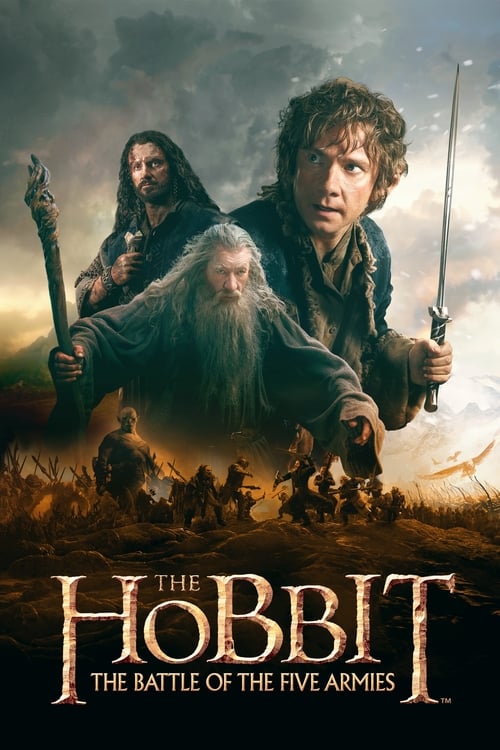
The Hobbit: The Battle of the Five Armies
2014 · Peter Jackson
For when you want epic-scale fantasy warfare on the biggest screen you have — ideally as the payoff to a full trilogy watch rather than on its own. Popcorn scale with a farewell-tour heart.
What it's about
The dragon Smaug has fallen on Lake-town, and the mountain kingdom of Erebor — with its vast hoard of gold — stands open. Bilbo and the dwarves hold it, but the men of the ruined town and the elves of Mirkwood have claims of their own, while Thorin's obsession with the treasure curdles into something darker. Then two orc armies converge on the mountain, and the quarreling peoples of Middle-earth must unite or be destroyed — with Bilbo, the smallest person on the field, carrying the last hope of peace.
The experience
Essentially one sustained climax: a shorter, battle-driven finale that trades the earlier films' wandering for spectacle, clashing armies, and the melancholy of a journey ending. It's big, loud, and elegiac in its final stretch.
Performances
Martin Freeman remains the trilogy's soul as Bilbo — his small, decent, fretful presence keeps the human stakes visible amid the armies — while Richard Armitage charts Thorin's descent into gold-sick paranoia with real tragic force.
The craft
Peter Jackson stages the five-army convergence as one of the largest sustained battle sequences of the digital-effects era, with Weta's creature work and New Zealand vistas built for a huge screen and a loud room. At 144 minutes it's his shortest Middle-earth film, engineered less as a standalone story than as a load-bearing finale.
Why it matters
It closed out Jackson's six-film, thirteen-year Middle-earth cycle — the defining fantasy franchise of its era — and became a touchstone in the debate over stretching a slim children's book into a blockbuster trilogy.
Snapshot
The Battle of the Five Armies is the third and final installment of Peter Jackson's Hobbit trilogy and the sixth and last of his Middle-earth features, closing a cycle that began with The Lord of the Rings: The Fellowship of the Ring in 2001. Adapted from a comparatively slender children's novel by J.R.R. Tolkien, the film is essentially a single sustained climax: it picks up in the immediate aftermath of the dragon Smaug's assault on Lake-town and drives toward the pitched battle outside the Lonely Mountain of Erebor, where dwarves, elves, and men are drawn into conflict with two converging orc armies. At roughly 144 minutes, it is the shortest film Jackson made in Middle-earth, and it functions less as a self-contained story than as the load-bearing conclusion to a narrative that the trilogy had stretched across three years of release. It is best understood as a war film in fantasy dress — a spectacle of siege, cavalry, and single combat rendered almost entirely through digital means, and a coda to the most influential large-scale fantasy production of its era.
Industry & production
The film was produced by New Line Cinema and Metro-Goldwyn-Mayer, with Warner Bros. distributing, and was made at Jackson's production base in Wellington, New Zealand, drawing on the same Stone Street Studios and Weta infrastructure built up for The Lord of the Rings. Its production history is inseparable from turbulence. Guillermo del Toro was originally attached to direct and spent roughly two years developing the project with Jackson, Fran Walsh, and Philippa Boyens before departing, in large part because MGM's financial difficulties and the resulting delays made the open-ended commitment untenable; Jackson then stepped in to direct. Del Toro retains a screenplay credit alongside Walsh, Boyens, and Jackson, a residue of that earlier development.
The most consequential industrial decision was the expansion of the adaptation from two films to three, announced during production. This turned a short novel into a trilogy and required the three films to be photographed together as one continuous shoot, with substantial additional principal photography and pickups undertaken later — a structure that placed enormous weight on visual effects and second-unit work to generate material the source text did not supply. The three Hobbit films were also shaped by the standard modern practice of theatrical release followed by longer Extended Editions on home video, a model Jackson had established with The Lord of the Rings. Commercially the film performed strongly worldwide, consistent with the trilogy's overall success, though precise figures are outside the scope of this account.
Technology
Technologically, The Battle of the Five Armies is a landmark chiefly for its role in the high-frame-rate (HFR) experiment. Following An Unexpected Journey and The Desolation of Smaug, it was among the small handful of major features photographed and exhibited at 48 frames per second, double the century-old 24 fps standard, in stereoscopic 3D. Jackson championed HFR as a means of reducing the strobing and motion blur that afflict 3D, particularly in fast action; the reception was polarized, with many viewers describing a hyper-clear, "video"-like immediacy that some found immersive and others found flattening to the cinematic illusion. The Hobbit trilogy remains the most prominent test case for the format, and its mixed reception is part of the reason HFR did not become an industry norm.
The films were shot digitally on RED Epic cameras (the Dragon sensor was in use across the production) in rigs configured for native 3D capture. On the effects side, the film is a showcase for Weta Digital's crowd-simulation technology — the Massive software system originally developed by Stephen Regelous for the battle sequences of The Lord of the Rings, here deployed to populate an entire multi-army battle with autonomous digital agents. Weta's work also encompassed extensive digital characters and environments, motion-captured performance for creatures, and the digital dragon Smaug in the opening sequence. The film thus sits at the confluence of two of Jackson's signature technological investments: performance-driven digital creatures and algorithmically generated mass combat.
Technique
Cinematography
Cinematography was by Andrew Lesnie, Jackson's regular collaborator since The Lord of the Rings and the cinematographer of all six Middle-earth films; Five Armies was among his last major credits before his death in 2015, giving his work here a valedictory dimension. Lesnie's task was unusual: HFR and native 3D impose constraints on lighting and camera movement, and much of the imagery is built around or composited into digital environments. The palette leans cold — the wintry approach to Erebor, the gray stone of Dale, the blues and steels of the battlefield — in contrast to the golden dragon-hoard interiors. Compositionally the film relies heavily on scale contrast, cutting between vast overhead views of clashing armies and tight, kinetic coverage of individual duels, a strategy that manages the transition between simulated crowds and photographed (or motion-captured) principals.
Editing
The film was edited by Jabez Olssen, who had risen through the Middle-earth editorial team and cut the later Hobbit pictures. The editorial problem is the film's defining formal challenge: it is structurally a prolonged battle, and its coherence depends on cross-cutting among multiple simultaneous fronts — the men of Dale, the elves of Mirkwood, the dwarves of Erebor and their Iron Hills reinforcements, Thorin's psychological arc within the mountain, and the discrete single combats atop Ravenhill. Olssen's cutting has to sustain geography and stakes across these threads while modulating rhythm so that the spectacle does not exhaust the viewer before the emotional climaxes land. The film's brevity relative to its siblings suggests a tightening discipline in the final chapter.
Mise-en-scène / staging
Physical and digital design here descend directly from the vocabulary Weta Workshop and the art departments established across the two trilogies: the runic, geometric heaviness of dwarvish Erebor; the organic, antlered elegance of Thranduil's Mirkwood; the ruined civic grandeur of Dale. Much of the battle's staging is architectural — assaults on gates and bridges, the vertical set-piece of Ravenhill's frozen tower and falls — using built environment to organize combat into legible zones. The staging repeatedly juxtaposes the intimate (Thorin alone in the treasure chamber, hallucinating in a sea of gold) against the epic, so that the interior drama of "dragon-sickness" reads as the moral engine beneath the external war.
Sound
Sound design and mix were executed by the Weta/Park Road Post team that had defined the Middle-earth soundscape, with the film's audio built to fill large-format and immersive theatrical presentations. The specific technical credits are a matter of record within the production's below-the-line roster; where individual attributions are concerned I would defer to the film's formal credits rather than assert them from memory. Functionally, the sound work distinguishes the timbres of the combatants — the massed percussion and guttural weight of the orc host against the cleaner metallic registers of elves and men — and integrates Howard Shore's score into the battle rather than letting music and effects compete.
Performance
Martin Freeman anchors the film as Bilbo Baggins, playing the hobbit's decency and moral clarity as the still point around which the greed and bloodlust of larger figures turn. Richard Armitage carries the film's tragic weight as Thorin Oakenshield, whose descent into and recovery from "dragon-sickness" is the drama's spine. Luke Evans (Bard), Lee Pace (Thranduil), Evangeline Lilly (Tauriel), and Ian McKellen (Gandalf) form the surrounding ensemble; Manu Bennett provides the motion-capture and voice performance for the orc Azog. Benedict Cumberbatch's Smaug opens the film. The performances span a wide technical range — from Freeman's conventional on-set acting to fully motion-captured creature work — and the film's success depends on the editorial and directorial marriage of those registers.
Narrative & dramatic mode
The dominant dramatic mode is tragic-heroic, organized around Thorin's arc of hubris, corruption, and redemption — a compressed morality play about how gold poisons the will, set inside the machinery of an epic war film. The narrative is unusually front-loaded toward climax: it dispenses quickly with Smaug and then commits almost wholly to the battle, meaning that character resolution must be achieved amid spectacle rather than in quieter passages. Bilbo functions as the audience's moral witness, and the film's most affecting beats are small — a farewell, an acorn, a refusal to be swept up in vengeance — deliberately scaled against the surrounding carnage. Subplots (Tauriel and Kíli's cross-race romance, invented for the trilogy) supply pathos and casualty. The mode is elegiac as much as martial: the film knows it is ending not just a story but a cinematic era.
Genre & cycle
The film belongs to the epic-fantasy cycle that Jackson's own Lord of the Rings effectively inaugurated in its modern, prestige, big-budget form, and it stands as the terminal entry in that six-film corpus. Within genre history it is a war film wearing fantasy iconography, its battle drawing on the tradition of large-scale medieval and ancient combat spectacle. It also participates in the 2010s Hollywood cycle of expanded, multi-part adaptations — the industry-wide impulse to split source material into franchises — and it is one of the more conspicuous examples of a slim book stretched to trilogy length. As a "final chapter," it operates under the conventions of the closing installment: convergence of threads, elevated mortality among named characters, and a deliberate bridge toward the events of The Lord of the Rings.
Authorship & method
This is a Peter Jackson film in the fullest sense — the culmination of a decade-and-a-half authorial project realized through a stable repertory of collaborators. Screenwriting was the long-standing partnership of Jackson, Fran Walsh, and Philippa Boyens, with del Toro's earlier development credited; their method across the trilogy was expansive, weaving in appendices material and wholly invented connective tissue to enlarge the novel toward the tone of The Lord of the Rings. Andrew Lesnie's cinematography and Howard Shore's music are the two most defining authorial signatures beneath Jackson's: Shore, who scored all six films, threads leitmotifs across the entire cycle, so that themes established for the Ring, for Erebor, and for individual peoples pay off structurally in this finale. Jabez Olssen's editing and the Weta Digital / Weta Workshop craft base complete the authorial ecosystem — an unusually integrated, geographically concentrated model of filmmaking in which a single New Zealand production culture produced the entire body of work.
Movement / national cinema
The Middle-earth films are the flagship of a distinctly New Zealand mode of large-scale international production. Jackson's insistence on basing the productions in Wellington, and the parallel growth of Weta Digital, Weta Workshop, Stone Street Studios, and Park Road Post, effectively built a self-sufficient world-class visual-effects and production hub in a country previously peripheral to blockbuster filmmaking. This constitutes less a stylistic "movement" than an industrial one — the demonstration that a globally competitive effects-and-production ecosystem could be cultivated outside Hollywood and London. Five Armies is the last major expression of that integrated Middle-earth apparatus in feature form.
Era / period
The film is a product of the early-to-mid 2010s, a period defined by the industry's pivot to franchise and cinematic-universe thinking, the transition to fully digital acquisition and effects, and a wave of exhibition-format experimentation (3D, IMAX, and HFR) intended to differentiate theatrical spectacle from home viewing. The Hobbit trilogy sits at the leading edge of that format experimentation and at the tail end of the initial 3D boom that Avatar had reignited in 2009. It also arrives as the "expanded adaptation" strategy was cresting across Hollywood, making the film emblematic of both the technological ambitions and the commercial logics of its moment.
Themes
The film's governing theme is greed and its corrosive power — dragon-sickness as an allegory for the way accumulated wealth deranges judgment and dissolves loyalty, embodied in Thorin and echoed in the wider scramble for Erebor's hoard. Set against it are countervailing values of loyalty, humility, and moral restraint, carried by Bilbo. War itself is a theme: the film stages the futility and cost of conflict driven by pride and possession, with the "five armies" nearly destroying one another before an external evil forces reluctant unity. The rise of Sauron in the background frames these local quarrels as prelude to a larger darkness, tying the story's parochial stakes to the mythic sweep of The Lord of the Rings. Mortality and farewell — of characters, and of the whole cinematic world — give the film its elegiac undertone.
Reception, canon & influence
Critical reception was mixed-to-favorable and notably cooler than the responses to the original Lord of the Rings trilogy. The recurring critical charge across the Hobbit films — that a slight novel had been over-extended, over-plotted, and over-reliant on digital effects — attached to this installment as well, though many reviewers granted that its concentrated focus on a single battle gave it more momentum than its predecessors and praised its spectacle and Armitage's Thorin. The HFR presentation remained divisive. In canonical terms, the Hobbit trilogy has generally been received as a lesser satellite to The Lord of the Rings, valued more as a completion of Jackson's Middle-earth than as an achievement in its own right.
Its influences run backward to Tolkien's novel and its appendices, to the broader tradition of epic war cinema, and above all to Jackson's own earlier trilogy, whose visual language, casting, locations, and musical themes this film reprises and closes. Its forward legacy is twofold. Industrially, it consolidated the New Zealand production-and-effects ecosystem and the crowd-simulation and digital-creature techniques that Weta Digital continued to export across the visual-effects field. In exhibition history, the trilogy's HFR experiment stands as the format's most significant real-world trial to date, and its lukewarm reception is frequently cited in debates over whether higher frame rates belong in narrative cinema. Finally, as the terminal chapter of a six-film cycle, the film marks the end of the defining prestige-fantasy franchise of its generation — the benchmark against which later large-scale Tolkien adaptations, including subsequent television treatments of Middle-earth, have inevitably been measured.
A Deleuzian reading
Thorin stands still in a room full of gold.
The full Deleuzian reading of The Hobbit: The Battle of the Five Armies →
Reception
Landed in 2014 as the weakest-reviewed of Jackson's six Middle-earth films — 'bloated' was the word of the season — but a decade on, viewers who grew up with the Hobbit trilogy have started mounting a nostalgic defense, and the 'they're better than we said' revisionism is now a genre of its own.
How The Hobbit: The Battle of the Five Armies was received, from release to now →
How to watch The Hobbit: The Battle of the Five Armies: what to notice on a first viewing
- Watch how battle shots switch between vast overhead views and close combat. Jackson and Lesnie alternate elevated wide masters of colliding armies with tight, kinetic coverage of single duels, again and again. Deleuze calls this rhythm respiration-space: the wide shot is the world breathing in, the duel is it breathing out.
- Notice the cold blue-steel palette outside against the gold treasure room. Lesnie keeps the battlefield in wintry grays and steels while the mountain's hoard glows a saturated gold that soaks every scene inside it. The color scheme tells you where the story's real danger lives before a word of dialogue does.
- Track how often the film cuts between Dale, Mirkwood, and Ravenhill. Olssen crosscuts among five simultaneous fronts, holding geography legible while shifting stakes from one battlefield to the next. This crosscutting is what lets a single sustained battle carry a whole trilogy's emotional weight.
- Listen for the difference between the orcs' drums and the elves' metal. The mix gives the orc host massed percussion and guttural weight while elves and men sound cleaner and metallic, distinguishing armies by ear alone. You can tell which side is fighting without seeing a banner, just from the soundtrack.
- Notice how still Bilbo stays while everyone around him moves or shouts. Freeman plays Bilbo's decency as a fixed point; his stillness contrasts with the greed and bloodlust driving the larger figures around him. His restraint gives the audience something small and human to measure the surrounding carnage against.
The whole guide to watching The Hobbit: The Battle of the Five Armies, with the keys for a rewatch →
Influences: the films it descends from and the films it influenced
- The Lord of the Rings: The Return of the King (2003) — The Pelennor Fields sequence established the MASSIVE agent-based crowd-simulation software plus the multi-front cross-cutting battle grammar this film reprises almost wholesale.
- The Fellowship of the Ring (2001) — Shore's cycle-wide leitmotif architecture (the Erebor and Ring themes seeded here) is engineered to pay off structurally in this finale, and Lesnie's forced-perspective scale-contrast originates in this film.
- King Kong (2005) — Jackson and Weta's Serkis-driven performance-capture of a giant non-human creature, staged against tiny human figures for scale, is the direct methodological prototype for Smaug.
- Alexander Nevsky (1938) — The Battle on the Ice fused a mass medieval-battle set piece to a through-composed leitmotif score (Prokofiev), the audiovisual model Shore's per-people themes descend from.
- Ran (1985) — Color-coded armies read from elevated wide masters, prioritizing legibility of scale and troop movement over close combat — the cinematographic approach to massed forces this film adopts.
- Braveheart (1995) — Massed infantry charges intercut between commanders' vantage and ground-level chaos established the command-and-melee cross-cutting rhythm of the five-armies convergence.
- Jason and the Argonauts (1963) — Harryhausen's composited skeleton-vs-human duel is the foundational grammar of choreographed creature-vs-actor combat that digital creatures like the orc champions inherit.
- Star Wars (1977) — John Williams's leitmotif system spanning a film cycle is the template Shore extends across six Middle-earth films, with themes recurring as narrative payoff.
- Gemini Man (2019) — The most direct heir to the trilogy's HFR narrative-cinema trial, pushing to 120fps and repeatedly cited alongside the Hobbit in debates over whether high frame rates suit dramatic film.
- Billy Lynn's Long Halftime Walk (2016) — Extended the high-frame-rate exhibition experiment the Hobbit trilogy pioneered, testing HFR's hyper-clarity in an intimate rather than spectacle register.
- War for the Planet of the Apes (2017) — Carried Weta's outdoor, all-weather performance-capture of digital creatures to full lead-character maturity, exporting the pipeline the Hobbit films industrialized.
- Mortal Engines (2018) — Built by the same Jackson–Walsh–Boyens screenwriting team on the New Zealand Weta production hub, inheriting its crowd-sim, creature, and scale-contrast craft base directly.
- The Lord of the Rings: The Rings of Power (2022) — Later Middle-earth adaptation explicitly measured against this cycle, reproducing Shore-derived leitmotif scoring and Weta-style crowd and creature work as its benchmark.
- Rise of the Planet of the Apes (2011) — Weta's on-location performance-capture of a non-human protagonist (Serkis's Caesar) refined the exact creature-capture pipeline used contemporaneously for the Hobbit's beasts.
- Avatar (2009) — Cameron's Weta-built facial performance-capture and his stated push toward high-frame-rate exhibition run parallel to the HFR and mocap ambitions this trilogy productionized.
- The Hobbit: The Desolation of Smaug (2013) — Immediate predecessor within the same shoot: introduced Smaug's Cumberbatch performance-capture and the RED Epic Dragon sensor whose cold-palette look and dragon this film resolves.
- Harry Potter and the Deathly Hallows: Part 2 (2011) — Contemporary fantasy-epic that likewise resolves its saga through an extended digital-destruction siege climax, sharing the crowd-VFX-driven battle-as-finale craft.
Similar films
- The Lord of the Rings: The Return of the King (2003) — influence & lineage · same viewing thread
- King Kong (2005) — influence & lineage
- Braveheart (1995) — influence & lineage
- War for the Planet of the Apes (2017) — influence & lineage
- The Hobbit: An Unexpected Journey (2012) — same viewing thread
- Jason and the Argonauts (1963) — influence & lineage · same viewing thread
- Avatar (2009) — influence & lineage · same viewing thread
- The Lord of the Rings: The Fellowship of the Ring (2001) — same viewing thread
All the films related to The Hobbit: The Battle of the Five Armies →
Watch it with: curated runs of related films
- Studio-Sized Mythmaking — A run of blockbuster quest epics — fellowships forged, dark lords faced, and long roads home — that rhyme on scale, world-building, and the pull of a saga you can lose a weekend inside.