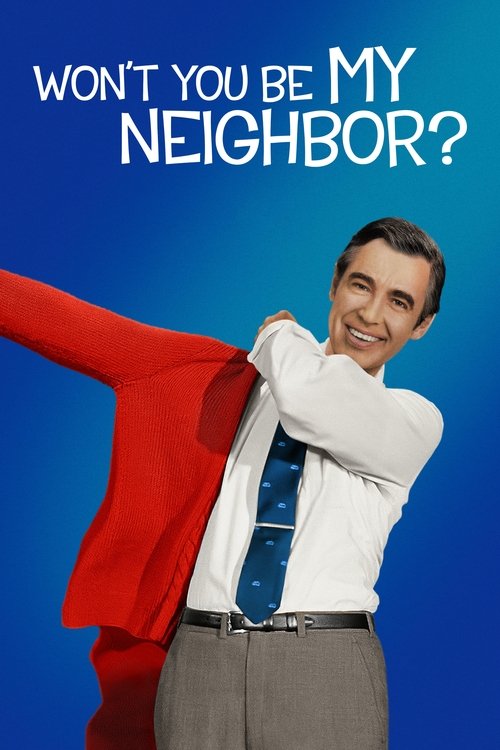
Won't You Be My Neighbor?
2018 · Morgan Neville
For when you need to feel that decency is real and possible — a restorative watch after a hard week or a bleak news cycle. Bring tissues; this is comfort viewing that sneaks up on you.
What it's about
A portrait of Fred Rogers, the soft-spoken Presbyterian minister who spent more than thirty years on public television talking directly to children — through puppets, songs, and radical patience — about the things adults avoid: death, divorce, anger, and being loved as you are. Built from archival footage of Mister Rogers' Neighborhood and interviews with family and colleagues, it asks what Rogers was actually up to, and why it mattered so much.
The experience
Disarmingly emotional — people routinely come out of it having cried at least once, often to their own surprise. It's warm and funny, but it's also quietly bracing: a portrait of kindness practiced as a discipline, which lands differently in cynical times.
The craft
Morgan Neville assembles the archival material with a light, sure hand, letting Rogers' own broadcasts — including some startling moments of on-air candor — carry the argument. The film resists hagiography just enough, letting doubts and complications in so the tribute feels earned rather than syrupy.
Why it matters
One of the highest-grossing biographical documentaries ever released, it sparked a full-scale cultural reappraisal of Rogers and a wave of renewed interest in his philosophy of talking honestly to children.
Snapshot
Won't You Be My Neighbor? is Morgan Neville's feature documentary about Fred Rogers (1928–2003), the ordained Presbyterian minister who spent more than three decades hosting Mister Rogers' Neighborhood on public television. Neville, already an Academy Award winner for 20 Feet from Stardom (2013), approaches Rogers not as a nostalgia object but as a moral and philosophical figure — a man who used the cheapest, most disposable medium available to make a radical argument that children deserved to be spoken to honestly about death, anger, divorce, disability, and love. The film premiered at the Sundance Film Festival in January 2018 and was released theatrically in June by Focus Features, where it became one of the most commercially successful documentaries of its era. Assembled largely from archival program footage, home movies, and a spine of new interviews with Rogers's collaborators and family, it is at once a biographical portrait, an argument about the ethics of broadcasting, and — in its final movement — an anxious meditation on whether Rogers's gospel of unconditional worth could survive the culture that outlived him.
Industry & production
The film was produced by Neville's own Tremolo Productions in partnership with Impact Partners and other independent documentary financiers, with Focus Features handling theatrical distribution and Independent Lens/PBS in the broader public-television orbit that was Rogers's native habitat. Its production model is characteristic of the mid-2010s "prestige documentary" economy: a modestly budgeted, festival-launched nonfiction film built on archival licensing and interview access, then positioned for a specialty theatrical run and awards consideration.
Two industrial facts shape the film decisively. First, access: the cooperation of Joanne Rogers (Fred's widow), the surviving Neighborhood cast and crew, and Fred Rogers Productions gave Neville the archive — decades of tape, outtakes, and personal material — without which the film could not exist. Second, the archive itself was the production's central logistical challenge, since it meant clearing, digitizing, and upscaling an enormous body of low-resolution analog video. The film's commercial performance was notable for the genre: it grossed well over twenty million dollars in North America, placing it among the highest-grossing documentaries of the decade and demonstrating an unusual crossover appeal to general, family, and older audiences rather than the art-house-only base most documentaries reach. That success in turn helped accelerate Hollywood's broader "Rogers moment," culminating in the Tom Hanks star vehicle A Beautiful Day in the Neighborhood the following year.
Technology
Technologically, the film is a study in the collision of two eras of imaging. The overwhelming bulk of its material is standard-definition analog videotape — the 4:3, soft, color-bled texture of 1960s–2000s public-television production, a look that is inseparable from the show's meaning and its low-budget sincerity. Neville and his post team retained rather than disguised this texture, letting the archival grain read as authenticity while carefully upscaling and color-correcting so the footage could survive theatrical projection. Against this sits crisp modern digital interview photography, and the contrast between the two registers is itself expressive: the past arrives fuzzy and warm, the present sharp and elegiac.
The film's other significant technological gesture is animation. Recurring animated sequences render Rogers's puppet alter ego, Daniel Striped Tiger, as a small hand-drawn figure moving through the Neighborhood of Make-Believe — a device that visualizes Rogers's own confessed identification with the shy, anxious tiger and lets the film enter his inner life where archive cannot follow. This is a technological solution to a biographical problem: how to picture a private interior in a subject who left behind mostly public performance.
Technique
Cinematography
The film's visual identity is fundamentally curatorial rather than photographed — its "cinematography" is as much the selection and re-framing of existing images as the shooting of new ones. The original interview photography is conventional in the best sense: warm, evenly lit, static talking-head setups that keep attention on faces and testimony rather than calling attention to themselves. Neville's stylistic restraint is deliberate; the camera adopts something of Rogers's own unhurried attentiveness. (The specific credited director of photography for the interview segments is a detail on which the public record is thin, and I will not guess a name; what matters technically is that the new footage is subordinated, by design, to the archive.)
Editing
Editing is where the film's authorship most visibly lives, and here the record is firmer: the picture was cut by Aaron Wickenden — a frequent Neville collaborator — with Jeff Malmberg. The editorial task was immense: distilling thousands of hours of episodes and outtakes into a shapely 94-minute argument. The cutting is thematic rather than strictly chronological, organizing Rogers's life around ideas — silence, anger, death, self-worth — and moving fluidly between decades to build a case rather than a timeline. Key sequences are constructed almost entirely in the edit: the 1969 Senate subcommittee testimony before Senator John Pastore, in which Rogers talks a skeptical legislator into preserving public-broadcasting funding, is allowed to play at length, trusting the archival moment to do its own dramatic work. The film's emotional architecture — its famous use of silence, its slow builds to release — is an editorial achievement.
Mise-en-scène / staging
Because so much of the film is found footage, its mise-en-scène is largely inherited: the handmade sets of the Neighborhood, the trolley, the model, the sweater and sneakers, the deliberate cheapness that Rogers weaponized against the frenetic commercial television around him. Neville's contribution is to frame that staging as a philosophy — to show that the slowness, the eye-level address, the ritual of changing shoes were not budget limitations but a designed pedagogy of calm. The new interviews are staged simply, in domestic and neutral spaces, so the contemporary present never competes with the vividness of the archive.
Sound
Sound is one of the film's quiet triumphs. Rogers's own voice — soft, deliberate, unmistakable — is the film's connective tissue, and the sound design foregrounds his signature use of silence, a rhetorical tool the film both analyzes and deploys. The original score by Jonathan Kirkscey, a Memphis-based cellist and composer, favors chamber textures — piano and strings — that echo Rogers's own musicianship (he was a trained pianist and composer who wrote the show's songs) without swelling into sentimentality. The film also leans on Rogers's compositions themselves, letting the deceptively simple children's songs carry unexpected emotional and theological weight when recontextualized for adults.
Performance
The "performances" are testimony and archive. Rogers, of course, is the central presence, and the film is attentive to the gap between the on-air Fred and the private man. Among the interviewees, François Clemmons — who played Officer Clemmons and whose foot-pool scene with Rogers quietly rebuked the era's segregation of public swimming — provides the film's most moving spoken performance, recounting a complicated, loving, and at times painful relationship. Joanne Rogers, Betty Aberlin, David Newell (Mr. McFeely), Yo-Yo Ma, family members, and production staff round out the chorus. Neville's skill is in editing these accounts so that admiration is never uncritical; the film lets its witnesses complicate the saint.
Narrative & dramatic mode
The film operates in the biographical-essay mode: it tells the arc of a life while continuously stepping back to argue about that life's meaning. It is broadly chronological — childhood, seminary, the founding of the program, the Senate testimony, the response to national traumas, later life and death — but the chronology is a scaffold for thematic movements. Its dramatic mode is elegiac and increasingly interrogative. The final act shifts register markedly: rather than closing on unqualified tribute, it stages a genuine anxiety, asking whether Rogers's message that "you are special" was misheard or has failed in a coarsened, cynical culture — a question the film pointedly refuses to answer with false comfort. This turn toward doubt is what lifts the film above hagiography and gives it its dramatic tension.
Genre & cycle
The film sits within the archival biographical documentary — the "great life reconsidered" genre that flourished in the 2010s on the strength of streaming appetite and prestige-doc economics. It belongs specifically to a cycle of empathetic, argument-driven portraits of cultural figures that Neville himself helped define; his subsequent Roadrunner: A Film About Anthony Bourdain (2021) is a clear companion piece. More broadly it participates in the era's wave of "kindness" and civic-nostalgia nonfiction, films that implicitly hold a contemporary moment of political rancor against a remembered decency. Its unusual family-audience reach also aligns it, commercially, with the crowd-pleasing documentary lineage.
Authorship & method
Morgan Neville is the film's clear author, and it reflects his established method: the empathetic, music-attuned, archive-driven portrait that seeks the philosophy inside a life. His authorship here is one of framing and structure — the decision to treat Rogers as a thinker, to build the film around ideas, and to end in honest uncertainty. His key collaborators materially shaped the result: editors Aaron Wickenden and Jeff Malmberg, who translated an unmanageable archive into a moral argument; composer Jonathan Kirkscey, whose chamber score honors Rogers's own musicianship; and the animation team, whose Daniel Tiger sequences supplied the film's window into interiority. Above all, the method depended on the trust of Joanne Rogers and Fred Rogers Productions, whose cooperation gave Neville both the archive and the license to complicate its subject.
Movement / national cinema
The film is squarely within American independent nonfiction and, more specifically, within the public-television documentary tradition that was Rogers's own world — a fitting formal home for a subject who believed in the civic mission of broadcasting. It carries no avant-garde or movement affiliation; its aesthetics are those of accessible, humanist American documentary. If it belongs to any "movement," it is the institutional culture of PBS/public media and the values that culture embodies, which the film both documents and quietly champions.
Era / period
Released in 2018, the film is unmistakably a product of its moment. Though it never names contemporary politics directly, its reception and much of its emotional charge derived from being received as an implicit rebuke to an era of division, cruelty, and mediated cynicism — a portrait of radical gentleness offered to an audience hungry for it. It also reflects the late-2010s peak of the theatrical prestige documentary, when specialty distributors could turn a nonfiction portrait into a genuine crossover hit. The film thus lives in two periods at once: the analog public-television past it lovingly reconstructs, and the anxious digital present it addresses.
Themes
The film's governing theme is the ethics of attention — Rogers's conviction that taking a child seriously, and offering unconditional worth, is a radical act. From this flow its major concerns: the honest treatment of difficult subjects (death, divorce, disability, and race, dramatized through the Clemmons foot-pool sequence and the program's response to national traumas such as the RFK assassination); silence and slowness as resistance to commercial television's noise; the relationship between Rogers's Presbyterian faith and his secular pedagogy of love; and self-worth as a birthright rather than an achievement. The film's most distinctive thematic move is its willingness to question its own subject: in its final movement it interrogates whether "you are special" curdled into entitlement or narcissism, and whether kindness is a sufficient answer to the world's cruelty — leaving the question open as a challenge to the viewer.
Reception, canon & influence
Critically, the film was received with near-unanimous acclaim and became a cultural event as much as a movie, praised for its emotional force, its restraint, and its refusal of easy sentiment. Commercially it far outperformed genre norms, grossing well over twenty million dollars in North America and drawing audiences well outside the usual documentary base. It won significant industry recognition, including Producers Guild and Critics' Choice documentary honors; its most-discussed reception event, however, was a snub — its conspicuous absence from the Academy Award nominations for Best Documentary Feature, widely regarded at the time as one of the year's notable Oscar omissions.
Its influences run backward to the archival-portrait tradition and to Neville's own 20 Feet from Stardom, which established his humane, music-driven method; and its very possibility rested on the vast institutional archive of public television. Looking forward, the film's success materially shaped the culture's "Rogers revival," helping create the conditions for A Beautiful Day in the Neighborhood (2019), the Marielle Heller drama starring Tom Hanks. Within Neville's own filmography it prefigures the more contested Roadrunner (2021), extending his project of using documentary to weigh what a beloved public figure's life meant. In the longer canon it stands as a defining example of the late-2010s empathetic biographical documentary — and as a rare nonfiction film that used its subject's own tools, silence and sincerity, to make an argument about how we might live.
Reception
An instant phenomenon out of Sundance 2018 — it became one of the highest-grossing documentaries ever and the year's designated communal cry. It hasn't needed a reappraisal; it settled almost immediately into 'the doc that broke everyone' status, later boosted by the Tom Hanks companion piece it clearly paved the way for.
How Won't You Be My Neighbor? was received, from release to now →
Influences: the films it descends from and the films it influenced
- 20 Feet from Stardom (2013) — Establishes Neville's own template imported wholesale here: the humane, music-attuned archival portrait that treats interviews as chamber duets and cuts to the emotional beat of a musical phrase rather than to chronology.
- The Times of Harvey Milk (1984) — The archival-plus-testimony biographical documentary that builds a moral argument out of a single life, using survivors' talking-head recollection as ethical witness rather than mere information.
- The Civil War (1990) — Source of the American public-TV grammar the film leans on — slow motivated pans across still photographs paired with an unhurried period chamber score that treats archival imagery as elegy.
- The Kid Stays in the Picture (2002) — Pioneers the archive-only first-person portrait, animating a subject's own photographs and materials into a self-mythologizing narrative — the assembly-as-authorship approach Neville's editors adopt.
- Amy (2015) — Constructs intimacy almost entirely from a subject's own archive, floating recorded voices over found footage so the person seems to narrate themselves — the testimony-archive method behind Rogers speaking his own philosophy.
- Waltz with Bashir (2008) — Legitimizes animation inside nonfiction as a window into a subject's interior life, the exact function of the film's Daniel Tiger sequences rendering Rogers's inner world.
- Best of Enemies (2015) — Neville's prior demonstration of shaping degraded standard-def broadcast videotape into an argument about American public discourse and civility on television.
- I Am Not Your Negro (2016) — The biographical essay-film that treats its subject as a thinker and structures itself around ideas and the figure's own words, the 'treat him as a philosopher' architecture Neville uses for Rogers.
- Fred Rogers: It's You I Like / Mister Rogers' Neighborhood (1968) — Rogers's own program supplies the film's core aesthetic tools — deliberate silence as rhetoric, direct-address sincerity, and low-fi puppetry — which Neville quotes and turns into an argument about attention.
- A Beautiful Day in the Neighborhood (2019) — The narrative feature directly enabled by the Rogers revival this film seeded, adopting the show's own miniature-model cityscapes and set aesthetic as its formal signature.
- Roadrunner: A Film About Anthony Bourdain (2021) — Extends Neville's project of weighing a beloved public figure's meaning through a life-spanning archive into more contested territory, testing the same testimony-archive method against a darker subject.
- Val (2021) — Builds a portrait almost entirely from a subject's self-shot personal videotape, extending the reliance on a figure's own recorded materials as the primary evidentiary and emotional source.
- Jane (2017) — Reassembles a vast institutional archive (National Geographic's) into an intimate portrait carried by a commissioned lyrical score — the same archival-assembly-plus-chamber-score marriage.
- RBG (2018) — The same-year empathetic-icon documentary combining reverent talking heads with archival footage, which likewise broke out commercially by canonizing a beloved public figure as a moral exemplar.
- Life, Animated (2016) — Uses bespoke animated sequences to externalize a subject's inner emotional and cognitive world, the same interiority-through-animation device.
- Three Identical Strangers (2018) — Deploys the interrogative turn — a feel-good archival story that pivots midway into unsettling ethical inquiry — mirroring the film's move from warmth to 'was it enough?' uncertainty.
- John Candy: I Like Me (2025) — Deploys motif refrain and emotionally-timed needle-drops within an affectionate-reclamation archival portrait that argues for a beloved figure's underappreciated seriousness.
Similar films
- The Oldest Person in the World (2026) — shared sensibility
- Remarkably Bright Creatures (2026) — shared sensibility
- Mary and Max (2009) — shared sensibility
- The Muppet Christmas Carol (1992) — shared sensibility
- Me and You and Everyone We Know (2005) — shared sensibility
- My Life as a Zucchini (2016) — shared sensibility
- Forrest Gump (1994) — shared sensibility
- Toy Story (1995) — shared sensibility