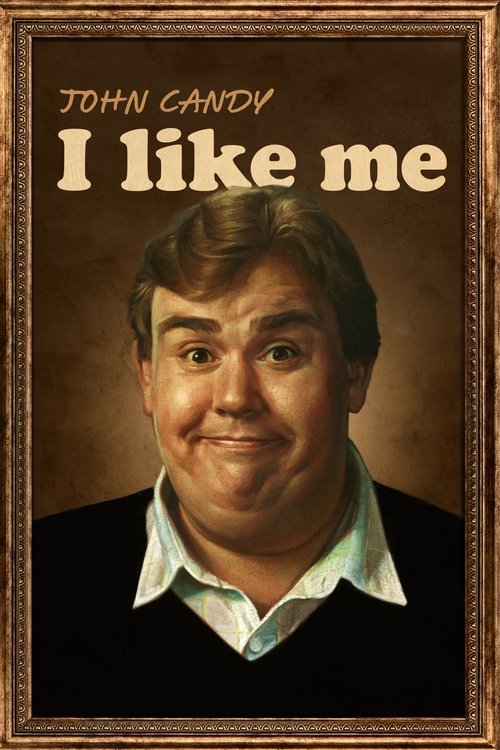
John Candy: I Like Me
2025 · Colin Hanks
For a nostalgic night when you want to laugh and get a little misty about it — perfect if Candy's comedies were part of your growing up. Pure comfort, with a lump in the throat.
What it's about
A documentary portrait of John Candy, the beloved Canadian comic actor, told by the people who knew him best — family, friends, and collaborators — alongside never-before-seen home movies and archival footage. It traces his path from Toronto's comedy scene through SCTV and his run of hit comedies, up to his death at just forty-three, asking what made his warmth on screen feel so real.
The experience
Funny and openly affectionate, then quietly heartbreaking — a film that keeps making you laugh at old clips while a sense of loss builds underneath. It plays like an evening of stories about a friend everyone misses.
The craft
Colin Hanks builds the film from rich archival material — home movies, outtakes, SCTV-era footage — and lets the interviews stay personal rather than promotional. The title, borrowed from Candy's most famous screen monologue, signals its real subject: the tenderness underneath the shtick.
Why it matters
Part of a wave of affectionate reappraisals of beloved comic actors, it cements Candy's standing as one of comedy's great warm presences rather than a footnote of 1980s nostalgia.
Snapshot
John Candy: I Like Me is a feature documentary portrait of the Canadian comic actor John Candy (1950–1994), directed by Colin Hanks and produced under Ryan Reynolds' Maximum Effort banner for Amazon MGM Studios. The film assembles archival footage, home movies, and fresh interviews with family, friends, and collaborators to reconstruct Candy's life and career — from his formative years in Toronto's comedy scene through his ascent via SCTV and a run of studio comedies, to his death at forty-three during the production of Wagons East. Its title is drawn directly from Candy's most quoted screen moment: Del Griffith's plea in Planes, Trains and Automobiles — "I like me. My wife likes me." That borrowing signals the film's thesis, which reads Candy's warmth and self-deprecation not as mere shtick but as the emotional core of his work and the site of his private vulnerability. The documentary premiered at SXSW in March 2025 and subsequently streamed on Prime Video, positioning it as a prestige-adjacent celebrity-legacy documentary aimed at a broad nostalgia audience rather than an art-house one.
Industry & production
The film sits at the intersection of two contemporary industry currents: the streamer-driven boom in music-and-celebrity documentaries, and the star-producer legacy project. Ryan Reynolds — a fellow Canadian who has repeatedly cited Candy as a formative influence — produced through Maximum Effort, the company he built with George Dewey, which has specialized in brand-inflected, audience-friendly content. Colin Hanks, himself the child of a movie star, produced alongside directing. The backing of Amazon MGM Studios and distribution via Prime Video is characteristic of the current model, in which a globally-distributed streamer absorbs the theatrical-release risk of a documentary whose commercial ceiling rests on affection for its subject rather than on box-office draw.
Access is the decisive production variable for any biographical documentary, and here it appears to have been substantial: the film's marketing and its SXSW framing emphasized cooperation from the Candy estate and the participation of Candy's children, Jennifer and Christopher Candy, which in turn unlocked personal home-movie material and family recollection. That estate cooperation shapes both the film's strengths (intimacy, previously unseen footage) and its structural constraint (an authorized portrait tends toward tribute). The precise financing terms, budget, and licensing arrangements for the extensive archival clips — always a major cost center for this genre, given the need to clear footage from Universal, Paramount, and other rights-holders across Candy's filmography — are not fully documented in the public record, and I won't speculate on figures.
Technology
As a contemporary archival documentary, the film is built on a hybrid technical pipeline typical of the form circa the mid-2020s. New interviews would have been captured digitally in high resolution; the connective tissue is decades of heterogeneous archival material — 16mm and 35mm film elements from theatrical features, standard-definition analog videotape from SCTV and television appearances, and consumer-grade home-movie formats (Super 8, VHS, camcorder) from the family archive. The central technical labor of such a film is restoration and normalization: upscaling, color-correcting, and stabilizing sources of wildly varying provenance so they can coexist on a modern high-dynamic-range streaming master without the seams becoming distracting. The deliberate retention of grain, tape artifacts, and format degradation is itself an aesthetic-technical choice, used to signal authenticity and period. Specific tools and vendors used on this production are not part of the reliable public record.
Technique
Cinematography
The film operates in the two visual registers standard to the archival-portrait documentary. The first is the newly-shot interview: sitters framed in controlled, softly-lit setups, typically medium close-ups that privilege the face and the emotional register of recollection. The second, and dominant, register is found footage — over which the filmmakers exercise curatorial rather than photographic authorship, choosing how to frame, punctuate, and juxtapose existing images. The specific cinematographer(s) credited for the new interview photography are not something I can attribute reliably, so I will not invent a name; the meaningful cinematographic statement of a film like this lives less in original camerawork than in the selection and re-presentation of Candy's own screen image.
Editing
Editing is the true authorial engine here, as in most archival documentaries, and it is where Hanks's method is most legible. The genre's default is a broadly chronological life-arc — childhood, breakthrough, stardom, decline or loss — braided with talking-head testimony that comments on and contextualizes the archival flow. The editorial challenge specific to Candy is tonal modulation: cutting the enormous comic energy of the performance clips against the film's more elegiac undercurrent about overwork, health, and early death, without letting either register cancel the other. The recurrence of the "I like me" motif functions as an editorial spine, a refrain the cut can return to. I don't have a reliable credit for the editor to attribute the specific rhythmic choices to.
Mise-en-scène / staging
In an archival documentary, "staging" applies chiefly to the interview environments — the choice to place subjects in warm, domestic, or memory-evoking spaces rather than neutral studio voids — and to the presentation of physical artifacts (photographs, letters, memorabilia) as on-screen objects. The film's estate access implies a design leaning on personal ephemera to ground abstract recollection in tangible things. Beyond that, the "staging" the film inherits is Candy's own: the blocking and physical comedy of the films it quotes.
Sound
The soundscape combines archival production audio (comic dialogue, the specific vocal texture of Candy's delivery), contemporary interview recording, and an original score plus needle-drops chosen for period and mood. Music does heavy lifting in this genre, steering the audience between comic buoyancy and the melancholy of retrospect. Candy's voice — genial, quick, self-effacing — is itself a sonic through-line the film can foreground. I don't have a verified composer credit to attribute the score to and will not fabricate one.
Performance
The "performances" the documentary showcases are twofold. First, Candy's own, drawn from the archive: the ensemble virtuosity of SCTV, the pathos-inflected comedy of Planes, Trains and Automobiles and Only the Lonely, the broad warmth of Uncle Buck and Cool Runnings, and his rarer dramatic turns (notably in Oliver Stone's JFK). Second, the "performance" of testimony by the interviewees — the way friends and collaborators shape memory into narrative on camera. The film's emotional effectiveness depends on the sincerity of these accounts.
Narrative & dramatic mode
The film adopts the biographical-elegiac mode standard to the posthumous celebrity documentary: a largely chronological life-story organized around the tension between public exuberance and private cost. Its dramatic engine is dramatic irony the audience already carries — we know how the story ends, so scenes of triumph are shadowed from the outset. The "I like me" framing gives the film a psychological throughline, inviting the audience to read Candy's on-screen lovability against questions of self-worth, insecurity, and the pressures of a body and a persona built around a certain physical presence. This is memory-cinema: the truth-claim rests on testimony and document rather than dramatization, and the film's authority derives from proximity to its subject.
Genre & cycle
The documentary belongs squarely to the mid-2010s-through-2020s streaming cycle of affectionate, access-driven portraits of beloved entertainers — a lineage that includes films on comedians and pop-culture figures produced for and by platforms hungry for library-friendly, algorithm-legible nostalgia content. Within Colin Hanks's own output it extends his interest in cultural memory: his All Things Must Pass (2015) mourned Tower Records as a lost institution, and I Like Me similarly treats its subject as a vanished object of collective affection. It also participates in a Canadian-comedy-heritage strand, honoring the SCTV generation (O'Hara, Levy, Short, Moranis, Thomas, Flaherty) as a defining comedic cohort.
Authorship & method
Colin Hanks directs as a fan-scholar rather than a formal provocateur. His documentary method, established on All Things Must Pass and Eagles of Death Metal: Nos Amis (Our Friends), favors patient assembly, generous interview time, and an unshowy visual grammar that keeps attention on subject and story rather than on directorial signature. His particular qualification here is genealogical and personal: as the son of Tom Hanks — Candy's co-star in Splash and Volunteers — Colin Hanks occupies an insider's position relative to Candy's world, which plausibly aided both access and tonal understanding. Ryan Reynolds' role as producer is more than nominal; his public advocacy for Candy supplied cultural momentum for the project.
On key below-the-line collaborators — cinematographer, editor, composer, and any credited writer — I do not have reliable, verifiable attributions, and consistent with sound scholarship I decline to invent them. This is a genuine gap in the readily-available record as I can attest to it, and it should be filled from the film's own credits rather than from supposition.
Movement / national cinema
The film's most meaningful "national cinema" dimension is thematic rather than formal: it is, in significant part, a document of Canadian comedy and Canadian identity. Candy was a proud Torontonian whose sensibility was forged at The Second City's Toronto stage and on SCTV, and who — like Reynolds, Hanks-adjacent collaborators, and the SCTV alumni — belongs to a specific Canadian comic tradition marked by ensemble generosity, parody literacy, and a certain unpretentious warmth. The documentary implicitly frames Candy as a Canadian export to the American studio-comedy machine, and its production by two Canadians (Reynolds) and Canada-connected figures gives that framing authorial weight. Formally, the film is a work of mainstream North American documentary practice, not of any avant-garde movement.
Era / period
I Like Me is a 2025 work looking back across two eras. Its own moment is the streaming-consolidation period, when catalog nostalgia and star-legacy IP became core platform strategy. Its subject's era is the late-1970s-through-early-1990s window of North American comedy: the SCTV years, the John Hughes studio-comedy boom, and the broad-comedy blockbuster economy of the 1980s. The film thus doubles as a period study of that comic culture — its production conditions, its physical-comedy stars, and the industry pressures (relentless output, health, typecasting by body and persona) that the retrospective mode allows the film to reassess with hindsight.
Themes
The film's governing theme, announced by its title, is self-regard and its shortfall — the gap between how thoroughly Candy was loved and how securely he could love himself. Radiating from that are several linked concerns: the emotional labor of the funnyman and the cost of being everyone's warm presence; mortality and premature loss, with Candy's death at forty-three inevitably inflecting every earlier scene; fatherhood and family, foregrounded by the participation of his children; and the physical body as both comic instrument and site of anxiety. There is also a meta-theme of memory and legacy itself — the documentary's implicit argument that Candy deserves to be remembered as an artist of feeling, not merely a big man who fell down funny.
Reception, canon & influence
Influences on the film (backward). The documentary draws on the established grammar of the archival-portrait film and, most directly, on Colin Hanks's own prior work in cultural-memory documentary. It is shaped by the very Candy filmography it quotes — SCTV, Planes, Trains and Automobiles, Uncle Buck, Only the Lonely, Cool Runnings — and by the broader tradition of SCTV/Second City comedy that produced its subject and many of its interviewees. Its posture of affectionate reclamation echoes a wave of comedian-legacy documentaries that treat their subjects as under-appreciated emotional artists.
Reception. The film premiered at SXSW in 2025 and reached audiences via Prime Video, arriving with strong goodwill owing to Candy's enduring popularity and the involvement of Hanks and Reynolds. Consistent with the authorized-tribute form, the discourse around such films typically praises intimacy and archival richness while noting the limits of a portrait made with estate cooperation. I want to be careful here: I do not have reliable aggregate critical figures, specific published review quotations, or viewership numbers to cite, and I will not fabricate them. A rigorous account of the film's reception should draw on the contemporaneous reviews and any released performance data rather than on invented specifics.
Legacy / what it shaped (forward). As a 2025 release, the film's downstream influence is not yet historically settled, and it would be premature to assert a legacy it has not yet had. Its most plausible near-term effect is on Candy's own reputation — consolidating a reassessment of him as a comedian of genuine tenderness and dramatic capacity rather than a purveyor of broad shtick — and on the continued viability of the star-produced, streamer-distributed heritage documentary as a form. Whether it becomes a reference point for future comedian portraits is a judgment that only time, and a fuller critical record than I can responsibly cite here, will support.
Reception
It arrived as a love-in — opening night of TIFF's 50th edition in Candy's hometown crowd, with tears in the room — and settled almost instantly into life as a comfort-watch tribute rather than a contested doc.
How John Candy: I Like Me was received, from release to now →
Influences: the films it descends from and the films it influenced
- All Things Must Pass: The Rise and Fall of Tower Records (2015) — Hanks's own fan-scholar template — patient chronological assembly, generous interview time, and an unshowy visual grammar that subordinates directorial signature to subject and story — is reused wholesale here.
- Eagles of Death Metal: Nos Amis (Our Friends) (2017) — Hanks's method of building emotional trust with insiders to earn candid, unguarded talking-head testimony carries directly into the estate-cooperative access of the Candy portrait.
- Senna (2010) — Pioneered the archive-only biographical elegy — a montage grammar cut from found footage and contemporaneous material, with interviews used as voiceover rather than on-camera, the technique the film's archival sequences descend from.
- Amy (2015) — Scores home-video archive with the subject's own creative output to build a mortality-shadowed elegy steeped in dramatic irony, where the audience's foreknowledge of the death recontextualizes every early clip.
- The Kid Stays in the Picture (2002) — Established the modern archival star-portrait built almost entirely from stills and clips animated with photo-parallax motion, treating the archive itself as the film's primary visual vocabulary.
- Cobain: Montage of Heck (2015) — Collages home movies, personal audio, and ephemera under estate cooperation to render a beloved artist's premature loss with intimate, first-person texture.
- Listen to Me Marlon (2015) — Constructs a portrait narrated wholly by the subject's own recorded tapes over archive, the pure archival-restoration-plus-found-audio approach echoed in the film's use of Candy's own voice.
- I Am Chris Farley (2015) — The SCTV-comedian premature-loss tribute built from archival sketch clips plus affectionate peer talking heads reclaiming a broad comic as an emotional artist — the same reclamation posture and archival-comedy performance device.
- Robin Williams: Come Inside My Mind (2018) — Reframes a manic broad comic as a tender, wounded artist by intercutting archival stand-up and performance footage against elegiac interviews — the archival-comedy-as-evidence-of-depth technique.
- Belushi (2020) — A Second City/SNL comedian elegy that uses recorded audio letters and interviews as narrative spine over archival performance, mourning premature loss through the subject's and intimates' own recorded voices.
- Won't You Be My Neighbor? (2018) — Deploys motif refrain and emotionally-timed needle-drops within an affectionate-reclamation archival portrait that argues for a beloved figure's underappreciated seriousness.
- The Zen Diaries of Garry Shandling (2018) — An insider-fan director assembles a comedian-legacy elegy from the subject's own private diaries and archive, using genealogical closeness to the comedy world to earn access and tonal understanding.
- Val (2021) — A mortality-inflected star portrait built from the subject's own decades of self-shot home and found footage, foregrounding archival restoration of personal reels as the narrative material.
- Still: A Michael J. Fox Movie (2023) — A Canadian-star mortality elegy that recuts the subject's own filmography into illustrative montage married to reflective interview and needle-drop, restaging a life through repurposed archival clips.
- Sly (2023) — The star-produced, streamer-distributed heritage doc that reassesses a physically-typecast icon as a serious craftsman via talking-head plus archive — the same authorized-legacy form and distribution model.
- Welcome to Wrexham (2022) — Ryan Reynolds' Maximum Effort nonfiction house style — affectionate underdog framing, warm archival montage, and celebrity-advocacy momentum driving the project — is the producer method behind this film.
Similar films
- Jay Kelly (2025) — shared sensibility
- The History of Concrete (2026) — shared sensibility
- Toy Story (1995) — shared sensibility
- Rental Family (2025) — shared sensibility
- Ghostlight (2024) — shared sensibility
- My Mom Jayne (2025) — shared sensibility
- The Ballad of Wallis Island (2025) — shared sensibility
- The Truman Show (1998) — shared sensibility