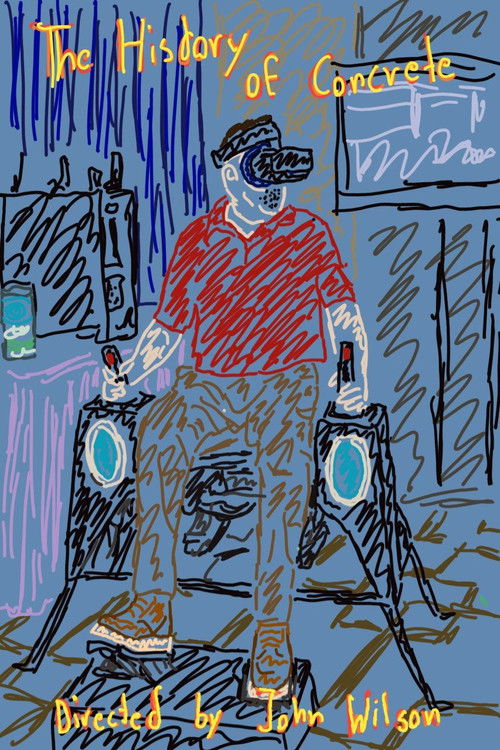
The History of Concrete
2026 · John Wilson
For when you want to laugh and learn at the same time — a low-stakes, high-curiosity evening that leaves you looking differently at your own sidewalk. Comfort viewing for people who like their comfort a little strange.
What it's about
Documentary filmmaker John Wilson signs up for a workshop on how to write and sell a Hallmark movie, then tries to apply that same formula to the least romantic subject imaginable: a documentary about concrete. What follows is both an actual history of the gray stuff holding up the modern world and a comedy about the absurd business of getting a documentary made and sold at all.
The experience
Wry, digressive, and quietly sincere — it keeps making you laugh at its own premise and then ambushing you with genuine wonder at something you've walked past your whole life. The pace is wandering by design, the pleasure cumulative.
The craft
Wilson's signature method — patient observational footage cut against a deadpan voiceover, with editing that turns stray street images into punchlines — scales up here to feature length. The joke of forcing formulaic movie structure onto nonfiction becomes the film's actual architecture, so the writing and editing are doing double duty: parody and essay at once.
Why it matters
Wilson's first feature after his acclaimed HBO series, and a marker of how docu-comedy's most distinctive voice of the 2020s translates to the big screen — while slyly commenting on how documentaries get financed now.
Snapshot
John Wilson's first feature-length documentary takes the most anonymous material in the built world — gray, poured, universal, structurally load-bearing and aesthetically invisible — and tries to sell it as a Hallmark movie. The conceit, per the film's synopsis, is that Wilson attends a workshop on writing and selling a Hallmark picture and then applies its formula to a documentary about concrete. That is a joke about genre, but it is also a working method and, underneath, a real problem: in the mid-2020s, the question of how one gets a documentary financed has become as pressing as what the documentary is about.
Wilson arrives at the feature from How To with John Wilson (HBO, 2020–2023), three seasons of essayistic docu-comedy that established one of the most distinctive nonfiction grammars of the decade — a solitary cameraman roaming New York, an ocean of incidental footage, and a hesitant second-person voiceover that starts on a mundane instructional premise and drifts into something unguarded. The History of Concrete is that method scaled to a single subject and a theatrical running time.
A caveat that governs this dossier: as a very recent release, the film's documentary record — festival trajectory, distribution terms, full crew credits, the shape of its critical reception — is thin and, in places, not something I can verify. Where that is the case I say so rather than filling the gap. What can be described with confidence is the method, the lineage, and the industrial and material history the film is working inside.
Industry & production
The film sits in an ecosystem that Wilson helped define and that has since become precarious. How To with John Wilson was an HBO production made in the orbit of Nathan Fielder, who executive produced alongside Michael Koman (Fielder's Nathan for You co-creator) — an institutional lineage that matters, because it is the pipeline through which American television legitimized long-form comic nonfiction as something other than a prank show.
The premise of The History of Concrete is itself a piece of industry criticism. Between roughly 2022 and 2025, the streaming platforms that had spent the previous decade absorbing documentary output sharply reduced their commissioning; acquisition prices for nonfiction at festivals fell; the "one-off feature doc" became notoriously hard to finance without a celebrity subject, a crime, or a legacy IP hook. Hallmark, meanwhile, represents the opposite industrial logic: a vertically integrated, formula-driven factory producing dozens of interchangeable seasonal titles a year on compressed schedules and known budgets — an efficient machine for manufacturing reliable sentiment. Running a documentary about cement through that machine is a gag whose punchline is the entire funding environment.
Production economics follow from Wilson's method rather than from a budget line. He shoots himself, continuously, over long periods, accumulating a vast personal archive of New York street footage from which sequences are later mined. That inverts the normal documentary cost structure: almost no crew-day expenditure, enormous post-production burden — logging, searching, rights clearance. The clearance problem is real and underdiscussed. Footage of identifiable people shot in public in New York occupies contested ground under state right-of-publicity law, generally protected by newsworthiness and expressive-work exemptions but still requiring judgment about which faces can carry a joke. Any Wilson project is, in practice, as much a legal sorting operation as an editorial one.
Technology
Two technologies are in play, and the film's wit depends on their contrast.
The first is the one being filmed. Concrete has a genuinely long documented history: Roman opus caementicium, using volcanic ash pozzolana, produced the Pantheon dome and marine structures that have survived two millennia; the technique lapsed after antiquity; Joseph Aspdin patented "Portland cement" in 1824; reinforcement with steel in the later nineteenth century made the material capable of spanning and cantilevering, which is the precondition for nearly every modern building typology. It is also, at the time of the film, an environmental problem of the first order — cement production is routinely estimated at something on the order of seven to eight percent of global CO₂ emissions, an unavoidable consequence of calcining limestone. A film about concrete in 2026 cannot be only whimsical.
The second is the camera. Wilson's practice descends from the consumer digital revolution that began with DSLR video around 2008 and matured into small, cheap, high-resolution bodies that can be carried all day and pointed at strangers without registering as a film crew. The camera's social invisibility is the aesthetic. So is the storage economics: terabytes are cheap enough that "shoot everything and find the meaning later" became a viable authorial strategy rather than a waste. The consequences are visible on screen — compression artifacts, autofocus hunting, blown skies — and when such footage is enlarged for theatrical projection, those artifacts stop being flaws and become the film's texture, a vernacular grain analogous to 16mm in an earlier documentary era.
Technique
Cinematography
Wilson is his own cinematographer, and this is not a budgetary fact but a formal one: the shooting eye and the writing voice belong to one person, which is why image and narration can be made to rhyme so precisely. The camera behaves like a pedestrian — handheld, ambling, frequently arriving late to its own subject, zooming to find something already in progress. Compositions are rarely "found" in the classical sense; they are caught. The recurring pleasures are signage, misspelling, municipal absurdity, and human gesture snagged mid-transit.
The closest honest comparison is not to documentary cinematography but to postwar American street photography — Garry Winogrand's compulsive over-shooting, Helen Levitt's attention to the incidental choreography of sidewalks. Wilson's innovation is to run that sensibility through an editing machine that assigns it retroactive meaning.
Editing
Editing is where the form actually lives. The governing operation is the associative cut between a spoken abstraction and a literal image: narration says one thing, the picture supplies an over-obedient or slightly wrong illustration, and the gap between them generates the laugh. Repeated, the device escalates — typically a rhythm of literal, literal, then a swerve into something that is no longer a joke at all. Across How To, this produced the signature effect: an episode entering on a trivial instructional premise and exiting on grief, loneliness, or civic despair, earned rather than announced.
A feature poses the structural question directly: a digressive engine tuned to roughly thirty minutes must now sustain ninety or more. The Hallmark-formula conceit is, read generously, the answer — an externally imposed three-act armature (the meet-cute, the return to the small town, the third-act misunderstanding, the reconciliation) borrowed precisely because Wilson's native mode has no shape of its own. It is an Oulipian move: adopt an arbitrary constraint to make a shapeless practice load-bearing.
Mise-en-scène / staging
Documentary staging here means selecting rather than building. Interviews take place in subjects' own environments, where the clutter does the characterization; the screenwriting workshop functions as a found set, a rented room whose fluorescent banality is already the commentary. Wilson himself appears mostly by implication — a voice, a shadow, a reflection in glass, an arm entering frame — a reflexivity that is constant but never insists on itself.
On the evidence of the premise (this is inference, not reportage), the film has available to it a genuine visual antithesis: the Hallmark register of soft key light, artificial snow, string-lit Main Streets and saturated reds against the flat, cold, undifferentiated gray of poured concrete. Two American visual ideologies — engineered warmth and structural indifference — in the same frame.
Sound
The voiceover is the architecture. Wilson's delivery is flat, hesitant, apologetic, with hesitations and false starts left in rather than smoothed out, and it addresses the viewer in the second person — "if you're like me" — a rhetorical form borrowed from instructional and self-help media and turned into intimacy. The written text is dense and carefully worked; the performance pretends it is not.
Beneath it sits the city's own track: traffic, jackhammers, sirens, the ambient percussion of construction, which for a film about concrete is diegetically on-theme. I cannot confirm the feature's music credits, and I will not guess at them; what can be said is that the series' scoring leaned on cues that mimic the earnest uplift of industrial and educational film, a register that the Hallmark conceit would naturally extend.
Performance
Nearly everyone on screen is a non-professional performing themselves, and Wilson's central ethical instrument is his own studied naivety. It places him in a recognizable documentary tradition of the ingénu interviewer — Nick Broomfield's shambling persistence, Louis Theroux's polite incomprehension — but with a crucial difference in temperature. Where Nathan Fielder's work in Nathan for You and The Rehearsal builds elaborate structures that put subjects under pressure, Wilson's method is fundamentally receptive: he lets enthusiasts talk, and the comedy arrives from specificity rather than from entrapment. The enthusiast — the person who has organized a life around an unfashionable expertise — is his recurring protagonist, and concrete is a subject that reliably produces them.
Narrative & dramatic mode
The film operates in at least three modes simultaneously. It is an essay film, advancing an argument through juxtaposition and first-person digression. It is a quest documentary, in which the filmmaker's attempt to accomplish something — here, to sell the film we are watching — supplies forward motion. And it is a procedural comedy of frustration, deriving its beats from institutional friction.
The Hallmark template is the binding agent, and it produces a specifically reflexive irony: the formula promises that any story can be made to resolve in reconciliation, while documentary's defining property is that reality declines to resolve. The film's dramatic tension is therefore between its imposed shape and its recalcitrant material — the same tension, one notes, that reinforced concrete itself embodies, a brittle mass held together by tension members it cannot see.
Genre & cycle
The History of Concrete belongs to several converging cycles.
The first is the American docu-comedy of the 2010s–20s: Nathan for You, The Rehearsal, How To with John Wilson — nonfiction that treats reality as a medium for constructed comic situations, descended in part from The Office's mock-documentary grammar but operating on unwitting or semi-witting real participants.
The second is the eccentric-subject documentary, whose foundational texts are Errol Morris's Gates of Heaven (1978) and Vernon, Florida (1981), and whose later flowering includes Fast, Cheap & Out of Control (1997) — films that take marginal obsessives seriously enough to be funny about them.
The third is the single-object history, familiar from nonfiction publishing (Mark Kurlansky's Cod and Salt are the type specimens) and from the industrial and educational film tradition preserved in archives like the Prelinger collection: the material that made civilization, narrated with unearned grandeur. Wilson's "how-to" framing was always a parody of exactly this instructional voice.
The fourth is the film-about-failing-to-make-the-film: Symbiopsychotaxiplasm (1968), Burden of Dreams (1982), American Movie (1999), Lost in La Mancha (2002), Exit Through the Gift Shop (2010), and behind all of them Welles's F for Fake (1973).
Authorship & method
Wilson is a New Yorker — Queens-raised — who studied film at SUNY Binghamton, whose cinema department was founded by Ken Jacobs and is historically associated with structural film and found-footage practice. That context is worth registering: the emphasis on duration, on the re-examined image, and on material accumulated rather than staged runs directly into Wilson's archive method, even though his surface is comic rather than avant-garde. Before the HBO series he made short work, including The Road to Magnasanti (2014), a portrait of a player who engineered a dystopian SimCity, and he has described early employment involving surveillance-style shooting — training, by his own account, in filming inconspicuously.
His authorship is unusually total at the level of image and voice: he shoots, he narrates, he drives the writing. But the work has never been solitary in construction. The How To model paired Wilson with comedy producers from the Fielder school and with a writers' group that notably included published prose essayists — Susan Orlean is among the series' credited writers — which accounts for the voiceover's literary density, its willingness to hold a digression long past the joke. The editorial team's role is decisive and underacknowledged: in a practice where meaning is discovered in the archive rather than planned on set, the edit is the screenplay.
For the feature specifically, I cannot verify the crew list — cinematographer (almost certainly Wilson himself, per his invariable practice), composer, editors, co-writers — and I decline to attribute names I cannot confirm.
Movement / national cinema
The film is American independent nonfiction of a particular metropolitan strain. Its deepest ancestry is the New York city-film: the city symphony tradition, the street photography of Levitt, Weegee and Rudy Burckhardt, Jonas Mekas's diary cinema, and the 1960s direct-cinema apparatus of the Maysles brothers, Pennebaker and Leacock that made portable synchronous shooting possible in the first place.
Its more immediate relatives are the American first-person essay documentary — Ross McElwee's Sherman's March (1986), Alan Berliner's family films — and Jem Cohen's urban-detritus cinema, Lost Book Found (1996) and Chain (2004), which share Wilson's conviction that the overlooked textures of a city constitute its real historical record. What Wilson adds is comedy, and a vernacular register drawn from YouTube and home video rather than from the gallery.
Era / period
The film is legible as a document of the mid-2020s. Post-pandemic New York was a city visibly preoccupied with its own infrastructure: Local Law 11 façade inspections had made sidewalk scaffolding a semi-permanent feature of the streetscape (Wilson devoted an early How To episode to it), and the 2021 collapse of the Champlain Towers South condominium in Surfside, Florida gave concrete failure a national vocabulary. The Infrastructure Investment and Jobs Act of 2021 had put large-scale public construction back into political circulation. And the climate arithmetic of cement — one of the hardest industrial sectors to decarbonize — had moved from specialist concern to mainstream reporting.
There is also a media-historical dimension. By 2026 the indexical authority of the recorded image was being actively destabilized by generative synthesis. A film built entirely from footage a person physically stood somewhere and shot is, in that environment, making an implicit argument about evidence and presence — whether or not it says so.
Themes
Permanence and its failure: concrete is the material that promises to outlast us and routinely does not, and the film's comedy of documentary financing sits inside a larger meditation on what actually endures.
Formula versus feeling: the Hallmark apparatus manufactures emotion to specification; Wilson's method finds emotion by accident and cannot reproduce it on demand. The film sets these two production systems against each other and lets the comparison implicate both.
The gray substrate: infrastructure as the unregarded ground of civic life, and the ethical proposition that attention itself is the documentary's contribution.
The enthusiast and the seminar: American self-invention as an industry — the workshop, the certificate, the promise that a formula can be purchased. Wilson has always been a sympathetic ethnographer of people buying instructions for their own lives, and here he is explicitly one of them.
Reception, canon & influence
On reception, honesty requires restraint. How To with John Wilson was received with sustained critical enthusiasm across its run and recurred on year-end lists; it was widely credited with expanding what nonfiction television could formally attempt. For The History of Concrete specifically, I cannot responsibly characterize the critical consensus, festival awards, or commercial performance, and I will not invent figures or quotations to fill that space. The reasonable expectation — that a first feature by a filmmaker with an established critical constituency would be evaluated primarily on whether the short-form method scales — should be treated as a prediction about discourse, not a report of it.
Influences on the film. The instructional and industrial film tradition, parodied at the level of address. Errol Morris's eccentric-subject portraiture. Nathan Fielder's comic nonfiction and the production culture around it. The Binghamton experimental lineage and its patience with accumulated material. American street photography's ethic of over-shooting and late selection. Jem Cohen's and Ross McElwee's first-person urban essayism. Chris Marker's model of the image commanded by a thinking voice. And, directly, Hallmark itself — studied here the way an ethnographer studies a rite.
Influence forward. Too early to assess, and any confident claim would be fabrication. What can be observed is that Wilson's prior work had already propagated: the archive-first, voice-over-driven personal documentary became a recognizable mode across streaming nonfiction and the video-essay economy in the first half of the 2020s, and a generation of makers absorbed the lesson that a single person with a small camera and several years of patience can constitute a production. If The History of Concrete extends that influence, it will most plausibly be by demonstrating that the mode can carry a feature — and that an ironic structural constraint is a workable substitute for conventional documentary architecture.
A Deleuzian reading
Think about where the camera is.
The full Deleuzian reading of The History of Concrete →
Reception
Premiered at Sundance in January 2026 to instant warm buzz — widely tagged the most purely entertaining doc of the festival — and is only now (September 2026) reaching theaters via Magnolia, so its reputation is still being written in real time.
How The History of Concrete was received, from release to now →
Influences: the films it descends from and the films it influenced
- Sans Soleil (1983) — The model of footage shot without a script and then commanded after the fact by a thinking, second-person commentary — a voice that says 'he wrote me' or 'you' and thereby assigns meaning to images the camera merely happened to catch.
- Sherman's March (1986) — Single-operator sync-sound shooting in which the announced historical subject is abandoned mid-film and the failure to make the intended documentary becomes the actual structure, narrated by the same person holding the camera.
- Bright Leaves (2003) — The commodity-history essay: a single material (tobacco) researched as a quest that keeps digressing into the narrator's own implication in it, establishing the 'history of one object' as a first-person form rather than an expository one.
- The Gleaners and I (2000) — Consumer-grade DV handled by the director alone, with the camera's accidents — lens caps, drifting hands, low-light mush — kept in the cut as evidence of the shooting body, and digressions permitted to outlast their pretext.
- Lost Book Found (1996) — Years of unassigned New York street footage indexed to a voiced catalogue of small objects, so that pedestrian-level accumulation, not scene coverage, supplies the film's entire image bank.
- Gates of Heaven (1978) — Eccentric-subject portraiture that holds a frontal interview well past the punchline until the speaker turns unexpectedly grave, refusing to cue the audience when to laugh at them.
- Tom, Tom, the Piper's Son (1969) — The Binghamton practice of re-examining an existing image until its degradation becomes content — grain, drift and transfer damage read as information, the direct forebear of compression artifacts treated as texture rather than flaw.
- F for Fake (1973) — An essay assembled entirely in the edit by an on-mic trickster-narrator who keeps announcing the procedure of the film he is making, so that montage logic and confession of method are the same gesture.
- Symbiopsychotaxiplasm: Take One (1968) — The production's own breakdown — crew revolt, unusable takes, a premise nobody can execute — promoted from outtake to architecture, proving a documentary can be built from the record of its own non-completion.
- Los Angeles Plays Itself (2003) — A feature-length single-subject history assembled wholly from mined footage and driven by a cranky, unhurried first-person commentary that treats the built environment as the thing being read.
- The City (1939) — The civic-industrial address itself — omniscient instructional narration over poured concrete and new highways — which is the register Wilson parodies at the level of voice while reusing its object-lesson structure.
- Cane Toads: An Unnatural History (1988) — Deadpan comic natural history of one subject: absurd low-angle coverage and straight-faced expository narration played entirely without winking, so the comedy comes from the form's own solemnity.
- Room 237 (2012) — An essay built from obsessive unseen speakers laid over mined footage, where the associative cut — illustrating a claim with a borrowed image that slightly mismatches it — supplies both argument and joke.
- Cameraperson (2016) — A feature discovered by re-editing a career's discarded rolls, demonstrating the archive-first premise Wilson works from: the edit is the screenplay, and the shooter's off-camera presence is the through-line.
- Rat Film (2016) — A single-object city history that cuts between street-shot digital footage and municipal archive, using a flat affectless narration to make an infrastructural material carry a social argument.
- Fraud (2016) — A feature cut entirely from a stranger's uploaded home video, where low-bitrate consumer-camera texture is the film's visual signature and narrative is imposed onto footage shot for other reasons.
- Kate Plays Christine (2016) — A reflexive quest that repeatedly stages its own inability to deliver the promised film, converting research dead-ends and refused access into the documentary's forward motion.
- Minding the Gap (2018) — A decade of self-shot skate footage — one operator, cheap cameras, no production — re-read years later so that material gathered as habit becomes, through selection alone, a structured feature.
Similar films
- Sherman's March (1986) — influence & lineage
- Primary (1960) — shared sensibility
- The Big Short (2015) — shared sensibility
- Hundreds of Beavers (2024) — shared sensibility
- Man with a Movie Camera (1929) — shared sensibility
- The Oldest Person in the World (2026) — shared sensibility
- John Candy: I Like Me (2025) — shared sensibility
- Chronicle of a Summer (1961) — shared sensibility