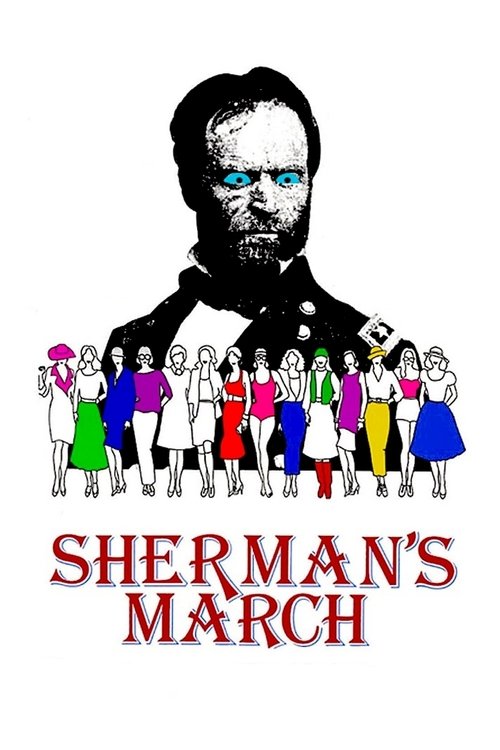
Sherman's March
1986 · Ross McElwee
For when you're in the mood to wander — a long, digressive, human documentary to sink into on a lazy weekend, especially if you've ever nursed a heartbreak into a project. A talky, patient watch that rewards surrendering to its pace.
What it's about
Ross McElwee sets out to make a documentary retracing General Sherman's scorched-earth march through the South — but a breakup on the eve of filming derails him, and the camera turns instead to his own fumbling search for love along the route. What emerges is a two-and-a-half-hour confessional travelogue through the 1980s South: aspiring actresses, survivalists, old flames, and a filmmaker narrating his own romantic disasters in a wry Southern deadpan, with Sherman's ghost and Cold War dread hovering at the edges.
The experience
Funny in a dry, self-deprecating way that keeps deepening into something melancholy and true — it meanders on purpose, and the meandering is the pleasure. You come away feeling like you've spent a long road trip with a hyper-observant, lovelorn friend.
The craft
McElwee shoots and narrates everything himself, and the film's craft is in that intimacy: a handheld camera that people forget is there, and voice-over that turns romantic failure into literature. The deadpan full title alone signals the game — a Civil War travelogue continually ambushed by real life.
Why it matters
A landmark of American autobiographical documentary, it helped legitimize the first-person, filmmaker-on-screen mode that countless personal documentaries and essay films have worked in since.
Snapshot
Sherman's March — its full, deadpan title is Sherman's March: A Meditation on the Possibility of Romantic Love in the South During an Era of Nuclear Weapons Proliferation — is a roughly two-and-a-half-hour first-person documentary in which the filmmaker's ostensible subject collapses into his own life. Ross McElwee sets out to trace General William Tecumseh Sherman's 1864 scorched-earth march through Georgia and the Carolinas; instead, dislocated by a breakup on the eve of shooting, he turns the camera on his own halting search for love among the women he meets along the route. The film became one of the defining works of American autobiographical nonfiction, a hinge between the observational "direct cinema" McElwee was trained in and the confessional, essayistic first-person documentary that would flourish in the decades after. It is talky, digressive, funny, and quietly melancholic, and it treats Sherman's campaign less as a subject than as a haunting historical rhyme for McElwee's own anxieties about destruction, memory, and the South.
Industry & production
The film belongs squarely to the world of independent, grant-and-institution-supported American documentary rather than to any studio or broadcaster's commissioning system. McElwee was a product of the MIT Film Section, where he studied and later taught, and the picture carries the low-budget, single-maker economics of that milieu: shot over an extended period on 16mm, largely self-financed and grant-assisted in the manner typical of personal documentary in the early-to-mid 1980s. (Precise budget figures and the full roster of grants are not something I can state reliably, and I won't invent them.) What is well documented is the mode of production: McElwee worked essentially as a one-man crew, operating camera and recording synchronous sound simultaneously, which is central to both the film's economy and its intimacy.
The film's commercial life came through the festival and specialty-theatrical circuit rather than wide release. It was widely reported to have won the top documentary prize (the Grand Jury Prize) at the Sundance Film Festival — then still recently renamed from the U.S. Film Festival — for 1987, and that recognition, together with strong critical notices, gave a long, difficult, uncommercial-seeming film an unusual afterlife in art houses and on the campus and repertory circuit. It has remained continuously in circulation through nonfiction distribution channels, an unusually durable shelf life for a personal documentary of its era.
Technology
Technologically the film sits at the mature end of the lightweight-sync-sound revolution that had reshaped documentary since the early 1960s. It was shot on 16mm film with a portable camera and crystal-sync sound recording — the same broad toolkit pioneered by McElwee's teachers Richard Leacock and D. A. Pennebaker's generation, but here pushed to a logical extreme. The decisive technical fact is that McElwee handled both image and sound himself, wearing or rigging his recording gear so that a single person could capture usable synchronous dialogue while shooting. This solo capability is not incidental; it is the enabling condition of the film's entire aesthetic. Because there is no crew, the people McElwee films behave as if they are talking to one man rather than a production unit, and McElwee can keep the camera running through private, unguarded, late-night moments. The film predates consumer video's dominance of personal documentary; its grainy, warm 16mm texture and the physical limits of film magazines (which shape how long any take can run) are part of its period signature.
Technique
Cinematography
McElwee shoots almost entirely in available light, handheld, in a rough, responsive style that follows conversation rather than composing tableaux in advance. Because he is both operator and participant, the camera is frequently at hip or chest level, or panned quickly toward whoever is speaking; focus and framing sometimes lag reality, and those imperfections read as honesty rather than error. The filmmaker's own presence is registered obliquely — in shadows, reflections, the tilt of the frame when he reacts, and above all in the fact that subjects address the lens as they address him. Interspersed are quieter, more contemplative images: Southern landscapes, monuments, kudzu-choked ground, historical markers, the residue of Sherman's campaign. The visual grammar deliberately oscillates between the reactive (people, talk, courtship) and the meditative (land, ruin, history), and the tension between those registers is much of the film's meaning.
Editing
The editing — McElwee's own — is where the film is truly authored, since the raw material is a sprawl of encounters shot over a long stretch of time. The structure is nominally organized as a series of "stops" along Sherman's route, each associated with a woman and often introduced with mock-scholarly intertitles about Sherman's military progress that ironically counterpoint McElwee's romantic non-progress. Out of hours of contingent footage the cut builds recurring motifs (the specter of nuclear war, the figure of Burt Reynolds, the pull of old teachers and family), running gags, and a slow emotional arc. The essayistic voice-over, recorded after the fact, is threaded through to bind episodes and to editorialize on McElwee's own behavior, frequently undercutting him. The length is itself a formal choice: the film's shagginess and duration enact the aimlessness and repetition of its maker's search.
Mise-en-scène / staging
"Staging" is a fraught term for a film committed to non-intervention, and Sherman's March lives on the productive ambiguity of that commitment. Much of what we see is plainly unstaged — real conversations in real kitchens, cars, beaches, and back yards. Yet McElwee is candid, in voice-over and in his behavior, that his presence with a camera changes what happens: women perform for it, or resist it, or use it. The film's "sets" are the vernacular spaces of the 1980s South, and its recurring human fixtures — most memorably Charleen Swansea, McElwee's former teacher, who erupts periodically to scold him for hiding behind the camera and to try to arrange his love life — function almost like staged interventions that were not, in fact, staged. The mise-en-scène is documentary reality curated by selection rather than arrangement.
Sound
Sound is unusually expressive for an observational film. The synchronous dialogue McElwee records himself is the spine, but the film's signature is its two-layered voice: the "live" McElwee inside scenes and the reflective, often whispered, insomniac McElwee of the voice-over, frequently narrating directly to the camera in darkened rooms. That confessional whisper — self-deprecating, anxious, wry — is arguably the film's most influential single element. The soundtrack draws on ambient and source sound rather than an original orchestral score; the film is not built around a composer's music but around talk, silence, and the textures of place. (I would not want to overstate the presence of scored music, which is minor at most.)
Performance
There are no actors, but there are unforgettable "characters," and the film's charge comes from real people who are vivid on camera: an aspiring actress rehearsing and dreaming of Hollywood; a survivalist couple preparing for nuclear apocalypse; a linguist; a singer; women who variously flirt with, tolerate, or flee the filmmaker. McElwee's own on-screen "performance" — hesitant, decent, comically passive, forever narrating his failures — is a genuine construction, a persona shaped in the edit even though everything in it is real. The ethical weight of the film rests on how it presents these women, and critics have long debated whether the film exploits or honors them; the persistence of that debate is itself evidence of how alive the performances feel.
Narrative & dramatic mode
The film's dramatic mode is the essay-diary: episodic, first-person, digressive, and self-reflexive. It sets up a mock-quest structure — retrace Sherman, find love — and then lets both quests fail in illuminating ways. The historical thread (Sherman as destroyer, as haunting Southern memory, as a man who also had his own romantic entanglements) works as extended metaphor and ironic frame rather than as a history lesson. Tonally it braids comedy and dread: the running joke of McElwee's romantic ineptitude sits alongside genuine terror about nuclear annihilation, so that the "era of nuclear weapons proliferation" of the subtitle is not a throwaway but the film's emotional weather. The result is a narrative that advances by accretion and association rather than by plot, trusting the viewer to feel the pattern.
Genre & cycle
Sherman's March is a documentary, but more precisely it is a founding text of the autobiographical, first-person, essayistic documentary cycle in American cinema. Its immediate lineage is the "personal cinema" that emerged from the direct-cinema tradition — most directly the diary films of McElwee's MIT mentor Ed Pincus — but it pushed that mode toward a wider, more entertaining, more openly narrated register. In genre terms it also functions as a nonfiction road movie and a Southern film, using travel and region as organizing principles. It helped define a cycle that would include a range of confessional, filmmaker-in-front-of-the-lens documentaries in the years that followed.
Authorship & method
This is, by design, a near-total authorship: McElwee is director, cinematographer, sound recordist, narrator, on-screen protagonist, and editor. That concentration of roles is the method — the film could not exist as it is if any of those functions were delegated, because its intimacy depends on the subjects relating to one person and its meaning depends on that same person shaping the material afterward. The key creative "collaborators" are therefore less crew than the recurring figures who anchor the film, above all Charleen Swansea, whose exhortations give the film both comic energy and a moral conscience. McElwee's method — long immersion, solo shooting, and a reflective voice-over composed in the edit — descends visibly from Richard Leacock's and Pincus's teaching at MIT, but it inverts direct cinema's ideal of the invisible observer: here the observer is the subject. There is no traditional screenwriter (the film is unscripted) and no composer-driven score; the authorship is unusually singular, and it is precisely that singularity that later filmmakers would emulate.
Movement / national cinema
The film is American, and specifically a product of the Cambridge/MIT documentary milieu that grew out of the 1960s American direct-cinema movement (Leacock, Pennebaker, the Maysles, Frederick Wiseman). But Sherman's March marks a turn away from that movement's ethic of self-effacement toward the personal and reflexive. It also belongs to a distinctly Southern American strain of nonfiction, preoccupied with the region's memory of the Civil War, its landscapes, and its social textures. Internationally it resonates with the tradition of the essay film associated with figures like Chris Marker, though McElwee's idiom is more homespun and confessional than the European essayists', and there is no need to claim direct lineage there.
Era / period
The film is deeply of the mid-1980s. Its Cold War anxiety — the survivalists, the recurring dread of nuclear war, the sense that romance and even history unfold under the shadow of the bomb — is entirely period-specific, and the subtitle foregrounds it. So is its texture of Reagan-era Southern life: the aspirational pull of media celebrity (the Burt Reynolds motif, the actress's Hollywood dreams), the vernacular spaces and speech, the mixture of religiosity and disquiet. Technologically and institutionally it sits at the last moment when personal documentary was still made on film rather than video, giving it a material warmth that would soon become rare in the genre.
Themes
Several themes interlock. First, memory and destruction: Sherman's march becomes a figure for how violence scars land and lineage, and how the past persists in the Southern present. Second, romantic longing and male passivity: the film is an unusually honest, self-critical study of a man who cannot quite act, who mediates every relationship through a lens. Third, the ethics of the camera itself — the film keeps asking, sometimes through Charleen's rebukes, whether filming life is a way of living it or a way of avoiding it. Fourth, apocalypse and intimacy: the constant background hum of nuclear dread reframes the search for love as a small, stubborn act of hope against annihilation. Finally, the South as inheritance — familial, historical, and psychological.
Reception, canon & influence
Critically, Sherman's March was received as a landmark, praised for its wit, candor, and formal daring, and it has retained the admiration of critics and documentary historians ever since; its festival recognition (the top documentary prize at Sundance for 1987, as widely reported) helped cement that standing. Its canonical status was later ratified by selection to the U.S. National Film Registry of the Library of Congress, marking it as culturally and historically significant.
Its influences flow backward to the MIT/direct-cinema tradition — Richard Leacock's observational rigor and, most decisively, Ed Pincus's Diaries, the immediate model for turning the camera on one's own domestic and romantic life — as well as to McElwee's own earlier autobiographical work.
Its forward influence is large and easy to trace in outline. Sherman's March is routinely cited as a foundational work of the first-person, filmmaker-on-camera documentary that became a dominant nonfiction mode in the following decades — from the ironic, self-inserting essay-documentary to the confessional diary film. Filmmakers working in the reflexive, narrated, personally implicated vein of nonfiction owe an evident debt to McElwee's template, and the film is a fixture of documentary teaching precisely because it so cleanly demonstrates how autobiography, essay, and observation can be fused. McElwee himself extended the project across a body of related first-person films in later years, and Sherman's March remains the keystone of that career and one of the most influential American documentaries of the 1980s.
A Deleuzian reading
A man sits in a dark room, turns the camera on himself, and whispers.
The full Deleuzian reading of Sherman's March →
Reception
An unlikely art-house hit in 1986 — a 2.5-hour first-person doc that won the Grand Jury Prize for documentary at the 1987 U.S. Film Festival (soon to be Sundance) — it's since been fully canonized, entering the National Film Registry in 2000 as the founding text of the confessional personal documentary.
How Sherman's March was received, from release to now →
How to watch Sherman's March: what to notice on a first viewing
- Listen for two different versions of McElwee's voice. One voice talks inside scenes as they happen. A second, whispered voice-over, recorded later in darkened rooms, comments on and often undercuts the first. You are hearing a man argue with his own past self in real time.
- Watch for mock-scholarly intertitles tracking Sherman's progress. Cards report the general's military advance through Georgia while McElwee's own romantic search stalls out beside it, the two timelines running in ironic counterpoint. History marches forward on schedule. His own life very pointedly does not.
- Watch the camera sit at hip or chest level, unsteady. Because McElwee operates the camera himself while talking to people, the framing lags and drifts rather than composing a tidy image in advance. The imperfection reads as honesty. You can feel one person doing everything at once.
- Watch Charleen interrupt him to scold him on camera. His former teacher recurs across the film to tell him he hides behind the lens and to try to arrange his love life for him. One recurring character keeps saying out loud what the rest of the film only implies about him.
- Watch for kudzu, monuments, and old historical markers. Quieter, more contemplative shots of Southern landscape and Civil War-era markers recur between the conversations and courtships. The land keeps holding onto a history nobody on screen is actively discussing.
The whole guide to watching Sherman's March, with the keys for a rewatch →
Influences: the films it descends from and the films it influenced
- Diaries (1971-1976) (1982) — The direct template: Pincus turned a solo sync-sound 16mm camera on his own marriage and domestic life over years, and as McElwee's MIT teacher handed him the exact autobiographical-diary method he adopts.
- Chronicle of a Summer (1961) — Reflexive cinéma vérité in which the filmmakers appear on camera and openly interrogate the ethics of filming their subjects — seeding McElwee's on-screen presence and running camera-ethics thread.
- Primary (1960) — Pioneered lightweight synchronized 16mm sound rigs that made one- or few-person observational shooting possible, the technical precondition for McElwee's entirely solo synchronous-sound method.
- Don't Look Back (1967) — Single-operator handheld, available-light following of one subject at close range — the portable observational intimacy McElwee inherits and turns back onto himself.
- Grey Gardens (1975) — Builds its intimacy on subjects performing directly to the present, acknowledged filmmakers rather than to an invisible fly-on-the-wall — the interpersonal dynamic McElwee makes his explicit subject.
- David Holzman's Diary (1967) — A (fictional) man turns the camera on his own romantic life and narrates it aloud, prefiguring the confessional camera-as-self conceit and the diarist protagonist who talks to his own lens.
- Sans Soleil (1983) — Essayistic voiceover written and layered over footage after the fact, the reflective narration-composed-in-the-edit structure that converts raw observation into personal essay.
- F for Fake (1973) — The self-aware, digressive first-person essay film with an on-screen authorial trickster — a model for fusing mock-scholarly framing, irony, and personal address into nonfiction.
- Backyard (1984) — McElwee's own earlier autobiographical short establishing the family-and-self subject, solo shooting, and whispered reflective voiceover he expands to feature length here.
- Roger & Me (1989) — Extends the ironic first-person mock-quest structure — a narrating filmmaker-protagonist chasing an elusive goal on camera — into the political essay-documentary that dominated the next decades.
- Nobody's Business (1996) — First-person familial essay-doc in which the implicated filmmaker argues on the soundtrack with his subject, extending McElwee's fusion of autobiography, interview, and narrated reflection.
- Tarnation (2003) — Confessional diary autobiography assembled from a lifetime of self-shot footage, taking the camera-turned-on-one's-own-life premise to its most raw first-person extreme.
- My Winnipeg (2007) — A mock-scholarly personal essay-film braiding memoir, civic history, and a wandering quest with deadpan narrated voiceover — descended from McElwee's ironic-intertitle, essayistic register.
- Stories We Tell (2012) — Reflexive personal documentary that foregrounds the filmmaker's own implication in the story and the constructedness of memory, inheriting the authorship-as-subject stance.
- Cameraperson (2016) — A first-person reflexive doc built from an operator's accumulated footage that interrogates the ethics of the camera and the filmmaker's presence behind it — McElwee's camera-ethics thread made the whole form.
- Bowling for Columbine (2002) — Establishes the on-camera director-protagonist whose digressive personal persona and comic-confessional voiceover carry the film, the auteur-as-character mode Moore weaponizes for advocacy.
- The Watermelon Woman (1997) — Perfected the wandering first-person documentary where the filmmaker's own romantic life derails the ostensible subject, the autobiographical digression structure Dunye weaves through her research plot.
- American Splendor (2003) — Built a feature from deadpan first-person voiceover laid over the quotidian texture of an ordinary life — the documentary-voiceover-over-the-mundane register Pekar's narration inhabits.
- Minding the Gap (2018) — Pioneers the reflexive first-person documentary in which the filmmaker's own life and voice become the organizing subject, the reflexive stance Liu adopts by writing himself in as a character.
- For Sama (2019) — Canonizes the first-person diary-essay in which the filmmaker's own handheld camera and confessional voiceover become the organizing consciousness, folding private life into a larger historical journey — the diaristic authorship For Sama adopts.
- Black Box Diaries (2024) — McElwee's continuous first-person voiceover turns his own faltering personal quest into the documentary's investigative spine — the diaristic narration mode structuring Ito's account.
- The Gleaners and I (2000) — A solo-scaled handheld first-person road essay in which the filmmaker registers herself obliquely — hands, hair, reflections — while wandering a country, the same self-inscribing nonfiction travelogue mode.
- The Emperor's Naked Army Marches On (1987) — Autobiographical handheld camera trained on the filmmaker's own intimate entanglements, turning private pursuit into structure — a Western contemporary of the confessional self-implication Hara pioneered in Extreme Private Eros.
- Burden of Dreams (1982) — Essayistic-observational documentary that folds the camera's own presence and the filmmaker's obsession into the film's reflexive subject, extending direct cinema toward first-person authorship.
Similar films
- Chronicle of a Summer (1961) — influence & lineage
- Sans Soleil (1983) — influence & lineage
- Primary (1960) — influence & lineage
- Grizzly Man (2005) — shared sensibility
- The Motorcycle Diaries (2004) — shared sensibility
- The Searchers (1956) — shared sensibility
- Paisan (1946) — shared sensibility
- Twenty Years Later (1984) — shared sensibility