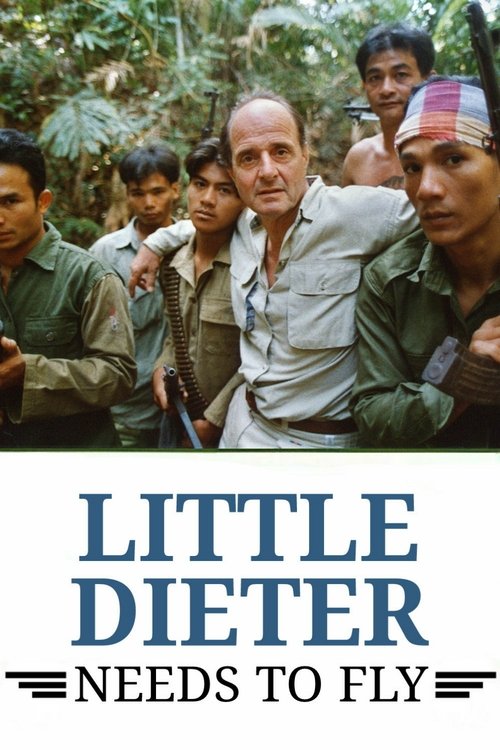
Little Dieter Needs to Fly
1997 · Werner Herzog
For when you want a true story that's stranger and more moving than fiction — a survival tale to watch riveted and think about after. Intense subject matter, but the man's spirit makes it oddly uplifting.
What it's about
Dieter Dengler grew up in bombed-out postwar Germany dreaming of nothing but flying; he emigrated, joined the U.S. Navy, and was shot down over Laos in 1966 in the covert early days of the Vietnam War. Captured and held in jungle camps, he survived months of brutal captivity before a daring escape. Thirty years on, Herzog takes him back to Laos, where Dengler retells his story on the spot — and even re-enacts parts of it with local villagers standing in for his captors.
The experience
Gripping and strangely buoyant — Dengler recounts horror with the brisk, almost cheerful precision of a man who has made peace with it, which somehow makes it hit harder. You lean in for the whole running time, and the images of him back in the jungle stay with you.
Performances
Dengler himself is the film: a natural, magnetic storyteller whose candor, odd rituals, and undimmed love of flying give the film a protagonist no screenwriter would dare invent.
The craft
Herzog blends present-day location shooting, archival images, and staged reenactments — including having Dengler walk his own escape route bound by villagers — chasing what he calls a deeper truth than plain testimony. The result reads as both documentary and psychological portrait, with Herzog's narration threading it all together.
Why it matters
A landmark of Herzog's approach to documentary, so potent he later retold the same story as a fiction feature. It's a key text in the argument that staging and stylization can make a true story truer.
Snapshot
Werner Herzog's seventy-nine-minute documentary follows Dieter Dengler, a German-born American naval aviator who was shot down over Laos in early 1966 during the covert opening phase of the Vietnam War, captured by Pathet Lao guerrillas, held in jungle camps under brutal conditions, and eventually escaped after months of captivity. The film interweaves Dengler's present-day narration — delivered with the blunt, almost cheerful authority of a man who has metabolized horror — with location shooting at the sites of his captivity, archival photographs, and staged reenactments performed with the help of local villagers. It belongs squarely to Herzog's sustained interrogation of what he calls the "ecstatic truth" — the conviction that a deeper, more essential reality can be reached by the documentary filmmaker only through license, invention, and the directed performance of remembered experience. The result is one of the defining works of performative documentary and one of the most searching portraits of trauma, obsession, and the will to survive in post-war cinema.
Industry & production
The film was produced under Herzog's own banner with co-production support from German and British television; it aired as a television documentary before receiving theatrical screenings and festival exposure. The production was modest by any measure: a small crew traveling with a single central subject across northern California (where Dengler had settled after the war) and Southeast Asia. Herzog had encountered Dengler's story through Dengler himself, and the director's characteristic method of deep personal immersion — living alongside his subjects, pressing them toward extremity — shaped every production decision. The film's low institutional footprint freed Herzog from the conventions of the prestige television documentary, allowing reenactment and staged duration to coexist with direct testimony in ways that broadcast norms would typically discourage. The film's influence on later documentary practice almost certainly exceeds the scale of its original distribution.
Technology
Shot on 16mm film — the format Herzog has consistently preferred for documentary work, valuing its grain, its responsiveness to difficult light conditions, and the physical discipline it imposes on camera operators who must commit to takes — "Little Dieter" makes no attempt to aestheticize its technology. The format is a tool, not a statement. The decision to shoot on location in Southeast Asia rather than reconstruct the terrain elsewhere gave the film a textural authenticity against which the reenacted sequences press with visible artificiality, and this tension is deliberate. There is no glossing of the gap between past and present; the technology is mobilized to hold both open simultaneously.
Technique
Cinematography
Peter Zeitlinger, who became Herzog's principal documentary cinematographer through the 1990s and into the 2000s, shot the film with a practiced attentiveness to the unglamorous density of actual place. The jungle sequences are neither beautified nor made to perform menace — they are rendered with the flat particularity of somewhere genuinely remote, which is more disturbing than any expressionistic treatment would be. The California sequences that open the film — Dengler at home, performing his private rituals — are photographed with close, unhurried attention, the camera holding on behaviors (the repeated opening and closing of the front door; the arrangement of escape routes around the house) long enough to make them strange. This patience, Zeitlinger's most consistent contribution to Herzog's late documentary work, transforms behavioral observation into something approaching phenomenological inquiry.
Editing
The editing sustains a double temporality throughout: Dengler in the present tense, speaking at the sites of his captivity, and the reconstructed past pressing against that present through reenactment and archival image. The cutting avoids the rhythmic reinforcement that conventional television documentary employs — the edit that arrives precisely to underscore what the voiceover has just said. Instead, the film allows gaps, allowing Dengler's narration to run ahead of or behind the image, which keeps the viewer's interpretive work active and resists the closure that edited testimony normally provides. The specific editor's name for this production is not one I can confirm with certainty, and I will not attribute the work speculatively.
Mise-en-scène / staging
The most contested and most discussed element of the film is its reenactment sequences, in which Dengler — with the visible cooperation of local villagers cast as his former guards — restages the tortures and humiliations of his captivity. Herzog is visible in the film's orchestration of these scenes: they are not discovered but arranged, and the arrangement is acknowledged. This is the engine of the film's ethics and its aesthetics simultaneously. The reenactment is not offered as evidence — it cannot recover the past — but as a performative act through which the body that survived the original event attempts to transmit the weight of that experience to a viewer who was not there. The staging of Dengler's captivity at the actual sites, with the director present as interlocutor and prompter, gives these scenes a quality that falls between confession, theater, and ceremony.
The opening sequence at Dengler's California home establishes the film's method immediately. Dengler opens and closes his front door dozens of times — a compulsion Herzog describes as a kind of anti-claustrophobic ritual, a daily reassertion of freedom that the pilot developed after his return. Whether Herzog directed Dengler to perform this or found him already performing it is a question the film does not answer, and the ambiguity is characteristic. The mise-en-scène throughout stages reality with a theatrical consciousness that is never quite concealed.
Sound
The film's sound design uses the dense ambiance of jungle — birdsong, insect noise, the distant percussion of water — to ground the reenacted sequences in a sensory present that the historical photographs cannot provide. Herzog's voiceover narration, delivered in his distinctive Bavarian-accented English, frames and inflects the film's meaning without fully governing it: the narration reflects, associates, occasionally corrects, and sometimes simply describes what is visible, trusting the image to mean beyond its description. The film's use of music is restrained; where music appears, it does not swell to cue the viewer's response. The specific musical credits are not ones I can confirm with confidence, and I decline to speculate.
Performance
Dieter Dengler is among the most extraordinary documentary subjects in the history of the form. His manner — frank, concrete, at moments almost manic with the pleasure of having survived — runs directly counter to the register of the traumatized witness that documentary convention has established. He does not speak of his captivity from a position of anguished remove; he plunges into it with something approaching relish, his narration rich with specific physical detail (the texture of the food, the precise mechanics of his bonds, the exact moment he understood escape was possible) in ways that make the horror intimate rather than abstract. This directness is partly cultural, partly temperamental, and partly — one senses — a coping structure that has calcified over decades into a mode of being. Herzog draws on it without exploiting it, recognizing in Dengler's manner a kind of natural Herzogian protagonist: the man who insists on the body's capacity against every environmental pressure.
Narrative & dramatic mode
The film's narrative structure is episodic rather than continuous, organized around the stages of Dengler's captivity and escape rather than a conventional arc of rising and falling tension. The dramatic mode is interrogative — Herzog, visible and audible throughout, presses Dengler on his memories, on his psychology, on the question of what experience at that extremity does to a person. The film refuses the redemptive resolution that the survival narrative typically demands: Dengler's return to civilization was not a restoration but a transformation, and the film is interested in the nature and cost of that transformation. The repeated returning to sites of captivity, physically and narratively, enacts the impossibility of leaving the past behind while simultaneously demonstrating the survivor's continued vitality.
Genre & cycle
"Little Dieter Needs to Fly" belongs to the post-Vietnam documentary cycle that emerged most fully in the 1980s and continued through the 1990s — work attempting to account for a war whose cultural processing remained visibly incomplete. But it belongs only obliquely to that cycle: it is less interested in the political and strategic dimensions of the conflict than in the phenomenology of captivity and escape, and its frame is not American national trauma but the particular experience of a man who arrived in America as a German immigrant, fell in love with aviation by watching American planes over his village during the Second World War, and read the sky as a promise of freedom that the war in Southeast Asia would attempt to cancel. This immigrant inflection — shared by Herzog himself — places the film at an angle to its American contemporaries.
More precisely, the film belongs to what Bill Nichols would categorize as the performative mode of documentary: work that foregrounds the subjective and evocative dimensions of nonfiction filmmaking, prioritizing the transmission of an experiential truth over the assembly of evidence toward a verifiable claim. Herzog's films constitute perhaps the most sustained and formally sophisticated body of work in this mode.
Authorship & method
Werner Herzog is among the most extensively theorized of living filmmakers, and the theoretical apparatus he has himself supplied — the concept of "ecstatic truth," the distinction between the "accountant's truth" of cinema vérité and the deeper truth that requires the filmmaker's active intervention — is directly operative in "Little Dieter." Herzog's documentary method, refined across decades and subjects as varied as Klaus Kinski, the Antarctic research station at the South Pole, and the caves of Chauvet, involves the director's conspicuous presence as a shaping consciousness: he appears on screen, he asks questions in his own voice, he stages and restages. The camera is never innocent, and the film does not pretend otherwise.
Peter Zeitlinger's collaboration with Herzog represents one of the most productive director-cinematographer relationships in contemporary documentary. Zeitlinger's capacity to find the visual register appropriate to Herzog's interrogative mode — observational without being passive, attentive without being intrusive — is evident throughout the film.
Movement / national cinema
The film is a German-language documentary production directed by a German filmmaker about a German-American subject, but it refuses easy placement within any national cinema. Herzog has always operated at the margins of the New German Cinema with which he is historically associated — he shares the generation of Fassbinder, Wenders, and Schlöndorff but has pursued a consistently more eccentric and internationally oriented body of work, oriented toward myth, extremity, and the non-European world in ways that set him apart from the Adenauer-era cultural reckoning that preoccupied his contemporaries. "Little Dieter" is German in its director, American in its subject and setting, and Southeast Asian in its most charged locations — a genuinely transnational work.
Era / period
Made in the mid-1990s, the film belongs to a moment of documentary consolidation in which the formal innovations of the direct cinema and cinéma vérité movements had become so fully absorbed into television practice as to constitute a new convention — one against which filmmakers like Herzog, Errol Morris, and Chris Marker had been pressing for years. The film's confident use of reenactment and authorial staging reflects an aesthetic position that was becoming, in this period, more widely legible: the late-1990s and early-2000s documentary revival would formalize many of the approaches Herzog had been developing across his career.
Themes
Flight is the film's governing metaphor and its literal subject. Dengler's obsession with aviation — which began in childhood, watching Messerschmitt fighters over his village — is not merely biographical context but the film's central claim about desire and its consequences: that the things we love most intensely are precisely the things capable of bringing us to destruction. The film is deeply concerned with freedom — its physical, psychological, and existential dimensions — and with what captivity reveals about the self. The repeated imagery of doors, of thresholds, of open sky against confined space, gives the thematic material a visual grammar.
Survival and its transformation of the survivor is the film's secondary preoccupation. Dengler is not traumatized in the mode the film's subject matter might predict; he is energized by his survival in ways that are both inspiring and unsettling. Herzog's interest in this energized survivor — the man who has been to the limit and returned altered but functional — is continuous across his career, from the subjects of his fiction films to the documentary subjects he is consistently drawn toward.
Reception, canon & influence
Critical reception at the time of release was strongly positive, with reviewers across European and American film culture responding to the film's formal confidence and the power of Dengler as a subject. The film is regularly cited in discussions of Herzog's documentary work and in academic treatments of performative and reflexive documentary practice.
The influences on the film run backward, most significantly, to Errol Morris's "The Thin Blue Line" (1988), which had established reenactment as a legitimate and formally sophisticated documentary tool. Herzog's use of reenactment is less forensic and more theatrical than Morris's, but the enabling precedent is clear. More diffusely, the film inherits from the essayistic documentary tradition associated with Marker and the cinéma vérité mode's acknowledgment of the filmmaker's presence.
The film's forward influence is substantial. Its approach to reenactment — insisting on the performed, artificial quality of the reconstruction rather than disguising it — prefigures the strategies of later documentarians who would push the mode further. More directly, the film generated Herzog's own "Rescue Dawn" (2006), a fiction feature starring Christian Bale as Dengler, which represented the rare case of a documentary reconstituted as narrative film by the same director who made the documentary. The two films together constitute a kind of diptych on the limits of each mode: what the documentary can transmit that fiction cannot, and vice versa.
Dieter Dengler died in 2001 of amyotrophic lateral sclerosis; he did not live to see "Rescue Dawn." The documentary stands as the more searching of the two accounts, precisely because it cannot hide behind its actors: Dengler himself is present, opening and closing the door, returning to the jungle, performing the experience that the fiction film would later simulate. The performance is irreducible, and it is the film's most enduring achievement.
A Deleuzian reading
The man keeps opening his front door.
The full Deleuzian reading of Little Dieter Needs to Fly →
Reception
Warmly received on the doc circuit in 1997, it got a second life a decade later when Herzog remade the same story as Rescue Dawn — sending a wave of new viewers back to the original, which many now rank among his very best documentaries.
How Little Dieter Needs to Fly was received, from release to now →
Influences: the films it descends from and the films it influenced
- The Thin Blue Line (1988) — Morris established reenactment as a constitutive formal device — stylized, non-transparent, aesthetically autonomous — rather than mere illustration, creating the enabling precedent Herzog cites implicitly when he insists Dengler physically perform his own captivity rather than simply describe it.
- Night and Fog (1956) — Resnais's intercutting of a color present-tense camera drifting through abandoned camp sites against black-and-white archival footage and voiceover narrating absent events invents the double-temporality structure Herzog applies when Dengler returns to the Laotian jungle: the present body moving through a past that the image cannot recover.
- Chronicle of a Summer (1961) — Rouch and Morin's on-screen questioning and explicit staging of encounters — the filmmaker visible as orchestrator, not neutral observer — establishes the director's shaping presence as a productive formal element that Herzog radicalizes into full dramaturge-mode, asking Dengler to open and close the door until the gesture yields its meaning.
- Sans Soleil (1983) — Marker's narrating voice interprets, contradicts, and philosophically reshapes the image track rather than describing it, establishing the narration-image gap Herzog exploits when his voiceover layers an interpretive consciousness over Dengler's testimony that is visibly distinct from — and sometimes in tension with — what the camera shows.
- Shoah (1985) — Lanzmann's insistence that survivors perform trauma rather than merely describe it — refusing archival footage and demanding the body re-enter the past through speech and gesture — provides the ethical and formal precedent for Herzog's decision to send Dengler back to the jungle and the door: the irreducible presence of the surviving body as the documentary's primary evidence.
- Gates of Heaven (1978) — Morris's patience with extended monologue as behavioral performance — allowing subjects to self-reveal through unedited speech patterns, pauses, and self-contradictions — trains the observational mode Herzog applies to Dengler's extended self-narration, treating the witness's voice as a performance to be sustained rather than compressed.
- Land of Silence and Darkness (1971) — Herzog's own prototype of the interrogative-observational mode — voiceover-led behavioral observation of subjects navigating extreme perceptual limitation, the director's shaping consciousness making formal choices visible — establishes the internal template that Little Dieter refines and makes explicit through the survivor-reenactment device.
- Rescue Dawn (2006) — Herzog reconstitutes Little Dieter's documentary events as fiction with Christian Bale performing what Dengler had physically demonstrated, creating an explicit diptych that tests the documentary mode's irreducible advantage: the surviving body itself, which fiction can only simulate and not possess.
- Grizzly Man (2005) — Herzog extends the narration-image gap by explicitly overriding Treadwell's own documentary project with his interpretive voiceover, making the director-orchestration mode more confrontational — the narrator's authority is now contested by a prior filmmaker's footage, intensifying the anti-vérité insistence that the shaping consciousness is always present.
- The Act of Killing (2012) — Oppenheimer radicalizes Little Dieter's survivor-reenactment logic by inverting its subject: perpetrators reenact killings in cinematic genres of their own choosing, collapsing the staged/authentic boundary that Herzog's Dengler sequences first productively destabilized and making the reenactment's artificiality its epistemological content.
- S-21: The Khmer Rouge Killing Machine (2003) — Panh returns perpetrators to the physical site of their crimes and has them demonstrate and reenact their actions with their own bodies, applying Herzog's on-site bodily reenactment technique to the perpetrator rather than the survivor and testing whether physical re-entry to a site of atrocity produces the same confessional pressure as it does for the victim.
- Stories We Tell (2012) — Polley makes the artificial quality of reenactment the film's explicit subject by visibly constructing staged sequences within a documentary frame, extending Herzog's anti-transparent reconstruction method — his insistence on the performed, artificial quality of the reconstruction — into a formal examination of what reenactment can and cannot restore.
- The Fog of War (2003) — Morris's Interrotron creates a confessional-interrogative space where McNamara becomes a self-performing witness positioned between perpetrator and survivor, developing the interrogative mode as a documentary genre parallel to Herzog's — different technology, same core formal insight that the truth requires a witness performing under pressure rather than merely recalling.
- Waltz with Bashir (2008) — Folman applies the double-temporality and narration-image gap to animated form — recovered war trauma reenacted as drawn image — where the visible gap between animation and testimony marks the inaccessibility of traumatic memory in the same register that Herzog's location-reenactment marks what the jungle cannot return to Dengler.
- My Best Fiend (1999) — Herzog applies his own interrogative-orchestration mode self-reflexively to his collaboration with Kinski, using archival footage and voiceover to construct a performative portrait that simultaneously documents and enacts the director-subject dynamic — the filmmaker as dramaturge, the subject as performer — that structures Little Dieter's formal logic.
Similar films
- Grizzly Man (2005) — influence & lineage
- My Best Fiend (1999) — influence & lineage
- Waltz with Bashir (2008) — influence & lineage
- Night and Fog (1956) — influence & lineage
- Lessons of Darkness (1992) — shared sensibility
- Lone Survivor (2013) — shared sensibility
- Burden of Dreams (1982) — shared sensibility
- United 93 (2006) — shared sensibility