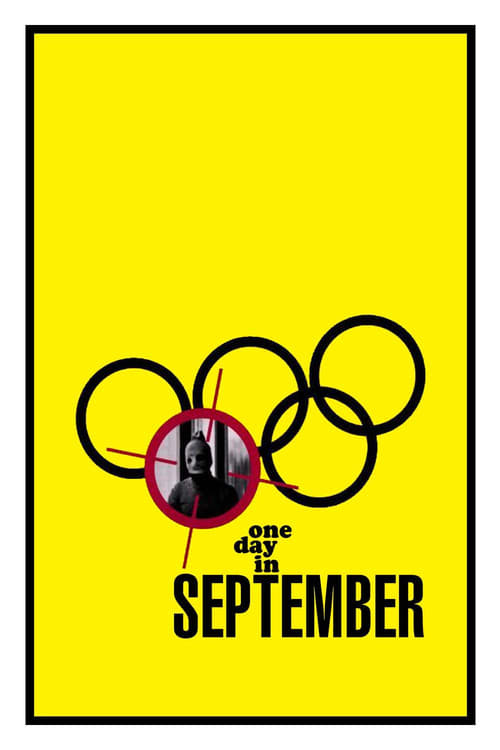
One Day in September
1999 · Kevin Macdonald
For when you want a documentary with the grip of a heist film — a true story told with real momentum. It's heavy material, so bring your attention, not your comfort food.
What it's about
A documentary reconstruction of the 1972 Munich Olympics hostage crisis, when members of Black September seized Israeli athletes in the Olympic Village while the Games — and the world's TV cameras — rolled on. Built from archival broadcast footage and interviews with officials, families, and, remarkably, the sole surviving member of the attacking unit, it walks hour by hour through a rescue effort that went catastrophically wrong.
The experience
Plays like a thriller even though you may know how it ends — the archival footage puts you inside the day as it unfolded, and the mounting official incompetence produces a slow, cold horror. Gripping, sobering, and at times genuinely enraging.
The craft
Kevin Macdonald cuts live 1972 television coverage against present-day testimony with the pacing of a fiction thriller, building the day minute by minute toward its verdict on the German authorities' failures. The interview with the last surviving attacker, conducted in secrecy, is a journalistic coup no dramatization could match.
Why it matters
It won the Academy Award for Best Documentary and helped pioneer the thriller-paced documentary style that reshaped nonfiction filmmaking — and it launched Macdonald toward a major directing career.
Snapshot
Kevin Macdonald's feature documentary reconstructs the seventy-two hours of the 1972 Munich Olympics massacre with the narrative momentum of a thriller and the evidentiary precision of investigative journalism. Combining archival television footage — much of it drawn from ABC Sports' live coverage — with contemporary talking-head interviews, the film builds toward a damning verdict: that the West German authorities, politically unable to accept Israeli counter-terrorism assistance and strategically unprepared for hostage rescue, doomed eleven Israeli athletes and coaches at Fürstenfeldbruck airbase. The film's singular coup is the on-camera testimony of Jamal Al Gashey, the sole surviving member of the Black September unit responsible for the attack, interviewed in an undisclosed location under conditions of secrecy. One Day in September won the Academy Award for Best Documentary Feature at the 72nd ceremony in 2000, confirming a late-1990s resurgence for feature-length documentary in theatrical release and helping establish Macdonald as a major voice in nonfiction cinema.
Industry & production
The film was produced by Arthur Cohn, a Swiss-based producer with an extraordinary Academy Award record spanning decades (Black Orpheus, The Garden of the Finzi-Continis), working alongside John Battsek. Cohn's involvement signals the film's ambitions for prestige documentary release rather than television commission — a meaningful distinction at a moment when documentary was migrating back into cinemas after a long retreat to broadcast. The project required extensive archival licensing from television networks that had broadcast live coverage of the crisis, most significantly ABC, whose sports and news departments had cameras in Munich throughout. Securing the interview with Al Gashey was logistically the film's most critical and precarious undertaking; his location was withheld from the credits for his security, and the terms of access remain partially undisclosed. The production gained co-operation from Israeli and German officials as well as surviving family members of the slain athletes, assembling a roster of interviewees whose testimony spans the political, institutional, and personal registers of the event.
Technology
The production straddles two image generations. The 1972 archival material exists in the mixed formats of television newsreel — 16mm film, early video tape, Super 8 home footage — each carrying the grain, color shift, and compression artifacts of its era. Macdonald and his team chose to let this heterogeneity stand rather than smooth it into false uniformity; the textural dissonance between archival and contemporary footage becomes a legible marker of temporal distance. The contemporary interview segments, shot in the late 1990s, would have used Betacam SP or comparable broadcast-grade video, the professional standard for documentary location work before digital cinema cameras displaced it in the following decade. The period is precisely transitional: the film predates the DV revolution that would transform low-budget documentary aesthetics in the early 2000s, and its production values reflect a budget capable of premium location work and international travel (to reach Al Gashey, German officials, Israeli intelligence figures, and survivors across multiple countries).
Technique
Cinematography
Macdonald's directorial approach to the interview segments emphasizes gravity and stillness. Subjects are lit and framed with the composed, low-affect formality associated with the best tradition of British documentary portraiture — close or medium-close, backgrounds controlled, the camera largely static. This visual sobriety throws the archival material into higher relief: when Macdonald cuts to the jerky, overexposed, zooming footage from Munich's Olympic Village or Fürstenfeldbruck, the contrast is kinetic and almost shocking. The archival footage is at times fragmentary and partial, and the film is notably transparent about what the cameras of 1972 could and could not see. The long sequences in which journalists and spectators — unknowingly — filmed Black September operatives on rooftops have a queasy, retrospective dread that no restaging could replicate.
Editing
Justine Wright, who would go on to edit Touching the Void (2003) and establish herself as one of the most skilled editors in British documentary, shapes One Day in September as a controlled escalation. The first act reconstructs the planning and infiltration of the Olympic Village with almost procedural patience; the middle section tracks the hostage standoff in real time, using the actual television broadcasts to create the sensation of relived duration; the final third, covering the catastrophic rescue attempt and its immediate aftermath, accelerates into something close to montage horror. Wright's work is intelligent about withholding: the camera does not witness the deaths of the athletes directly, because no camera did, and the film's refusal to fabricate imagery at its most extreme moments is one of its ethical achievements.
Mise-en-scène / staging
The film contains no conventional dramatic reconstruction — no actors in period costume, no staged action. This was a principled and aesthetically consequential decision. Where some contemporaneous documentaries (and many that followed) would have used reconstruction to paper over gaps in the visual record, Macdonald relies instead on still photographs, maps, diagrams, and the words of witnesses. The Fürstenfeldbruck airbase geography is communicated through diagrams and eyewitness verbal description rather than reconstructed imagery, forcing the audience to do imaginative work that intensifies rather than diminishes the horror. The film's mise-en-scène is thus fundamentally an editorial and compositional one: the placement of testimony against archival imagery constitutes its primary staging strategy.
Sound
Alex Heffes's score is taut and largely percussive, calibrated to sustain dread without tipping into melodrama. It is deployed selectively — the film is not afraid of silence and natural sound in the archival sequences, where the ambient noise of a stadium crowd or a television announcer carries more information and affect than any composed underscore could. The decision to retain Jim McKay's voice from the original ABC broadcast is especially resonant; McKay's real-time reporting, including his famous announcement that "they're all gone," functions as a kind of found sound that the score must acknowledge and give space to rather than compete with.
Performance
In documentary terms, "performance" refers to the comportment of interviewees before camera. Al Gashey's testimony is the film's dramatic centerpiece, and Macdonald frames it with a visible moral tension: Al Gashey speaks without evident remorse, justifying the operation in political terms, and the film does not editorially overwhelm his testimony with counter-argument. The German police official Ulrich Wegener and various Israeli figures (including intelligence veterans speaking with guarded precision) provide institutional counter-testimony. Michael Douglas narrates — a casting choice that signals mainstream theatrical intent and provides a recognizable American voice for what is substantially a British production aimed at international audiences. Douglas's delivery is measured and unsensational.
Narrative & dramatic mode
The film operates in what might be called the investigative thriller mode of documentary — a structural template in which a historical atrocity is reconstructed with the pacing and revelation-management of genre fiction. Its primary narrative engine is dramatic irony: the audience knows the athletes will die, knows the rescue will fail, and Macdonald exploits this foreknowledge to generate agonizing suspense in the standoff sequences. The film also employs a second narrative strand — the Mossad's subsequent Operation Wrath of God — as a coda that extends the event's temporal and moral horizon beyond Munich. This decision shapes the documentary as an argument about the long consequences of political violence rather than merely a chronicle of a single catastrophe.
Genre & cycle
One Day in September belongs to a late-1990s surge in feature documentary that sought theatrical release and genre-conscious narrative craft: Hoop Dreams (1994), When We Were Kings (1996), The Thin Blue Line (1988, slightly earlier but catalytic), and Crumb (1994) had demonstrated that documentary could compete with narrative fiction in multiplex contexts. Macdonald's film is specifically part of a strand of politically engaged historical documentary that treats institutional failure and political violence as its core subject — a strand that would proliferate through the 2000s. It also participates, somewhat uncomfortably, in the true-crime documentary mode, though its historical distance and political stakes distinguish it from purely sensationalist iterations of that form.
Authorship & method
Kevin Macdonald (b. 1967, Glasgow) had previously made a biographical documentary on the filmmaker Emeric Pressburger (The Making of an Englishman, 1995) — his grandfather — and a study of Donald Cammell. One Day in September was his breakthrough work, and it crystallized a method he would refine across subsequent films: the use of documentary technique to impose thriller-like tension on historical events, combined with a willingness to confront morally complex testimony without resolving it editorially into simple verdicts. His subsequent Touching the Void (2003) would push this method further by incorporating dramatic reconstruction alongside survivor testimony; the comparison illuminates how resolutely One Day in September refuses reconstruction as a tool. Justine Wright's editing is a genuine co-authorial contribution: the film's tension is fundamentally a product of her pacing decisions. Alex Heffes's score would continue to develop across several Macdonald projects, making theirs a sustained creative partnership. The absence of a credited writer in the conventional sense underscores the film's reliance on archival material and spoken testimony as its primary texts.
Movement / national cinema
The film is a British production (with Swiss co-production through Arthur Cohn's involvement), and Macdonald's background in British documentary culture is perceptible in its formal restraint and its inheritance of the tradition associated with the National Film Board and the BBC documentary strand — a tradition of measured, authoritative historical narration. At the same time, the film's commercial ambitions and Hollywood star narrator place it outside the purely public-service documentary tradition. It occupies a productive middle space between the European art-documentary and the American theatrical documentary that would expand dramatically in the 2000s. The Munich massacre itself is a West German, Israeli, and Palestinian story, and the film's international scope reflects the limits of any single national cinema as a frame for it.
Era / period
The film was made in the late Blair era in Britain and the late Clinton era in the United States — a period of comparative geopolitical optimism in the West that gave way, within two years of the film's release, to the very different political landscape of post-September 11 discourse on terrorism. Viewing the film in retrospect, it is striking how much its treatment of terrorism retains analytical rather than simply punitive frameworks, and how clearly it identifies state incompetence as a co-producer of catastrophe alongside political violence. The 1990s theatrical documentary moment the film inhabits would not survive the decade unchanged; the post-2001 environment transformed how political violence could be represented and what moral frameworks documentary could deploy without attracting accusation.
Themes
The film's central preoccupation is institutional failure — the catastrophic inadequacy of the West German response — but it situates that failure within a broader architecture of political violence and historical grievance. The Munich Olympics had been designed, explicitly and anxiously, to project a new Germany free of the shadow of 1936; the Black September operation was in part an exploitation of that anxiety, counting on German reluctance to deploy lethal military force that might evoke unwanted historical echoes. The film maps this dynamic without simplifying it. Justice and revenge are posed against each other in the Operation Wrath of God coda: Macdonald presents the Israeli reprisal campaign soberly, noting both its strategic logic and its moral costs, including operations that killed the wrong people. Memory, accountability, and the political uses of spectacle — the Olympics as global stage for a terror operation designed to be watched — are sustained thematic concerns. The film also engages, without fully resolving, the question of whether giving Al Gashey a platform constitutes a form of platforming for political violence, or whether testimony, however uncomfortable, is an obligation of historical record.
Reception, canon & influence
Critical reception was strongly positive on release. The Academy Award win — always a significant amplifier for documentary — brought the film to wide attention. Critics noted its pacing and argued, persuasively, that it functioned as well as any thriller released that year; the comparison was frequently to Z (Costa-Gavras, 1969), the political thriller that had earlier fused genre mechanics with historical atrocity in a theatrical context.
Influences on the film (backward): The investigative documentary tradition most directly relevant is Errol Morris's The Thin Blue Line (1988), which had demonstrated that crime reconstruction and the sustained interview with a participant in violence could be combined into a feature that compelled theatrical exhibition. The tradition of serious television documentary in Britain — particularly the long-form work produced for the BBC — gave Macdonald both formal vocabulary and an assumption about what audiences could sustain. The 1970s political cinema of Costa-Gavras (Z, State of Siege) and Francesco Rosi (The Mattei Affair, 1972) informed the film's treatment of institutional violence as a proper subject for dramatic exposition.
Legacy and forward influence: The film's most direct and significant forward influence is Steven Spielberg's Munich (2005), which dramatizes Operation Wrath of God and draws explicitly on One Day in September as a primary source document — Spielberg and screenwriter Tony Kushner have acknowledged the film as a key reference. The relationship between the two works is unusually clear in the historical record: Spielberg's film effectively dramatizes what Macdonald's documentary narrates. More broadly, One Day in September participated in establishing the conditions for the theatrical documentary revival of the 2000s — demonstrating, alongside Bowling for Columbine (2002) and Fahrenheit 9/11 (2004), that documentaries about political violence and institutional failure could draw theatrical audiences. Kevin Macdonald's subsequent career, moving between documentary (Touching the Void) and narrative fiction (The Last King of Scotland, 2006; State of Play, 2009), is itself a kind of legacy: the film established him as a filmmaker capable of commanding thriller-genre tension across both modes, with The Last King of Scotland in particular showing the same appetite for morally compromised testimony that distinguishes One Day in September.
A Deleuzian reading
There is a piece of footage in Kevin Macdonald's film that no one meant to shoot.
The full Deleuzian reading of One Day in September →
Reception
It won the Best Documentary Oscar in 2000 — beating heavy favorite Buena Vista Social Club, to some grumbling — and while it's still admired as gripping, its slick thriller-style treatment of a real atrocity has only gotten more debated with time.
How One Day in September was received, from release to now →
Influences: the films it descends from and the films it influenced
- The Thin Blue Line (1988) — Established the sustained single-subject interview with a participant in criminal violence as the primary dramatic engine of a feature-length theatrical documentary, a structural model Macdonald directly inherits and cites.
- Z (1969) — Demonstrated that controlled-escalation thriller editing — building toward a known catastrophic outcome — could be applied to recent political atrocity in a theatrical context, establishing the genre template Macdonald imports into documentary form.
- The Mattei Affair (1972) — Pioneered the accumulation of contradictory institutional evidence — press footage, official testimony, forensic record — as the dramatic substance of a political thriller about state cover-up, a structural approach Macdonald applies to the Munich investigation's unresolved accountability.
- State of Siege (1972) — Deployed dramatic irony — the audience knows the fatal outcome before the narrative delivers it — as the structuring principle of a political thriller about institutional violence; Macdonald imports this wholesale: viewers know the hostages will die before the film begins.
- Night and Fog (1955) — Established archival-textural contrast — degraded historical footage cut against sharp contemporary cinematography — as a formal device for generating documentary horror; Macdonald extends this to mixed-format archival sources (16mm news, TV broadcast, Super 8) for the same destabilizing effect.
- Hearts and Minds (1974) — Built its indictment of institutional actors through found-sound broadcast footage — television news reports and political speeches repurposed as evidence — cut against interview testimony; Macdonald uses the Olympic broadcast feed in precisely this way, letting institutional self-presentation convict the institutions.
- Shoah (1985) — Established sustained perpetrator testimony — including interviews with former SS officers — as a legitimate and formally rigorous strategy in documentary about political violence; Macdonald's extended interview with Jamal Al-Gashey, the surviving gunman, belongs to this post-Shoah tradition of confronting perpetrators without editorial resolution.
- Touching the Void (2003) — Macdonald extends his own controlled-escalation interview method by adding dramatic reconstruction alongside survivor testimony; the contrast with One Day in September — which refuses reconstruction entirely — illuminates how the earlier film's no-reconstruction position was a deliberate formal choice, not a resource limitation.
- Munich (2005) — Directly dramatizes Operation Wrath of God using One Day in September as an acknowledged primary source document; Spielberg's narrative film fictionalizes what Macdonald's documentary narrates — the lineage is unusually traceable because Spielberg and Kushner named the film explicitly.
- Man on Wire (2008) — British theatrical documentary inheriting One Day's controlled-escalation editing structure and dramatic-irony narrative around a single high-stakes historical event, mixing archival formats (8mm, 16mm, news footage) with selective score deployment to sustain thriller tension toward a known outcome.
- Senna (2010) — British theatrical documentary using exclusively archival footage without on-camera talking heads or reconstruction — voices appear only over archival images, as in One Day in September — deploying selective score against found-sound broadcast material to build thriller mechanics around a fatal outcome the audience already knows.
- The Imposter (2012) — British theatrical documentary sustaining thriller mechanics through withheld-imagery editing — strategically deferring the revelation of key evidence — around a true-crime investigation anchored by morally compromised first-person testimony; extends Macdonald's investigative-thriller structure into a more explicitly suspense-oriented register.
- Amy (2015) — Applies Kapadia's extension of Macdonald's archival-only method — textural contrast between degraded camcorder footage and broadcast-quality material, selective score deployment, voice-over testimony over archival images — to a case of institutional failure and spectacle, carrying the formal strategy into a new subject domain.
- The Last King of Scotland (2006) — Macdonald's move into narrative fiction carries the appetite for morally compromised testimony that defines One Day in September: the film is structured around a protagonist whose culpable ignorance mirrors the viewer's, sustaining the same dramatic irony the documentary achieves through perpetrator interview.
- September 5 (2024) — The archival reconstruction of the identical Munich event, against whose panoramic documentary sweep September 5 deliberately defines itself by staying inside the hour and the room.
- Capturing the Friedmans (2003) — Theatrical documentary using home video archival material alongside institutional documentation to construct dramatic irony around institutional failure and perpetrator testimony that resists editorial resolution — working the same investigative-thriller genre position as One Day in September, with mixed-format archival texture as formal signature.
Similar films
- Munich (2005) — influence & lineage
- Touching the Void (2003) — influence & lineage
- The Last King of Scotland (2006) — influence & lineage
- September 5 (2024) — shared sensibility
- Black Hawk Down (2001) — shared sensibility
- United 93 (2006) — shared sensibility
- A Moment of Innocence (1997) — shared sensibility
- Four Days in September (1997) — shared sensibility