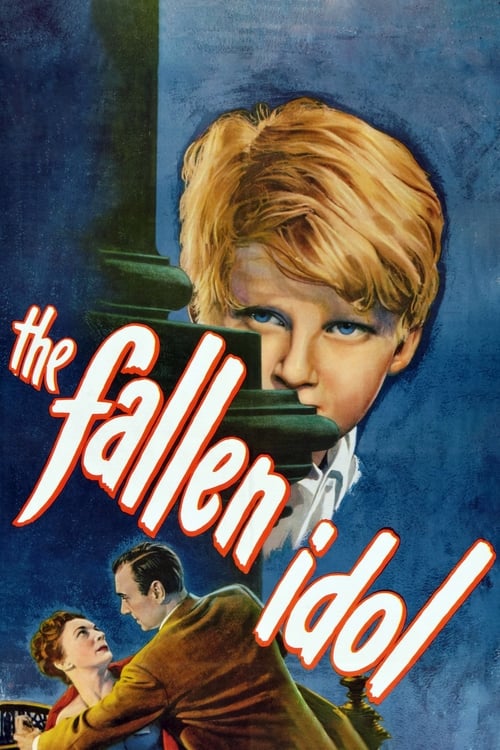
The Fallen Idol
1948 · Carol Reed
When you want an elegant, intelligent classic thriller — more heartbreak-and-suspense than shocks — that you'll be turning over afterward. A perfect quiet-evening film for someone who loves watching a story told with total control.
What it's about
An eight-year-old boy, son of an ambassador, is left in a grand London embassy in the care of the butler he hero-worships — and the butler's wife, whom he fears. Wandering the house's staircases and half-open doors, he stumbles into adult secrets he can't decode, and when suspicion falls on the man he loves, his loyal attempts to help only tangle things further. It's a thriller built entirely from a child's-eye view of grown-up trouble.
The experience
Quietly gripping and emotionally precise — the suspense comes from watching a child misread the adult world with the best intentions. It's tender and nerve-wracking at once, and the final stretch is agonizing in the gentlest possible way.
Performances
Ralph Richardson gives one of his finest performances as Baines, warm and increasingly desperate, and young Bobby Henrey's untrained naturalness as the boy is the film's miracle — Carol Reed built the whole picture around it.
The craft
Reed and Graham Greene engineer the entire film around what the boy sees versus what it means, with the embassy's vast staircases shot to make the child small in a house full of secrets. It's a masterclass in point-of-view storytelling — every reveal staged through doorways, banisters, and overheard fragments.
Why it matters
The first of the celebrated Carol Reed–Graham Greene collaborations, made just before The Third Man, and a touchstone for films told through a child's limited understanding of adult events.
Snapshot
A boy of eight, marooned in a London embassy while his parents are away, worships the butler and detests the butler's wife. Over two days he stumbles into the butler's affair, watches the wife die in a fall he only half-sees, and then — trying to protect the man he loves — tells a series of lies that come very close to hanging him. The Fallen Idol is a chamber thriller built entirely out of the gap between what a child sees and what a child understands, and it is one of the most precisely engineered exercises in restricted narration in British cinema.
It is also the first of the three Carol Reed–Graham Greene collaborations (with The Third Man, 1949, and Our Man in Havana, 1959), the middle picture of Reed's extraordinary late-forties run beginning with Odd Man Out (1947), and the film in which Reed worked out the vertical, staircase-bound, low-angle grammar that The Third Man would carry into Vienna. Adapted by Greene from his own 1935 short story "The Basement Room," it won the BAFTA for Best British Film, brought Reed the New York Film Critics Circle directing prize, and earned Oscar nominations for Reed's direction and Greene's screenplay. Its reputation has always lived slightly in the shadow of the film that followed it — which is a fair description of its fate, not of its quality.
Industry & production
The film was produced by Reed for Alexander Korda's London Film Productions and distributed by British Lion, and it belongs to a very specific and very brief moment of British confidence. In August 1947 the Labor government's ad valorem duty on imported films — the "Dalton Duty" — provoked an American distributors' boycott, and British studios enjoyed a sudden, artificial vacuum to fill. Production surged through 1947 and 1948. By 1949 the duty had been withdrawn, the American backlog flooded back, British Lion was in enough trouble to need one of the first loans from the newly created National Film Finance Corporation, and the boom was over. The Fallen Idol was shot and released inside that window, at the top of the market.
Korda's London Films had been rebuilt around Shepperton Studios, and the picture is essentially a Korda house production: Vincent Korda designed it, Georges Périnal shot it, and the international casting — the French star Michèle Morgan opposite the English stage knight Ralph Richardson — reflects Korda's lifelong ambition to make British films that traveled. Reed took producer as well as director credit, a mark of the autonomy Odd Man Out had bought him.
The most consequential production decision was casting Bobby Henrey, an eight-year-old non-professional (son of the writers Robert and Madeleine Henrey; his mother later published a memoir of the shoot) with no training and, by every surviving account, a short attention span. The whole schedule bent around him. Reed's solution was to abandon conventional coverage of the child and build the performance in fragments — feeding him reactions, talking to him from beside the lens, shooting far more footage than a scene needed, and assembling the result in the cutting room. The method is invisible on screen, which is the point.
Technology
Standard for its moment and unshowy about it: 35mm black-and-white nitrate, Academy ratio, optical monaural sound, studio interiors at Shepperton with location exteriors in Belgravia. What matters technologically is what the late-1940s toolkit enabled. Faster panchromatic stocks and coated lenses let Périnal hold deep focus across the embassy hall at light levels a studio could actually deliver, so the boy can be small and sharp in a foreground that runs back thirty feet. Vincent Korda's central set — a full-height Regency hall, staircase and gallery — was built as a practical multi-storey structure so the camera could climb, look down the stairwell, and shoot through the balusters rather than faking those angles with process work. The film's signature images are a consequence of set carpentry as much as of camera placement.
Technique
Cinematography
Périnal's work here is the hinge between his French period (Clair's Sous les toits de Paris, Cocteau's Le sang d'un poète) and his Korda period (The Private Life of Henry VIII, The Thief of Bagdad), and it draws on both: French studio modeling of light, English scale. Two decisions organize everything. First, camera height: enormous stretches of the film sit at roughly Phile's eyeline, so adults enter frame as legs, hands and voices before they become faces. Second, the balustrade: again and again the boy is photographed through or behind the staircase railings, which cut the frame into bars — surveillance and imprisonment in the same figure, and a visual pun on a child watching a world he is not admitted to.
The lighting is chiaroscuro without being noir. The embassy is marble, glass and chandelier — reflective, cold, over-lit in the public rooms and pooled in the private ones — while the basement kitchen where Baines reigns is warm and low. Dust sheets over the absent ambassador's furniture turn the upper floors into a ghost house. The night sequence in which the boy runs into the streets shifts register entirely: wet pavements, sodium and arc, a brief and genuinely frightening excursion into location realism.
Editing
Oswald Hafenrichter — who would cut The Third Man the following year — is the film's other author of point of view. The crucial passage is the death: Mrs. Baines, having pretended to leave, is spying; there is a quarrel on the landing; she falls. Hafenrichter and Reed distribute the information unevenly on purpose. The audience is given enough to know the fall is an accident; the boy, whose sightline is partial and whose position is wrong, is given exactly enough to conclude murder. Everything after that — every lie, every evasion, the whole second half — is generated by that editorial asymmetry. It is dramatic irony constructed by cutting rather than by dialogue.
The rest of the cutting is patient and ellipsis-heavy. Adult conversations begin before we arrive and continue after we leave, because the boy hears them that way.
Mise-en-scène / staging
The house is a moral diagram. Basement: servants, warmth, food, Baines's tall tales. Ground and first floors: emptiness, protocol, the machinery of a state the film never names. The staircase connects them, and almost every important event happens on it or is watched from it. Class geography and dramatic geography are the same structure — an unusually elegant piece of design thinking, and one reason the film survives repeated viewing.
Objects carry the argument. Phile's pet snake, MacGregor, is his one secret and his one possession; Mrs. Baines burns it in the boiler, which is all the characterization she needs. A paper dart, a set of housekeeper's keys, a cake in a Bloomsbury tea shop where Baines meets Julie and introduces her as his niece — the film's plot advances almost entirely through small domestic props, and the boy misreads all of them.
Sound
William Alwyn's score is deliberately sparing and knows when to stop; it is most present in the lyrical material around Julie and most conspicuously absent through the long suspense of the night and the police interrogation, where Reed lets the hall do the work. The acoustic design of that hall — echo, footsteps on marble, doors closing several rooms away, clocks — is the sonic equivalent of the visual scheme: the boy hears adult speech as muffled fragments through wood and distance, catching the wrong words at the wrong volume. Off-screen sound is used as an information filter throughout, not as atmosphere.
Performance
Richardson gives one of his finest screen performances precisely by underplaying the charm: Baines is courteous, evasive, faintly sad, a man whose invented African adventures are told with just enough private amusement that we see the lie and the boy does not. The film's cruellest irony is that Baines lies about everything heroic and tells the truth about the death — and is disbelieved.
Sonia Dresdel's Mrs. Baines could have been a gorgon and is instead a woman with one or two terrible flashes of thwarted feeling, which makes her death land as something other than relief. Michèle Morgan's Julie is written thin on purpose — the child cannot read her, so neither can we — and Morgan plays reticence rather than filling the gap. Denis O'Dea, Jack Hawkins and Bernard Lee make the police tired, decent and ordinary, an anti-noir choice that is essential to the ending. Dora Bryan appears briefly as a prostitute in the night streets.
Bobby Henrey's performance is the film's high-wire act: flat, distractible, physically small, entirely unlike a trained child actor. Whether one calls it acting or assembly hardly matters; the effect is a real child rather than a performing one.
Narrative & dramatic mode
Greene expanded a twenty-odd-page story into a three-movement structure: domestic idyll (the day out at the zoo, the tea shop, the boy's happiness), the night of the death, and the procedural morning in which the police slowly take the house apart. The mode is suspense, but the engine is not concealment — it is misunderstanding. We are ahead of the boy and behind the police, and the tension comes from watching a child's loyalty express itself as lying at the exact moment when lying is lethal.
The most significant departure from "The Basement Room" is moral. In the story the housekeeper's death is not an accident, the child's testimony destroys Baines, and a coda leaps forward decades to show a life permanently deformed by that night. Greene made the death accidental for the film and reversed the ending's mechanism: Phile's frantic lies are finally not believed at all, and Baines is cleared because the police discount everything the boy says. Innocence is preserved by being ignored. It is a lighter ending than the story's and a stranger one — mercy arrives as a bureaucratic accident.
Genre & cycle
It sits at the intersection of three things: the postwar British "quality" film, the Greene adaptation cycle that ran from Brighton Rock (1947) through The Third Man, and the domestic gothic of the hostile grown-up house. It is adjacent to British noir — Odd Man Out, They Made Me a Fugitive (1947), Night and the City (1950) — without belonging to it, because its violence is accidental and its police are kind. It also runs alongside the late-forties European turn to children as moral witnesses: De Sica's Shoeshine (1946) and Bicycle Thieves (1948), Rossellini's Germany Year Zero (1948). Reed reaches a comparable place by the opposite route — total studio artifice rather than the street.
Authorship & method
Reed's authorship is of the kind that auteurism was slow to credit: meticulous preparation, an "invisible" style that is in fact heavily designed, and an unusual gift with actors and with children. He had come up as an actor in Edgar Wallace's company and an assistant to Basil Dean, and his war work (The Way Ahead, 1944; The True Glory, 1945, co-directed with Garson Kanin) gave him a documentary discipline he then applied to invented worlds. Twenty years later he would make Oliver! — another film about a small boy in a predatory adult city.
The collaborators are the Korda repertory at full strength: Greene adapting himself and inventing most of the film's second half; Périnal on camera; Vincent Korda designing the staircase that determines the shot list; Hafenrichter cutting; Alwyn scoring. The Reed–Greene partnership worked because Greene supplied the moral architecture — betrayal, loyalty, culpability — and Reed supplied the spatial one.
Movement / national cinema
The Fallen Idol is a British film made largely by Europeans: a Hungarian designer, a French cinematographer, an Austrian editor, a French leading lady, presented by a Hungarian-born producer. London Films was an émigré enterprise, and the film's Continental polish — its interest in light on marble, its refusal of English cosiness — comes from that. It belongs to the brief, confident 1945–49 stretch when British cinema believed it could make internationally legible art films, and to the specific Korda–Rank rivalry that funded them.
Era / period
Everything about the setting is postwar. An embassy of an unnamed country, staffed by servants of a class that was rapidly vanishing from British life; a great Belgravia house half under dust sheets; adults conducting an affair in tea shops because there is nowhere else. The film never mentions austerity and is saturated in it. The diplomatic frame — displacement, provisional identities, a household of people from elsewhere — is 1948 Europe in miniature.
Themes
Betrayal and loyalty, Greene's permanent subject, here inverted: the betrayal is committed by love. The unreliability of testimony — the film is, among other things, a small essay on why children make catastrophic witnesses and why adults deserve most of the blame for that. Adult sexuality as an unreadable code, glimpsed and mis-transcribed. Class as physical architecture. And, underneath, a recognizably Catholic proposition: guilt and innocence are not settled by evidence, and the mercy that arrives at the end is unearned, procedural, and slightly absurd. The title names the arc — an idol is worshipped, discovers his feet of clay, and is neither punished nor redeemed but merely, exhaustedly, let off.
Reception, canon & influence
Reception. The film was well received on its 1948 British release and won the BAFTA for Best British Film. Its American release came over a year later, which is why it competed at the 1950 Academy Awards, where Reed was nominated for direction and Greene for screenplay (both lost to Joseph L. Mankiewicz for A Letter to Three Wives); the New York Film Critics Circle named Reed best director. Reliable commercial figures for the picture are not well documented in accessible sources — it is generally described as a success in Britain, but any specific gross should be treated with suspicion. From 1949 onward The Third Man absorbed most of the attention available for a Reed–Greene film, and The Fallen Idol settled into the position it still occupies: the connoisseur's choice of the three.
Influences on the film (backward). Greene's own story is the primary source, but the picture also draws on Hitchcock's British thrillers — Sabotage (1936), with its child carrying a bomb, is the obvious precedent for suspense generated by a child's ignorance — on the French poetic-realist tradition that Périnal and Morgan carried with them, on the German Kammerspielfilm's single-house tragedies, and, more loosely, on Dickens: the small boy alone in a large hostile household is a nineteenth-century English inheritance that Reed would return to directly with Oliver!
Legacy (forward). The most direct consequence was The Third Man: the same producer, writer, director and editor, the same taste for canted angles, staircases and moral compromise, made a year later with the confidence The Fallen Idol had earned. Reed's three-film run (1947–49) remains the strongest sustained stretch by any British director of the period.
Beyond that, the film's influence is best described as exemplary rather than traceable. It is a standard teaching case for restricted narration and for suspense built from asymmetric knowledge, and it stands near the head of a long line of child's-eye films — Forbidden Games (1952), The Night of the Hunter (1955), The Go-Between (1971), The Spirit of the Beehive (1973), Hope and Glory (1987), Atonement (2007) — with which it shares a structure: a child misreads an adult sexual situation and someone pays for it. Direct citation by those filmmakers is largely undocumented, and it would be dishonest to claim a chain of influence where what exists is a family resemblance and a common ancestor in Greene.
Reed's critical standing dipped sharply during the auteurist turn of the 1960s and 70s, when his self-effacing craft was read as impersonality and his best films were credited to Greene. That verdict has softened considerably. Restoration and home-video canonization — BFI and StudioCanal restorations, a Criterion edition — have kept the film in circulation, and it is now routinely ranked among the finest British films of the decade, admired for exactly the quality that once counted against it: a technique so completely subordinated to a child's point of view that you have to look twice to see it working.
A Deleuzian reading
A boy lies on the landing carpet with his face against the banister rails, watching the hall below.
The full Deleuzian reading of The Fallen Idol →
Reception
A hit with critics on release — it won the very first BAFTA for Best British Film and earned Reed and Graham Greene Oscar nominations — then spent decades in the shadow of The Third Man, made one year later. A 2006 US theatrical revival and a Criterion release restored its reputation as the quieter masterpiece of the Reed–Greene partnership.
How The Fallen Idol was received, from release to now →
How to watch The Fallen Idol: what to notice on a first viewing
- Watch how low the camera sits through the film. Reed keeps huge stretches of the film at roughly eight-year-old Phile's eye level, so adults enter the frame as legs, hands, and voices before their faces ever appear. You are made to see the embassy the way a small child does, arriving in pieces from the bottom up.
- Notice adults still in focus behind Phile in the foreground. Périnal holds deep focus across the embassy hall, keeping Phile small and sharp up front while adult business runs on, equally sharp, thirty feet behind him. The shot hands you a whole adult world in view, more of it than a child could ever actually read.
- Watch for the staircase railings crossing the frame. Reed keeps photographing Phile through or behind the balusters, so the bars of the railing cut across the picture whenever the boy is watching something he should not see. The same bars that let him watch the adult world also lock him out of it, in one image.
- Listen for conversations that start before you can see who's talking. Reed lets doors close several rooms away, footsteps cross distant marble, and adult speech arrive as muffled fragments, the same broken way Phile hears it. Sound here is not atmosphere, it is information rationed out the way a child actually receives it.
- Track small objects the boy carries or is given. A pet snake, a paper dart, a set of housekeeper's keys, a cake at a tea shop: the plot moves almost entirely through small domestic props that Phile handles and reads in his own way. Every object here carries two meanings at once, an innocent one for the boy and a different one for you.
The whole guide to watching The Fallen Idol, with the keys for a rewatch →
Influences: the films it descends from and the films it influenced
- Hintertreppe (1921) — The Kammerspielfilm that compresses a servant-class tragedy into a single building's back staircase, establishing the stair itself — not dialogue — as the instrument that measures who may go where, exactly the geometry Reed builds the embassy around.
- The Last Laugh (1924) — Class exposition delivered by a building's vertical zoning (lobby above, lavatory basement below) and by livery rather than by speech, with camera position doing the work of the missing intertitles — the template for Baines's standing being legible from where he is allowed to stand.
- Sous les toits de Paris (1930) — Georges Périnal's own precedent: the camera craning down through the stacked interiors of one building, and sound used selectively as an offscreen event heard through walls and floors rather than as a continuous track — the exact filtering Reed applies to Phile's eavesdropping.
- Sabotage (1936) — Suspense manufactured wholly from a child's ignorance of what he is carrying, with the audience holding information the boy does not — the asymmetric-knowledge engine Reed transposes from a bomb to a lie.
- Quai des brumes (1938) — The poetic-realist grammar Michèle Morgan carries into the embassy: underplayed fatalism in close-up and rain-slick, low-key interiors where the light source is diegetic and half the face is surrendered to shadow.
- Citizen Kane (1941) — Toland's deep focus shot from low camera heights, holding a foreground object and a distant doorway in one plane — the technique that lets Reed keep adult business sharp and unexplained at the far end of a boy's-height frame — plus the assembly of a person from contradictory testimony.
- Odd Man Out (1947) — Where Reed and editor Oswald Hafenrichter worked out the method of constructing a scene from partial, subjectively weighted glimpses rather than continuous coverage, and where Krasker's expressionist night lighting set the chiaroscuro register Périnal domesticates indoors.
- The Third Man (1949) — Same producer, writer, director and editor a year later: canted angles, staircase and doorway framings, and a plot restricted to what one naive observer is permitted to see and how badly he construes it.
- Forbidden Games (1952) — A child performance built in the cutting room from fragments of unrehearsed behavior rather than sustained takes, with the whole film held to a girl's misreading of adult death ritual.
- The Night of the Hunter (1955) — Camera pitched to child eyeline, cellar-and-staircase blocking, and adult sexual menace rendered as silhouette and as sound heard through floorboards — knowledge reaching the children only in the degraded form their position allows.
- The Innocents (1961) — Freddie Francis's deep-focus scope frames hold a child sharp in the foreground while an ambiguous adult figure stands at depth, and offscreen sound (whispers, a music box) is the filter through which sexual knowledge is implied but never confirmed.
- The Servant (1963) — The townhouse staircase and its mirror made the principal dramatic instrument of a master–servant inversion, with Slocombe's wide-angle depth staging keeping the balustrade between camera and subject exactly as Reed's does.
- The Go-Between (1971) — A boy made the physical carrier of adult correspondence — prop-driven plot in its purest form — whose misreading of a class-crossing affair detonates it, with the great house's rooms and thresholds functioning as an explicit class diagram.
- The Spirit of the Beehive (1973) — Narration held with near-total discipline to a small girl's sightline: reverse angles withheld, adult conversation reaching her as fragments, score used only in isolated cues, and the catastrophe issuing from her literal reading of an adult fiction.
- Atonement (2007) — Dramatic irony assembled from a child's misread glimpse through a window and a mis-delivered note, then reframed as unreliable testimony — the same structure as Phile's evidence, with the retrospective correction Reed leaves implicit made explicit.
- Oliver Twist (1948) — The parallel Dickens case: a small boy alone in a predatory adult household, Guy Green's high-contrast deep-focus interiors, and a non-professional child (John Howard Davies) directed toward the same flat, unperformed reactions Reed extracted from Bobby Henrey.
- Germany Year Zero (1948) — A non-professional child carrying an adult moral catastrophe he cannot parse, staged almost entirely in stairwells and the vertical wreckage of an apartment block, with the fatal act arriving through the boy's misapplication of overheard adult speech.
- The Window (1949) — The child whose truthful testimony is disbelieved because he is a known liar, with suspense staged on tenement fire escapes and stairwells and the crime delivered as a partial sightline through a window frame.
Similar films
- The Third Man (1949) — influence & lineage
- Citizen Kane (1941) — influence & lineage
- Odd Man Out (1947) — influence & lineage
- Forbidden Games (1952) — influence & lineage
- The Servant (1963) — influence & lineage
- Fanny and Alexander (1982) — shared sensibility
- Gaslight (1944) — shared sensibility
- Hamlet (1948) — shared sensibility