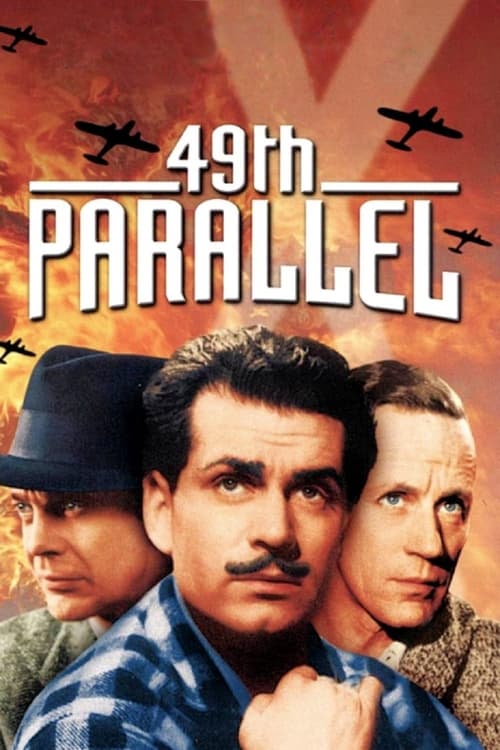
49th Parallel
1941 · Michael Powell
When you want a classic adventure-thriller with a brain — something with old-fashioned momentum and stakes that still feel earnest rather than corny. Comfortable to watch, but with more to chew on than you'd expect.
What it's about
Early in World War II, a German U-boat is sunk in Canada's Hudson Bay, and the six survivors of its landing party set out overland toward the still-neutral United States — the one border that won't arrest them. Their trek across Canada becomes a series of collisions with the people in their path: a French-Canadian trapper, a religious farming community, ordinary citizens who each get their moment to stand up to the fugitives. It's a chase film told from an unusual angle — you travel with the hunted.
The experience
Episodic and propulsive, with each encounter playing like its own short film — some tense, some surprisingly funny, some genuinely moving. For a wartime propaganda picture it's strangely thoughtful: the villains are individuals, the arguments are real, and the suspense holds up.
Performances
The rotating cast of stars — Laurence Olivier as the fur trapper, Leslie Howard, and Raymond Massey among them — each get a single vivid episode, while Eric Portman's fanatical Lieutenant Hirth holds the whole film together as its unnerving through-line.
The craft
Michael Powell shot across real Canadian locations, from Hudson Bay to the Rockies, giving a wartime mission film the sweep of a landscape epic. Emeric Pressburger's script is the secret engine — a propaganda commission rebuilt as a structurally daring relay race where the protagonist keeps changing and the antagonists carry the story.
Why it matters
Made partly to sway American opinion before the U.S. entered the war, it became a major hit, won an Academy Award for its story, and established Powell and Pressburger as the partnership that would define British cinema for the next decade.
Snapshot
A U-boat is sunk in Hudson Bay; six survivors of its landing party set out across Canada toward the one border that will not arrest them — the American one, still neutral in 1941. That premise turns a propaganda commission into something stranger and more durable: a chase film in which the audience travels with the hunted Nazis, and in which each "hero" appears only long enough to argue with them and die, escape, or win. 49th Parallel was Michael Powell and Emeric Pressburger's third film together and the one that made them a going concern, financed in part by the British Ministry of Information and aimed squarely at American opinion. It is episodic by design, didactic by commission, and far more morally curious than its brief required — a film whose antagonists are individuated, whose protagonists rotate, and whose real subject is what a plural society sounds like when a monoculture walks through it. Pressburger won an Academy Award for the original story; the film was also nominated for Best Picture and for its screenplay. In the United States it was released, shortened, as The Invaders, by which time Pearl Harbor had rendered its persuasive mission moot and turned it into a confirmation instead of an argument.
Industry & production
The film exists because the British state wanted a picture that could speak to Americans without sounding like Britain asking for help. Powell pitched a story built around the Canadian–American frontier — the longest undefended border in the world, a phrase the film's own opening map insists on — and found support at the Ministry of Information's Films Division, then under Kenneth Clark. The MoI advanced production money (accounts differ on the exact sum, and the arrangement was structured as an investment to be recouped rather than an outright grant), with Powell's Ortus Films producing and General Film Distributors handling the British release; Columbia distributed in the United States.
Production was extraordinarily difficult in ways that had nothing to do with art. A unit crossed the Atlantic in wartime to shoot in Canada in 1940 — Hudson Bay and the sub-Arctic north, the prairies, the Rockies around Banff and Lake Louise, and finally Niagara — with cooperation from Canadian authorities and the railways, then returned to Denham Studios in England for interiors, the submarine sets and the miniature and effects work. Crew were being called up; stock, transport and studio space were rationed; the schedule slipped badly and costs rose. Casting churned: Elisabeth Bergner, originally engaged as the Hutterite girl Anna, left the production and was replaced by the young Glynis Johns — accounts of how much Bergner material survives in the finished film vary and should be treated as uncertain. The star roster Powell assembled — Laurence Olivier, Leslie Howard, Raymond Massey, Anton Walbrook — was possible partly because the episodic structure asked each of them for days rather than months, and partly because a patriotic project could call in favours.
Commercially the gamble paid off at home; standard accounts describe it as the most popular British film at the domestic box office in 1941, and it did respectable business in America. Its more consequential return was structural: the film's success gave Powell and Pressburger the leverage to formalize their partnership as The Archers on the next picture, One of Our Aircraft Is Missing (1942), with the shared "Written, Produced and Directed by" card that would become one of the most unusual authorship arrangements in film history.
Technology
Standard 35mm black-and-white on nitrate stock, Academy ratio, optical sound. The interest lies in what that meant on location. Blimped studio cameras of 1940 were heavy, and the northern Canadian material — the Bay, the trading post at the edge of the tree line, the lakes and portages — was shot with the kind of logistical improvisation more familiar from documentary units than from British features, which in this period overwhelmingly stayed in the studio. Location sound of any complexity was impractical; dialogue in exteriors is generally post-synchronised, and the film leans on a robust, studio-built soundtrack to knit locations to sets.
The U-boat is a hybrid of miniature work, process shots and full-scale interiors built at Denham, cut together with real aerial and water photography. Model and matte work also carries the aerial attack that opens the film. The seams are visible by later standards, but the strategy — real geography for the travelogue, controlled artifice for the spectacle — is exactly the division of labor that wartime scarcity enforced, and Powell exploits it: the artifice is concentrated in the German sphere (the sealed steel tube of the submarine), while the documentary air belongs to Canada.
Technique
Cinematography
Freddie Young — two decades before Lawrence of Arabia — photographs Canada as scale and emptiness, with high, wide compositions that place the six men as specks against water, muskeg, wheat and rock. The film's visual argument is stated in its first minutes by map and aerial view: this is a country too large to be conquered by six men, and too various to be understood by them. Young's northern material has a hard, documentary flatness; the Hutterite prairie sequences are softer, with deep-focus interiors and lamplit night scenes that recall Dutch genre painting more than British studio realism; the Rockies episode with Leslie Howard's aesthete is the most conventionally beautiful and the most ironic, luxury landscape framing a man who has retreated from history into art. Against all this, the U-boat interiors are pinched, low-ceilinged and raked with hard sources — a claustrophobic grammar that the film then keeps reapplying to the Germans wherever they are.
Editing
David Lean cut the film, one of his last major editing assignments before he moved to direction with In Which We Serve (1942). The job was structural as much as rhythmic: the script is a relay of self-contained novellas, and the cutting has to make a chain feel like a line. Lean's solutions include tightening each episode's exposition to almost nothing — we arrive in each new world already mid-conversation — and using hard geographical cuts (map, train, aerial, water) as connective tissue rather than dissolving between them. The action set pieces, particularly the trading-post massacre and the seaplane sequence, are cut with an economy notably in advance of most British features of 1941. The American release version, The Invaders, was shortened by roughly a fifth, which mostly cost the film its discursive scenes — the very passages that give the British cut its argumentative weight.
Mise-en-scène / staging
The film's controlling idea is staged rather than stated: the Germans move as a bloc, in formation, facing outward; every community they meet is arranged as a circle. Powell repeatedly gives the Hutterites a communal table, a shared meal, a congregation — bodies at rest in relation to one another — and puts Hirth on his feet in front of them, addressing rather than joining. Leslie Howard's tepee-study, hung with modern paintings and stacked with books, is a private circle of one; its destruction by fire is the film's most economical image of what fascism does to culture. The trading post's mixed room of Cree and Inuit people, French and English speakers is the pluralist thesis in a single set-up. Costume works the same way: uniforms versus the specific, local, weathered clothing of everyone else.
Sound
Ralph Vaughan Williams's score was his first for the cinema, written at sixty-eight and conducted by Muir Mathieson; its broad, modal Prelude was later adapted with words as "The New Commonwealth." The scoring is deliberately unmartial — hymn-like, pastoral, English-inflected even when the images are Canadian — which sets up an odd, productive friction: the music refuses to meet the Germans on their own rhetorical ground. Vaughan Williams went on to score Coastal Command, The Story of a Flemish Farm and Scott of the Antarctic, and his engagement here is a landmark in the wartime traffic between British concert composers and the film industry. Beyond the score, the film is unusually attentive to speech as sound: accents (Québécois, Scots, German-Canadian, Oxford English) carry the thematic load, and the Hutterite scenes are among the few in a British war film to let German be spoken sympathetically at length.
Performance
Eric Portman's Hirth is the film's engine and its finest piece of acting — cold, articulate, entirely without doubt, a man who has replaced interiority with doctrine. Portman does not caricature; he plays conviction, which is far more frightening. Around him the Germans are carefully differentiated: Raymond Lovell's bluff Kuhnecke, John Chandos's thug Lohrmann, and Niall MacGinnis's Vogel, the baker who wants to stay with the Hutterites and is tried and shot for it — the film's quietest and most devastating passage. The guest turns are variable by design. Anton Walbrook, an Austrian émigré himself, delivers Peter's speech to the community with a controlled, unhistrionic dignity that makes it the film's moral center rather than its soapbox. Leslie Howard plays the aesthete's late conversion to violence with real relish. Raymond Massey's AWOL soldier gives the ending a democratic plainness. Laurence Olivier's Johnnie is the outlier — a broad French-Canadian turn that has drawn criticism from the film's own era onward, though the character's death still lands.
Narrative & dramatic mode
The structure is picaresque, and the picaro is the enemy. The Germans supply continuity; Canada supplies episodes. Each encounter is built as a debate with a body count: a case for pluralism, faith, art or ordinary decency is made, tested, and paid for. This is closer to the moral-tale anthology or to Pilgrim's Progress inverted than to the standard chase thriller, and it is why the film's detractors call it talky — the speeches are the plot. What redeems the design is attrition: the German party shrinks from six to five to two to one, and each loss is caused by the specific virtue of the world they have just passed through. The mode is dialectical rather than dramatic in the conventional sense, and the resolution is a joke about procedure — an American customs officer refuses the boxcar because its contents do not match the manifest, and neutrality's own legalism sends Hirth back across the line. It is the wittiest possible answer to a film that has spent two hours arguing that rules-bound societies are not weak ones.
Genre & cycle
It sits at the crossing of the war film, the manhunt thriller and the state-sponsored persuasion picture. The manhunt lineage is British and specific — Hitchcock's The 39 Steps (1935) above all, with its fugitive crossing a landscape that keeps changing its social character — but Powell reverses the polarity so that the fugitive is the villain. Within the 1940–42 British cycle of invasion-anxiety films it stands beside Cavalcanti's Went the Day Well? (1942) and Powell and Pressburger's own Contraband (1940) and One of Our Aircraft Is Missing (1942), the last of which repeats the structure with the nationalities swapped. It also belongs to the documentary-inflected feature cycle that the Crown Film Unit was pushing in the same years, and to a small tradition of Canadian landscape cinema in which the country's size is itself dramaturgy.
Authorship & method
49th Parallel is the hinge on which Powell and Pressburger's collaboration turned from a working relationship into a method. Pressburger — Hungarian-Jewish, trained in the German industry, a refugee twice over — wrote the story and screenplay, with Rodney Ackland credited on the scenario and dialogue; the Academy honored Pressburger's original story with an award and nominated Ackland and Pressburger jointly for the screenplay. The film bears Pressburger's signature preoccupation with the émigré's double vision: it is a British propaganda film in which the most sympathetic long speech is delivered in and about German by a German-speaking community, and in which the enemy's humanity is a structural requirement rather than a concession. Powell's contribution is the conviction that landscape carries argument, and the appetite for shooting in real, hard places that runs from The Edge of the World (1937) through to I Know Where I'm Going! (1945).
The key collaborators are unusually consequential. Freddie Young's photography establishes the epic-scale outdoor register Powell would keep returning to. David Lean's cutting gives an anthology the momentum of a chase. Vaughan Williams's score opens British art music to the cinema. David Rawnsley's art direction handles the submarine and the studio-built Canada. Powell's method throughout was to send a small unit into real conditions and then rebuild what could not be filmed — the pragmatic hybrid that would later flower into the wholly artificial worlds of Black Narcissus and The Red Shoes.
Movement / national cinema
The film belongs to the wartime consolidation of British cinema, in which state sponsorship, documentary personnel and commercial studios briefly converged and produced a national style of unusual seriousness. It is also, awkwardly and interestingly, a film about Canada made by Britons for Americans — an imperial triangulation. Canada appears less as a nation than as a demonstration model of federated difference: French and English, Anglican and Anabaptist, settler and Indigenous, coexisting under a shared law. The presentation of Cree and Inuit characters is thin and instrumental by present standards, functioning largely to establish German brutality; this is a real limitation of the film's pluralist argument and worth naming plainly. Finally, the film is a monument of émigré cinema: Pressburger writing it, Walbrook speaking its central speech, both men refugees making the case that Germanness and Nazism are not the same thing — at a moment when British public discourse was not much interested in the distinction.
Era / period
Everything about the film is dated by its exact moment. It was conceived and largely shot while Britain stood alone, before the German invasion of the Soviet Union and well before Pearl Harbor; its entire rhetorical purpose was to make American neutrality feel untenable. By the time it opened in the United States in 1942 as The Invaders, America was in the war and the film's argument had been settled by events. What survives that obsolescence is the thing propaganda usually lacks: an interest in the enemy's mind. The film's insistence that fascism is an idea to be refuted rather than a monster to be shot is a product of 1940 seriousness, and it is why the film has aged better than most of its cycle.
Themes
Pluralism against uniformity is the spine. Each episode isolates a value the Nazi order cannot accommodate: communal faith and pacifism among the Hutterites, private conscience in Vogel, disinterested art in Philip Armstrong Scott, ordinary unheroic obstinacy in Andy Brock, rooted local belonging in Johnnie. Against these, Hirth offers only the Reich's abstraction — a doctrine that requires everyone to become the same thing. The border itself is the film's governing metaphor: a line that is meaningful because it is agreed to rather than defended, which is the definition of a liberal order and the definition of what the Germans cannot understand. There is a persistent counter-theme about the cost of decency — nearly every good person in the film is killed, wounded or humiliated for their virtue — that keeps the propaganda honest. And there is the émigré's theme, stated once, unforgettably: that a language and a people are not the property of the regime that claims them.
Reception, canon & influence
Contemporary British reception was strong and the film found a wide audience at home; American critics and the Academy responded warmly, with Best Picture and screenplay nominations and Pressburger's win for original story. Reservations then and since have clustered in the same places: the didacticism of the set-piece speeches, the episodic structure's unevenness, and Olivier's accent. Later criticism, particularly from the Powell and Pressburger revival that gathered from the 1970s onward — driven by Powell's own memoirs, by advocates including Martin Scorsese, and by BFI restoration and reissue — has tended to reverse the emphasis, treating the film's willingness to individuate its Nazis as its central achievement rather than a flaw in its propaganda.
Backward, it draws on the Hitchcockian British manhunt, on the documentary movement's location ethic, and on the German industry that trained Pressburger and produced the shadowed, enclosed visual language given to the U-boat. Forward, its influence runs in three channels. First, within its own authorship: the sympathetic German is carried directly into The Life and Death of Colonel Blimp (1943), where Walbrook plays Theo, an incalculably richer version of the position sketched here, and the film's success bought the independence that made Blimp, A Canterbury Tale and A Matter of Life and Death possible. Second, in the war film generally, it is an early and influential instance of the enemy-as-protagonist structure — the pursued German unit given interiority and internal dissent — a device that recurs across decades of the genre. Third, it is a node in British filmmaking careers: Lean's last stretch as an editor, Freddie Young's move toward the epic landscape work he would define, Vaughan Williams's entry into film scoring, Glynis Johns's early exposure. As propaganda it was overtaken within months of release. As an argument about what tolerance costs and why it is worth the price, it has not been.
A Deleuzian reading
The first thing the film gives you is a map.
The full Deleuzian reading of 49th Parallel →
Reception
A genuine wartime hit — Britain's top box-office draw of 1941 and an Oscar winner — it later got filed away as 'the propaganda one' before Powell & Pressburger's canonization pulled it back up; it's now read as the warm-up act where the Archers' style clicks into place.
How 49th Parallel was received, from release to now →
How to watch 49th Parallel: what to notice on a first viewing
- Watch how small the six men look against the Canadian landscape. Freddie Young frames them as specks against water, wheat, and rock in wide, high compositions from the film's opening minutes onward. The scale itself argues that no small band of men could ever actually hold this country.
- Notice how the Germans stand compared to everyone they meet. The soldiers move in formation, facing outward, while every community they encounter is arranged in a circle, a shared table, a congregation. You can read the whole film's argument in how each group physically occupies a room.
- Notice the uniforms against everyone else's ordinary, worn clothing. The Germans stay in matching uniform throughout, while every other character wears specific, local clothing that looks like it belongs to an actual place. Clothing alone tells you who is marked by this place and who refuses to be.
- Listen for how many different accents the film moves through. Québécois, Scots, German-Canadian, and Oxford English each get real space on the soundtrack, including German spoken sympathetically at length. The variety of voices is doing the film's argument for it before anyone states a position.
- Listen for how gentle and unmilitary the music sounds during tense scenes. Vaughan Williams writes a hymn-like, pastoral score that never meets the Germans on their own dramatic terms, even during a manhunt. The music refuses to make the chase feel thrilling on the enemy's terms.
The whole guide to watching 49th Parallel, with the keys for a rewatch →
Influences: the films it descends from and the films it influenced
- M (1931) — Lang's parallel cross-cutting of hunters and hunted, and above all his decision to hand the pursued criminal the film's climactic self-defending monologue before a kangaroo tribunal, supplies the villain-protagonist rhetoric that Powell gives Hirth in the Hutterite meeting hall.
- Kameradschaft (1931) — Pabst's sealed subterranean sets — low ceilings, raking practicals, depth compressed to a single crawlable axis — plus untranslated bilingual dialogue that makes national language itself the physical obstacle, is the exact grammar Powell reuses in the U-boat and inverts in the German-speaking colony.
- Morgenrot (1933) — The Ufa submarine picture Pressburger knew from inside the German industry codified the rivet-and-gauge U-boat interior and the crew-tallied-by-berth ensemble, the staging David Rawnsley's set and Powell's opening reel reproduce almost shot-for-function.
- The 39 Steps (1935) — Hitchcock's chain-of-strangers chassis — a fugitive crossing a nation through discrete regional encounters, each a self-contained set-piece with its own supporting cast — is the structural blueprint; Powell keeps the relay and swaps the wronged innocent for a Nazi.
- Night Mail (1936) — The GPO unit's working method — shoot the real place and the real regional voices, rebuild the interior in studio for sync coverage, then cap the reel with a scored rhythmic set-piece — is precisely the location-studio hybrid and accent-as-documentary-texture Powell carries into Canada.
- The Edge of the World (1937) — Powell's own proof-of-method: park a small unit in genuinely hostile terrain for months and let weather, rock and scale dictate coverage, so that landscape becomes the argument rather than the backdrop.
- La Grande Illusion (1937) — Renoir made accent and language plot mechanics rather than color, and gave the enemy officer the most articulate humanist position on screen — the structural requirement, not concession, that Pressburger builds the whole relay around.
- The Spy in Black (1939) — The first Powell-Pressburger film already installs a German U-boat commander as the point-of-view figure and hands him the tactical exposition; 49th Parallel keeps the submarine prologue and the enemy-eyeline and extends them to feature length.
- The Life and Death of Colonel Blimp (1943) — Walbrook's unbroken immigration-tribunal monologue is the fully realized version of Peter's German-language speech to the Hutterites: the same device — halt the narrative, let a German define the war's moral stakes in a single held take — with an actor and a script equal to it.
- A Canterbury Tale (1944) — The picaresque relay is repatriated to the Kent chalk downs: strangers moving through a landscape that argues, and a culprit permitted a reasoned defense of his own crime instead of a punishment.
- The Seventh Cross (1944) — Zinnemann builds an entire escape as seven discrete host encounters, each staffed by a name actor for a single scene — the star-cameo relay used, as here, to survey a nation's moral character one household at a time.
- Odd Man Out (1947) — Reed passes a doomed fugitive hand to hand through a chain of Belfast citizens, each cameo a self-contained moral test of the person who takes him in — the relay structure retained but the episodes now judging the hosts, exactly as the Canadian encounters do.
- Scott of the Antarctic (1948) — Vaughan Williams, whose first film score this seed was, extends the same practice of scoring terrain as antagonist rather than illustrating action — writing symphonic material for ice that he would later lift wholesale into the Sinfonia antartica.
- Le Silence de la mer (1949) — Melville stakes a whole feature on the device Powell uses once: a cultivated German officer delivering long, unanswered civilized monologues to hosts who refuse to reply, the enemy's articulacy carrying the film's entire moral load.
- Lawrence of Arabia (1962) — Both graduates of this production complete their apprenticeship here — Freddie Young's horizon-line compositions in which scale itself makes the argument, cut by Lean with the hard geographic transitions he first practiced turning an anthology of Canadian provinces into a continuous chase.
- Cross of Iron (1977) — Peckinpah takes the enemy unit as protagonist and fractures it along the same fault: Stransky's ideological officer against Steiner's professional humanist is Hirth against Vogel, the internal dissent within the German group doing the dramatic work the pursuers can't.
- Das Boot (1981) — Petersen's tracking camera driven the full length of the boat, and the sustained low-ceiling claustrophobia of a hull under depth charge, is the seed's submarine prologue expanded to a feature — with the same premise that a German crew's interiority is the point, not a transgression.
- Went the Day Well? (1942) — Cavalcanti — himself out of the documentary movement — takes the same disguised-German-unit-loose-in-a-civilian-community premise and runs it with the sympathy vector reversed, the village rather than the invaders given the interiority.
Similar films
- The Life and Death of Colonel Blimp (1943) — influence & lineage
- Das Boot (1981) — influence & lineage
- Grand Illusion (1937) — influence & lineage
- A Canterbury Tale (1944) — influence & lineage
- Cross of Iron (1977) — influence & lineage
- The Long Voyage Home (1940) — shared sensibility
- The Bridge on the River Kwai (1957) — shared sensibility
- Foreign Correspondent (1940) — shared sensibility