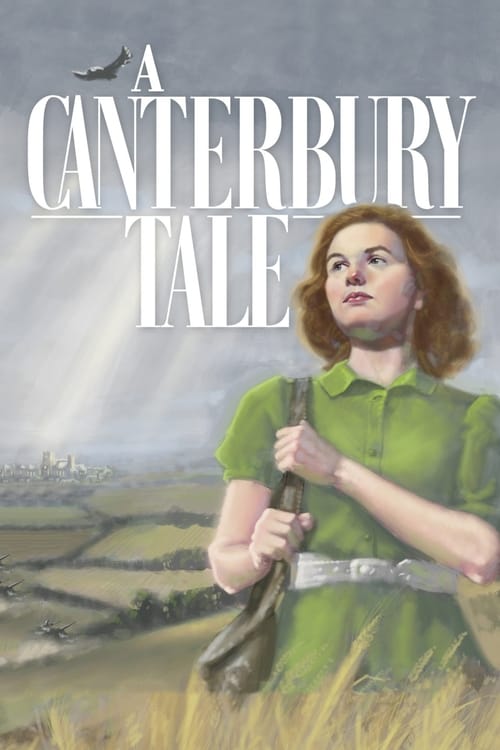
A Canterbury Tale
1944 · Michael Powell
For a contemplative Sunday-afternoon watch when you want to be soothed and surprised at once — comfort viewing with an undertow of mystery. Reach for it when you're in the mood for kindness, countryside, and a film that believes in small miracles.
What it's about
On a blacked-out wartime night, three strangers step off a train in a small Kentish town: a London shopgirl turned Land Girl, a British Army sergeant, and a homesick American GI. A bizarre local menace — a shadowy figure who pours glue into girls' hair after dark — gives them a mystery to solve, but the real journey is the old pilgrim road to Canterbury, and what each of them finds along it.
The experience
Gentle, strange, and slowly enchanting — it starts as a whodunit and turns into something closer to a blessing. The pace is unhurried, the humor dry, and by the cathedral finale it achieves a quiet emotional lift that sneaks up on you completely.
Performances
Eric Portman gives the film its fascinating center as the local magistrate — courtly, fervent, and just unsettling enough that you're never sure what to make of him. John Sweet, a real American serviceman and non-actor, brings a guileless warmth no professional could fake.
The craft
Powell and Pressburger wrote, produced, and directed as a team, and their shared sensibility is everywhere: luminous black-and-white photography of the Kent countryside, sound design that lets birdsong and cathedral bells carry meaning, and one audacious cut that leaps six centuries in a single gesture. The rural light alone makes it worth the biggest screen you have.
Why it matters
A commercial puzzle in 1944 that has since been embraced as one of the most personal and beloved British films of its era — a key work in the Archers' legendary run and a lasting influence on how cinema imagines the English landscape as a place of memory and enchantment.
Snapshot
A Canterbury Tale is among the strangest and most personal films to emerge from the wartime British cinema — a pastoral mystery, a spiritual pageant, and an oblique piece of propaganda folded into one. Nominally credited here to Michael Powell, it was in fact the joint work of Powell and Emeric Pressburger under their shared banner, The Archers, who wrote, produced, and directed together. The premise is deliberately eccentric: on a blacked-out night in the fictional Kentish town of Chillingbourne, a shadowy figure known as "the Glue Man" pours glue into the hair of local girls who go out after dark. Three modern pilgrims — a British Land Girl, a cynical British Army sergeant, and a homesick American GI — set themselves to solve the crime, and in doing so are drawn along the old road to Canterbury and its cathedral. What begins as a whodunit resolves into something closer to a secular sacrament, in which each traveler receives a kind of blessing. The film failed to connect with audiences on release and was for decades a marginal title; it is now widely regarded as one of the Archers' masterpieces and one of the great films about the English landscape and the continuity of national memory.
Industry & production
The film was made by The Archers for their releasing partner during the Rank-affiliated years, produced in 1943 and released in 1944 — the middle of the Second World War and the middle of Powell and Pressburger's most fertile creative run, following The Life and Death of Colonel Blimp (1943) and preceding I Know Where I'm Going! (1945) and A Matter of Life and Death (1946). Like those films, it was shot substantially on location, an unusual practice for the period, using the villages and countryside of Kent — Powell's own home county, where he had grown up near Canterbury. Fordwich, Wickhambreaux, Shottenden, Chilham and the road toward Canterbury supply the film's textures, and the climactic sequences use Canterbury itself, including the Cathedral, which had survived while much of the surrounding city had been damaged in the Baedeker raids. Studio interiors were completed at the Archers' usual production base.
A distinctive production fact is the casting of a genuine United States Army sergeant, John Sweet, as the American pilgrim Bob Johnson. Sweet was not a professional actor but a serviceman stationed in Britain, and his participation gives the film's Anglo-American strand a documentary authenticity. For the American release, the distributor recut the film and added framing material featuring Kim Hunter, reshaping it for US audiences — a version that circulated separately from the British cut and further muddied the film's early reputation. Precise budget and box-office figures are not something I can state with confidence, and I will not invent them; what is securely documented is that the film underperformed commercially and puzzled both critics and audiences on first release.
Technology
A Canterbury Tale was produced in black-and-white, at a moment when the Archers were also pioneering Technicolor (they would move decisively to color with A Matter of Life and Death two years later). The choice of monochrome is not merely a wartime economy; it is essential to the film's tonal register, allowing the Kentish downs, hedgerows and skies to be rendered as luminous, near-abstract fields of gray and silver. The technology of the film is otherwise that of standard mid-1940s British studio practice — orthochromatic-era sensibilities giving way to panchromatic stock, optical printing for the film's celebrated transitions, and location sound supplemented by post-synchronised dialogue and studio scoring. There is no technological novelty in the equipment; the innovation lies in how conventionally available tools are marshalled toward an unconventional, almost mystical effect.
Technique
Cinematography
The photography is by Erwin Hillier, the German-born cameraman who would shoot the Archers' I Know Where I'm Going! the following year, and it is one of the film's glories. Hillier treats the Kent landscape with an almost devotional attention: high skies, deep-focus vistas of the downs, sunlight raking across grass and stubble, and interiors modeled with a chiaroscuro that recalls his European training. The most famous single image is the opening match cut, in which a medieval falconer releases a hawk into the sky and the shot dissolves — via the bird's silhouette — into a soaring Spitfire, collapsing six centuries into a single graphic gesture. This cut is often cited as an antecedent of the celebrated bone-to-spacecraft transition in Kubrick's 2001: A Space Odyssey more than two decades later. Throughout, Hillier's camera makes the landscape a character, and the film's spiritual argument is carried as much by the quality of light as by the dialogue.
Editing
Cut by John Seabourne, the film's editing is patient and associative rather than propulsive. The mystery-plot mechanics are deliberately underplayed; the rhythm instead lets scenes breathe — a long conversation on a hillside, a boy's mock battle in a stream, the slow approach to Canterbury. The editing's boldest stroke is that opening temporal leap, but its subtler achievement is a structure that keeps sliding away from genre expectation, refusing the tightening tension a conventional detective story would demand and letting the pilgrimage form take over.
Mise-en-scène / staging
The staging fuses documentary observation of rural wartime life — the wheelwright's shop, the Land Girls, the billeted soldiers, village children — with a heightened, almost allegorical framing. Powell and Pressburger repeatedly compose the landscape so that the old Pilgrims' Road and the modern war coexist in the same frame, and the film's argument about continuity is delivered through this layering: the same ground walked by Chaucer's pilgrims and by 1943's soldiers. The interiors, particularly the scenes involving the magistrate Colpeper, are staged to suggest a man both rooted in and estranged from his community.
Sound
Music is by Allan Gray, another regular Archers collaborator (he also scored I Know Where I'm Going! and A Matter of Life and Death). His score moves between the pastoral and the liturgical, and the film builds toward the organ and choral sound of Canterbury Cathedral, where music becomes the vehicle of the concluding blessings. Sound design also makes expressive use of the natural world — wind over the downs, the river, birdsong — so that the landscape is heard as well as seen. Eric Portman's voice, in Colpeper's lecture on the history and meaning of the Pilgrims' Way, carries one of the film's central passages almost entirely through spoken cadence.
Performance
Eric Portman gives the film's most demanding performance as Thomas Colpeper, the local magistrate and gentleman-farmer who is revealed as the Glue Man. Portman must make an eccentric — even criminal — figure into the film's spiritual conscience, a man whose distorted methods spring from a genuine, if authoritarian, love of England and its history; he holds that contradiction without softening it. Sheila Sim, as the Land Girl Alison Smith, provides the emotional center, her grief for a lost fiancé quietly threaded through the film until its resolution. Dennis Price plays Peter Gibbs, the sardonic soldier and would-be cinema organist, and Sergeant John Sweet, the non-professional, brings an unforced, open warmth to the American Bob Johnson that no trained actor could easily have counterfeited.
Narrative & dramatic mode
The film's dramatic mode is its most radical feature: it presents itself as a mystery and then declines to behave like one. The "crime" is minor and bizarre; the culprit is identified without conventional suspense; and the true action is inward and spiritual. The structure is that of a pilgrimage — a journey along the old road toward Canterbury during which each of the three modern pilgrims carries a private burden and, at the destination, receives a form of grace: Alison learns her fiancé may be alive; Bob receives long-delayed letters from his girl in America; Peter, the frustrated organist, is given the chance to play the Cathedral organ. Colpeper, meanwhile, faces a reckoning. The narrative thus operates on two levels — a surface investigation and an underlying moral pattern derived from Chaucer, the film's explicit medieval frame — and it is the tension between these registers that early audiences found baffling and later audiences have found profound.
Genre & cycle
A Canterbury Tale resists easy generic placement, which is part of why it was mishandled on release. It has the outward apparatus of a mystery and belongs, loosely, to the cycle of wartime British films concerned with national morale and Anglo-American cooperation — the latter a live propaganda concern given the mass presence of US servicemen in Britain before D-Day. But its true kinship is with the pastoral and the visionary: it is a "landscape film," a meditation on Englishness and historical continuity that stands closer to a lyric poem than to a genre picture. Within the Archers' own output it forms part of an informal cycle of films about place, belonging and the numinous quality of the British landscape, of which I Know Where I'm Going! is the immediate companion.
Authorship & method
The film is a definitive Archers production, and its authorship is genuinely dual. Powell, a Kentish man, supplies the rooted feeling for the specific landscape and the visual audacity; Pressburger, a Hungarian émigré, supplies the outsider's clarifying love of England and the structural conceit that binds Chaucer to the war. Their method — writing, producing and directing jointly, shooting on real locations, trusting atmosphere over plot mechanics, and pursuing personal obsessions inside the commercial system — is fully present here. Among collaborators, Erwin Hillier's cinematography, Allan Gray's score, and John Seabourne's editing are the load-bearing contributions, while the casting of a real soldier reflects the Archers' willingness to break professional convention in pursuit of authenticity. It is, more than most Powell–Pressburger films, a work whose eccentricity signals its authors' refusal to subordinate a private vision to audience expectation.
Movement / national cinema
The film sits at the heart of a particular strand of 1940s British national cinema — not the documentary-realist school of the wartime GPO/Crown tradition, though it borrows that movement's feeling for place and ordinary life, but a more romantic, visionary tendency of which the Archers were the supreme exponents. It belongs to the broader flowering of British filmmaking during the war, when Rank-scale resources coincided with unusual creative freedom. Its deep investment in landscape, folk memory and the spiritual meaning of English soil connects it to a long native tradition in the other arts, and it can be read as cinema's contribution to a wartime rediscovery of the English pastoral.
Era / period
Made in 1943–44 and released in 1944, the film is saturated with its moment: the blackout, the billeting of troops, the Land Army, the American build-up before the invasion of Europe, and the fragile survival of Canterbury Cathedral amid bomb damage. Yet its distinctive gesture is to set that acute present against the deep past, insisting that the war is one more episode in a continuity stretching back to the medieval pilgrims. It is a film about 1944 that is equally about the fourteenth century, and its power depends on holding both eras in view at once.
Themes
The governing themes are pilgrimage and grace; the continuity of English history and landscape; and the healing of wounds — personal and national — inflicted by war. Colpeper's cracked idealism raises a genuinely uncomfortable theme: the coercion latent in love of country and tradition, the way devotion to heritage can curdle into control. Anglo-American understanding runs throughout, embodied in the friendship between the British and American pilgrims. And beneath all of it lies a quasi-religious conviction that place itself can bless those who move through it attentively — that the old road still confers something on those who walk it.
Reception, canon & influence
On its 1944 release the film was, by broad consensus, a commercial disappointment and a critical puzzle; audiences primed for a mystery or a straightforward morale picture found its glue-pouring premise and mystical resolution eccentric or off-putting, and the differently edited American version did nothing to clarify matters. For years it remained one of the Archers' least understood works. Its reputation was rebuilt in the later twentieth century, as the critical reassessment of Powell and Pressburger — aided by admirers including Martin Scorsese and by restoration and reissue — recognized it as a singular achievement; it is now routinely counted among their finest films. Looking backward, the film's chief influences are literary and native: Chaucer's Canterbury Tales as an explicit frame, and the deep English tradition of pastoral and pilgrimage. Looking forward, its most frequently cited legacy is that audacious falcon-to-Spitfire cut, held up as a precursor to Kubrick's match cut in 2001, and, more diffusely, its example as a "landscape film" has shaped how later British filmmakers have treated the countryside as a repository of memory and meaning. Its rehabilitation is itself part of the story: a film that failed in its own time and became, in retrospect, a canonical statement of a certain idea of England.
A Deleuzian reading
A hawk lifts off a falconer's glove into a fourteenth-century sky, and before it can settle the shot dissolves: the bird's dark silhouette hardens into a Spitfire, and six hundred years close in the space of a single graphic rhyme.
The full Deleuzian reading of A Canterbury Tale →
Reception
Baffled wartime audiences and critics in 1944 — it flopped, got recut for America with tacked-on framing scenes — but after its restoration in the late 1970s it climbed to masterpiece status, now cherished as one of Powell & Pressburger's strangest and most soulful films.
How A Canterbury Tale was received, from release to now →
How to watch A Canterbury Tale: what to notice on a first viewing
- Watch a medieval hawk in flight dissolve into a wartime plane. The opening match cut takes a falconer's released hawk and turns its silhouette directly into a soaring Spitfire, collapsing six centuries in one graphic gesture. A single cut tells you the old world and the present war occupy the same ground, before a word of dialogue explains anything.
- Watch how much sky and open downland fill every landscape shot. Hillier shoots the Kent countryside in deep-focus vistas with high skies and raking light, treating the land itself as a presence rather than as scenery. The landscape gets as much attention as any character, which tells you the place matters as much as the plot.
- Notice how little urgency the three pilgrims bring to the crime. A Land Girl, a sergeant, and an American GI set out to investigate the Glue Man, but the film keeps letting the mystery drift while conversations and country walks take over. The whodunit machinery is there, but the film is clearly more interested in something else it never quite names.
- Listen for wind, birdsong, and the river under the dialogue. Allan Gray's score moves between pastoral and liturgical registers, and the natural sound of the landscape, wind over the downs, running water, is given equal weight to the music. The countryside is something you hear as much as see, which is part of how the film builds its quiet, almost devotional mood.
- Notice real wartime village life staged alongside the mystery plot. A wheelwright's shop, Land Girls at work, billeted soldiers, and village children are folded into the story with documentary plainness, blurring where reportage ends and fiction begins. The ordinary details of wartime life feel as carefully observed as anything in the central mystery.
The whole guide to watching A Canterbury Tale, with the keys for a rewatch →
Influences: the films it descends from and the films it influenced
- Song of Ceylon (1934) — Establishes the GPO documentary-poetic method of associative sound-image montage and reverent, rhythmic landscape observation that the Archers repurpose into the film's documentary-allegory of the Kent downs.
- Night Mail (1936) — Models the GPO Film Unit practice of casting real workers and building narrative rhythm out of the English working landscape, feeding the non-professional casting of a real serving soldier and the film's documentary texture.
- Man of Aran (1934) — Prototype of documentary-allegory built from a single specific terrain and a non-professional 'cast,' the template for treating place and ordinary people as carriers of a national essence.
- Sunrise: A Song of Two Humans (1927) — Source of the expressionist chiaroscuro and mobile camera gliding through nocturnal countryside; cinematographer Erwin Hillier's German-trained low-key lighting descends directly from this school.
- M (1931) — The Lang/UFA milieu in which Hillier apprenticed; its shadow-carved interiors and low-key modeling are the concrete pedigree of the film's chiaroscuro.
- October (Ten Days That Shook the World) (1928) — Codifies intellectual montage — linking two unlike images by graphic rhyme to force an idea — the editing logic behind the falcon-to-Spitfire match cut.
- 49th Parallel (1941) — The Archers' own prior experiment using geography and landscape as the driving engine of a national-propaganda narrative, the immediate methodological precursor.
- I Know Where I'm Going! (1945) — Companion landscape film in which a specific locale becomes a coercive mystical force bending a character's will, built on the same anti-plot, atmosphere-over-mechanics method.
- 2001: A Space Odyssey (1968) — The bone-to-satellite graphic match cut is the most-cited heir of the falcon-to-Spitfire cut, extending the technique of compressing millennia across a single edit.
- The Wicker Man (1973) — English folk-landscape film embedding pagan continuity and coercive belief in a specific rural place, extending the countryside-as-repository-of-memory-and-menace idea.
- Penda's Fen (1974) — Visionary English-landscape drama of buried continuity, pastoral mysticism and coercive Englishness, a direct heir to the film's landscape-film and English-continuity mode.
- Akenfield (1974) — Casts real Suffolk villagers as themselves and treats the working landscape as living memory, extending the non-professional-casting documentary-allegory of rural England.
- A Field in England (2013) — Black-and-white English-landscape visionary cinema treating the countryside as a charged, hallucinatory repository of national history, continuing the British-visionary landscape-film line.
- A Matter of Life and Death (1946) — Same Archers unit deploying an audacious editing/optical conceit (the falcon-Spitfire cut's cousin) in which a formal device carries the metaphysical argument.
- Black Narcissus (1947) — Extends the Archers' place-as-psychological-force staging through expressionist chiaroscuro and studio-built landscape, the same conviction that environment dictates character.
- Went the Day Well? (1942) — Wartime English-village allegory in which an ordinary rural community embodies national continuity under threat — the documentary-allegory sibling from the same GPO-trained lineage.
- Listen to Britain (1942) — Poetic documentary weaving landscape, ambient sound and musical/liturgical motifs into a portrait of English continuity in wartime, the same sound-and-place montage aesthetic.
- A Diary for Timothy (1945) — Essay-film addressing English continuity and the postwar future through montage of land, labor and war, sharing the film's meditation on inheritance and coercive patriotism.
- Mrs. Miniver (1942) — Shares the liturgical-sound endgame — organ and hymn gathering wartime strangers into a congregation inside a sacred space — as the formal resolution of a film that otherwise refuses conventional plot closure.
Similar films
- A Matter of Life and Death (1946) — influence & lineage
- 49th Parallel (1941) — influence & lineage
- The Wicker Man (1973) — influence & lineage
- I Know Where I'm Going! (1945) — influence & lineage
- The Life and Death of Colonel Blimp (1943) — shared sensibility
- Men (2022) — shared sensibility
- Small Things Like These (2024) — shared sensibility
- Mrs. Miniver (1942) — shared sensibility