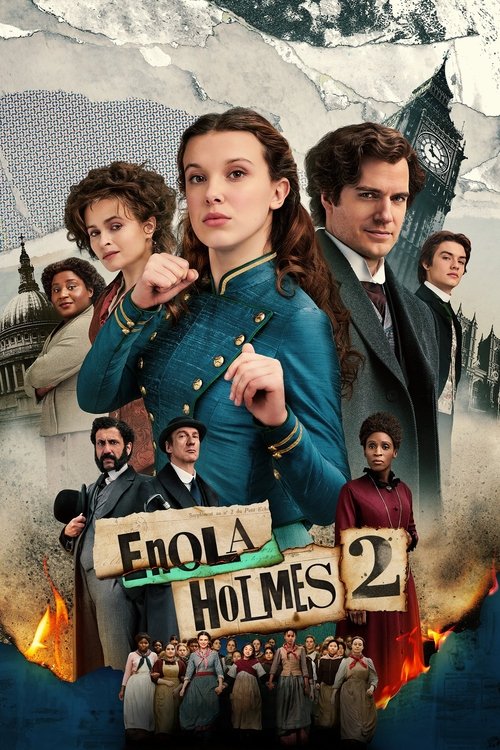
Enola Holmes 2
2022 · Harry Bradbeer
For a fun family movie night or when you want something clever and energetic that doesn't ask too much of you. Pure comfort viewing with a spark of history in it.
What it's about
Enola Holmes, now running her own fledgling detective agency in Sherlock's long shadow, takes her first official case: a young matchstick-factory worker has gone missing. The trail leads into the real history of the 1888 London matchgirls' strike and a conspiracy of corruption and profit big enough that she'll need her friends — and her famous brother — to crack it.
The experience
Fast, cheeky, and buoyant, with Enola talking straight to the camera and dragging you along at a sprint. It's a caper with a conscience — light on its feet even when the subject matter gets serious.
Performances
Millie Bobby Brown's direct-to-camera charm carries the whole enterprise, and Henry Cavill makes an appealingly warm, slightly rumpled Sherlock.
The craft
Jack Thorne's script braids an invented mystery into a documented historical event — the Bryant & May matchgirls' strike — and the production dresses Victorian London with playful energy rather than museum stiffness. The fourth-wall winks and brisk editing keep it feeling like a page-turner.
Why it matters
It confirmed the first film's success was no fluke, cementing one of the streaming era's few genuinely successful original franchises and Brown's standing as a lead who can carry one.
Snapshot
Enola Holmes 2 is a Netflix original mystery-adventure, the sequel to the streamer's surprisingly durable 2020 hit, again directed by Harry Bradbeer from a screenplay by Jack Thorne and again headlined by Millie Bobby Brown as the teenage sister of Sherlock Holmes. Where the first film adapted Nancy Springer's young-adult novel The Case of the Missing Marquess, the sequel departs from any single Springer title and builds an original mystery around a documented historical event: the London matchgirls' strike of 1888 at the Bryant & May factory. Enola, now hanging out her own detective's shingle and struggling in Sherlock's shadow, takes the case of a missing factory girl and finds it braided into a conspiracy of corruption, disease, and profit. The film retains the property's defining stylistic tic — Brown's direct-to-camera address, breaking the fourth wall to narrate, joke, and confide — and its brisk, brightly lit register of period adventure aimed squarely at a family and teen audience. It is a well-made, competently mounted studio product rather than a landmark, and the honest scholarly frame here is that of a franchise entry: its interest lies in what it borrows, how it packages Victoriana for the streaming era, and the specific creative signatures its makers carry across from other work.
Industry & production
The film is a product of the streaming consolidation that reshaped mid-budget cinema at the turn of the 2020s. The first Enola Holmes had been developed for a theatrical release through Warner Bros. with Legendary Pictures; when the COVID-19 pandemic shuttered theaters in 2020, Legendary sold the picture to Netflix, where it became one of the platform's most-watched original films of that year. That performance guaranteed a sequel, and Enola Holmes 2 was greenlit as a Netflix original from the outset — a clean illustration of how the pandemic accelerated the migration of star-driven, mid-budget "four-quadrant" entertainment from theaters to streaming.
Production companies include Legendary Pictures and PCMA Productions, the company through which Millie Bobby Brown and her family produce; Brown holds a producer credit, part of a deliberate strategy in which she leveraged the franchise to build standing as a producer as well as a star. Mary Parent and others produced. The returning creative team — director Bradbeer, writer Thorne, and the principal cast — signaled Netflix's preference for continuity in a proven property.
One industrial wrinkle shadows the series: the intellectual-property status of Sherlock Holmes. Most of Arthur Conan Doyle's Holmes stories are in the public domain, but a subset of the final stories remained under U.S. copyright through the Conan Doyle Estate. The Estate sued over the first film, arguing that its depiction of a warmer, more emotional Sherlock drew on still-protected later stories. That suit was reportedly settled, but it usefully frames the franchise's careful positioning of Sherlock (Henry Cavill) as a supporting figure to an original protagonist — Enola, Springer's invention — rather than a straightforward Holmes adaptation.
Technology
Enola Holmes 2 was shot digitally, the industry standard for a production of this budget and delivery format by 2022, and finished for streaming distribution rather than for a wide theatrical run. The record on its specific camera and lens packages is not something I can attest to with confidence, so I will not invent technical specifications. What can be said with assurance is that the film is a conventional, high-gloss digital production: its effects work is largely invisible and augmentative — set extensions to conjure Victorian London, crowd multiplication for the strike sequences, and the ordinary digital grooming of a big-canvas period film — rather than spectacle-driven VFX. The technological story here is less about any innovation on set than about the delivery pipeline: a film engineered from conception for home-screen consumption via Netflix's global platform, with the color, contrast, and sound mix calibrated for that context.
Technique
Cinematography
Cinematographer Giles Nuttgens, a seasoned feature DP whose credits range widely across independent and studio work, returns from the first film to maintain visual continuity. The house style is bright, saturated, and legible — a storybook Victoriana that favors clarity and momentum over shadow and grit. This is a deliberate genre choice: the film's London is grimy in its subject matter (factory disease, exploitation) but rarely in its image, keeping the register buoyant and accessible. Camera movement is active and often subjective, frequently reframing to accommodate Enola's turns to the lens, so that the fourth-wall breaks feel woven into the visual grammar rather than pasted on.
Editing
Editor Adam Bosman cuts the film at the propulsive pace the property demands, threading exposition, action, and Enola's asides into a continuous forward drive. The editing carries a real structural burden here: the fourth-wall address requires clean, well-timed cuts to and from Brown's direct gaze, and the mystery's clue-work depends on montage-style visualizations of deduction — freeze-frames, inserts, rapid recombinations of evidence. This deductive-montage vocabulary is a franchise inheritance from the broader modern Sherlock idiom (notably the BBC's Sherlock), adapted to a younger, brisker key.
Mise-en-scène / staging
Production designer Michael Carlin and costume designer Consolata Boyle — both craftspeople with substantial period-film pedigrees — build a densely dressed but bright Victorian world: the match factory floor, gentlemen's clubs, music halls, and grand houses. Costume does real narrative work, as Enola's frequent disguises and class-crossing require legible transformations. The staging balances two modes: intimate two-handers built around Enola's confidences to the audience, and larger set pieces (the strike, chases, a music-hall sequence) that open the frame to spectacle and choreography.
Sound
Composer Daniel Pemberton returns with a score that is one of the series' most distinctive assets. Pemberton — known for stylistically adventurous, genre-hopping work — supplies a playful, propulsive orchestral idiom laced with period and anachronistic textures, matching the film's tone of mischievous adventure. The sound design supports the fourth-wall conceit by modulating the aural space around Enola's asides, and the mix foregrounds dialogue and music in the clean, front-loaded manner suited to home viewing.
Performance
Millie Bobby Brown anchors the film with a performance built on charm and direct address; her rapport with the camera is the engine of the whole enterprise, and her comfort with the confiding, conspiratorial mode is what makes the device land. Henry Cavill plays Sherlock as watchful and quietly warm, a deliberately softened, fraternal version of the detective. Louis Partridge returns as Tewkesbury, and Helena Bonham Carter as the elusive mother Eudoria. David Thewlis and Sharon Duncan-Brewster join the cast; Susan Wokoma returns as jujitsu-teaching suffragette Edith. The ensemble plays in a heightened, warmly comic register consistent with the property's family-adventure aims.
Narrative & dramatic mode
The film's defining formal feature is its metafictional narration: Enola repeatedly breaks the fourth wall, addressing the viewer directly to comment, explain, and editorialize. This is not incidental — it is the organizing dramatic mode, converting the audience into Enola's confidant and ally, and it structures both comedy and suspense. Beneath that device sits a classical detective architecture: a missing-person case that unspools into a larger conspiracy, complete with false leads, disguises, deductions, and a climactic revelation. The film also runs on a coming-of-age spine — Enola's struggle to establish an identity independent of her famous brother — and a romance subplot with Tewkesbury. The result is a hybrid mode: procedural mystery, adventure serial, and Bildungsroman fused under a self-aware comic narration.
Genre & cycle
Enola Holmes 2 sits at the intersection of several cycles. Most immediately it belongs to the long, self-renewing tradition of Sherlock Holmes screen adaptation — but it is a revisionist, feminist offshoot that decenters Sherlock in favor of an invented sister, part of a broader 21st-century impulse to retell canonical properties from marginalized or overlooked perspectives. It also belongs to the YA-adventure cycle, translating the tone of teen-fronted franchise entertainment into a period key. And it participates in the Netflix "original film" cycle of the early 2020s: mid-budget, star-driven, series-minded pictures designed to drive subscription engagement. Its use of the matchgirls' strike aligns it, loosely, with a strain of period films that fold real social-history and suffrage-era struggle into popular entertainment.
Authorship & method
The dominant authorial signature is Harry Bradbeer's. Bradbeer directed the entirety of Fleabag's acclaimed run and much of Killing Eve, and the fourth-wall address that defines Enola Holmes is a direct transplant of the device he made famous with Phoebe Waller-Bridge — repurposed from adult tragicomedy to youthful adventure. Recognizing this lineage is essential to reading the films: the direct-to-camera confidence is not a gimmick invented for Enola but a considered authorial method carried across genres.
Screenwriter Jack Thorne is among the most prolific and versatile British dramatists of his generation (This Is England episodes, Harry Potter and the Cursed Child, His Dark Materials), and his script supplies the film's blend of mystery mechanics, social conscience, and brisk wit. The key craft collaborators — cinematographer Giles Nuttgens, composer Daniel Pemberton, editor Adam Bosman, designers Michael Carlin and Consolata Boyle — largely carry over from the first film, giving the series an unusually consistent aesthetic authorship across both entries. Pemberton's score, in particular, functions as a strong secondary signature.
Movement / national cinema
The film is firmly a work of British popular filmmaking — British creative leadership, cast, crew, settings, and history — financed and distributed through the American streaming and studio system (Netflix, Legendary). It belongs to no art-cinema movement; it is commercial transatlantic product. Its most meaningful "national" dimension is its engagement with British social history: the matchgirls' strike, the class geography of Victorian London, and the emergent suffrage politics threaded through the series. In that sense it participates in a long British tradition of period drama as popular national storytelling, updated for global streaming.
Era / period
Set in 1888 London, the film mines the late-Victorian moment for both texture and theme: industrial exploitation, public-health scandal (the phossy-jaw disease caused by white phosphorus in match manufacture), nascent labor organizing, and the constraints on women's independence. It is a 2022 film about the 1880s, and it reads its period through a contemporary lens — foregrounding female agency, labor solidarity, and institutional corruption in ways calibrated to resonate with present-day audiences. The production is meticulous in surface period detail while unabashedly modern in sensibility and pacing.
Themes
Central themes include the forging of an independent identity against the gravitational pull of family and fame (Enola versus the Holmes name); female agency and solidarity, dramatized through the collective action of the factory women; and the exposure of institutional corruption — the film's mystery ultimately indicts respectable men and profitable systems rather than a lone villain. Justice is framed as social as well as individual: solving the case means surfacing a wrong done to a whole class of workers, not merely catching a culprit. The recurring motif of disguise and performance connects to the film's metafictional form, and the Enola–Sherlock relationship dramatizes a theme of mutual recognition, as the celebrated brother learns to see his sister as a peer.
Reception, canon & influence
Critically, Enola Holmes 2 was received much as its predecessor: as a charming, well-crafted, unchallenging entertainment carried by Brown's performance and Bradbeer's fourth-wall energy, with reviewers generally rating it a solid, agreeable sequel rather than a significant film. I do not have exact aggregate scores or verified viewership figures to cite, and will not invent them; the safe statement is that it performed strongly enough on Netflix to keep the franchise viable, with further installments subsequently reported to be in development.
Its influences backward are legible and multiple: Conan Doyle's Holmes canon as source-world; Nancy Springer's YA novels as the property's originating text; the modern screen-Sherlock idiom (Guy Ritchie's action-inflected films, the BBC's Sherlock) as a template for kinetic deduction; and, most distinctively, Bradbeer's own Fleabag as the direct source of its narrative address. Its grounding in the real 1888 matchgirls' strike and the historical figure of the strike's organizers gives it an unusual anchor in documented labor history for a family adventure.
Its influence forward is, appropriately, modest and franchise-internal: the film consolidated Enola Holmes as a durable Netflix property and a vehicle for Brown's expanding producer-star career, and it stands as a visible example of the streaming-era, feminist-revisionist reworking of a canonical literary detective. Its lasting significance is likelier to be industrial and cultural — as a case study in how a pandemic-displaced theatrical film became a streaming franchise, and in how the Fleabag address migrated into mainstream family entertainment — than aesthetic. As scholarship, the honest verdict is that this is a competent, engaging genre sequel whose interest lies more in its lines of inheritance than in any innovation of its own.
A Deleuzian reading
A girl in a Victorian street stops mid-sentence, turns her head, and looks at a place where nobody is standing.
The full Deleuzian reading of Enola Holmes 2 →
Reception
Landed in 2022 as that rarity — a Netflix sequel widely called better than the original — and has since settled comfortably into 'cozy autumn rewatch' status while fans wait out the long-rumoured third film.
How Enola Holmes 2 was received, from release to now →
How to watch Enola Holmes 2: what to notice on a first viewing
- Watch other actors clear space when Enola turns to you. Bradbeer blocks each scene so a gap opens at Enola's eyeline, and the other actors step clear of it right before she glances into the lens. No character can ever stand where you are, but the film builds you a place in the scene anyway.
- Watch for freeze frames during Enola's deduction scenes. Bosman's editing stops the image, isolates an object, then recombines it with something spotted scenes earlier, turning her thinking into a visible sequence of cuts. You watch her thinking happen instead of being told about it afterward.
- Notice how many disguises Enola wears across the case. Boyle's costumes have to read instantly as she crosses between factory floor, gentlemen's club, and music hall, doing double duty as cover and as clue. Each costume lets her be two things at once, a detective and whatever role she needs to pass as.
- Listen for anachronistic textures inside the orchestral score. Pemberton mixes period instrumentation with modern, playful flourishes that keep pace with the film's brisk momentum rather than sitting quietly underneath it. The music never lets the Victorian setting feel like a museum piece.
The whole guide to watching Enola Holmes 2, with the keys for a rewatch →
Influences: the films it descends from and the films it influenced
- Fleabag (2019) — Bradbeer's blocking reserves an eyeline for the lens as a co-conspirator, so the protagonist can flick a mid-scene glance or aside straight to camera — the exact direct-address grammar transplanted onto Enola.
- Enola Holmes (2020) — The immediate predecessor that established the film's shared vocabulary — the confiding to-camera address plus the whip-cut deductive montage — carried forward by the same DP (Nuttgens), composer (Pemberton) and editor (Bosman).
- Sherlock Holmes (2009) — Ritchie's pre-visualized, slow-motion-then-rapid-cut rendering of Holmes's reasoning is the template for Enola's 'deductive montage,' where cognition is dramatized as choreographed action before it happens.
- Sherlock (2010) — McGuigan's on-screen floating typography and subjective inserts that externalize the detective's mind supply the visual-cognition editing idiom the Enola films inherit for staging deductions.
- Amélie (2001) — Jeunet's saturated storybook production design and narrator-mediated whimsy — a heroine framed within a fairy-tale-colored city who reaches toward the audience — is the model for Enola's 'storybook Victoriana' look.
- Ferris Bueller's Day Off (1986) — Hughes's charismatic young lead who steps out of the plot to confide schemes and reactions to camera is the youth-coded direct-address charm Enola repurposes for adventure.
- Tom Jones (1963) — Richardson breaks the fourth wall inside a bawdy 18th-century costume romp, establishing the precedent for direct address staged within period costume drama rather than modern comedy.
- Alfie (1966) — Gilbert's sustained to-camera narration by a roguish protagonist confiding his motives is a foundational British direct-address template feeding the Bradbeer method.
- Dickinson (2019) — Anachronistic, youth-coded feminist reframing of a 19th-century figure using deliberately modern voice and address — the same collision of period surface and contemporary sensibility Enola trades on.
- Bridgerton (2020) — Streaming period drama's glossy, revisionist Regency-Victoriana aimed at a modern audience, mediating its world through a confiding narrator (Lady Whistledown) much as Enola confides through the lens.
- Killing Eve (2018) — Bradbeer's other signature work shares his tonal fusion of wit, menace and female-driven propulsion, with a camera that flirts with the viewer's complicity.
- His Dark Materials (2019) — Thorne's screenwriting method — a spirited young heroine, social conscience and brisk wit braided into genre plotting — is the same authorial recipe he brings to the Enola scripts.
- Mr. Holmes (2015) — A revisionist deconstruction of the Holmes myth that foregrounds the fallible human behind the legend, paralleling Enola's decentering of the canonical detective.
- The Irregulars (2021) — A streaming-era Victorian Sherlock reworking that hands the detective world to marginalized youth, running the same feminist/revisionist reframing of the Doyle canon for Netflix.
- Knives Out (2019) — A revitalized whodunit built on a charismatic detective and audience-teasing withheld-then-replayed deductions, sharing Enola's playful, self-aware handling of mystery mechanics.
- The Queen (2006) — Costume designer Consolata Boyle's period-precise, character-revealing costuming — carried into both Enola films — gives the historical world its tactile authority.
Similar films
- Enola Holmes (2020) — influence & lineage
- Detective Conan: The Phantom of Baker Street (2002) — shared sensibility
- Black Widow (2021) — shared sensibility
- The Conjuring 2 (2016) — shared sensibility
- The Sheep Detectives (2026) — shared sensibility
- Minions & Monsters (2026) — shared sensibility
- Luther: The Fallen Sun (2023) — shared sensibility
- The Batman (2022) — shared sensibility