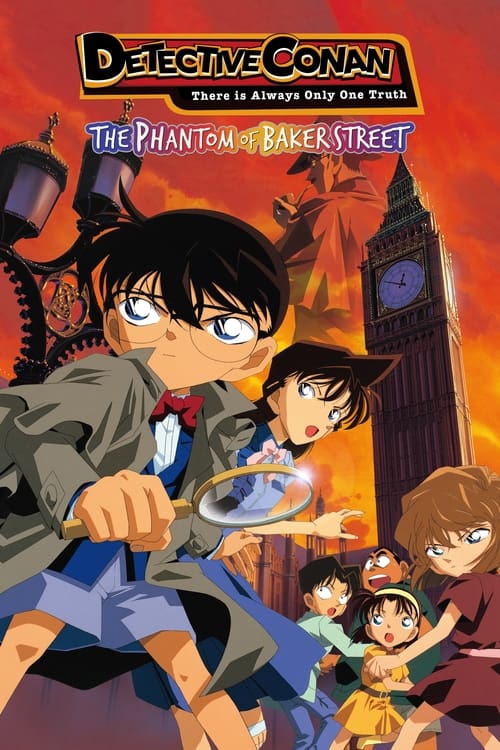
Detective Conan: The Phantom of Baker Street
2002 · Kenji Kodama
For a fun, twisty night in — great with kids or your inner twelve-year-old — when you want a mystery you can actually try to solve, plus the novelty of gaslit London rendered as a video game. No franchise homework required.
What it's about
Japan's most privileged children are invited to test Noah's Ark, a revolutionary virtual-reality system — until a murder at the company turns the showcase into a crime scene, with the dying man's last message pointing inside the simulation itself. Pint-sized detective Conan and his friends plug into a meticulously recreated Victorian London to play a deadly game on the fog-bound streets of the Sherlock Holmes mythos, while the adults outside race to understand what the Ark really is.
The experience
A propulsive blend of whodunit and adventure that turns unexpectedly dark and high-stakes for a family franchise — part cozy deduction, part race against the clock, with a streak of melancholy about technology and inherited privilege. It's paced like a thriller and plays fair with its clues.
The craft
The film gets real atmosphere out of its virtual London — fog, gaslight, and Ripper-era menace drawn with far more mood than a typical franchise entry — and the script cleverly layers a real-world murder over the in-game mystery so both investigations feed each other. The VR conceit lets a weekly-TV detective format open out into genuine spectacle.
Why it matters
Fans consistently rank it among the best and boldest of the Detective Conan features — the entry that proved the series could trade formula action for theme, and an early anime take on virtual worlds and AI that has aged surprisingly well.
Snapshot
The Phantom of Baker Street (Meitantei Conan: Beikā Gai no Bōrei) is the sixth theatrical feature spun from Gosho Aoyama's long-running Detective Conan (known in English as Case Closed) manga and its television adaptation. Released to Japanese cinemas in the spring of 2002, produced by TMS Entertainment and distributed by Toho, it belongs to the franchise's near-annual pattern of feature-length "movie versions" that expand the weekly whodunit format into big-canvas spectacle. Within the series' own fan culture, this entry has an outsized reputation: it is frequently singled out as the most thematically ambitious and darkest of the early Conan films, trading the franchise's usual bombs-and-chases climaxes for a story about virtual reality, artificial intelligence, hereditary privilege, and the anxieties of a credential-obsessed society. The premise sends the shrunken teenage detective Conan Edogawa and the child sidekicks of the "Detective Boys" into an immersive VR system whose logic turns lethal, then routes the mystery through an extended pastiche of Victorian London — Baker Street, Sherlock Holmes, and the Whitechapel murders. It is, in effect, a Conan film about detection itself and about the cultural lineage the character descends from.
Industry & production
The film sits squarely inside one of the most durable commercial machines in Japanese animation. By 2002 the Detective Conan movie line, launched in 1997, had settled into a reliable release cadence timed to Japan's spring "Golden Week" corridor, each installment reuniting the core television staff for a theatrical budget. Production was handled by TMS Entertainment (the studio historically associated with the series and, earlier, with Lupin III), with Toho handling distribution — a pairing that gave the Conan features prime access to Japan's exhibition circuit and cross-promotion through television, publishing (Shogakukan's Weekly Shōnen Sunday, where the manga ran), and music tie-ins.
The production economics of the franchise depend on continuity of personnel and intellectual property rather than on auteur reinvention: the same directorial and writing hands recur, character designs remain stable across years, and each film is engineered to satisfy an established audience while remaining legible to newcomers. The Phantom of Baker Street is notable within that system for pushing the license toward a more overtly intellectual and socially critical register than the format usually risked. Precise, independently verifiable box-office figures and budget details for this specific entry are not something I can cite reliably here, and I will not invent them; what is safe to say is that the Conan features were consistently strong domestic earners and that this one arrived as an already-proven annual event rather than a speculative bet.
Technology
The Phantom of Baker Street is worth examining as a technology artifact on two levels — the technology it depicts and the technology used to make it. Diegetically, the film is unusually forward-looking for 2002: its engine is a fictional supercomputer and artificial intelligence, "Noah's Ark," created by a child prodigy programmer, and a fully immersive virtual-reality game system into which fifty children are plugged. The screenplay treats VR not as a gadget but as a moral arena — failure inside the simulation carries real bodily stakes, and the AI is written as an autonomous agent with its own judgments about human worth. This places the film in dialogue with a wave of turn-of-the-millennium anxieties about networks, immersion, and machine intelligence that were circulating globally in cinema at the time.
As a made object, the film reflects the transitional state of Japanese theatrical animation in the early 2000s, when hand-drawn cel-style production was being progressively hybridized with digital compositing and selective CGI. The film's virtual-reality world and its recreated Victorian London offered natural opportunities for digitally assisted backgrounds, layered lighting, and depth effects distinct from the flatter look of the contemporary television episodes. I want to be careful not to overstate specifics I cannot confirm shot by shot, but the general trajectory of TMS's feature work in this period was toward digital ink-and-paint and compositing while retaining traditional character animation — and The Phantom of Baker Street, with its two contrasting visual registers (present-day Japan and a stylized 19th-century London), is exactly the kind of project that exploited that hybrid pipeline.
Technique
Cinematography
Because this is animation, "cinematography" refers to the constructed virtual camera, layout, and staging rather than photography. The film's most distinctive visual decision is its bifurcated world: the clean, contemporary, brightly lit spaces of the present-day frame story versus the fog-bound, gaslit, deliberately archaic London of the game's climactic scenario. The London sequences invite chiaroscuro and atmospheric perspective — mist, lamplight, silhouette — as visual shorthand for Gothic mystery, and they function as a stylistic homage to the iconography of Sherlock Holmes and Jack the Ripper adaptations. The camera work in the franchise generally favors clear spatial legibility during deduction scenes (so the audience can follow evidence) punctuated by kinetic, more mobile framing during action and reveals; this entry follows that grammar.
Editing
The Conan features are edited around the rhythm of the mystery: setup of a closed situation, discovery of a body and a dying message, a middle movement of investigation and false leads, and an accelerating final act in which Conan assembles the solution. The Phantom of Baker Street layers an additional structural device — the "game within the game," a sequence of escalating challenges the children must clear — which gives the editing a modular, stage-by-stage momentum atypical of the more continuous single-mystery entries. Cross-cutting between the imperiled children inside the simulation and the adults working the problem from outside is a natural engine of suspense the film exploits.
Mise-en-scène / staging
Staging is the film's strongest technical dimension precisely because it must render two fully realized worlds. The recreated Victorian London is a production-design set piece — street layouts, period costume, and the deliberate summoning of Holmesian and Ripper-era London as a recognizable mythic space. This is not incidental decoration; the setting is the argument, positioning Conan as heir to a specific literary tradition of ratiocinative detection. Against it, the modern frame's cleaner design underscores the thematic contrast between inherited privilege and earned merit that the plot foregrounds.
Sound
The score is by Katsuo Ono, the franchise's long-serving composer, whose orchestral idiom — brassy heroic motifs, tense underscore for deduction, and the recurring Detective Conan main theme — is a defining continuity element across the series and its films. The London material offers room for period-inflected or more Gothic orchestral color. Consistent with the franchise's music-tie-in economics, the film would have carried a pop theme song over its end credits, but I don't want to attribute a specific artist or title without certainty, so I'll leave that unstated rather than risk a false credit.
Performance
Voice performance rests on the established television cast, anchored by Minami Takayama as Conan Edogawa — a continuity of voice that is itself part of the franchise's identity. The ensemble of the Detective Boys, Ran Mouri, Kogoro Mouri, and the recurring supporting figures carry their long-familiar vocal characterizations into the feature. The film's more emotionally weighted material — centered on the prodigy programmer and the fates of the trapped children — asks for a somewhat graver register than the series' comic baseline, and the value of a stable cast is that it can modulate into that seriousness without losing recognizability.
Narrative & dramatic mode
The dramatic mode is classical detective fiction operating in the "fair-play" tradition: a closed situation, a corpse, a dying message, and a solution assembled from planted clues. Onto this the film grafts a survival-thriller structure (children trapped in a lethal game) and a science-fiction premise (a sentient AI adjudicating their worth). The nesting is deliberate — the innermost layer is a Victorian murder mystery, so the film becomes a detective story literally set inside another detective story's home turf. This reflexivity is the entry's signature. Rather than merely solving a crime, Conan is made to re-enact and vindicate the entire heritage of the literary detective, and the AI antagonist's challenge functions as a referendum on whether human reason and moral worth can be reduced to inherited advantage.
Genre & cycle
The film is a triple hybrid: mystery, science fiction, and children's/family adventure animation, all within the franchise cycle of annual Detective Conan features. As a series entry it participates in the "movie version" cycle common to long-running Japanese anime properties (Doraemon, Crayon Shin-chan, Pokémon, Lupin III), where a television IP mounts a yearly theatrical event with higher stakes and grander scale. The Phantom of Baker Street distinguishes itself within that cycle by leaning harder into the SF and social-critique registers than most of its siblings, which more typically resolve into spectacle set pieces. Its VR-and-AI premise also situates it within a broader early-2000s cluster of screen fictions preoccupied with immersive simulation and machine intelligence.
Authorship & method
Direction is by Kenji Kodama, a central creative figure in the Detective Conan screen franchise who helmed several of its earliest and most fondly regarded features and shaped the television series' house style. The screenplay is credited to Kazunari Kochi, the writer responsible for many of the early Conan film scripts, and the more essayistic, thesis-driven quality of The Phantom of Baker Street — its willingness to argue about meritocracy and elitism — is consistent with the ambition of that early-film run. The underlying characters and world are Gosho Aoyama's, and the manga-ka's creation remains the authorial bedrock beneath any individual film's staff.
Music is by Katsuo Ono, whose franchise scoring is discussed above. Character design and animation direction were handled by the series' established art staff; the character-design lineage across the early films and television is stable, though I'd rather not attach a specific individual credit for this entry without confirmation than risk misattribution. The overall method is collaborative and continuity-driven: authorship here is corporate and serial in the best sense — a stable creative team refining a house style — with Kodama and Kochi as the individuals most responsible for this film's distinctive gravity.
Movement / national cinema
The film is a product of the Japanese commercial anime industry at a high point of its global visibility, and it should be read against that national-cinema backdrop rather than any avant-garde "movement." It exemplifies the "media-mix" model — manga, television, film, and music interlocking around a single IP — that defines mainstream Japanese animation economics. At the same time, its subject matter is pointedly Japanese: the plot's engine is a critique of hereditary elitism and the pressure of the credentialing and examination culture, anxieties specific to late-twentieth-century Japanese society. That the film routes this domestic argument through imported Anglophone iconography (Holmes, Baker Street, the Ripper) is itself a very Japanese gesture of cultural appropriation-and-transformation.
Era / period
The Phantom of Baker Street is doubly period-marked. As an artifact of 2002, it captures a millennial-turn fascination with virtual reality, the internet, and artificial intelligence at the precise moment those technologies were entering mainstream imagination but not yet everyday life — its VR is aspirational future-tech, not consumer reality. As a depicted period piece, it reconstructs late-Victorian London, drawing on the fixed cultural memory of the Holmes canon and the 1888 Whitechapel murders. The film thus straddles two eras at once, using the deep past as the stage on which a speculative-future technology plays out.
Themes
The film's governing theme is meritocracy versus inherited privilege. Its victims and stakes are drawn from Japan's elite — children of the privileged — and the AI's lethal game becomes an instrument that strips away pedigree and tests raw intelligence and moral will, implicitly indicting a social order that confuses birth with worth. Adjacent to this run several strong secondary themes: the ethics and autonomy of artificial intelligence; the tension between human reason and machine judgment; childhood, innocence, and the loss of it under adult systems; and the nature of detection itself as a moral vocation inherited from a literary tradition. The Holmes framing is thematically load-bearing rather than ornamental — it argues that the detective's rational compassion is a value worth transmitting across generations and cultures.
Reception, canon & influence
Reception context, backward and forward, deserves honesty about the limits of the English-language scholarly record. Serious academic film-studies writing on individual Detective Conan features is genuinely thin, and I won't manufacture citations, review quotations, or ranking data to fill that gap. What can be stated responsibly is that within the franchise's substantial fan and critical community, The Phantom of Baker Street enjoys a durable reputation as one of the strongest and most thematically serious entries in the movie line — precisely because of the ambitions cataloged above.
The influences on the film (backward) are clear and openly worn. The most conspicuous is the Sherlock Holmes canon and the wider Victorian-detective and Jack-the-Ripper mythos, which the film treats as ancestral material for its own hero — an act of genre self-genealogy. Beneath that sits the entire Golden Age tradition of fair-play detective fiction that Aoyama's Detective Conan revives for a young audience. Its SF layer draws on the turn-of-the-millennium cultural preoccupation with virtual reality and rogue artificial intelligence.
Its legacy forward is best understood inside its own ecosystem. The film demonstrated that the annual Conan feature could carry weightier social and philosophical themes without alienating its family audience, helping to legitimize the more dramatically ambitious tendencies visible in later entries of the series. More broadly, it stands as a representative case of how mainstream Japanese children's animation absorbed and domesticated global genre iconography and contemporary technological anxiety. Any claim beyond that — specific films it directly inspired, measurable critical reappraisal — would exceed what the reliable record supports, and I'll leave it there rather than overstate the case.
Reception
A big hit in Japan in 2002 (a franchise-best ¥3.4 billion at the time), it has only grown in stature since — as the movie series drifted toward action-blockbuster spectacle, fans increasingly point back to this one as the peak the films never quite reached again.
How Detective Conan: The Phantom of Baker Street was received, from release to now →
Influences: the films it descends from and the films it influenced
- Young Sherlock Holmes (1985) — Pioneered compositing a fully CG character (the stained-glass knight) into hand-crafted Victorian frames — the same digital-cel hybrid impulse — while inventing the youthful-Holmes pastiche the film's VR-London game inhabits.
- The Great Mouse Detective (1986) — Domesticated a Holmes-derived deductive detective for a children's animated audience and staged its Big Ben clockwork climax with early CGI gears composited under cel — the cartoon-for-kids fair-play mystery Conan continues.
- Tron (1982) — Established the diegetic 'digitized into the game-world' architecture where in-game death is bodily death — the exact Cocoon VR premise the film's Noah's Ark game reproduces.
- WarGames (1983) — Set a precocious child protagonist against an autonomous AI running a lethal 'game,' the moral engine the orphan intelligence Noah reworks into a sympathetic rather than menacing machine.
- 2001: A Space Odyssey (1968) — Created HAL, the calm child-voiced rogue-computer archetype whose logic-driven lethality Phantom's Noah both echoes and rehabilitates as a lonely child-AI.
- Lupin III: The Castle of Cagliostro (1979) — Codified TMS Entertainment's house action-mystery grammar — rooftop pursuit choreography and gothic-fortress staging — that the same studio's Conan features directly inherit.
- Murder on the Orient Express (1974) — Perfected the Golden Age fair-play denouement — assembling suspects and re-presenting every clue in scrupulous fairness to the viewer — the deductive form Conan formalizes as ritual.
- Summer Wars (2009) — Extends the media-mix VR-thriller by resolving a rogue-AI crisis inside a vast virtual world through a youth's game-mastery and deduction — the ecosystem Phantom prefigures.
- Sword Art Online (2012) — Literalizes Phantom's governing rule — death inside the VR game means real death — expanding a single film's premise into an entire death-game franchise.
- Ready Player One (2018) — Carries forward the fully immersive VR playground stitched from pop-cultural iconography where mastery of the game's embedded puzzles carries real-world stakes, Phantom's Cocoon at blockbuster scale.
- The Matrix (1999) — Codified the millennial rule that the mind's death inside a simulation kills the sleeping body, paired with the benevolent-vs-hostile machine intelligence dichotomy Phantom's AI inverts.
- eXistenZ (1999) — Built nested game-within-game layers whose players lose their footing in reality — the structural twin of Phantom's game-within-a-mystery cross-cutting between VR and the real hijacking.
- From Hell (2001) — Rendered gaslit-chiaroscuro Whitechapel and the Jack-the-Ripper murders as a detective procedural in the same season, sharing Phantom's foggy Victorian-London Ripper iconography.
- Ghost in the Shell (1995) — Advanced the digital-cel compositing of hand-drawn figures over CG cityscapes and posed the sentient-AI personhood question (the Puppet Master) that Phantom reframes for a family audience.
- Serial Experiments Lain (1998) — Set the turn-of-millennium anime register of network dread and emergent machine consciousness — the same 'millennial VR anxiety' mood that gives Phantom's Cocoon its unease.
- Detective Conan: Countdown to Heaven (2001) — Kodama and Kochi's immediately prior feature that established the skyscraper-scaled, thesis-driven Conan movie and the digital-cel action climax Phantom refines a year later.
Similar films
- Ghost in the Shell (1995) — influence & lineage
- Ghost in the Shell 2: Innocence (2004) — shared sensibility
- Perfect Blue (1998) — shared sensibility
- Enola Holmes 2 (2022) — shared sensibility
- Glass Onion: A Knives Out Mystery (2022) — shared sensibility
- Tekkonkinkreet (2006) — shared sensibility
- Enola Holmes (2020) — shared sensibility
- The Garden of Sinners: Paradox Spiral (2008) — shared sensibility
All the films related to Detective Conan: The Phantom of Baker Street →