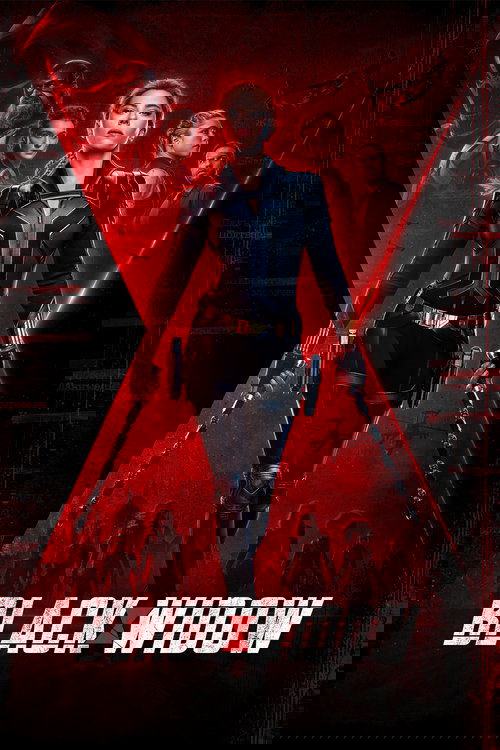
Black Widow
2021 · Cate Shortland
For when you want a big, satisfying action night that still has a heart — comfort viewing with fists, best with company and snacks. Also the one to reach for if you've ever wanted the quieter Avenger to finally get her due.
What it's about
Natasha Romanoff is between chapters of her life as an Avenger when her past as a Russian-made spy comes calling. A conspiracy tied to the Red Room — the program that trained her and countless other women as assassins — forces her back to the fake family she was planted with as a child in 1990s Ohio, including Yelena, the younger 'sister' she left behind. What follows is part globe-hopping espionage thriller, part awkward, bruised family reunion.
The experience
It moves like a spy movie more than a superhero one — brutal hand-to-hand fights, chases, safehouses — but the scenes that stick are the bickering family dinners, funny and sad at once. Punchy and fast, with a streak of real melancholy about the lives these women never got to have.
Performances
Florence Pugh walks off with the movie as Yelena — needling, deadpan, and quietly heartbroken — while Scarlett Johansson gets to play Natasha with more weariness and history than the ensemble films ever allowed her.
The craft
Cate Shortland grounds the spectacle in character, borrowing the texture of espionage thrillers — cold locations, close-quarters fights, a family of liars around a table. The action is muscular and legible, built for a big screen, but the film's best tool is letting scenes breathe long enough for the jokes and the hurt to land together.
Why it matters
A milestone for Marvel — the long-delayed solo film for its first female Avenger, directed by a woman, and the launchpad that made Florence Pugh's Yelena a fixture of the franchise going forward.
Snapshot
Black Widow is the standalone origin-adjacent feature Marvel Studios finally granted Natasha Romanoff after a decade in which the character served principally as an ensemble player across the Avengers and Captain America films. Directed by the Australian filmmaker Cate Shortland, it functions less as a conventional superhero picture than as an espionage thriller braided into a fractured-family drama: a sleeper-agent "family" in 1995 Ohio, the state-run Red Room that manufactured the Widows, and the adult reckoning of two synthetic sisters, Natasha (Scarlett Johansson) and Yelena Belova (Florence Pugh). Notably, the film is a prequel-in-the-timeline — set in the narrative gap after Captain America: Civil War (2016) and before Avengers: Infinity War (2018) — released after the character's death in Avengers: Endgame (2019). That structural fact colors everything about it: it is a valediction and a hand-off, arriving as both the first film of Marvel's "Phase Four" and, by circumstance, the most contested theatrical release of the pandemic era.
Industry & production
The project sat in development limbo for years; a Black Widow solo film had been discussed since roughly the first Avengers cycle, but Marvel's release calendar and internal priorities repeatedly deferred it. The film that emerged was greenlit in the wake of the character's cultural prominence and the broader industry pressure — visible after Wonder Woman (2017) and Captain Marvel (2019) — to foreground female-led tentpoles. Jac Schaeffer wrote an early draft and receives story credit alongside Ned Benson; Eric Pearson, a Marvel veteran (Thor: Ragnarok), took the screenplay. Kevin Feige produced under Marvel Studios, with Scarlett Johansson also credited as an executive producer, reflecting her long tenure and stake in the character.
The dominant industry story of Black Widow, however, is its release. Slated originally for spring 2020, it was postponed repeatedly as the COVID-19 pandemic closed theaters, becoming one of the most conspicuously delayed blockbusters. When Disney finally released it in July 2021, it did so day-and-date: simultaneously in theaters and on Disney+ via the paid "Premier Access" tier. That hybrid model precipitated a widely reported lawsuit in which Johansson alleged that the streaming release breached her contract by depressing the theatrical box-office receipts to which her compensation was tied. The dispute — which Disney and Johansson later settled — became a landmark flashpoint in Hollywood's negotiation of streaming-era talent deals and backend participation. Beyond the legal narrative, the film's commercial performance was genuinely difficult to read cleanly: a strong opening was followed by a steep second-weekend drop, variously attributed to the pandemic, the concurrent home availability, and piracy. I won't assign specific grosses here, but the qualitative record is that it opened powerfully for its moment yet fell off unusually fast.
Technology
Black Widow is a conventional large-scale Marvel production in its toolkit: principal photography on digital cinema cameras (the production was shot largely in the UK, at Pinewood and on location, with additional work in Norway, Hungary, and Morocco), supplemented by extensive visual-effects work for its aerial third act aboard the disintegrating Red Room facility. The VFX are workmanlike within the house style rather than a showcase innovation; the film's most ambitious sequence — a free-fall skydiving-through-debris climax — leans on the compositing and digital-environment pipelines standard to the franchise. Where the film is more interesting technologically is in what it declines to over-egg: much of the first two acts favor practical stunt work, vehicular chases, and close-quarters fights staged to read as grounded spycraft rather than energy-beam spectacle. I don't want to overstate specifics of the camera package, which are not something I can attest to with certainty; the safe statement is that it uses the industry-standard digital acquisition and VFX apparatus of a 2020s tentpole, deployed with a slightly more restrained, terrestrial ambition than most MCU entries.
Technique
Cinematography
Gabriel Beristain, the veteran cinematographer (Blade II, S.W.A.T., and extensive Marvel television work), shot the film. The visual grammar is deliberately closer to the contemporary spy thriller than to the primary-colored comic-book register: handheld and shoulder-mounted coverage in the fights, a cooler and grittier palette for the Budapest and Morocco material, and a bleached, melancholy quality in the 1995 Ohio prologue that reads as memory. The film opens with one of its strongest sustained images — the montage over the opening credits depicting girls trafficked into the Red Room — rendered in desaturated, near-monochrome tones that announce a darker thematic intent than the surrounding franchise. Across the picture the compositions favor legibility of action and faces over the kinetic incomprehensibility that mars some entries in the genre; the staging generally keeps the geography of a fight readable.
Editing
Cut by Leigh Folsom Boyd and Matthew Schmidt, the film adopts a structure that is more novelistic than most Marvel product: a lengthy, tonally distinct prologue; a mid-film reunion that slows to sustained dialogue and dark comedy around the "family" dinner table; and an accelerating action climax. The editing's central task is managing tonal whiplash — between trauma-drama, buddy comedy, and set-piece spectacle — and it largely succeeds in the character-driven middle while conforming to franchise rhythm in the finale. The credits-sequence montage is the most formally assured piece of cutting, using music and image to compress an appalling backstory into a few wordless minutes.
Mise-en-scène / staging
The production design opposes two spatial ideas: the counterfeit warmth of the Ohio home — suburban, autumnal, doomed — and the cold institutional geometry of the Red Room and its aerial fortress. In between are the transient safe-houses and vehicles of the fugitive spy. Costume and staging do considerable narrative work: Yelena's tactical vest becomes a running gag and a genuine emotional token; the "family" is re-costumed and re-assembled as a grim parody of domesticity. The Widows themselves are staged as interchangeable, chemically controlled bodies — a visual argument about the erasure of individual will.
Sound
Lorne Balfe composed the score, working in the propulsive, percussion-forward idiom he brought from the Hans Zimmer school (Mission: Impossible — Fallout). The music leans into espionage-thriller drive rather than triumphal superhero fanfare, which suits the film's register. The needle-drop of a somber cover of Nirvana's "Smells Like Teen Spirit" over the opening credits is the film's signature sonic gesture, retroactively framing the 1995-set trauma with a grunge-era elegy and setting a tone of mourning rather than heroism.
Performance
The performances are the film's most durable achievement. Johansson plays Natasha with a weary, valedictory gravity — this is a character being given, belatedly, an interior. But the film is effectively stolen by Florence Pugh as Yelena, whose blend of deadpan comedy, brittle rage, and genuine wounded feeling gives the picture its center of gravity and, not incidentally, launched a character Marvel would carry forward. David Harbour plays Alexei / Red Guardian as a run-to-seed Soviet super-soldier, mining pathos and buffoonery in equal measure, and Rachel Weisz brings a cool ambiguity to Melina. Ray Winstone's Dreykov is a functional, somewhat thinly written villain; the film's antagonist energy lives more in the concept of the Red Room than in any single performance.
Narrative & dramatic mode
The dramatic mode is the espionage thriller crossed with the reunion melodrama. Its true subject is not a mission but a family that never existed — a cover assignment that nonetheless left real attachments in its four members. The plot engine (destroy Dreykov, free the Widows from chemical control) is serviceable genre scaffolding; the film's felt content is the negotiation between Natasha and Yelena over what their shared, fabricated childhood meant. This gives the picture a two-hander intimacy unusual for the franchise. Because it is a prequel to a known death, the mode is also elegiac: the audience watches a character work toward reconciliation and agency knowing the ledger will close in Endgame.
Genre & cycle
Black Widow sits at the intersection of the superhero cycle and the post-Bourne spy thriller. Its clearest generic cousins are the Bourne films and the Mission: Impossible series — grounded, globe-trotting, hand-to-hand espionage — rather than the cosmic register Marvel had drifted toward. Within the superhero cycle, it belongs to the sub-strand of "grounded/street-level" entries and to the belated wave of female-led comic-book tentpoles. It is also a franchise-hygiene artifact: a "gap-filler" prequel designed to service continuity and, crucially, to introduce a successor character (Yelena) into the ongoing serial.
Authorship & method
The most consequential authorial choice was hiring Cate Shortland. Her prior features — Somersault (2004), Lore (2012), and Berlin Syndrome (2017) — are intimate, female-centered studies of trauma, coercion, and young women navigating hostile circumstances, several shot in a naturalistic European-arthouse idiom. Reportedly recommended in part by Johansson, Shortland was an unusual choice for a tentpole, and the film's DNA shows the graft: the interest in coerced girlhood, in the psychology of survival, and in performance over spectacle is legibly hers, even as the third act reverts to franchise machinery. The tension in the film — and much of the critical conversation around it — is precisely this negotiation between an auteur of small, sharp trauma dramas and the demands of the Marvel apparatus.
Her key collaborators reinforce the register: cinematographer Gabriel Beristain (grounded, thriller-inflected imagery), composer Lorne Balfe (propulsive espionage scoring), editors Leigh Folsom Boyd and Matthew Schmidt (tonal management across drama and set-piece), and screenwriter Eric Pearson (working from a story with Jac Schaeffer and Ned Benson). Schaeffer's involvement is worth flagging as part of a broader authorial current: she went on to define Marvel's more formally adventurous television work (WandaVision), and the character-first, trauma-aware sensibility is shared across that lineage.
Movement / national cinema
The film has no movement affiliation in the strict sense — it is a Hollywood studio franchise product. But its authorship imports a strain of Australian and European art cinema: Shortland is a product of the Australian film culture that also produced Jane Campion and the broader tradition of female-directed intimate realism, and her earlier work engaged directly with European history (Lore is set in post-war Germany). Black Widow is thus a minor but real instance of the "arthouse director absorbed by the tentpole" phenomenon — the same industrial pattern that took Chloé Zhao (Eternals), Taika Waititi, and Ryan Coogler into Marvel. Its production is transnational in the ordinary blockbuster way (UK studios, European and North African locations, an American studio).
Era / period
Black Widow is doubly period-marked. Diegetically it reaches back to a 1995 Cold-War-hangover imaginary — Soviet super-soldiers, sleeper families, grunge on the soundtrack — that trades on post-Soviet iconography for its villainy and its melancholy. Industrially it is a pure artifact of the 2020–2021 pandemic rupture: conceived for one release paradigm and delivered into another. It marks the transition from Marvel's "Infinity Saga" to a more diffuse, streaming-integrated "Phase Four," in which theatrical features and Disney+ series became a single serialized fabric. The film's own post-credits scene — Yelena directed toward a revenge plot that pays off in the Hawkeye series — is the clearest sign of that new, TV-braided era.
Themes
The film's governing theme is the weaponization and reclamation of women's bodies and wills. The Red Room is an explicit metaphor: girls trafficked, sterilized, and chemically deprived of choice, turned into disposable instruments of a patriarchal state embodied by Dreykov. Against this the film sets the possibility of chosen family and recovered agency — Natasha and Yelena's bond, and the liberation of the enslaved Widows, is framed as the undoing of coercive control. Secondary themes include the ledger of guilt Natasha carries (her "red in my ledger," seeded across earlier films), the falseness and residual truth of performed intimacy, and generational succession — an older heroine consciously making room for a younger one. The film's feminism is legible and sincere, if constrained by the requirement to resolve in spectacle.
Reception, canon & influence
Critical reception was broadly positive but qualified. Reviewers consistently praised Pugh (and often Harbor), the character-driven middle stretch, and Shortland's attempt to import a grittier, more intimate register; the common reservations were a formulaic villain and a third act that surrenders the film's distinctive texture to standard-issue franchise climax. The dominant reservation in the broader discourse was one of timing: many critics noted the melancholy of a solo film arriving after its heroine's death, a hand-off more than an origin.
Its influences run backward to the post-Bourne spy thriller and the Mission: Impossible action idiom, to Cold-War espionage iconography, and — through Shortland — to a lineage of intimate trauma dramas about coerced young women. Forward, its most concrete legacy is Yelena Belova: Florence Pugh's character graduated immediately into the Hawkeye series and subsequent Marvel projects, making Black Widow function, in retrospect, as a launch vehicle. Its second, arguably larger legacy is industrial: the Johansson lawsuit became a defining precedent in the fight over streaming-era backend compensation, cited across trade coverage and talent negotiations, and it accelerated Hollywood's move away from unqualified day-and-date releasing. In the canon of superhero cinema the film is likely to be remembered less as a formal landmark than as a hinge — the elegiac close of one character's arc, the introduction of her successor, and the legal and industrial case study that clarified what a "theatrical release" would mean in the streaming age.
A Deleuzian reading
Before anyone in *Black Widow* speaks, a line of girls is being moved into the Red Room.
The full Deleuzian reading of Black Widow →
Reception
Landed in summer 2021 to a shrug — solid-enough reviews but a loud chorus of 'ten years too late,' arriving after the character's story had already ended in Endgame. It's since been reframed less as Natasha's send-off than as the start of Marvel's post-Endgame drift — and, more warmly, as the film that launched Florence Pugh's Yelena.
How Black Widow was received, from release to now →
How to watch Black Widow: what to notice on a first viewing
- Watch the opening credits and try to tell the girls apart. A few wordless minutes carry the whole Red Room backstory in near-monochrome, under a slow cover of Smells Like Teen Spirit. The girls are processed in lines and the cutting keeps them interchangeable on purpose. It is the most assured sequence in the film, and it sets the job for everything after: get two faces out of that mass.
- Notice how drained of color the 1995 Ohio scenes look. Gabriel Beristain bleaches the suburban prologue into autumnal melancholy and keeps Budapest and Morocco cool and gritty. Nothing in the picture uses the primary-color register the franchise usually runs on. The look tells you this is a spy film with a memory problem rather than a comic-book adventure.
- Watch the fights cut on impact instead of on a pose. Beristain shoots hand to hand with handheld, shoulder-mounted coverage in the grammar the Bourne films established. Geography stays readable, but the camera samples ordinary moments of a fight rather than holding a silhouette. Superhero films are built on the held pose. This one runs verite impact cutting through the genre most dependent on it.
- Watch how often Yelena mentions her vest. It starts as a joke about pockets and keeps coming back as something Yelena fusses over. A garment carries a feeling nobody states: an assigned family produced attachments nobody meant to produce.
- Watch Pugh deliver a joke and a wound in one line. She plays Yelena deadpan, brittle and genuinely hurt, often inside the same sentence. Johansson plays Natasha weary and valedictory. The film's weight keeps sliding toward the younger sister. Marvel gave a character being written out one last film and a successor walked off with it.
The whole guide to watching Black Widow, with the keys for a rewatch →
Influences: the films it descends from and the films it influenced
- The Bourne Ultimatum (2007) — Its handheld, fragmented hand-to-hand combat cut on impact rather than on clean masters supplies the Greengrass/Christopher Rouse verité-action grammar that Beristain's camera and the film's close-quarters fights directly inherit.
- Mission: Impossible – Fallout (2018) — The escalating practical-stunt set-pieces and sustained vehicular pursuit choreography follow the M:I method of stacking real, physically grounded spectacle into one continuous chase, an idiom Black Widow explicitly stages for its Budapest and prison-break sequences.
- Somersault (2004) — Shortland's debut established the tactile, skin-close naturalism and study of a young woman's coerced sexuality that she grafts onto the family-melodrama middle stretch.
- Lore (2012) — Its post-Reich portrait of a girl marched through hostile territory, shot in desaturated available light with handheld intimacy, is the direct stylistic template for Black Widow's naturalistic, performance-over-spectacle register.
- Berlin Syndrome (2017) — Shortland's captivity thriller rehearses the psychology of coercion, control, and survival under a manipulative captor-institution that resurfaces as Dreykov and the Red Room.
- Hanna (2011) — Its engineered girl-assassin raised as a state weapon and scored with propulsive electronic percussion (Chemical Brothers) prefigures both the weaponized-female-body premise and Balfe's percussion-forward espionage scoring.
- La Femme Nikita (1990) — The foundational template of a woman conscripted and remade into a state assassin against her will — the coerced-female-operative genre from which the Red Room backstory descends.
- Captain America: The Winter Soldier (2014) — It established the MCU's grounded 1970s-conspiracy spy register and Natasha's espionage characterization, the in-house genre grammar and continuity Black Widow directly extends.
- Casino Royale (2006) — Its post-Bourne reboot of Bond into a grittier, physically grounded, emotionally wounded espionage register is the genre reorientation the film's spy-thriller texture inherits.
- Hawkeye (2021) — Yelena Belova graduates directly from this film into the series, confirming Black Widow as a launch vehicle whose comic-melancholic Pugh register and chosen-family throughline carry forward.
- Thunderbolts* (2025) — It carries Yelena's grief-inflected interiority and Black Widow's melancholy, chosen-family-over-spectacle register into an ensemble, directly continuing the emotional throughline Shortland seeded.
- Salt (2010) — A female sleeper-agent thriller built on the same post-Soviet Cold-War iconography and the doubling of institutional handler against personal loyalty that structures Natasha's defection.
- Red Sparrow (2018) — Its literal Russian 'Sparrow' program that trains women's bodies into intelligence weapons is the closest contemporary sibling to the Red Room's weaponized-female-body conceit.
- Atomic Blonde (2017) — A Cold-War-set female-spy thriller constructed around brutal long-take handheld fights and a wall-to-wall period needle-drop soundtrack — the sibling template for Black Widow's own diegetic needle-drops.
- The Americans (2013) — Its premise of Soviet operatives performing an all-American nuclear family — the mission masquerading as domestic life — is the exact institutional-vs-domestic template for the Ohio prologue's fabricated family.
- WandaVision (2021) — Sharing story writer Jac Schaeffer, it extends the same trauma-aware, character-first, formally adventurous sensibility into Marvel's television, a parallel branch of the same authorial current.
Similar films
- Thunderbolts* (2025) — influence & lineage
- Captain America: The Winter Soldier (2014) — influence & lineage
- Avengers: Endgame (2019) — shared sensibility
- The Avengers (2012) — shared sensibility
- Iron Man 2 (2010) — shared sensibility
- Spider-Man: No Way Home (2021) — shared sensibility
- Black Panther (2018) — shared sensibility
- Avengers: Infinity War (2018) — shared sensibility