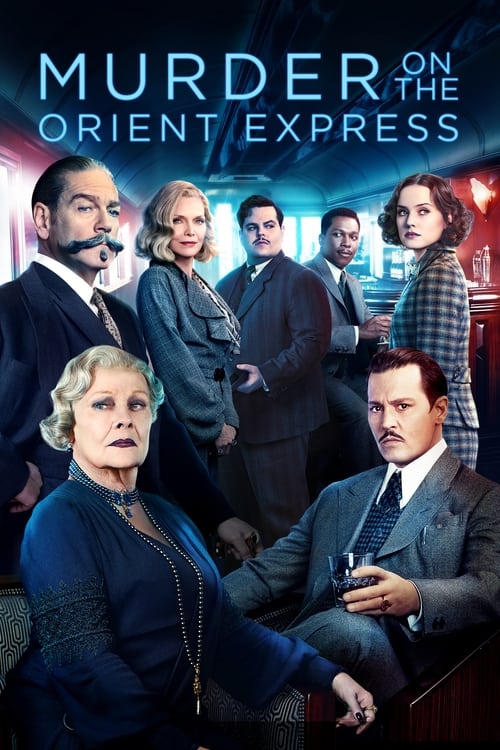
Murder on the Orient Express
2017 · Kenneth Branagh
For a snowy Sunday afternoon when you want glamour, a locked-room puzzle, and zero stress — the cinematic equivalent of a good hardcover mystery and a pot of tea. Pure comfort viewing.
What it's about
Hercule Poirot, the fastidious Belgian detective, boards the Orient Express hoping for a quiet ride across Europe — until a snowdrift strands the train in the mountains and a wealthy American passenger is found stabbed in his sleeping compartment. Every elegant passenger aboard has an alibi, which means one of them is lying, and Poirot has until the tracks are cleared to work out who.
The experience
A plush, old-fashioned whodunit that moves like the train itself — stately, handsome, and comfortable, with an ensemble of famous faces taking turns under interrogation. It's cozy-mystery pleasure with a surprisingly mournful streak by the end.
Performances
Kenneth Branagh has visible fun as Poirot, all magnificent mustache and wounded precision, while Michelle Pfeiffer stands out from a stacked ensemble that includes Judi Dench, Willem Dafoe, and Penélope Cruz.
The craft
Branagh directs with unabashed lavishness — sweeping snowbound vistas, gliding camera moves along the train's corridors, and a production design that makes the Express itself the star. Shot on 65mm, it's built for the biggest screen you can find.
Why it matters
Its box-office success revived Agatha Christie as a theatrical franchise, launching a new series of star-studded Poirot films with Branagh at the helm.
Snapshot
Kenneth Branagh's Murder on the Orient Express is a lavish, star-laden return of Agatha Christie's most famous detective to the big screen — the first major theatrical Poirot since Sidney Lumet's 1974 version. Adapted by Michael Green from Christie's 1934 novel, the film places Branagh himself behind and in front of the camera as Hercule Poirot, fronting an ensemble cast that includes Penélope Cruz, Willem Dafoe, Judi Dench, Johnny Depp, Michelle Pfeiffer, Daisy Ridley, Josh Gad, Leslie Odom Jr. and Derek Jacobi. The premise is among the most recognizable in detective fiction: a wealthy American passenger is found stabbed in a sleeping car after the train is stranded by a snowdrift in the Balkans, and Poirot must determine which of the dozen-odd passengers — all of whom appear to have alibis — is the killer. Released by 20th Century Fox in November 2017, the picture was conceived as the launch of a renewed Christie franchise; its commercial success duly produced Death on the Nile (2022) and A Haunting in Venice (2023). It is best understood not as a reinvention of the material but as a deliberately old-fashioned, handsomely upholstered piece of mainstream studio classicism, distinguished by its widescreen 65mm photography, its emphasis on movie-star faces, and Branagh's idiosyncratic, mustache-forward conception of Poirot.
Industry & production
The film emerged from 20th Century Fox's interest in reviving recognizable, IP-driven properties with built-in name recognition — Christie being one of the most adapted authors in the world. The Christie estate, through Agatha Christie Limited (in which the family and, since 2012, a controlling stake held by a media investor have an interest), granted the rights, and the production was mounted by Fox with Branagh's own Mammoth Screen and Scott Free–adjacent partners among the producing entities; Ridley Scott, Mark Gordon, Simon Kinberg, Judy Hofflund and Branagh are credited among the producers. The headline strategy was the assembly of a "constellation" cast in the tradition of Lumet's 1974 film, which had itself won Ingrid Bergman an Academy Award and demonstrated that an all-star Christie could be a prestige event. Branagh, an actor-director with deep theatrical roots and prior experience steering large studio machines (Thor, Cinderella), was a logical choice to wrangle an ensemble of this size.
Principal photography took place largely in England, with interiors and much of the train constructed at Longcross Studios in Surrey, where a working, articulated set of the Orient Express carriages was built so that the camera could move through the cramped corridors and compartments. Exterior and landscape material was gathered in New Zealand to stand in for the mountainous, snowbound Balkan pass. The production made a point — in its own publicity — of building a physical train rather than relying wholly on digital sets, in keeping with the film's tactile, period-craft sensibility. Exact budget and box-office figures should be checked against trade sources rather than asserted here; what is well established is that the film performed strongly enough worldwide to greenlight sequels, with much of its return coming from international markets where Christie's brand is exceptionally durable.
Technology
The most consequential technical decision was to shoot on 65mm film. Cinematographer Haris Zambarloukos and Branagh photographed the picture using large-format film stock, a choice that aligns the project with a small contemporary movement of filmmakers returning to 65mm for its resolution, tonal latitude and sheer optical "presence." The format is somewhat counterintuitive for a story set largely inside a narrow railway carriage, and the film's visual interest lies partly in that tension: an enormous capture format trained on confined spaces and faces. The large negative renders the period production design — brass, lacquer, velvet, snow — with a richness that smaller formats would not match, and gives close-ups of the star ensemble a creamy depth. Visual effects, supervised through major houses, were used to extend the mountain landscapes, build the snowdrift and avalanche set-piece, and seamlessly join the New Zealand exteriors to the studio-built train. The effects are mostly invisible by design, serving the period illusion rather than spectacle; the film's "technology story" is fundamentally about old-format photographic luxury rather than digital novelty.
Technique
Cinematography
Zambarloukos's photography is the film's most discussed formal element. Working within the inherently claustrophobic geometry of a train, the camera repeatedly seeks ways to open the space up or to comment on the entrapment. An early, much-noted choice has the murder's immediate aftermath observed from directly overhead, the camera craning down the length of the corridor and looking into the compartments from above — a God's-eye geometry that turns the carriage into a diagram of suspects, and that visually externalizes Poirot's ordering intelligence. Elsewhere the film uses long lateral tracking moves along the corridor, reflections in windows and glass, and compositions that shoot through doorways and partitions to keep multiple characters in frame within tight quarters. The 65mm frame and shallow focus are used to isolate faces against the plush, slightly unreal backgrounds. The exterior sequences — Istanbul at the opening, the viaduct where the train halts — are staged for postcard grandeur, a deliberate contrast with the hothouse interiors.
Editing
Mick Audsley's editing manages the perennial structural problem of this story: a long middle stretch that is, by design, a sequence of one-on-one interviews. The film paces these interrogations to keep faces and reactions foregrounded, intercutting Poirot's observations with the passengers' guarded responses, and occasionally breaking the talk with movement — Poirot pacing the snow, the train's mechanical business, flashes of the backstory crime. The cutting works to sustain momentum across what is essentially a chamber piece, and to marshal the large cast so that each star registers without the ensemble blurring. The climactic revelation, staged unusually (see below), is edited to let the full company share the frame.
Mise-en-scène / staging
Production designer Jim Clay and costume designer Alexandra Byrne (a long-time Branagh collaborator) build a world of 1930s luxury travel — marquetry, etched glass, monogrammed linens, fur and tailoring — that is both authentic in spirit and heightened toward the romantic. The standout staging choice is Branagh's decision to reframe the novel's denouement. Rather than confine the final accusation to a compartment, he stages the assembled suspects in a row outside the train, seated at a long table in the mouth of a tunnel — a tableau explicitly evoking Leonardo's Last Supper, with Poirot as the figure pacing before them. This theatrical, almost liturgical staging makes literal the film's interest in judgment, communion and shared guilt, and is the clearest fingerprint of Branagh's stage-derived sensibility.
Sound
Patrick Doyle's score — Doyle being Branagh's most enduring artistic partner, dating to Henry V (1989) — supplies a lush, melancholy orchestral idiom that leans into the romance and tragedy beneath the puzzle rather than playing the material as brisk parlor game. The film's sound design exploits the textures of steam-era rail travel: the rhythm of wheels on track, the hiss and clank of the engine, the muffled hush of the snowbound halt. Michelle Pfeiffer performs the end-credits song "Never Forget," written by Doyle with lyrics, foregrounding the film's elegiac register. The specific authorship details of the song should be confirmed against the credits, but its function — to send the audience out on a note of sorrow rather than triumph — is unmistakable.
Performance
The film is, above all, a performance showcase, and the performances pull in two directions. Branagh's Poirot is the organizing creation: fastidious to the point of comedy (the famous business with matched eggs), defined by an enormous, elaborately groomed two-tiered mustache that became the film's signature image, and given a new layer of inner wounding — a backstory of lost love and a near-religious commitment to moral order that the case will fracture. Around him the ensemble works in the older mode of star turns: Pfeiffer's brittle, flirtatious widow; Dench's imperious princess; Dafoe's prickly passenger; Cruz's devout missionary; Depp's oily, doomed Ratchett; Leslie Odom Jr. and Daisy Ridley as the young couple under suspicion. With so many actors and limited screen time each, the performances are necessarily compressed into vivid single notes; the film trades psychological depth across the suspects for the pleasure of recognizable faces inhabiting types.
Narrative & dramatic mode
Structurally the film is a closed-circle "whodunit" of the purest kind — the form Christie did more than anyone to codify. The narrative contracts the world to a single stranded train and a finite set of suspects, then proceeds through the classical detective rhythm: discovery of the body, establishment of the impossible situation (no one could have left, yet someone did the deed), serial interrogation, accumulation of contradictory clues, and a summation in which the detective reorders the fragments into a solution. What distinguishes this particular story — and the film honors it — is the famous twist on the form, in which the solution overturns the genre's usual moral economy: the puzzle's answer implicates not one guilty party against the innocent many, but a collective, and forces the detective to choose between the letter of justice and a harder equity. Branagh's adaptation foregrounds this ethical turn more heavily than Lumet's, building Poirot's crisis of conscience into the film's emotional spine and recasting the denouement from intellectual triumph into moral anguish.
Genre & cycle
The film sits at the confluence of the detective film, the "prestige literary adaptation," and the ensemble star vehicle. Its most direct generic ancestor is the cycle of glossy all-star Christie adaptations launched by Lumet's Murder on the Orient Express (1974) and continued through Death on the Nile (1978) and Evil Under the Sun (1982). More broadly it belongs to the perennial screen tradition of the closed-circle mystery. Its commercial success arrived alongside, and helped reinforce, a late-2010s revival of the studio whodunit as theatrical event — a current that Rian Johnson's Knives Out (2019) would crystallize a couple of years later, albeit in a more satirical, contemporary key. Branagh's own film spawned its own mini-cycle: Death on the Nile (2022) and A Haunting in Venice (2023), the latter loosely adapting Hallowe'en Party and tilting the series toward gothic horror.
Authorship & method
The film is unmistakably a Branagh production, and reading it through his career is illuminating. Branagh's directorial signature has always been theatrical — large casts, declamatory set-pieces, an appetite for spectacle married to classical text — and his method here is to treat Christie as he might treat a Shakespeare or a well-made play: as a vehicle for ensemble acting and for bravura staging. His most important collaborators are long-standing partners. Patrick Doyle has scored the great majority of Branagh's films since Henry V; cinematographer Haris Zambarloukos has shot many of them (Sleuth, Thor, Cinderella); costume designer Alexandra Byrne has dressed his work repeatedly and won an Oscar for his Elizabeth: The Golden Age (as director Shekhar Kapur's collaborator) — within the Branagh circle she is a fixture. Editor Mick Audsley brought a heavyweight pedigree in narrative cinema. Screenwriter Michael Green, coming off Logan and Blade Runner 2049, was tasked with compressing Christie's plot, redistributing the suspects' material across a manageable runtime, and — crucially — deepening Poirot's interiority, giving him the lost-love backstory and the philosophical preoccupation with balance and order that frame the film. The collaborative method, then, is one of trusted repertory: Branagh surrounds himself with artists he has worked with for decades and applies a stage-director's ensemble discipline to a studio blockbuster.
Movement / national cinema
The film resists easy placement in any movement; it is a transnational studio product, American-financed (20th Century Fox) but British-made in its key creative personnel and its sensibility. It belongs to a strand of British-inflected, heritage-adjacent filmmaking — the prestige period adaptation — that has long been an export strength of UK production, drawing on the country's deep benches of theatrically trained actors and craft technicians. Branagh's whole career has been a negotiation between this British classical tradition and Hollywood scale, and Orient Express is a near-perfect emblem of that negotiation: a Hollywood franchise launch executed with the cast, crew and cultural register of British heritage cinema.
Era / period
The film is doubly period: made in 2017, set in 1934. Its production context is the late-2010s studio environment of risk-averse, IP-driven greenlighting, in which a known author's brand and an all-star cast were seen as hedges against uncertainty — and in which the theatrical mid-budget adult drama was increasingly squeezed, making the "event" framing of a star ensemble strategically important. Its depicted era, the interwar 1930s, is rendered with nostalgic luxury: the Orient Express as a symbol of a vanishing cosmopolitan Europe, glamorous and doomed, with the Armstrong kidnapping backstory (Christie's transposition of the real Lindbergh case) anchoring the plot in the anxieties of its time. The film leans into the period as romance — the golden age of rail, of tailoring, of the gentleman detective — even as its story interrogates the justice of that world.
Themes
Beneath the puzzle, the film's governing theme is the relationship between justice and order. Branagh's Poirot is conceived as a man who needs the world to balance — symbolized by his compulsion for symmetry, his matched eggs, his straightened tie — and the case confronts him with a crime that cannot be resolved without unbalancing his moral universe. The film thus dramatizes the gap between law and justice, the legitimacy of collective vengeance against an unpunished evil, and the cost to the person who must adjudicate it. Secondary themes include grief and its long aftermath (the entire plot is an architecture of mourning for a murdered child), the performance of identity (every passenger is, in some sense, in disguise), and community versus isolation — the lone, exiled detective set against a group bound by shared loss. Branagh's Last Supper staging makes the film's interest in guilt, communion and judgment explicit, lending the closed-room mystery an almost sacramental dimension.
Reception, canon & influence
Critical reception was decidedly mixed-to-lukewarm. Reviewers broadly admired the production's craft — the 65mm photography, the costumes and design, the sheer handsomeness — and many singled out Branagh's committed, eccentric Poirot and the pleasure of the assembled cast. The recurring reservation was that the film, for all its surface luxury, felt inert or over-reverent: a competent, glossy retelling that struggled to justify itself against Lumet's well-loved 1974 version, and that gave its many stars too little to do. The Last Supper finale and the deepened, more anguished Poirot drew both praise (for ambition) and skepticism (for tonal overreach). Audiences were warmer than critics, and the film's commercial performance — substantially driven by international markets — was strong enough to sustain the franchise. (Specific scores, grosses and award tallies should be verified against trade and aggregator sources rather than asserted from memory.)
The influences on the film run backward through a clear lineage: Christie's 1934 novel above all; Lumet's 1974 adaptation as the template for the all-star Christie event; and Branagh's own theatrical and Shakespearean practice, which shapes the staging and the ensemble method. Its legacy forward is concrete and twofold. First, it relaunched a viable Poirot/Christie film franchise, directly producing Death on the Nile (2022) and A Haunting in Venice (2023), with Branagh continuing as star-director and the series progressively darkening in tone. Second, it formed part of — and helped demonstrate the commercial appetite for — the broader late-2010s revival of the theatrical whodunit, a current most vividly realized in Rian Johnson's Knives Out (2019) and its sequels, which answered Branagh's reverent classicism with contemporary satire. Whether Orient Express shaped Knives Out directly is not a documented claim and should not be overstated; what is fair to say is that both belong to, and helped sustain, the same renewed mainstream interest in the form. In the long view, Branagh's film is likely to be remembered less as a definitive Orient Express than as the handsome, divisive launch of a durable modern Poirot series — and as a notable late example of a major studio betting on movie stars, film stock and a ninety-year-old plot.
A Deleuzian reading
The camera lifts.
The full Deleuzian reading of Murder on the Orient Express →
Reception
Critics shrugged in 2017 (mixed reviews, lots of '1974 did it better'), but audiences turned it into a $350M+ hit — big enough to launch a whole Branagh-Poirot trilogy. It's since settled into 'cozy Sunday whodunit' status, and gets partial credit for warming the seat for the star-studded murder-mystery revival that Knives Out cashed in two years later.
How Murder on the Orient Express was received, from release to now →
Influences: the films it descends from and the films it influenced
- Murder on the Orient Express (1974) — Defined the all-star single-set Christie event as a chain of one-on-one suspect interrogations; Branagh inherits this closed-circle interrogation pacing and ensemble-casting architecture wholesale.
- Death on the Nile (1978) — Established the exotic-location, glamorous period-design Christie picture built around a mannered marquee Poirot (Ustinov), the luxury-travel template Branagh's framing and production design directly extend.
- Evil Under the Sun (1982) — Modeled Anthony Shaffer's compression of a sprawling suspect roster into screen-manageable ensemble set-pieces, the same redistribution problem Michael Green's adaptation solves.
- Henry V (1989) — Launched the Branagh–Patrick Doyle scoring partnership and his stage-trained declamatory direction of large casts, the ensemble method transplanted onto Christie here.
- Gosford Park (2001) — A period country-house closed-circle murder whose vast star ensemble is choreographed through overlapping group staging — the upstairs-downstairs whodunit blocking Branagh echoes.
- Sleuth (2007) — Established the Branagh–Haris Zambarloukos cinematography partnership inside a confined chamber mystery of two-hander gamesmanship and prowling camera moves.
- Cinderella (2015) — Reunited Branagh with Zambarloukos and costume designer Alexandra Byrne on saturated storybook period design and opulent costume spectacle, the visual luxury carried into the train.
- Lawrence of Arabia (1962) — The British large-format prestige epic whose 65/70mm photographic grandeur Branagh consciously revives by shooting Orient Express on 65mm film.
- Death on the Nile (2022) — Direct franchise continuation with the same repertory crew, deepening the lost-love Poirot interiority Green introduced and repeating the closed-circle-aboard-a-vessel structure.
- A Haunting in Venice (2023) — Pushes the series' tonal darkening into gothic horror, extending the anguished, philosophically burdened Poirot and the shooting-through-doorways/canted spatial play.
- Knives Out (2019) — Answered the prestige whodunit revival with a contemporary star-ensemble closed-circle mystery driven by the same sequential-interrogation engine, but satirical rather than reverent.
- Glass Onion (2022) — Cemented the star-ensemble closed-circle whodunit as a recurring marquee franchise — the durable commercial form Branagh's film helped demonstrate appetite for.
- See How They Run (2022) — A meta theatrical whodunit explicitly riding the late-2010s revival of the Christie-style closed-circle mystery that Orient Express helped reignite.
- The Remains of the Day (1993) — Merchant-Ivory's British heritage register — period-luxury production design and restrained ensemble interiority — supplies the prestige-adaptation grammar Branagh works within.
- Anna Karenina (2012) — A canonical literary adaptation staged with overt theatrical, proscenium artifice within British heritage cinema — the stage-director's framing of a classic Branagh shares.
- The Hateful Eight (2015) — A contemporaneous revival of 65mm large-format stock (Ultra Panavision 70) deployed for a single-confined-location whodunit of trapped, mutually suspicious suspects.
- Wake Up Dead Man: A Knives Out Mystery (2025) — The modern large-format (65mm) star-vehicle Christie revival that, like the Blanc films, rebuilds the ensemble whodunit as a prestige theatrical event driven by a single showcased detective.
Similar films
- Murder on the Orient Express (1974) — influence & lineage
- Knives Out (2019) — influence & lineage
- The Hateful Eight (2015) — influence & lineage
- Strangers on a Train (1951) — shared sensibility
- Nosferatu (2024) — shared sensibility
- Enola Holmes (2020) — shared sensibility
- Wake Up Dead Man: A Knives Out Mystery (2025) — shared sensibility
- The Lady Vanishes (1938) — shared sensibility