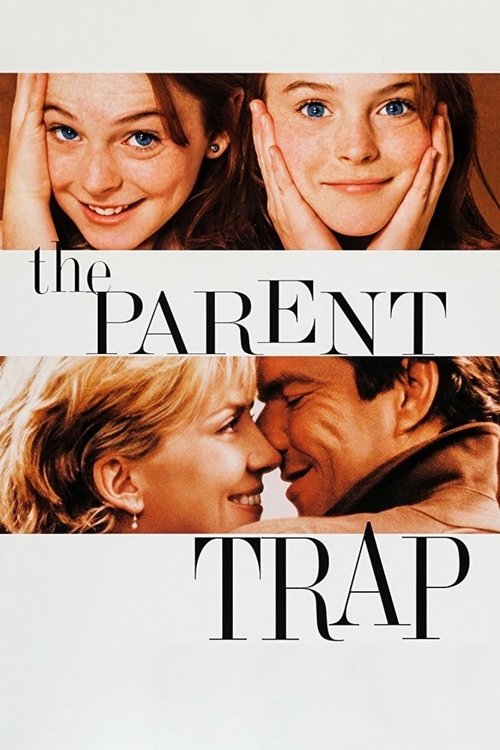
The Parent Trap
1998 · Nancy Meyers
Peak comfort viewing — for a rainy Sunday, a family movie night, or when you want to revisit the exact feeling of being eleven and believing a good enough plan can fix anything. Zero challenge, all pleasure.
What it's about
Identical twins Hallie and Annie — one raised on a Napa vineyard with their dad, one in London with their mom — meet by chance at summer camp with no idea the other exists. Once they figure out the truth, they swap lives, each crossing an ocean to meet the parent she's never known, and hatch a scheme to get their divorced parents back in the same room. A gold-digging fiancée complicates the plan.
The experience
Sunny, generous, and effortlessly charming — a classic caper engine running on camp pranks, accents, and elaborate schemes, paced with an unhurried warmth that lets you live in its world. It's the kind of family movie that makes everything look delicious.
Performances
Eleven-year-old Lindsay Lohan plays both twins — different accents, postures, and temperaments, often acting opposite herself — in one of the most impressive child-star debuts of its era. Natasha Richardson brings unexpected grace and feeling to the mom, and Dennis Quaid is easy, rumpled charm as the dad.
The craft
Nancy Meyers's directing debut, and her signature is already everywhere: gorgeous houses, sun-drenched Napa vineyards and London townhouses, and a novelistic patience unusual for a family comedy. The twin effects still hold up, seamless enough that you forget one girl is playing two.
Why it matters
It launched Lindsay Lohan, started Nancy Meyers's run as a director, and became the rare remake a generation embraced as its own definitive version.
Snapshot
Nancy Meyers's directorial debut is a remake twice removed: Disney's 1998 The Parent Trap reworks David Swift's 1961 studio hit, which in turn adapted Erich Kästner's 1949 children's novel Das doppelte Lottchen. Meyers, who had spent nearly two decades as a writer-producer in partnership with Charles Shyer, took the director's chair at a moment when Disney was systematically mining its own live-action back catalog. What she delivered was less a nostalgia exercise than a recalibration: the same farce engine — separated twins, a summer camp, an impersonation plot, a remarriage — retooled for a transatlantic, upper-bourgeois world of Napa vineyards and London townhouses, and paced at an unusual, almost novelistic length for a family comedy (roughly two hours and eight minutes).
The film introduced Lindsay Lohan, then eleven, in a dual role, and paired her with Dennis Quaid and Natasha Richardson as the sundered parents. It performed solidly rather than spectacularly in North America — a domestic gross in the neighborhood of $66 million against a mid-range budget — and then did what many Disney family titles of the era did: it accumulated a much larger second life on video, cable, and eventually streaming, where it became a durable object of affection for a generation that encountered it long after 1998.
Industry & production
The film sits precisely inside Disney's late-Eisner live-action strategy. Through the mid-to-late 1990s, under studio chief Joe Roth, Disney recycled its own library with a regularity that amounted to a production line: 101 Dalmatians (1996), That Darn Cat (1997), Flubber (1997), Mighty Joe Young (1998), Inspector Gadget (1999). The logic was sound — pre-sold titles, four-quadrant appeal, low star cost, and merchandising and home-video tails that dwarfed theatrical returns. The Parent Trap was among the more artistically ambitious entries in that cycle, largely because of who was handed it.
Meyers and Shyer had been one of the most commercially reliable writing-producing teams in Hollywood comedy since Private Benjamin (1980), which earned them an Academy Award nomination for original screenplay, through Irreconcilable Differences (1984), Baby Boom (1987), and the two Father of the Bride films (1991, 1995). Shyer had directed most of those; Meyers had written and produced. The Parent Trap inverted the arrangement — Meyers directed, and shares screenplay credit with Shyer (with David Swift credited for the 1961 screenplay). It was effectively the end of the partnership; the couple's professional and personal collaboration dissolved shortly afterward. That biographical fact is not incidental to a film about a marriage that ends and the children who try to reassemble it, though the film's development predates the split and the parallel should be drawn lightly rather than pressed.
The production was genuinely bi-continental. The Napa Valley material was shot in wine country — the Parker vineyard exteriors used the Staglin Family Vineyard in Rutherford — and the James household material was shot on London locations and stages. The camp sequences, though set at a fictional Camp Walden in Maine, were photographed in California. The result is a film with two distinct geographic registers, which the production design and photography exploit systematically.
Casting is where the remake's cleverest institutional gesture sits: Joanna Barnes, who played the gold-digging Vicky Robinson in the 1961 film, returns here as Vicki Blake, mother of the new gold-digger, Meredith Blake. It is a nod that works both as fan service and as a small joke about heredity — the film's actual subject.
Technology
The Parent Trap is, at bottom, a twinning-effects picture, and both versions are useful markers of where the technology stood.
The 1961 film relied on the classic toolkit: locked-off split-screen, matte work overseen by Disney's special-processes veterans (Ub Iwerks was the studio's authority on such compositing at the time), and a physical double for Hayley Mills in over-the-shoulder and rear-facing setups. The constraint is visible in the staging — the camera tends to hold still when both girls share a frame, and the twins rarely cross the seam.
By 1998, two things had changed. Motion-control camera systems allowed a move to be repeated with mechanical precision across passes, so the camera could dolly or crane while both halves of a split were captured. And digital compositing — commercially mature after the mid-1990s — allowed the seam to be soft, curved, animated, and hidden behind foreground elements rather than sitting as a hard vertical line. The film exploits this: the twins hug, hand objects to each other, pass in front of one another. A body double performed opposite Lohan for eyelines and physical business, with Lohan's own reverse-angle performance composited in. Reports from the production describe playback of Lohan's recorded dialogue being used to cue the double's timing; the specifics of the on-set methodology are thinly documented and should not be overstated.
What matters cinematically is that the technology stopped dictating the blocking. Meyers can stage a two-shot of the same actress as an ordinary scene rather than as a stunt, and the effect recedes far enough that the performance carries the sequence.
Technique
Cinematography
Dean Cundey photographed the film, and the choice is more interesting than it first appears. Cundey's reputation was built on genre — John Carpenter's Halloween and The Thing, the Back to the Future trilogy, Who Framed Roger Rabbit, Jurassic Park — which is to say on precisely the kind of technically demanding, effects-integrated photography that a twinning picture requires. He brings that discipline to a bright, high-key, saturated family comedy.
The two-world structure is carried visually. Napa is golden, horizontal, and warm — long lens compressions of vine rows, sunlight raked across a ranch house, a palette of amber and dust. London is cooler, more vertical, more enclosed: rain-slicked stone, blue-gray daylight through tall windows, interiors composed in depth through doorways. The camp material sits between them as a neutral green summer zone. It is unshowy work, but the discrimination between spaces is consistent enough that the audience always knows which parent's world it is in before anyone speaks.
Editing
Stephen A. Rotter, an Oscar winner for The Right Stuff, cut the film. The central structural problem is that from the midpoint the narrative runs two households in parallel, each containing a girl pretending to be her sister, and each pretense requiring the audience to track two levels of knowledge simultaneously. Rotter's cutting keeps the parallel legible by giving each thread long enough runs to establish comic rhythm before crossing — the film is patient in a way that the compressed 1961 version is not. The generous running time is partly a consequence of this: Meyers wants the impersonation halves played as complete comic worlds rather than as alternating gags.
Mise-en-scène / staging
Production design is by Dean Tavoularis — the designer of The Godfather, The Conversation, and Apocalypse Now. His presence on a Disney family remake is one of the film's genuine curiosities, and the work repays attention: the Parker vineyard house and the James London home are conceived as complete, lived-in class statements rather than sets. Costume design by Penny Rose reinforces the split — Hallie's Californian rough-and-ready wardrobe against Annie's tailored English formality.
This is the film in which the "Nancy Meyers interior" first appears in embryo: warm woods, deep sofas, functional beautiful kitchens, wealth rendered as comfort rather than display. The mature version of that idiom arrives with Something's Gotta Give and The Holiday, but the vocabulary is already legible here, and its later transformation into an internet aesthetic category has retroactively made The Parent Trap a founding document.
Sound
Alan Silvestri's score is light, jazz-inflected, and deliberately unsentimental for long stretches — a scherzo idiom for the scheming, warmer strings reserved for the reunions. The film's most quoted sonic gesture is its opening: Nat King Cole's "L-O-V-E" over the shipboard courtship and wedding of Nick and Elizabeth, a montage that establishes the parents' romance as already past, already archival, before a word of dialogue. The needle-drop strategy generally favors standards and midcentury pop, situating the parents' love story in a slightly mythic register while the girls' world runs on contemporary sound.
Performance
Lohan's dual performance is the film's load-bearing element, and it holds. She differentiates the twins by rhythm rather than by caricature — Hallie faster, looser, more physically forward; Annie clipped, upright, verbally precise, with a creditable English accent for an eleven-year-old American. Crucially, she also plays each girl playing the other, a third register that requires visible effort inside the performance, and the film's best comic beats come from the strain showing.
Natasha Richardson, then at a career high on stage (she won a Tony for Cabaret in 1998), gives Elizabeth James a controlled, adult melancholy that the material does not strictly require and is much better for. Dennis Quaid plays Nick as a decent man with poor judgment rather than as a fool. Elaine Hendrix's Meredith Blake is the film's designated obstacle and is played with a sharpness that has since carried the character into camp iconography quite independent of the film. Lisa Ann Walter as Chessy and Simon Kunz as Martin supply the servant-class parallel romance that the plot structure demands, and Maggie Wheeler contributes a comic turn among the camp staff.
Narrative & dramatic mode
The underlying form is New Comedy, and unusually pure: a blocking figure (Meredith) threatens a union, tricksters conspire, identities are confused, recognition arrives, and the play ends with marriage and restored household order. What Kästner and his adapters contributed was to move the trickster function from the clever slave of Plautus to the children themselves — the servants here, Chessy and Martin, get their own parallel romance but do comparatively little plotting.
Layered over this is a divorce-era inflection. The film belongs to what Stanley Cavell would recognize as the comedy of remarriage, except that the reconciliation is engineered by the offspring, which converts the genre's adult mutuality into something closer to wish fulfillment. Meyers's screenplay is honest enough to register the cost: the film's most affecting scenes are not the pranks but the two moments of a parent meeting the child they gave up, played almost entirely without comedy.
Structurally the film is a two-act farce with a deferred third: identification and swap at camp; parallel impersonation in two households; then convergence at a Lake Tahoe camping trip where the Meredith obstacle is dispatched and the parents are forced into proximity. The ticking clock — Nick's engagement — supplies the pressure that farce requires.
Genre & cycle
Three cycles intersect here. First, the Disney live-action library remake of the 1990s, described above. Second, the mid-to-late-1990s wave of films addressed to a newly identified "tween" girl audience — Now and Then (1995), Matilda (1996), Harriet the Spy (1996) — which Disney would industrialize through the Disney Channel in the following decade. Third, Meyers's own emerging cycle of affluent, interior-driven American comedies, of which this is the first she directed.
The film also belongs to the long international lineage of the Kästner adaptation: Josef von Báky's Das doppelte Lottchen (1950), Emeric Pressburger's British Twice Upon a Time (1953), Swift's The Parent Trap (1961), the Hindi Do Kaliyaan (1968), and the run of American television sequels in the late 1980s that brought Hayley Mills back. Few children's properties have been remade so persistently across so many national cinemas.
Authorship & method
Meyers's directorial signature — visible here in draft, definitive by the 2000s — combines three things: an interest in domestic space as characterization; a preference for long comic scenes played to completion rather than cut for pace; and a refusal to condescend to female desire, including the desire for a comfortable house. The Parent Trap is the first place all three appear under her control.
Her collaborators are unusually distinguished for the genre: Cundey's technical precision, Tavoularis's designed worlds, Rotter's structural cutting, Silvestri's score, Penny Rose's costumes. Shyer's co-writing credit and producing role mean the authorship is genuinely shared, and the screenplay's architecture — the plot beats derive from Swift and ultimately Kästner — is inherited rather than invented. Meyers's contribution is tonal and observational: the class comedy, the adult interiority given to Elizabeth, the willingness to let a family film run past two hours.
A small biographical detail that scholarship generally notes: the twins are named Annie and Hallie, as are Meyers and Shyer's own daughters.
Movement / national cinema
The film is American studio classicism executed with transatlantic texture. Its narrative DNA is German — a postwar Austrian-German children's novel about divorce, written by an author whose books had been burned by the Nazis and who returned after the war as a moral voice for German children's literature. Its 1953 British and 1961 American adaptations naturalized it into English-language family comedy. The 1998 version reintroduces the Anglo-European half explicitly by making one household London-based, giving the film a mid-Atlantic register — English restraint against Californian informality — that functions as both comedy and cultural shorthand.
Era / period
1998 is late in the pre-digital-distribution studio order: home video was still the dominant profit engine for family titles, theatrical release functioned partly as advertising for the cassette, and Disney's synergy apparatus — cable, merchandising, its own channel — could sustain a title for years. The film also arrives just as the youth-star system was industrializing; Lohan's trajectory from this debut to Disney Channel projects to Freaky Friday (2003) and Mean Girls (2004) is a textbook illustration of the pipeline that Disney built in these years.
Themes
Divorce and reparative fantasy sit at the center. The film is candid that the parents' separation was a genuine rupture and that the children's scheme is a coercive, slightly ruthless act of love. Identity is treated as performance: each girl learns her sister by rehearsing her, and the film's comedy comes from the labor of impersonation, which is also the labor of empathy. Class and taste run underneath — a Napa vintner and a London couturier, two versions of cultivated wealth, each rendered as an achieved aesthetic world. And the intruding fiancée serves the scapegoat function that family comedy requires, absorbing all the blame that the film declines to assign to either parent.
Reception, canon & influence
Critical notices in 1998 were broadly warm without being ecstatic; reviewers who liked it tended to single out Lohan's poise in the dual role and Richardson's unexpected emotional weight, while reservations clustered around the length and the inevitability of the plot. Lohan collected youth-performance honors for the film. It was not treated as a major work at the time — it was reviewed as a competent, likable studio remake.
Its backward influences are unusually easy to trace: Kästner's novel, the 1950 German and 1953 British films, and above all Swift's 1961 Disney version, which supplies the camp setting, the impersonation structure, the gold-digger antagonist, and — via Joanna Barnes — a literal performer.
Forward, the film's legacy is disproportionate to its 1998 standing. It launched Lohan, who became the defining teen star of the early 2000s. It launched Meyers as a director, and her subsequent run — What Women Want, Something's Gotta Give, The Holiday, It's Complicated, The Intern — made her one of the few women to sustain a large-budget comedy directing career in that period, and made "Nancy Meyers" a recognized aesthetic category, first in film criticism and later as an internet-native shorthand for a particular vision of domestic beauty. Meredith Blake became a camp figure with a life of her own online. Natasha Richardson's death in 2009 gave her performance here an elegiac quality it did not originally carry, and the film is now frequently cited among her most-seen work.
The film has aged into something like a generational touchstone — revisited, quoted, and periodically re-gathered, including a cast reunion produced for Netflix in 2022. Its most interesting long-term contribution may be structural: it demonstrated that a studio family remake could be given a real director, real designers, and two hours of running time, and that the audience would follow.
Reception
A well-liked summer hit in 1998, it has since been promoted from 'good Disney remake' to full millennial comfort-classic — buoyed by nostalgia for peak Lindsay Lohan, affection for Natasha Richardson, and the internet's canonization of the Nancy Meyers lifestyle aesthetic.
How The Parent Trap was received, from release to now →
How to watch The Parent Trap: what to notice on a first viewing
- Notice Napa scenes glow warm while London scenes turn cool. Cundey shoots golden, horizontal light over the vineyard and cooler, vertical, rain-slicked light in London, so you always know which parent's world you're in. The film tells you where you are through light alone, before a line of dialogue does.
- Watch for the strain when one twin impersonates the other. Lohan differentiates Hallie and Annie by rhythm, loose and fast against clipped and precise, then plays each one visibly working to imitate her sister. The best jokes come from watching the performance of a performance.
- Notice Hallie's rough wardrobe against Annie's tailored formality. Costume designer Penny Rose keeps the two girls' clothes distinct even after they trade places, a visual joke sitting right alongside the plot's disguise. The clothes remind you who each girl actually is, even when the story wants you to forget.
- Listen for the old standard playing over the parents' courtship. Nat King Cole's 'L-O-V-E' scores the wedding montage before a word is spoken, placing the parents' romance in an already-archival, storybook past. You're told this love story is already over before the present-day plot even starts.
- Notice how complete and lived-in each parent's house feels. Tavoularis designs the vineyard house and the London townhouse as full class worlds, not just backdrops for a farce. Each house argues for a whole way of living, which is part of what the girls are choosing between.
The whole guide to watching The Parent Trap, with the keys for a rewatch →
Influences: the films it descends from and the films it influenced
- The Parent Trap (1961) — Supplies the entire architecture the 1998 film re-shoots — camp meet-cute, cut-the-dress hazing, split-the-photograph reveal, gold-digger routing — and its Ub Iwerks sodium-vapor traveling matte twinning (Hayley Mills doubled by Susan Henning) is the process Meyers replaces one-for-one with motion control and digital compositing, right down to re-casting Joanna Barnes as the mother of the character she originally played.
- Das doppelte Lottchen (1950) — The Kästner adaptation that invents the parallel-household cutting scheme the remake inherits — two homes established in alternating blocks with matched compositions so the audience learns each mother/father world as a discrete visual grammar before the girls trade places.
- The Dark Mirror (1946) — The template for dual-role coverage as a technical discipline: locked-off split-screen plus a stand-in with rigorously matched eyelines, including the prestige shot of one twin passing an object across the matte seam — the same 'let them touch' problem the 1998 film solves in the handshake and hug beats.
- A Stolen Life (1946) — Bette Davis pioneered playing the reverse of her own scene against an over-the-shoulder double, establishing the performance method Lohan runs: record one twin's timing as playback, then act to a body double's shoulder while hitting marks set by the first pass.
- Big Business (1988) — Two leads each doubled across a farce of near-misses, staged with split-screen and motion-control passes in shared hotel spaces — the immediate comic precedent for building impersonation gags around the technical constraint of when the doubles may share a frame.
- Multiplicity (1996) — The two-years-prior proof of concept for the 1998 rig: motion-control passes composited digitally rather than by optical printer, so the seam could move with the camera and the duplicates could cross it, hand off props, and share physical contact.
- Back to the Future Part II (1989) — Dean Cundey's own schooling in VistaGlide motion control — lighting a set so a second pass matches the first frame-for-frame under a moving camera — is the exact competence he carries into The Parent Trap's twin coverage.
- Who Framed Roger Rabbit (1988) — Cundey's method for actors performing against a partner who isn't there — eyeline stakes, puppeteered stand-ins, and rig removal in the plate — is what makes Lohan's gaze land on empty air in the right place, and it is the direct source of the film's body-double eyeline protocol.
- One from the Heart (1982) — Dean Tavoularis's studio-built method of assigning each dramatic world its own saturated palette and material vocabulary, so the cut between them reads as a change of key — the design logic behind Napa's warm oak-and-vine California against Elizabeth's cool gray-and-white London townhouse.
- Irreconcilable Differences (1984) — The Meyers-Shyer script that first tells a divorce from the child's litigating point of view, giving the kid the structural agency to adjudicate the parents' marriage — the dramaturgy Annie and Hallie inherit when they engineer the reunion themselves.
- Baby Boom (1987) — Establishes the Meyers-Shyer treatment of domestic space and class markers as characterization rather than backdrop — the kitchen, the coat, the address doing the exposition — and refuses to punish a woman for wanting both a career and a beautiful house.
- Father of the Bride (1991) — The partnership's working model for the affectionate studio remake: keep the original's beat sheet intact, upgrade the crew (Silvestri scoring, designed upper-middle-class interiors), and let comic set pieces play long instead of cutting them for pace.
- The Princess Diaries (2001) — Takes the two-world palette and the Disney live-action tween template forward — an unglamorous home world and a moneyed European one, each color- and costume-coded, with a girl's transformation staged as the crossing between them.
- Freaky Friday (2003) — Rebuilds the Lohan vehicle around the same dual-register performance demand — playing a character playing someone else, with the joke living in imperfect impersonation — and confirms the Disney live-action-remake pipeline the 1998 film reopened.
- Something's Gotta Give (2003) — Meyers's mature realization of the house-as-character method drafted here: the Hamptons kitchen designed as a legible moral space, and long comic-emotional scenes allowed to play to completion rather than trimmed to genre length.
- The Holiday (2006) — Literalizes The Parent Trap's structure — the transatlantic swap between a cool English cottage and a warm Los Angeles house, cut as parallel households with matched beats, is the same two-world palette and alternating-block editing scheme with adults in the twins' place.
- Adaptation. (2002) — Pushes the motion-control-plus-body-double twin rig into dramatic rather than comic service — Cage's brothers touch, interrupt, and overlap in handheld-feeling frames — extending the same technique of shooting a performance to playback of one's own prior pass.
- The Social Network (2010) — The endpoint of the digital-compositing twinning line the 1998 film sits mid-stream in: Josh Pence performs the second Winklevoss and Armie Hammer's face is tracked onto him, retiring the split-seam entirely in favor of replacement.
Similar films
- Back to the Future Part II (1989) — influence & lineage
- Who Framed Roger Rabbit (1988) — influence & lineage
- Lady Bird (2017) — often watched together
- Mean Girls (2004) — shared sensibility
- Flipped (2010) — shared sensibility
- About Time (2013) — shared sensibility
- Hairspray (1988) — shared sensibility
- Back to the Future (1985) — shared sensibility