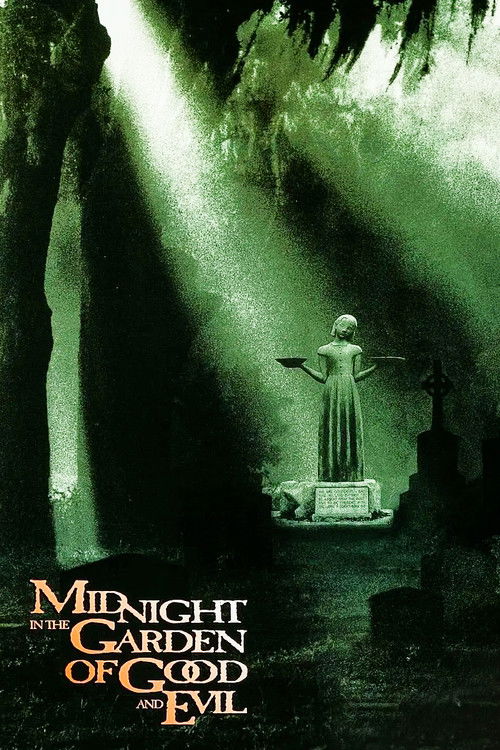
Midnight in the Garden of Good and Evil
1997 · Clint Eastwood
For when you want to sink into a place rather than race through a plot — a languid, moss-draped mystery to pour a drink with. Comfort viewing with a wicked streak, best when you're patient.
What it's about
A New York magazine writer flies to Savannah, Georgia, to cover a lavish Christmas party thrown by a charming self-made antiques dealer — and stays when his host is charged with shooting a volatile young hustler dead. The murder trial becomes his way into a hermetic Southern city crowded with eccentrics: a drag performer who steals every scene, a voodoo priestess, a man who walks an invisible dog. Adapted from John Berendt's nonfiction bestseller, it's as much a portrait of a place as a whodunit.
The experience
Slow, humid, and gossipy — less a courtroom thriller than a long evening of Southern hospitality where you're never quite sure who's telling the truth. It ambles where other crime films sprint, trading suspense for atmosphere, wit, and the pleasure of strange company.
Performances
Kevin Spacey gives the dealer a purring, unhurried charm that keeps you guessing about his guilt, and The Lady Chablis — a real Savannah drag performer playing herself — walks off with the movie whenever she appears.
The craft
Clint Eastwood directs with his characteristic unhurried patience, letting Savannah's squares, mansions, and cemeteries do half the storytelling; the location photography makes the city itself the lead character. The jazz-inflected soundtrack, drawing on Johnny Mercer's songbook, wraps the whole thing in warm Southern twilight.
Why it matters
A curiosity in Eastwood's directing career — his swerve into languid Southern Gothic after the leanness of his westerns — and the film that brought a publishing-phenomenon book, and the real Lady Chablis, to a national audience.
Snapshot
Midnight in the Garden of Good and Evil is Clint Eastwood's screen adaptation of John Berendt's 1994 nonfiction blockbuster of the same name — the sprawling, gossipy, semi-novelistic account of Savannah, Georgia, that became one of the publishing phenomena of the decade. The film follows John Kelso (John Cusack), a New York magazine writer dispatched south to cover a Christmas party thrown by Jim Williams (Kevin Spacey), a self-made antiques dealer and restorer of grand old houses, only to find his assignment overtaken when Williams is charged with the shooting death of a volatile young hustler, Billy Hanson (Jude Law). What follows is less a thriller than an immersion: a portrait of a hermetic Southern city and its gallery of eccentrics — a voodoo priestess, a man who walks an invisible dog, an inventor who threatens to poison the town's water supply, and above all the irrepressible drag performer The Lady Chablis, who plays herself. Eastwood, working at the height of his prestige in the years just after Unforgiven and The Bridges of Madison County, treats the material with unhurried, classical calm, leaning into atmosphere and character rather than incident. The result divided critics and underperformed the colossal expectations set by its source, but it endures as a distinctive entry in Eastwood's directorial filmography and a defining cinematic image of Savannah itself.
Industry & production
The film was produced by Eastwood's own Malpaso Productions and released by Warner Bros., the studio that had been Eastwood's home base for decades and with which Malpaso enjoyed an unusually stable, low-overhead relationship. The project's commercial logic was self-evident: Berendt's book had spent an extraordinarily long run on the New York Times bestseller list — by the time the film went into production it was among the longest-charting nonfiction titles in the list's history — and a screen version promised a built-in audience. The screenplay was written by John Lee Hancock, who had earlier scripted A Perfect World (1993) for Eastwood and who faced the central adaptation problem squarely: Berendt's book is a loosely structured, episodic work of literary reportage with no conventional protagonist's arc, organized around the author's own years of observation and the four successive murder trials of Jim Williams.
Hancock and Eastwood's solution was to compress and reshape. The narrator-author was fictionalized into "John Kelso" and given a more active dramatic function, and the four real trials were collapsed into a single courtroom climax. A romantic subplot was invented for Kelso — a relationship with a local woman, Mandy, played by Alison Eastwood, the director's daughter — that has no real counterpart in the book and that several critics singled out as an unnecessary concession to conventional structure. The casting mixed established actors with real Savannahians: Kevin Spacey, then at a career peak after The Usual Suspects (1995) and Se7en (1995), took Williams; Jack Thompson played the defense attorney Sonny Seiler; and, in a much-noted gesture toward authenticity, The Lady Chablis — a real Savannah performer who features prominently in the book — was cast as herself. Eastwood shot substantially on location in Savannah, using the city's real squares, mansions, and the Bonaventure Cemetery, an approach consonant with both the book's intense sense of place and Eastwood's habitual preference for real locations over sets.
Technology
Midnight in the Garden of Good and Evil is a conventionally produced 1997 studio film shot photochemically on 35mm, and it makes no claim to technological innovation; its means are entirely classical and in the service of place and performance. Eastwood and his cinematographer worked, as was their long practice, in widescreen and with a preference for naturalistic, available-feeling light rather than elaborate optical or digital effects. The period setting is contemporary-to-recent, so the production design and photography were tasked with rendering Savannah's existing antebellum and Victorian architecture, its draped Spanish moss, and its humid Lowcountry light rather than with any reconstruction requiring special technique. There is no evidence in the record of unusual technical apparatus, and it would be invention to claim otherwise; the film's distinctiveness is a matter of light, location, and pacing, not of tools.
Technique
Cinematography
The cinematography is by Jack N. Green, Eastwood's regular director of photography through this period, who had risen from camera operator on Eastwood's pictures to shoot the run that included Unforgiven and The Bridges of Madison County. Green's work here is built around Savannah's particular qualities of light and foliage: the gold-green diffusion of sun through moss-hung oaks, the warm interiors of Williams's lavishly appointed Mercer House, the cool blue of nocturnal cemetery scenes. The camera is patient and largely unshowy, favoring stable, composed framings that let the architecture and the actors hold the eye — an approach that matches Eastwood's general aesthetic of restraint. The film's most celebrated single image belongs to the visual culture surrounding the project as much as to the film itself: the "Bird Girl" statue in Bonaventure Cemetery, which had appeared on the book's iconic cover and which the film's photography helped cement as an emblem of Savannah's melancholy beauty.
Editing
The editing is by Joel Cox, Eastwood's longtime collaborator and Academy Award winner for Unforgiven. The film is notably long — running well over two hours — and its rhythm is deliberately relaxed, even meandering, a quality that drew much of the critical resistance the picture met. This is in keeping with Eastwood's directorial temperament: he is a filmmaker who shoots economically, prints early takes, and trusts atmosphere to carry scenes, and Cox's cutting reflects that unhurried sensibility. The structural challenge of the adaptation is visible in the editing: the film must move between the murder-and-trial spine and the looser, anecdotal texture of Savannah eccentricity drawn from the book, and the joins are not always seamless. Where the film succeeds, the leisureliness is the point — it lets the city's strangeness accumulate; where it falters, the same quality reads as slackness.
Mise-en-scène / staging
The staging is organized around interiors and rituals of Southern social life: the catered Christmas party at Mercer House, the cluttered opulence of Williams's antiques, the clubrooms and porches and graveyards where the town's private life is conducted. Production design renders Savannah as a closed, self-regarding world of inherited manners and concealed transgressions, and the costuming and decor mark the fine gradations of class and belonging that the outsider Kelso must learn to read. Eastwood stages the courtroom scenes with a similar classicism, and he repeatedly positions Kelso as an observer at the edge of the frame, the Northern visitor watching a society perform itself. The voodoo sequences with Minerva (Irma P. Hall), staged in the cemetery at midnight, introduce a frankly gothic register — the "garden of good and evil" of the title made literal — that the film holds in deliberate tension with its sunlit social comedy.
Sound
The film's sonic identity is bound up with the music of Johnny Mercer, the great American lyricist who was a native son of Savannah, and the soundtrack draws on the Mercer songbook as both period flavor and local homage — a fitting choice for Eastwood, a serious lifelong jazz devotee whose films are unusually attentive to American popular song and jazz idiom. The score is credited to Lennie Niehaus, the jazz saxophonist-arranger who scored most of Eastwood's films of the era and who shared the director's musical sensibility. The soundtrack album presented interpretations of Mercer standards by various vocalists; in the absence of a confident scene-by-scene record I will not attribute specific performances, but the governing strategy is clear: the music roots the film in Savannah's cultural memory and lends its drama a smoky, nostalgic warmth. Otherwise the sound design favors the naturalistic ambience of the Lowcountry — cicadas, church bells, the hush of the cemetery.
Performance
Performance is where the film is most consistently praised. Kevin Spacey's Jim Williams is a study in cultivated charm and concealed steel — a parvenu who has remade himself into a connoisseur and grandee, urbane and unflappable even in the dock, his composure itself a kind of mystery. Spacey gives the film its center of gravity. John Cusack's Kelso is the necessary straight man, the wry, watchful surrogate through whom the audience is introduced to Savannah; the part is more reactive than active, and Cusack plays it with an easy, slightly bemused intelligence. The performance most singled out by critics and audiences alike is that of The Lady Chablis, playing herself with a fearless, scene-stealing comic vitality that gives the film its jolts of unpredictable life. Jude Law, early in his career, brings a feral volatility to the doomed Billy Hanson; Irma P. Hall lends gravity to the voodoo priestess Minerva; and Jack Thompson is solid as the defense attorney. The ensemble's blend of professional actors and genuine locals is part of the film's texture and part of its claim to authenticity.
Narrative & dramatic mode
The film's dramatic mode is a hybrid that never fully resolves into a single genre, and this is both its character and its difficulty. On one axis it is a courtroom murder mystery: did Jim Williams kill Billy Hanson in self-defense, as he claims, or in cold blood, and the trial supplies the film's plot engine and its climax. On another axis it is a comedy of manners and a travelogue — an episodic immersion in a town of eccentrics, closer in spirit to its literary source than to any thriller. The reporter-outsider structure, in which a visitor is initiated into a strange closed society and gradually implicated in its secrets, gives the film its through-line, but Eastwood and Hancock keep subordinating forward momentum to atmosphere and digression. The question of guilt is held in genuine ambiguity — the title's "good and evil" names a moral uncertainty the film declines to resolve cleanly — and the real subject is less whodunit than the spell that a place and its people cast over an observer who arrives to judge them and stays to be charmed. The invented romance and the compression of four trials into one are the seams where the adaptation's competing impulses show.
Genre & cycle
The film sits at the intersection of several cycles. It is a literary adaptation in the prestige mode — the late-1990s vogue for bringing acclaimed bestsellers to the screen with name directors and stars. It is a courtroom drama, drawing on the durable American tradition of the murder trial as social X-ray. And it is, most distinctively, a work of Southern Gothic, joining a lineage of films and fictions that find in the American South a hothouse of decayed gentility, eccentricity, secret transgression, race, and the uncanny — a tradition with deep literary roots in writers like Truman Capote and Tennessee Williams. Within Eastwood's own filmography it belongs to a strand of literary or "soft," character-driven projects — alongside The Bridges of Madison County — that he interleaved with his harder crime and Western work, films in which mood and milieu matter more than action. It is also, frankly, an oddity in his catalog: a meandering ensemble piece with no Eastwood performance at its center and a tone of bemused observation rather than moral reckoning.
Authorship & method
The film is unmistakably an Eastwood production in method even where it is atypical in subject. Eastwood's directorial signature — economy of shooting, trust in actors, naturalistic light, unhurried pacing, an aversion to overstatement — is everywhere, and the film's leisurely length is a direct expression of his temperament. Working through Malpaso with a tight, loyal crew, Eastwood brought his core collaborators: cinematographer Jack N. Green, who supplied the film's warm, location-rooted images; editor Joel Cox, who shaped its relaxed rhythm; and composer Lennie Niehaus, whose jazz sensibility and the Johnny Mercer songbook gave it its musical soul. Screenwriter John Lee Hancock, a previous Eastwood collaborator, did the difficult structural work of turning Berendt's plotless reportage into a film with a spine. The casting of The Lady Chablis as herself, and the use of real Savannah locations and faces, reflect an authorial commitment to the documentary truth of the place — a fidelity to milieu that is one of the film's strongest instincts. If the picture is sometimes counted among Eastwood's lesser directorial efforts, the qualities that make it interesting — its patience, its refusal to sensationalize, its affection for its eccentrics — are precisely Eastwoodian.
Movement / national cinema
The film is a product of mainstream American studio cinema at the close of the 1990s, made within the prestige-adaptation economy that Hollywood maintained alongside its blockbusters. It does not belong to any avant-garde or national movement; rather, it exemplifies the kind of mid-budget, star-and-director-driven adult drama that the major studios still regularly financed in that era and that has since grown scarcer. Its more meaningful affiliation is regional and cultural: it is a Southern film, a contribution to the long American fascination — literary, cinematic, and touristic — with the mythology of the Deep South, and specifically with Savannah as a uniquely preserved and atmospheric Southern city. As an Eastwood-Malpaso-Warner Bros. picture it also exemplifies one of the most durable director-studio relationships in American film history.
Era / period
The film is set in a contemporary Savannah of the late twentieth century, but it is a Savannah deliberately presented as a place out of time — a city that has insulated itself from modern American homogenization and preserved an older code of manners, hierarchy, and secrecy. The story's events derive from real events of the early 1980s (the killing for which the real Jim Williams was tried four times), and the film carries the residue of that period even as it floats free of precise dating. As a cultural artifact of 1997, the film registers the late-1990s appetite for the South as exotic Americana and the moment's particular embrace of camp, drag performance, and queer eccentricity entering the mainstream — The Lady Chablis's prominence is very much of its time. The film also belongs to the brief window when Berendt's book had made Savannah a national obsession, and it both fed on and intensified that phenomenon.
Themes
The governing theme is announced in the title: the entanglement of good and evil, and the refusal of easy moral judgment. Jim Williams is neither cleanly innocent nor clearly guilty, and the film sustains that ambiguity as its central moral fact. Around it cluster several concerns. There is the theme of the outsider and the closed community — Kelso the Northern visitor learning to read a society that guards its secrets and absorbs its scandals into its own private code. There is the theme of self-invention and class: Williams is a man who has manufactured his own gentility, and the film is alert to the performances by which social status is maintained in the South. There is the persistent motif of the theatrical and the masked — most vividly in The Lady Chablis, whose drag performance literalizes the film's larger interest in self-fashioning and the gap between public face and private truth. There is the gothic and supernatural register of voodoo, conjure, and the cemetery at midnight, which frames Savannah as a place where the rational and the occult coexist. And running beneath all of it is the theme of place itself — the idea that a city can be a character, a moral atmosphere, a spell that holds its inhabitants and seduces its visitors.
Reception, canon & influence
Midnight in the Garden of Good and Evil arrived burdened by the immense success of its source, and the critical reception was decidedly mixed — a common verdict held that Eastwood had made a handsome, atmospheric, but overlong and structurally diffuse film that could not capture the book's particular charm and could not decide whether it was a murder mystery, a comedy of eccentrics, or a courtroom drama. The invented romantic subplot and the running time drew specific complaints. Against this, reviewers consistently praised the film's evocation of Savannah, Spacey's controlled performance, and especially The Lady Chablis, whose turn was widely regarded as the film's most vivid pleasure. Commercially the film did not match the extraordinary reach of the book, and it is generally counted among the more minor entries in Eastwood's directorial career rather than among his canonical achievements.
Its influences run backward to the Southern Gothic literary and cinematic tradition and, immediately, to Berendt's book, whose voice, structure, and gallery of characters the film inherits wholesale. Its forward influence is felt less in cinema than in culture and place: the book and film together transformed Savannah into a major tourist destination, with organized tours of the film's and book's locations becoming a fixture of the city's economy, and the Bird Girl statue grew so famous and so beset by visitors that it was eventually removed from Bonaventure Cemetery to a museum for its protection — a striking instance of a film and its source materially reshaping the place they depicted. Within Eastwood's body of work the film stands as evidence of his range and his willingness to take on uncharacteristic, literary, ensemble material, a tendency in his "softer" projects that would continue to inform the more emotionally expansive films of his later directorial career. For The Lady Chablis, the film extended a regional celebrity into national visibility. The picture's lasting place is thus a curious one: a modestly regarded film attached to a phenomenally successful book, remembered above all for how indelibly it fixed the image of a single American city in the popular imagination.
A Deleuzian reading
A man walks down a Savannah street holding a leash, and at the end of the leash there is no dog.
The full Deleuzian reading of Midnight in the Garden of Good and Evil →
Reception
A hotly anticipated adaptation of John Berendt's mega-bestseller that landed with a thud in 1997 — critics called it baggy and box office shrugged — but it's since been reclaimed as a low-key Savannah hangout movie, all humidity, gossip and vibes.
How Midnight in the Garden of Good and Evil was received, from release to now →
Influences: the films it descends from and the films it influenced
- Anatomy of a Murder (1959) — A procedurally patient courtroom drama scored with Duke Ellington's jazz that withholds moral verdict on its principals — the direct template for Niehaus's jazz idiom and Midnight's unhurried, ambiguity-preserving trial structure.
- In Cold Blood (1967) — Adapts a journalist's nonfiction true-crime reportage onto real locations with a Quincy Jones jazz score, modeling how to translate Berendt's reporter-driven reportage into atmospheric crime cinema rather than conventional plot.
- To Kill a Mockingbird (1962) — Prestige Southern literary adaptation that builds its courtroom on Elmer Bernstein restraint and a deep evocation of a single town as moral environment, anchoring the place-plus-trial mode.
- A Streetcar Named Desire (1951) — Canonical Southern Gothic stage-to-screen adaptation whose hothouse decay and outsider intruding on a sealed milieu set the genre's heightened performance register.
- The Night of the Hunter (1955) — Southern Gothic dread conjured through expressive available-darkness and folk-religion menace, an ancestor of Midnight's gothic-voodoo staging and low-key nocturnal atmosphere.
- Reflections in a Golden Eye (1967) — Carson McCullers adaptation of repressed eccentrics on a Georgia army post, the literary-adaptation lineage of the hothouse Southern character study Midnight inhabits.
- Wise Blood (1979) — Plays its grotesque Flannery O'Connor Southern eccentrics straight and with affection rather than for shock — the tonal model for Eastwood's refusal to sensationalize his gallery of Savannah characters.
- Mystic River (2003) — The emotionally expansive, ensemble, literary-source Eastwood film that Midnight's 'softer project' tendency points toward, extending the same Malpaso patience to weightier material.
- Big Fish (2003) — Alabama tall-tale of Southern eccentrics framed by a returning outsider piecing together a milieu, extending Midnight's affectionate gallery-of-characters mode.
- Get Low (2009) — Depression-era Southern folk-fable built on patient available-light Americana and a community of eccentrics, made by an Eastwood-school craftsman applying the same unhurried, place-rooted economy.
- Beasts of the Southern Wild (2012) — Casts a Southern milieu largely with non-professional locals playing versions of themselves, extending Midnight's documentary-truth fidelity to real faces and place — the same instinct that cast The Lady Chablis as herself.
- Mud (2012) — Southern river-country shot on real locations in natural light, with a regional sense of place treated as the film's true subject over its crime-and-outsider plot.
- Capote (2005) — Dramatizes the very In Cold Blood reportage tradition Midnight descends from — the writer-outsider extracting narrative from a real crime and a closed local world.
- Nashville (1975) — Episodic, plotless ensemble portrait of a single American city assembled from a gallery of eccentrics and performers playing near-versions of themselves — the structural cousin to Midnight's city-portrait diffuseness.
- Bird (1988) — Eastwood/Malpaso's own jazz film, with Lennie Niehaus scoring and Jack Green's low-key available-light photography establishing the exact house method Midnight reuses.
- The Bridges of Madison County (1995) — The immediately prior Eastwood bestseller adaptation where patience, location fidelity, and trust in actors turn pulp source into an unhurried mood piece — the direct methodological predecessor.
- Honkytonk Man (1982) — Earlier Eastwood music-soaked period piece that privileges relaxed pacing and an Americana songbook over plot momentum, the same temperamental indulgence that drives Midnight's length.
- Forrest Gump (1994) — Shot in Savannah's squares and Bonaventure-adjacent spaces just before Midnight, fixing the same city's visual iconography in prestige cinema using its location architecture as character.
Similar films
- The Bridges of Madison County (1995) — influence & lineage
- The Night of the Hunter (1955) — influence & lineage
- A Streetcar Named Desire (1951) — influence & lineage
- The Beguiled (1971) — shared sensibility
- Eve's Bayou (1997) — shared sensibility
- Where the Crawdads Sing (2022) — shared sensibility
- Dogville (2003) — shared sensibility
- The Killing of a Chinese Bookie (1976) — shared sensibility
All the films related to Midnight in the Garden of Good and Evil →