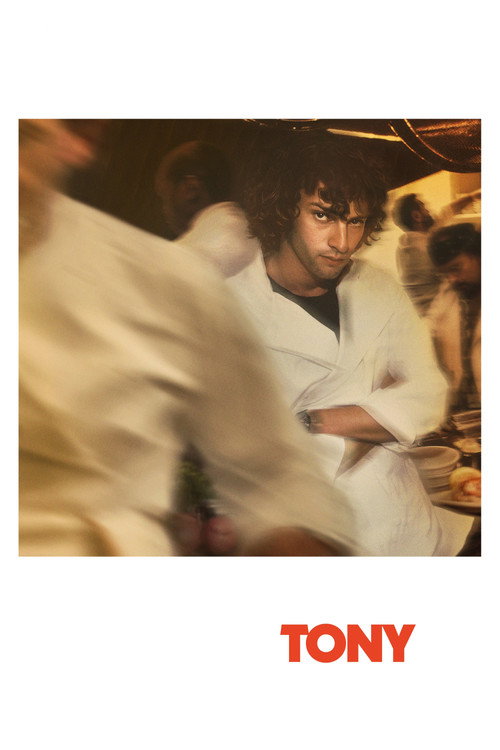
Tony
2026 · Matt Johnson
For when you want to feel young, hungry, and lit up about work and friendship — a comfort watch with soul, great with food nearby. Reach for it after a long week, when you want to remember why anyone falls in love with a craft.
What it's about
Anthony Bourdain at nineteen — directionless, dropped out, adrift — washes up in Provincetown for a summer and stumbles into a restaurant kitchen: the heat, the noise, the misfits, and a chef who takes him in. It's the true story of the season that showed him where he belonged, drawn from the Provincetown chapters of his own memoir, decades before anyone knew his name.
The experience
Warm, funny, and alive with kitchen chaos — the clatter and adrenaline of a working line, the hazing and camaraderie, the feeling of a summer that matters more than the people living it yet realize. It's a hangout movie with an ache underneath, and it leaves you nostalgic for a place you've never been.
Performances
Dominic Sessa plays the young Bourdain with loose-limbed charm and none of the impression-doing that sinks most biopics, and Antonio Banderas gives the chef who takes him in a worn, magnetic authority.
The craft
Matt Johnson directs with the scrappy, restless energy he brought to his earlier work, and the film's smartest choice is structural: it refuses the biopic's whole-life sprawl and holds to a single summer, letting the fame — and the loss — that made Bourdain famous stay entirely offscreen. The kitchen scenes have real sensory heat: sizzle, steam, and clatter that reward good speakers.
Why it matters
A biopic that became a model for how to film a famous life without embalming it — one summer, no legend-building — and a breakout step for both its director and its young lead.
Snapshot
Tony is a 106-minute coming-of-age comedy-drama drawn from the Provincetown chapters of Anthony Bourdain's Kitchen Confidential (2000) — the summer in which a directionless college student discovered that a restaurant kitchen was a place where he could belong. Dominic Sessa plays Bourdain at nineteen; Antonio Banderas plays the chef who takes him in. Matt Johnson, the Canadian director of The Dirties, Operation Avalanche and BlackBerry, directs from a script credited to himself, his longtime producing partner Matthew Miller, Todd Bartels and Lou Howe. A24 released it in select theatres on 7 August 2026 and expanded it on 21 August.
Its significance is threefold. It is a biopic that refuses the biopic's shape, holding to a single summer and declining to dramatize the fame or the 2018 death that give the subject his public meaning. It is the first film in which Johnson works inside the American independent-studio system, with an outside cinematographer of the first rank — Michael Bauman, Paul Thomas Anderson's collaborator — and without appearing on screen himself, and the resulting change in his visual language is the film's most legible formal fact. And it is a mentorship film in a cycle that has lately preferred the kitchen as a site of cruelty; Tony uses the same room to argue the opposite case.
Industry & production
The film was produced by Tim and Trevor White's Star Thrower Entertainment with Johnson and Miller's Toronto-based Zapruder Films, with Johnson and Miller credited as producers alongside the Whites. A24 distributed in the United States. This is the first Johnson feature made outside the Canadian independent apparatus — Telefilm, provincial tax credits, Elevation Pictures — that carried BlackBerry, and the trade of control it entailed has been discussed openly by the filmmakers: Miller has characterized the arrangement as one in which the financier calls the shots, which is the financier's prerogative. Johnson's counter-move was to keep post-production in Toronto with the collaborators he has used for a decade, treating his Canadian team as a screening committee against the film's American-financed front end.
Physically it was a small picture. Principal photography ran roughly 25 days in 2025, with only about five and a half of those days in Provincetown itself and the remainder elsewhere on Cape Cod — a schedule closer to Johnson's microbudget origins than to the resources A24 could have supplied. (Sources differ on the exact window; the Cape work is placed in spring 2025 and the wrap in August 2025, and the record does not reconcile them.)
Two rights questions sit under the project. The film is credited as based on Kitchen Confidential, which implies an underlying-rights deal with the Bourdain literary estate, but the specific terms, and the degree of estate participation in the screenplay, are not on the public record and should not be assumed. The second is the delicate cultural fact that any posthumous Bourdain film now works in the shadow of Morgan Neville's documentary Roadrunner (2021), whose use of an AI-synthesized Bourdain voice for lines he had written but never spoken provoked a genuine ethical argument about the limits of reconstruction. Tony answers that argument structurally, by choosing a period so early that no reconstruction of the famous man is required.
Technology
The most consequential technical decision is a matter of optics rather than capture. Bauman built the film's look around older, wider lenses, producing a coarser, grainier image than a contemporary digital package would deliver clean — a period texture achieved by glass and its aberrations rather than by grade or grain plug-in. This is a method Bauman knows intimately: his work with Paul Thomas Anderson on Licorice Pizza (2021), also a 1970s Southern California coming-of-age film, and his Oscar-nominated photography on One Battle After Another (2025), both proceed from the premise that period is a property of the lens and the light before it is a property of the production design.
The public record does not specify gauge, stock, or aspect ratio, and it would be irresponsible to assert them; the descriptions available speak to lens choice and resulting texture, not to a format. What can be said is that whatever the capture medium, the image was designed to look handled and slightly imperfect, and that the small schedule and heavy reliance on available Cape light — reviewers repeatedly reach for golden hour — indicate a fast, light package rather than a lit-from-scratch one.
Technique
Cinematography
Bauman and Johnson agreed on a governing figure: that watching the film should feel like turning the pages of a book. That is an unusual brief for Johnson, whose previous features are built on the grammar of the camera-as-participant — a handheld operator inside the scene, snatching focus, zooming to find the speaker, the frame confessing that someone is holding it. Here the camera is composed and the light is soft and warm, and the aggression of the earlier films is gone. Critics have described the result as dreamy and nostalgic, the Cape rendered in the honeyed register of remembered summer.
The interesting tension is between that romanticism and the material. Bourdain's own account of Provincetown is not soft; it is about drugs, sex, cruelty and hierarchy in a hot room. Shooting it in golden light is a choice with an argument in it — that we are seeing the summer as the man who wrote about it needed to remember it, rather than as it was.
Editing
Curt Lobb, who cut BlackBerry, edits with Robert Upchurch. The single most discussed construction is a montage of the summer's high points narrated by lies Tony tells to impress Nancy (Emilia Jones) — the images and the voice pulling apart, so that each embellishment lands against what the audience has already seen. This is a precise piece of ironic counterpoint, and it does structural work no expository scene could: it establishes early that Bourdain's genius and his self-mythology were the same faculty, which is the film's real thesis about its subject.
Otherwise the cutting appears to serve the slice-of-life shape rather than compress a life. At 106 minutes covering roughly three months, the editing has the rare biopic luxury of letting scenes reach their natural length.
Mise-en-scène / staging
Ryan Warren Smith's production design reconstructs a mid-1970s seafood kitchen and the town outside it. The kitchen staging is the film's technical centrepiece, and reviewers have noted the specific effect it achieves: a room full of degenerates that nonetheless runs with unexpected efficiency. That is precisely the observation Kitchen Confidential made and that most kitchen films get wrong — the professional line is not chaos but a choreography that only looks like chaos from the dining room. Staging this requires blocking cooks in sustained spatial relationships rather than cutting the work into fragments, and it is the point at which Johnson's documentary instincts and Bauman's classicism serve the same end.
Sound
Jay McCarrol, Johnson's collaborator since the Nirvanna the Band the Show web series, supplies the score, described consistently as a melancholy piano line threaded through the film and set against period needle drops. The piano is a departure from McCarrol's synth-forward, comically insistent work on BlackBerry; here the music carries the elegiac charge the narrative withholds, which is one of the few places the film acknowledges that we know how the story ends.
On sound design proper — the specific treatment of the kitchen's acoustic environment, which is the obvious opportunity in a film of this kind — the published record is thin, and the supervising sound credits are not readily documented. It would be invention to describe a mix that has not been described.
Performance
Sessa's Bourdain is built on transparency: a nineteen-year-old in a leather jacket mispronouncing ten-dollar words, whose posturing is legible to everyone but himself. The performance's task is to make aspiration and fraudulence the same gesture, and reviewers have credited it with the necessary nuance. It is also a shrewd piece of casting logic — Sessa's breakout in The Holdovers (2023) established him as an actor who can play defensive cleverness in a period New England setting, and Johnson has said the casting was settled within half an hour of meeting him.
Banderas, as the chef, gives what several critics call the film's standout performance, and the character is pitched at the level of myth rather than biography — a figure of discipline and dignity who lets the kid wash dishes and learn by watching. Leo Woodall's Sal supplies the hedonist counterweight; Emilia Jones's Nancy is the film's acknowledged weakness, several reviewers finding her written more as an object of desire than as a person, which is a real cost given that the character carries the romantic engine of the summer. Dagmara Domińczyk and Rich Sommer play Bourdain's parents; Stavros Halkias, Monica Raymund and Michael Jibrin fill out the line. Eric Ripert — Bourdain's closest friend in life — appears as a cooking instructor, a casting choice that functions as an in-memoriam gesture legible only to those who know.
Narrative & dramatic mode
The mode is bildungsroman, strictly held. The film opens on Bourdain being interviewed for a writing fellowship — a frame that quietly declares its subject to be a writer who cooked rather than a cook who wrote — and then stays inside one summer. There is no rise, no fall, no montage of book covers or television titles, and no death. This is the anti-biopic strategy that BlackBerry also used in a different key: pick the window in which the person became themselves, and trust that window to carry the whole.
The dramatic engine is apprenticeship rather than conflict. Tony wants in; the kitchen has a hierarchy; he climbs it by attention. Against that runs the lying, which supplies the film's irony and its structural spine. Historical fidelity is handled loosely on purpose — reviewers have flagged period markers that don't sit cleanly against the strict chronology of Bourdain's Provincetown summers, which in life spanned several years and are compressed here into one. The compression is a dramatic device, not an error, and the film's own dating has been reported inconsistently enough that the precise year should not be stated with confidence.
Genre & cycle
Tony sits at the junction of three live cycles.
The kitchen film, which runs from Big Night (1996) and Dinner Rush (2000) through Ratatouille (2007) and Chef (2014) to a recent turn toward the kitchen as a machine for producing damage — Boiling Point (2021), The Menu (2022), and above all The Bear (FX, 2022– ), which made the panic attack the genre's signature image. Tony pushes against that: its kitchen is hard but it is also a refuge, and the Rotten Tomatoes consensus reads the film as a tribute to mentorship.
The summer-job coming-of-age film — Dazed and Confused (1993), Adventureland (2009), The Way Way Back (2013), Licorice Pizza (2021). Tony belongs here more than to any food-movie tradition, and the Bauman connection to Licorice Pizza makes the kinship concrete rather than thematic.
The partial-life biopic, the dominant response to the genre's exhaustion: I'm Not There (2007), Jackie (2016), Spencer (2021), Johnson's own BlackBerry (2023), against the recapitulating mode of Bohemian Rhapsody (2018) or A Complete Unknown (2024).
Authorship & method
Johnson's authorship has been, until now, inseparable from a method: guerrilla shooting, docu-fiction framing, and his own body in the frame. The Dirties (2013) won the Slamdance Grand Jury Prize and was championed by Kevin Smith; Operation Avalanche (2016) shot undercover at NASA under a documentary pretext; Nirvanna the Band the Show built comedy out of unpermitted public shooting in Toronto; BlackBerry (2023) brought the handheld, zoom-driven vernacular to Berlinale competition and swept the Canadian Screen Awards. In every case Johnson played a character, and the film's realism was partly an alibi for its production method.
Tony strips almost all of that away. Johnson does not appear. The camera belongs to Bauman and is composed. The production is scheduled, permitted and financed by A24. What survives is the human attention — the interest in people who are not as impressive as they believe, the comic ensemble's overlapping texture, the refusal to condescend to a young man's delusions — and the Toronto post-production core of Lobb and McCarrol. The film is a useful test case for the distinction between a director's style and a director's sensibility: the style has changed almost entirely and the sensibility has not. The four-way writing credit with Miller, Bartels and Howe also marks a shift, as Johnson's earlier scripts were essentially two-man affairs with Miller built out through improvisation, and how much improvisation survived here is not documented in detail.
Movement / national cinema
Johnson is a Toronto filmmaker formed in the city's post-Trailer Park Boys, Ryerson-trained comedy-realist scene, and BlackBerry was a landmark of recent English-Canadian cinema precisely because it made a Canadian story — Waterloo, RIM, the national habit of near-greatness — into an international success without translating it. Tony is the crossover film, and the Canadian film press has covered it as such. It is an American picture in subject, financing, setting and distribution, made by a Canadian director who moved his post-production home. Whether this is a gain for Canadian cinema or a familiar loss of one of its talents to the American system is exactly the question such films always raise, and it is too early to say which this will turn out to be.
Era / period
The film's 1970s Provincetown is a specific and underfilmed place: an old Portuguese fishing port that had been an artists' colony since the Provincetown Players and Eugene O'Neill, that had become by the 1970s one of the few openly gay resort towns in America, and that ran on seasonal labour — a town where a nineteen-year-old could be nobody and become somebody between June and September. This is the post-Stonewall, pre-AIDS moment, the tail of the counterculture, and a decade before "chef" became a form of celebrity. That last point is the film's quiet historical argument: Bourdain entered the trade when cooking was manual labour with no prestige attached, and the mentorship he received was the mentorship of a craft, not of a career.
Themes
Apprenticeship and belonging. The kitchen as the place where a young man with no aptitude for institutions finds a hierarchy he can respect because it is earned at the stove rather than conferred.
Self-invention and the lie. The montage narrated by Tony's fabrications is the film's thesis in miniature: the impulse that made him a writer and the impulse that made him a fraud are one impulse, and the film neither excuses nor pathologizes it.
Appetite. Food, sex and drugs held in a single register, which is the register of Kitchen Confidential itself.
The absent ending. The film's largest theme is the one it does not state. Every viewer brings 2018 into the theatre. Working strictly inside a summer of possibility, with a melancholy piano underneath, the film lets that knowledge do its work without ever invoking it — a formal restraint that reads as an ethical position.
Reception, canon & influence
Reception. Tony was warmly received. It premiered at the Provincetown International Film Festival in May 2026 — a homecoming venue — before A24's August platform release. It holds a 94% positive rating on Rotten Tomatoes across 198 reviews (7.7/10 average) and a Metacritic score of 75, "generally favorable." The New York Times named it a Critic's Pick; Jeannette Catsoulis called the film "splendid" and made the shrewdest point in its favour — that "the film would be just as pleasurable if its subject were a complete unknown." Kyle Smith in the Wall Street Journal wrote that "the unshowy dedication to craft is a marvel, and so is much else in this crystalline little film." The Rotten Tomatoes consensus reads it as "a splendid tribute to mentorship, complete with a standout performance by Antonio Banderas." Dissent has clustered on the underwriting of Emilia Jones's Nancy and on the film's tonal softness relative to its source. It had grossed roughly $17 million — a strong result for a 25-day independent production, though not a phenomenon.
Influences on the film (backward). Kitchen Confidential is the acknowledged source and supplies the milieu and the voice. Formally, the film's closest relatives are the summer-job coming-of-age pictures, with Licorice Pizza a direct link through Bauman's lens-led approach to period. Johnson's own BlackBerry supplies the anti-biopic structure — the narrow window, the ensemble workplace, the refusal of the career montage. Roadrunner is the negative influence: the film's decision to go early and leave the famous man unfilmed reads as a considered response to the problems that documentary encountered.
Legacy (forward). It is too early to assess. The film has been in wide release for roughly three weeks as of this writing, and any claim about what it will shape is speculation. Two things are worth watching. The first is whether its mentorship-warm reading of professional kitchen life shifts a cycle that had settled into the kitchen-as-trauma register. The second is Johnson's own trajectory: Tony demonstrates that a director whose identity was bound to a production method can abandon the method and remain recognizable, which is the question every guerrilla filmmaker eventually faces. Whether that becomes an example others follow, or the moment a distinctive Canadian voice was absorbed, will only be legible in retrospect.
Reception
Announced to the internet's usual 'leave Bourdain alone' wariness — a biopic of the least biopic-able man alive — it landed to warm reviews and, remarkably, the Bourdain estate's public blessing for refusing to sand off his edges.
How Tony was received, from release to now →
Influences: the films it descends from and the films it influenced
- Licorice Pizza (2021) — Michael Bauman's lens-led period method carries over intact — vintage wide-angle glass pushed close to young faces so the room bends at the edges, golden-hour available light rather than gelled interiors, and period signalled through the optics' rendering instead of set-dressing inventory.
- BlackBerry (2023) — Supplies the anti-biopic architecture Tony reuses — a narrow window on one workplace, the career arc refused and no montage of later fame — plus the same Toronto post core, Curt Lobb cutting on overlapping ensemble dialogue and Jay McCarrol scoring with sparse piano.
- The Dirties (2013) — Establishes the sensibility Tony keeps after discarding the style: a camera that takes a self-mythologizing young man's delusions at his own valuation, without the ironic distance that would let an audience off the hook.
- Operation Avalanche (2016) — The high-water mark of the guerrilla/docu-fiction alibi — unpermitted shooting under a documentary pretext, Johnson's body in frame, zoom-driven handheld — which Tony deliberately abandons for composed coverage, making it the negative reference for the film's whole visual scheme.
- Goodfellas (1990) — The template for the insider's voiceover that explains a closed trade's rules and hierarchies with total confidence while the images quietly contradict the narrator, with period needle-drops chosen as the narrator's own soundtrack rather than the film's.
- Big Night (1996) — The founding text for kitchen choreography as staged labor — bodies, knives and pans blocked in sustained takes so the cooking is legible as craft and the brigade's chain of command reads spatially, without cutting to insert-shot food porn.
- Adventureland (2009) — The summer-job coming-of-age structure Tony inherits wholesale: a menial workplace as the entire world, an ensemble of colleagues functioning as comic chorus, and period pop used as the job's ambient radio rather than as nostalgia cue.
- American Graffiti (1973) — Originates the compressed-season structure with the lives-after epilogue deferred to text — the partial-life move Tony makes by ending before the subject becomes famous — and the wall-to-wall diegetic needle-drop as period architecture.
- Dazed and Confused (1993) — The plotless hang-out ensemble shot into magic hour, where scenes end when the conversation does rather than on story beats, and the older-to-younger mentorship is played as casual hazing-turned-tutelage.
- Almost Famous (2000) — The memoirist's generous unreliability — a first-person adaptation in which the narrating older self flatters the boy he was and the mentor figure, so the voiceover's warmth is itself the thing the film asks you to distrust.
- The Holdovers (2023) — Supplies Dominic Sessa's specific performance instrument — defensive erudition delivered fast and flat, then broken by a beat of visible need — and the mentor-and-boy two-hander rhythm built on the older actor underplaying against it.
- Roadrunner: A Film About Anthony Bourdain (2021) — The negative influence: its archive-plus-synthesized-voice problem is exactly what Tony evades by setting the story before the footage exists, leaving the famous man unfilmed and unimitated rather than reconstructed.
- Nirvanna the Band the Show the Movie (2023) — The Johnson–Miller improvisational ensemble texture — comic scenes built by letting a group talk over itself and cutting for rhythm rather than for the joke — survives in Tony's kitchen banter even under a four-way scripted credit.
- Boiling Point (2021) — The one-take service as pressure-cooker set the kitchen-as-trauma register Tony is reacting against — same brigade choreography and real-time floor geography, but Tony breaks the shot and keeps the mentorship warm where Barantini keeps the camera locked on for the breakdown.
- Beau Is Afraid (2023) — Bauman's other register with the same glass: wide lenses held at close range so a room's geometry warps around a protagonist who misreads it, and long handheld-adjacent moves that stay composed rather than jittery — the technique Tony deploys for comic kitchen space.
- Whiplash (2014) — The mentor-protégé duet cut as an escalating rhythm section — reverse-angle exchanges tightening shot by shot as the older man's approval is withheld — which Tony runs with the polarity reversed, Banderas granting attention where Simmons denied it.
Similar films
- Big Night (1996) — influence & lineage
- Boiling Point (2021) — influence & lineage
- The Holdovers (2023) — influence & lineage · same viewing thread
- Rental Family (2025) — same viewing thread
- Cha Cha Real Smooth (2022) — same viewing thread
- Lady Bird (2017) — same viewing thread
- The Smashing Machine (2025) — same viewing thread
- Ghostlight (2024) — same viewing thread
All the films related to Tony →
Watch it with: curated runs of related films
- The Making of a Legend — A run of biopics that watch private people get forged into public icons — the ambition, the pressure, and the loneliness of becoming somebody the world can't stop looking at.
- Funny Because It Aches — A run of tender, deadpan dramedies where love, grief, and the panic of becoming yourself all get metabolized through jokes — watch these when you want to laugh and cry in the same scene.