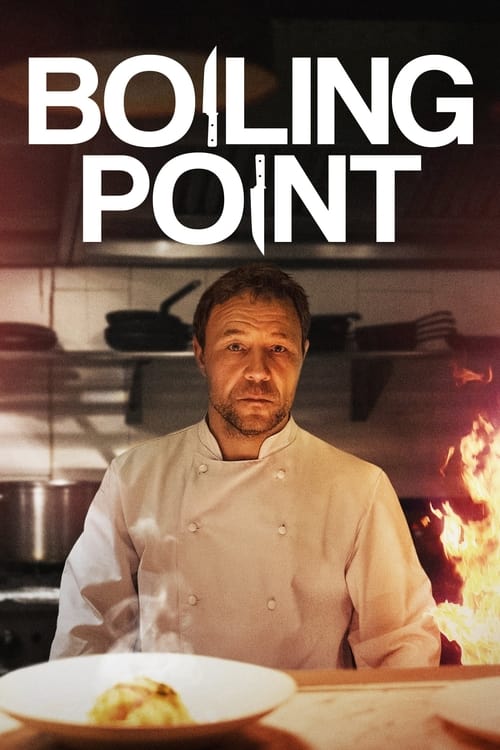
Boiling Point
2021 · Philip Barantini
For when you want intensity, not escape — the night you'd choose a white-knuckle ride over a warm blanket. Anyone who's worked hospitality will feel it in their bones; everyone else will finally understand.
What it's about
One catastrophic Friday-night service at a high-end London restaurant, followed in real time: a head chef holding together a health inspection, a toxic former boss at table seven, a fraying kitchen crew, and his own private unraveling. The whole film unfolds in a single unbroken shot — when the kitchen can't catch a breath, neither can you.
The experience
Pure pressure-cooker cinema: relentless, immersive, and genuinely stressful, with no cut to release the tension. You come out of it wrung out, a little shaky, and with new respect for everyone who's ever worked a service.
Performances
Stephen Graham is extraordinary as the chef, playing a man visibly coming apart while trying to run a kitchen — you can see him managing thirty small crises and one enormous one in every scene.
The craft
Ninety-odd minutes, one shot, no tricks — the camera weaves through the kitchen and dining room like another member of staff, and the choreography required to pull that off is staggering. The single take isn't a gimmick; it's the whole point, trapping you in the pressure the workers can't escape. Best watched loud and uninterrupted.
Why it matters
It became a touchstone for the wave of stressful kitchen dramas that followed, and turned its one-take approach into shorthand for what restaurant work actually feels like.
Snapshot
A London head chef named Andy Jones navigates a catastrophic Friday-night service at a high-end restaurant — a health-and-safety inspection, a toxic former boss, a cocaine relapse, a collapsing marriage — in real time, with no cuts. Philip Barantini's debut feature runs approximately ninety-two minutes and contains exactly one shot. That formal constraint is not a stunt: it transforms the hospitality workplace into a pressure chamber in which the audience cannot look away, cannot reorient, and cannot be relieved by the mercy of an edit. The result is one of the more formally rigorous British films of the 2020s, a picture in which the decision to never cut functions simultaneously as a technical feat, a moral position, and an act of solidarity with the people the camera never stops following.
Industry & production
Boiling Point grew out of a 2019 short film of the same name, also directed by Barantini and starring Stephen Graham, itself shot in a single continuous take. The feature originated in close collaboration between Barantini and Graham, who also served as a producer on the project. The screenplay is credited to James Cummings, working from the concept that Barantini and Graham had developed together. The production is small by any measure — a genuinely independent British film made with a modest budget, relying on institutional goodwill, cast commitment, and an unusual degree of logistical pre-planning rather than resources. The film was shot in a working London restaurant (accounts place production in the capital's East End), which gave the production both its texture of authenticity and its organisational constraints: every surface, every staff member, every prop had to function plausibly as part of an operating kitchen and dining room. Barantini received support from Film4 and the BFI Film Fund, situating Boiling Point within the established infrastructure for prestige low-budget British cinema. The film premiered at the BFI London Film Festival in 2021, where it quickly attracted the kind of word-of-mouth that follows a film whose central formal achievement can be summarized in one sentence and verified by watching it.
Technology
The film was shot on an ARRI Alexa — the industry-standard digital cinema camera for prestige productions in this period — with cinematographer Matthew Lewis operating in tight, constantly mobile configuration. The choice to shoot digitally rather than on film was functionally necessary: no film magazine holds ninety-two minutes of unbroken footage, and the logistical overhead of a genuine single-reel analog take at feature length would have been prohibitive. The digital infrastructure allowed for immediate playback and verification after each attempt, which mattered because the company would occasionally need to reset and try again from the beginning.
What Barantini and Lewis chose not to use is equally significant. There is no digital stitching here, no concealed cuts disguised by passing through a dark surface or a motion blur — the methods used to simulate the continuous take in films like Birdman (Alejandro González Iñárritu, 2014) and 1917 (Sam Mendes, 2019). Boiling Point is genuinely uninterrupted. The crew reportedly completed several full run-throughs before achieving the final take, meaning the actors and camera team had to internalize the entire ninety-two-minute choreography with the precision of a theater company performing a show. The lighting rig was designed to remain constant throughout, relying heavily on practical sources embedded in the restaurant environment itself — the warmth of the dining room, the harsh overhead fluorescence of the kitchen — rather than on adjustable rigging that a conventional multi-setup shoot would allow.
Technique
Cinematography
Matthew Lewis's camerawork is handheld throughout, close but not claustrophobic in the early passages, tightening perceptibly as the evening deteriorates. The camera follows individual characters through the restaurant, often cutting between spatial zones — kitchen to pass to dining room to back-of-house corridor — by simply following a body through a doorway. This spatial continuity gives the viewer a precise, navigable mental map of the restaurant's geography, which becomes increasingly important as the film's crises multiply: we understand instinctively why it matters that Andy is in the wrong part of the building at a given moment. Lewis uses focus as a quiet dramatic instrument, allowing background action to register in soft detail during conversations while occasionally pulling a face into sharp isolation. The single-take constraint means every compositional choice is live and unrepeatable within the take; the film's visual polish is a direct function of rehearsal rather than post-production selection.
Editing
There is, strictly speaking, nothing to edit. The picture is a single continuous shot; the editor's conventional functions — selection, juxtaposition, pacing, the construction of parallel action — are absent. What remains is sound editing (the ambient layering of kitchen noise, dialogue, and music), color grading, and the delivery of a clean master. The dramatic pacing that editing normally provides is instead encoded into the choreography and the performances. This displacement is part of the film's meaning: time cannot be compressed, gaps cannot be elided, crises cannot be dramatized by accelerating the cut rate. The film earns its tension by refusing to use the one tool most available to cinema for generating it.
Mise-en-scène / staging
The staging achievement here belongs partly to the director, partly to the actors, and partly to the movement directors and choreographers who helped block the film's continuous traversal of space. The restaurant must feel genuinely operational — a functioning service with real rhythms of ticket arrival, dish preparation, and table management — while simultaneously accommodating the camera's path and the dramatic beats of the script. This double obligation, serving the logic of the space and the logic of the drama simultaneously without the ability to isolate either in a dedicated setup, is the film's central theatrical challenge. Barantini stages the film more like an immersive theater production than a conventional shoot: the blocking is fixed, the transitions are cued, the crowd of extras has their own carefully rehearsed behavior. The result is mise-en-scène that reads as authentic because it literally is — the restaurant's ecology is functioning around the dramatic action rather than being suggested by it.
Sound
Sound does significant narrative and atmospheric work in Boiling Point, and is arguably as important as any image in establishing the film's register. The restaurant soundtrack is dense: the percussion of service — tickets printing, pans clanging, orders called, ice rattling in shakers, the ambient murmur of a full dining room — forms an almost constant bed beneath the dialogue. The sound design allows this ambient layer to intrude into conversations rather than ducking it politely, giving the dialogue scenes the acoustic texture of real workplaces rather than the cleaned-up sound of conventional cinema. As the evening progresses and the restaurant's operations begin to fail, the sound environment subtly shifts: silences become more audible, the kitchen noise thickens with stress. The film uses no score in any conventional sense; there is diegetic music from the restaurant's sound system, but no external orchestral or electronic underscoring. The absence of a composed score is correct to the film's method — a swelling cue would break the spell of real time — but it also places significant demand on the sound design to carry emotional temperature without the prompts that music conventionally provides.
Performance
Stephen Graham anchors the film in a performance of sustained, finely calibrated disintegration. Graham — one of the most consistently compelling British screen actors of his generation, known internationally for work in This Is England (Shane Meadows, 2006), Peaky Blinders, and The Irishman (Martin Scorsese, 2019) — brings to Andy Jones both the charisma required to make a restaurant leader plausible and the controlled self-destruction required to make his collapse credible. The single-take format places unique demands on the ensemble: every performer must sustain their character's internal logic throughout the running time, cannot rely on a reset between setups, and must absorb and respond to whatever mistakes or variations emerge in the moment. Vinette Robinson as Carly, the sous chef, gives an equally disciplined performance — her character's competence and suppressed frustration are registered in small adjustments across the film's arc. Hannah Walters, Graham's real-life partner, appears in the film in a supporting role. The ensemble quality throughout the restaurant staff is unusually high, likely a direct function of the extended rehearsal process that a genuinely single-take feature demands.
Narrative & dramatic mode
The film is structured around escalation without relief: the single-take format eliminates the possibility of the dramatic pause, the scene break, the time-skip that allows a conventional narrative to reset its pressure. Instead, Boiling Point operates as a long crescendo — problems compound, resources are depleted, each new development lands on top of unresolved prior crises. The dramaturgy is essentially theatrical in mode, closer to a two-act pressure play than to the scene-based structure of most cinema. The film's ending, which arrives without catharsis in the conventional sense, has divided audiences; several critics noted that the film builds towards a crisis it then refuses to resolve with the dramatic punctuation a feature film conventionally provides. Whether this constitutes a flaw or a formal commitment is a question the film leaves open.
The narrative also carries an ethical dimension in its representation of the hospitality workplace. The film documents, with some specificity, the class stratification of a high-end London restaurant — the kitchen staff are more ethnically diverse, more precarious, and more exposed to risk than the floor management and ownership; the diners are largely prosperous and entitled; the systems of inspection and oversight produce anxiety without producing safety. These observations are embedded in the film's texture rather than foregrounded as thesis.
Genre & cycle
Boiling Point belongs to a recognizable early-2020s cycle of kitchen-and-restaurant drama in which the hospitality workplace becomes a site for exploring masculine precarity, addiction, class pressure, and institutional dysfunction. The Bear (FX/Hulu, 2022), which arrived shortly after Boiling Point's international circulation, shares many of the same thematic and aesthetic preoccupations — though The Bear is a scripted episodic series using conventional multi-camera editing while deploying the feeling of continuous crisis. The two are connected by cultural mood rather than direct influence, and their near-simultaneous emergence suggests a broader cultural reckoning with the hidden labor conditions of aspirational food culture.
Within formal film history, Boiling Point joins a sparse lineage of genuine single-take features: Alexander Sokurov's Russian Ark (2002), shot in the Hermitage Museum in a single digital take, is the precedent usually cited, though its register — dreamy, essayistic, temporally diffuse — is entirely different. Sebastian Schipper's Victoria (2015), a German crime thriller shot in one 138-minute take across a single Berlin night, is a closer formal relative in tone and genre. Barantini has spoken about the influence of Rope (Alfred Hitchcock, 1948), which used concealed cuts to simulate continuous action, as both an inspiration and a provocation: Boiling Point takes the aspiration of Rope and removes the safety net.
Authorship & method
Philip Barantini trained as an actor — he appeared in British television productions including EastEnders before moving into direction — and brings to his filmmaking a performer's prioritization of the ensemble over the image. His method on Boiling Point was essentially theatrical: extensive rehearsal, precise blocking, trust in the cast's ability to sustain a full performance over a feature-length run. The actor-director dynamic between Barantini and Graham, developed through the earlier short film, is foundational to the project; Boiling Point is a film in which the director's formal ambition and the lead actor's capacity for sustained internal life are mutually dependent.
James Cummings, the credited screenwriter, has worked across British genre film; his screenplay for Boiling Point had to function as both a naturalistic workplace drama and as a performance score — the equivalent of a theatrical script in which the scene changes are replaced by spatial transitions within continuous action. The script needed to embed the camera's choreographic logic, since in a single-take film the writing and the blocking are inseparable.
Matthew Lewis's cinematography deserves separate acknowledgement as a collaborative authorial contribution: the choices he made about focal length, handheld movement style, and proximity to the actors are not merely technical solutions to a formal problem but active interpretive decisions about how close documentary attention can come to the reality it records.
Movement / national cinema
Boiling Point is firmly within the contemporary British social realist tradition — the lineage that runs from Ken Loach and Mike Leigh through Shane Meadows to contemporary practitioners. Its commitments to working-class experience, ensemble performance, and institutional critique connect it to that inheritance. But it modifies the tradition in a specific way: where classical British social realism tends toward observational patience, Boiling Point deploys formal extremity (the single-take) to produce something closer to sustained emergency. The film's London is multicultural, economically stratified, and operating under conditions of chronic stress — the restaurant is not a background but a social system with its own hierarchies and vulnerabilities.
The film also participates in a specifically contemporary British tendency, visible in the BFI-supported independent sector, toward formally ambitious small-scale work that uses genre or formal experiment to expand the register of social observation. In this it connects to films like Rungano Nyoni's I Am Not a Witch (2017), Remi Weekes's His House (2020), and others in which formal decisions are integral to social meaning.
Era / period
The film was shot in late 2020 or early 2021 and set in a contemporary London restaurant that has only recently reopened after pandemic closures — a detail that is not foregrounded but that gives additional weight to the material stakes of a service going wrong. The hospitality industry's precarity in the immediate post-pandemic moment is the film's unstated context: the desperation of the characters, the thinness of the margins, the sense that one bad night could be the last one, are inflected by an industry-wide crisis that the film captures without explicitly narrating.
Themes
The central subject is the unsustainability of a certain kind of masculine competence — the head chef as conductor, therapist, father figure, and scapegoat simultaneously, expected to hold together an organization's emotional life while his own is in collapse. Andy Jones's addiction is the film's clearest dramatic through-line, but the film is also interested in what the addiction masks: a set of workplace conditions and personal expectations that are structurally incompatible with human wellbeing. The film documents addiction not as individual moral failure but as a response to an environment that routinely demands more than people can give.
Subsidiary themes include class and race in London's restaurant economy, the exploitation embedded in service culture, the gap between front-of-house performance and back-of-house reality, and the particular difficulty that men of Andy's generation and background face in asking for help. The film is also, in its formal aspect, about the ethics of looking: the unbroken take implicates the viewer in a sustained act of witness that the usual mercy of the cut would relieve.
Reception, canon & influence
Boiling Point received enthusiastic critical reception at the BFI London Film Festival and on wider release, with particular attention paid to the technical achievement of the single-take and to Stephen Graham's performance. The film received multiple BAFTA nominations in the 2022 cycle, including in the Outstanding British Film category and for Graham in the Leading Actor category, though the exact wins should be verified against the official record. Critical consensus centered on the film's formal ambition as a genuine expressive achievement rather than a technical exercise.
Backward influences: The film's formal lineage runs through Russian Ark and Victoria to the long-take tradition in European art cinema — Béla Tarr, Theo Angelopoulos, André Téchiné — and to Hitchcock's Rope as the acknowledged origin point for the feature-length continuous-take aspiration. In terms of content, the British social realist tradition is the primary inheritance, with Leigh's ensemble workplace films and Loach's institutional critiques as background pressure.
Forward legacy: The most direct consequence of Boiling Point was a 2023 BBC One television series of the same name, written and produced by Barantini with Graham's continued involvement, in which Vinette Robinson reprised her character Carly as the protagonist — now running her own restaurant — with Graham in a supporting role. The series extends the film's world and social concerns without replicating its formal constraint, demonstrating that the film's characters and milieu had generated genuine audience investment independent of the single-take conceit. More broadly, Boiling Point contributed to the critical vocabulary around kitchen-as-pressure-chamber drama that The Bear subsequently popularized, and it remains a reference point in discussions of both formal ambition in low-budget British cinema and the ethics of representing working-class service labor on screen.
A Deleuzian reading
The camera meets Andy Jones at the door.
The full Deleuzian reading of Boiling Point →
Reception
A tiny British indie shot on the eve of COVID lockdown, it grew from festival word-of-mouth into a streaming-era sleeper, landing four BAFTA nominations — and now reads as the opening move of the Barantini–Stephen Graham one-take lineage that culminated in Adolescence.
How Boiling Point was received, from release to now →
Influences: the films it descends from and the films it influenced
- Rope (1948) — Established the feature-length single-take aspiration through concealed magazine-change cuts staged within a single room; the precise choreography of actors around fixed furniture as a substitute for editorial rhythm is the founding gesture Barantini fulfils genuinely rather than through simulation.
- Naked (1993) — David Thewlis's sustained performance across a single compressed night — the film's formal and emotional argument depending entirely on maintaining the actor's unbroken internal state across real time — establishes the model of a single-sustained-performance as the film's structural spine that Boiling Point inherits.
- Riff-Raff (1991) — Loach's handheld docufiction aesthetic applied to British working-class labor (construction), with non-professional actors in observational proximity to bodies doing real institutional work; the visual grammar of an unsteady camera close to working people in hierarchical workplaces is the lineage from which Barantini's kitchen cinematography descends.
- Sátántangó (1994) — Tarr's commitment to extended takes choreographed with absolute spatial precision — actors placed and moved within the frame so that blocking substitutes for cutting — establishes the aesthetic tradition from which Boiling Point descends, compressing Tarr's durational philosophy into a single restaurant shift.
- Funny Games (1997) — The refusal of catharsis as a formal-moral argument — Haneke constructs real-time escalation that denies genre release and punishes the viewer with unmediated duration; the no-catharsis principle Boiling Point shares is inherited from Haneke's polemical use of continuous real time against audience expectation.
- Eternity and a Day (1998) — Angelopoulos's extended takes that refuse editorial interruption as a way of embodying duration — time as continuous lived experience rather than selected moments — establishes the philosophical tradition of the uncut shot as an argument about endurance that Boiling Point compresses into service-industry labor.
- Timecode (2000) — Four simultaneous real-time single takes on digital video cameras with no cuts within any strand; the first major work to use digital capture to make genuine unbroken real-time the primary expressive constraint rather than a hidden-cut illusion, demonstrating the possibility Boiling Point later fulfils narratively.
- Russian Ark (2002) — The first feature-length uninterrupted digital single take (96 minutes, 2,000 performers, 33 rooms); proved that digital capture could achieve what Hitchcock could only simulate, establishing the technical precedent that Victoria and Boiling Point both inherit — the camera's continuous spatial journey as the film's entire formal argument.
- All or Nothing (2002) — Leigh's ensemble method applied to British working-class domestic and labor environments — devised naturalistic performance, sustained ensemble without a clear protagonist, class stratification as structural subject — is the sociological and methodological template for Boiling Point's kitchen world and its refusal of a redemptive arc.
- Fish Tank (2009) — British social realism with handheld observational cinematography and naturalistic ensemble performance centered on class-conscious labor conditions and institutional constraint; shares the methodological commitment to handheld proximity to working-class British bodies that Barantini inherits alongside Loach and Leigh.
- Victoria (2015) — The most direct technical predecessor — 138-minute genuine unstitched single take on Arri Alexa shot across Berlin in one night with partially improvised performances — demonstrates that sustained narrative escalation without any cut is achievable at feature length, providing Barantini with both technical proof of concept and a formal model to compress into a single location.
- Big Night (1996) — Pushes Big Night's two signature devices to their limit by running an entire restaurant service as one continuous Steadicam take that repeatedly traverses pass, kitchen and dining room without a cut.
- Locke (2013) — Single-location British film confined to real-time duration in which a sustained solo performance (Tom Hardy) is the entire formal apparatus; shares Boiling Point's investment in what a British actor can carry across unbroken screen time in a working-class professional crisis, with the car replacing the kitchen as the pressure chamber.
- Son of Saul (2015) — Handheld long takes that maintain tight proximity to a single actor's face through an institutional environment, refusing the editing that would provide spatial orientation; the camera's ethical commitment to staying with the body rather than cutting away shares Boiling Point's argument that sustained handheld proximity is the film's moral position, not merely its technique.
- Climax (2018) — Extended single-take sequences within a confined ensemble performing in a real location (community center), with choreographic blocking replacing editing and practical lighting throughout; the descent-into-chaos structure with no catharsis and the commitment to sustained unbroken time as escalating pressure directly parallels Boiling Point's formal logic.
- 1917 (2019) — Uses digitally concealed cuts to simulate an unbroken single take, with Roger Deakins's choreography of continuous action through space replacing conventional editing; shares Boiling Point's cinematographic problem of blocking narrative through movement rather than cutting, though unlike Barantini it uses VFX joins rather than genuine unstitched recording.
- Uncut Gems (2019) — Real-time escalation toward a no-catharsis conclusion with ambient sound design derived entirely from the diegetic environment (the gem district's overlapping noise) and ensemble sustained performance under constant professional-economic pressure; the formal commitment to unrelenting duration without release and the pressure-chamber workspace directly parallel Boiling Point's kitchen structure.
- Tony (2026) — The one-take service as pressure-cooker set the kitchen-as-trauma register Tony is reacting against — same brigade choreography and real-time floor geography, but Tony breaks the shot and keeps the mentorship warm where Barantini keeps the camera locked on for the breakdown.
Similar films
- Victoria (2015) — influence & lineage
- 1917 (2019) — influence & lineage
- Rope (1948) — influence & lineage
- Satantango (1994) — influence & lineage
- Climax (2018) — influence & lineage
- Athena (2022) — shared sensibility
- The Menu (2022) — shared sensibility
- Ivy (2015) — shared sensibility
All the films related to Boiling Point →