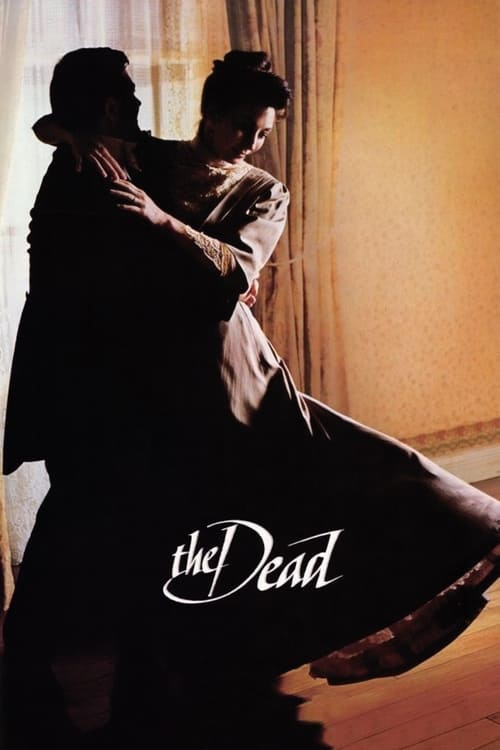
The Dead
1987 · John Huston
For a quiet, contemplative night when you want something short, beautiful, and profound — the kind of film you sit with in silence afterward. A gentle watch that earns a deep ache; keep it for when you're ready to feel it.
What it's about
Dublin, the Feast of the Epiphany, 1904: two elderly sisters host their annual dinner and dance, an evening of songs, speeches, too much drink, and old acquaintances. Among the guests are Gabriel Conroy and his wife Gretta — and as the party winds down through the snow, a piece of music stirs a memory in her that will quietly upend everything Gabriel thought he knew about his marriage.
The experience
Gentle, unhurried, and deceptively slight — for most of its 83 minutes you're simply at a lovely party — until the final movement lands with a tenderness and sorrow that can leave you wrecked. It's a film that ends far larger than it began.
Performances
Anjelica Huston is luminous as Gretta, and Donal McCann does extraordinary interior work as Gabriel — a man's entire self-understanding shifting almost entirely behind his eyes.
The craft
John Huston, in his eighties and directing from a wheelchair on oxygen, adapted James Joyce's famously 'unfilmable' novella with total confidence in stillness: warm candlelit rooms, song performed in full, and a closing passage of image and voice that ranks among the most beautiful endings ever filmed. It was his final film, and every frame feels like a leave-taking.
Why it matters
Released after Huston's death, it became one of cinema's great farewells — a career of adventure pictures closing on its most delicate work — and remains the benchmark for filming supposedly unadaptable literature.
Snapshot
John Huston's forty-seventh and final film is an eighty-three-minute chamber piece adapted from the closing novella of James Joyce's Dubliners (1914). It observes a single evening — the Misses Morkan's annual dance on the Feast of the Epiphany, 6 January 1904 — from the arrival of the first guests through supper, speeches and songs, to the cab ride back through the snow and a hotel room where Gretta Conroy (Anjelica Huston) tells her husband Gabriel (Donal McCann) about a boy who died for love of her when she was seventeen. Almost nothing happens; then everything does. Huston, in his eighties, immobilised by emphysema and directing on supplemental oxygen from a wheelchair, made a film about a man discovering he has never known his wife and has never truly been alive — and died before it opened. The coincidence of subject and circumstance is real, and it has shaped the film's reputation ever since, sometimes at the expense of how precisely it is made.
Industry & production
The Dead was assembled outside the studio system, in the manner of most of Huston's late work: an international package built around a director whose name still opened doors and whose commercial ceiling was modest. It was produced by Wieland Schulz-Keil and Chris Sievernich, who had worked with Huston on Under the Volcano (1984), through Liffey Films, with British finance and participation from Zenith Productions, and released in the United States by Vestron Pictures. That last detail places the film squarely in its moment. Vestron was a home-video distributor that had turned its cassette revenues into a theatrical production arm; 1987 was the year it released Dirty Dancing. An adaptation of a Joyce novella with no stars beyond Anjelica Huston, no plot to speak of, and a running time under ninety minutes existed because the ancillary market had temporarily made such films financeable.
The production's decisive fact is that Huston could not travel. The Dublin of the film was built and shot in California — the interiors on a soundstage in Valencia, with exterior and landscape material gathered in Ireland by a second unit. Huston worked from a wheelchair, tethered to oxygen, frequently watching the action on a video monitor from outside the set rather than beside the camera, and communicating with actors between takes. Accounts from the production consistently describe him as lucid and exacting throughout; the physical arrangement changed his access to the set, not his control of it.
He died on 28 August 1987, during post-production, having seen the film in rough form but not in its final release version. It opened in the United States that December and was nominated for two Academy Awards: Best Adapted Screenplay for Tony Huston, the director's son, and Best Costume Design for Dorothy Jeakins, who had dressed Huston's films since The Unforgiven (1960) and The Night of the Iguana (1964).
Technology
Technologically the film is deliberately unassuming: 35mm, spherical, a period interior lit largely to the logic of gas and oil lamps and candles. Its one genuine dependency on the state of the art is stock speed. The faster tungsten-balanced negatives that had become standard by the mid-1980s made it practical to key a feature-length interior to visible practical sources without either flattening the image with fill or crushing the shadows — the difference between a period room that looks lit and one that looks inhabited.
The other technology that matters is the video monitor. Video assist had been in use for two decades by 1987, but here it functioned less as a convenience than as a prosthesis: it is what allowed a director who could not stand at the camera to direct at all. It is worth saying plainly that the film records a late-career adaptation to infirmity that video tap made possible, and that this is a small but real instance of a tool changing who is able to work.
Snow, the film's governing image, is entirely artificial in the studio material — a stage effect asked to carry the weight of Joyce's final paragraph.
Technique
Cinematography
Fred Murphy's photography is the film's quiet triumph. The Morkan house is rendered in warm, low-key amber — lamplight, firelight, the gleam of a laid table — against the cold blue-white of windows and the street. The camera is mobile but unhurried: it drifts among the guests during the first act, picking up conversations mid-sentence and abandoning them, so that the party is presented as an environment to be moved through rather than a scene to be covered. Compositions are frequently crowded and slightly off-center, with figures cut by doorframes and banisters, which produces the sensation of overhearing rather than watching.
Two set-pieces reverse this method. The supper table is shot in a sustained sequence of shot–reverse–shot and slow lateral movement that ties the guests into a single social body — the film's most conventional passage and its most generous. And the moment when Gabriel looks up the staircase and sees Gretta arrested by the sound of a tenor singing "The Lass of Aughrim" isolates her in near-silhouette against the landing, an image Gabriel reads as a painting and misreads completely. The last movement leaves the interiors entirely for snow-covered Irish landscape — fields, water, a ruined abbey, a graveyard cross — under Gabriel's closing monologue.
Editing
Roberto Silvi, Huston's editor since Wise Blood (1979), cuts the party loosely and the hotel room tightly. The first hour tolerates dead air, overlapping talk and digressions that no plot requires; the film is confident enough to let Freddy Malins be tediously drunk in real time. The rhythm contracts sharply after Gretta begins to speak, and the final sequence abandons cutting-for-continuity altogether for a montage of landscapes keyed to the cadence of Joyce's prose. The transition from the cab to the hotel is the hinge: the film changes register without changing gear.
Mise-en-scène / staging
Stephen Grimes, production designer on Huston films going back to The Misfits (1961), built a house of stacked, adjoining spaces — hall, staircase, drawing room, supper room — and the staging exploits the sightlines between them constantly. Characters are overheard through doorways; the camera holds on an empty hall while music continues off-screen. The blocking is theatrical in the best sense, drawn from the ensemble stagecraft of the Irish theater, with actors arranged in shifting conversational clusters rather than shot-friendly rows. Jeakins's costumes and the dressing of the supper table do heavy expository work: this is a household of decayed gentility maintaining a ritual slightly beyond its means.
Sound
Music is not underscore here but event. The evening is organized around performances — Mary Jane's academy piece at the piano, Aunt Julia's frail rendition of "Arrayed for the Bridal," the tenor Bartell D'Arcy singing "The Lass of Aughrim" — and the film treats each as something the characters must sit through, applaud, and privately judge. Alex North's original music is chamber-scaled and sparing, drawn toward Irish air and salon idiom, and it withdraws almost entirely from the hotel scene. The ambient track is dense with the sounds of a house in use: cutlery, coughing, the door, feet on stairs. The closing monologue is delivered in voice-over by Donal McCann over near-silence and wind, the one moment where the film's sound design admits it is inside a man's head.
Performance
The casting is the film's other great decision: a company drawn largely from the Irish stage — Donal McCann, Donal Donnelly, Marie Kean, Dan O'Herlihy, Helena Carroll, Cathleen Delany, Ingrid Craigie, with the genuine Irish tenor Frank Patterson as D'Arcy — playing with the unforced ensemble timing that only long theatrical practice produces. McCann's Gabriel is a study in small vanities: the tug at the waistcoat, the rehearsed speech, the wince at Molly Ivors calling him a West Briton. Anjelica Huston, an Oscar winner two years earlier for her father's Prizzi's Honor and raised partly in County Galway, is peripheral for most of the film and then carries its last fifteen minutes in a performance built almost entirely out of exhaustion and reluctance rather than lyricism.
Narrative & dramatic mode
The film's structure is a wager: roughly an hour of plotless social observation, then a reversal that retroactively reorganizes everything preceding it. This is Joyce's architecture, and Huston keeps it intact, resisting the adapter's temptation to seed conflict earlier. The mode is Chekhovian — accumulated trivia, deflected feeling, an ending in recognition rather than action. The one substantial interpolation, Mr. Grace's recitation of the Lady Gregory translation of "Donal Og" ("Broken Vows"), is an invention of the adaptation, added to prepare the ground for Gretta's revelation. Critics have argued both sides of it ever since: it makes the film's structure legible, and it slightly softens the ambush Joyce sprang.
The larger adaptation problem is interiority. Gabriel's epiphany happens in prose, in the mind, and the film's solution — retaining Joyce's words as voice-over over landscape — is frankly literary. It works because the preceding eighty minutes have earned the right to be told rather than shown.
Genre & cycle
The Dead belongs to the mid-1980s prestige literary adaptation, the cycle that produced Merchant Ivory's A Room with a View (1985) and its many imitators, and it shares that cycle's period-interior craft. It differs in refusing consolation: the past here is not a warm room but an unlit one. It also completes an informal late-Huston trilogy of adaptations of supposedly unfilmable novels — Wise Blood (1979), Under the Volcano (1984), The Dead — in which the director repeatedly took on prose whose power lay in voice rather than incident. Within Joyce cinema it stands beside Joseph Strick's Ulysses (1967) and A Portrait of the Artist as a Young Man (1977), and is generally judged the more successful film, partly because the novella's scale suits a feature and partly because Huston adapted Joyce's manner rather than merely his events.
Authorship & method
Huston's late method was collaborative and unfussy: cast well, build a real space, stage the scene, and let the actors play it. He worked here with the collaborators of a lifetime — Grimes on design, Jeakins on costume, Silvi cutting, and Alex North composing, as North had for The Misfits, Wise Blood and Prizzi's Honor. The screenplay by Tony Huston, his first produced feature script, is unusually faithful, retaining large stretches of Joyce's dialogue verbatim; the adaptive labor went into selection, into the "Donal Og" interpolation, and into deciding what could be carried by faces. Fred Murphy, the relative newcomer among the principals, supplied the visual scheme.
The film is also, unavoidably, a family document — the father directing the daughter in a story about a man confronting the dead, with the son writing. Huston did not, so far as the record shows, describe it as a valediction while making it, and treating it purely as autobiography flattens a film whose craft is impersonal and exact.
Movement / national cinema
Huston took Irish citizenship in 1964 and lived for years at St. Clerans in County Galway, and the film's relation to Ireland is genuine but oblique: an American film, made in California, about the Anglo-Irish and Catholic middle class of 1904 Dublin, drawing its performers from the Abbey tradition. It arrived during a lean stretch for indigenous Irish film — the Irish Film Board, established in 1981, was defunded in 1987 and not restored until 1993 — so it stands somewhat apart from the emerging native cinema of Bob Quinn, Cathal Black, Pat Murphy and Neil Jordan rather than within it.
Its politics are period-specific and pointed. Molly Ivors's needling of Gabriel about the Gaelic League, the Aran Islands and his reviewing for a unionist paper stages the cultural-nationalist argument of the Revival years exactly, and the film keeps Joyce's refusal to resolve it.
Era / period
Two eras are in play. The film's 1904 is the Ireland of the Literary Revival, pre-Rising, pre-partition, a society of parlor recitals and coded loyalties whose paralysis Joyce diagnosed from Trieste. The film's 1987 is late-Reagan Hollywood, where such a project could only be made at the margins, on video-derived capital, with a director whose reputation dated to The Maltese Falcon (1941). The film is a period piece made by a man who was himself, by then, a period.
Themes
Joyce's governing subject in Dubliners is paralysis, and the film keeps it: a society performing continuity — the same guests, the same songs, the same goose — over an awareness that its forms are hollow. Around this cluster hospitality and its obligations; the generosity of the aunts set against Gabriel's self-regarding warmth; nationalism and cosmopolitanism as rival forms of self-deception; and above all the unknowability of another person. The film's central irony is that Gabriel's tenderness toward his wife is a form of possession, and that its collapse is the closest thing to grace he is granted.
The dead are everywhere before Michael Furey is named: Aunt Julia singing a bridal song she can no longer sustain, a recitation of a woman abandoned, a monk's coffin invoked at supper, the old tenors nobody remembers. Snow — falling on the living and the dead alike — supplies the final leveling image, and the film is honest enough to leave it ambiguous whether Gabriel's last vision is an awakening or a surrender.
Reception, canon & influence
Reception was strong and remains so. The film was widely praised on release for its restraint and its ensemble playing, appeared on numerous American year-end lists for 1987, and drew two Academy Award nominations (adapted screenplay, costume design). Reservations, where they surfaced, concerned the voice-over ending and the "Donal Og" interpolation, and the difficulty of separating admiration for the film from sentiment about the circumstances of its making. Its critical standing has been durable rather than fashionable: it is regularly cited among the best literary adaptations in English-language cinema and among the strongest final films by a major director, and it has generated a substantial secondary literature in Joyce studies, where it is treated as a serious critical reading of the novella rather than an illustration of it.
Backward, the film draws on Joyce above all; on Huston's own late, patient style as developed in Fat City (1972) and Wise Blood; on the ensemble stagecraft of the Irish theater; and on the long tradition of the party-as-social-anatomy that runs from Renoir onward — an affinity rather than a documented borrowing.
Forward, its influence is real but diffuse, as befits a film with no imitable hook. It is a standing reference point in two conversations: how to film interior consciousness without collapsing into illustration, and how to build a feature around a meal. Its most direct descendant is adjacent rather than cinematic — the Richard Nelson and Shaun Davey musical James Joyce's The Dead, which reached Broadway in 2000 and drew on the novella rather than the film, but arrived in a culture where the story's dramatic viability had been demonstrated. For Anjelica Huston it consolidated a reputation as a screen actress of the first rank. And for John Huston it produced the rarest thing in a long career: a last film that reads as a summation without ever announcing itself as one.
A Deleuzian reading
A man stands at the foot of a staircase with his coat over his arm, looking up.
The full Deleuzian reading of The Dead →
Reception
Acclaimed on release as a miraculous farewell — Huston died months before it premiered — and its stature has only grown; it now sits near the top of nearly every 'greatest final films' conversation.
How The Dead was received, from release to now →
How to watch The Dead: what to notice on a first viewing
- Watch the camera drift from one conversation to another without settling. Huston moves through the party picking up talk mid-sentence and abandoning it, treating the room as a space to wander rather than a scene to cover. You end up feeling like a guest overhearing the party, not an audience watching a scene.
- Notice how often a doorframe or banister cuts across a character's body. Stephen Grimes built the house as stacked adjoining rooms, and the camera keeps framing people through thresholds instead of head-on. It produces the sensation of overhearing a private house rather than watching a staged scene.
- Notice that every song or recitation is performed live, not scored over. Mary Jane's piano piece, Aunt Julia's frail ballad, and the tenor's song are all things the guests must sit through, applaud, and privately judge. The music is a social event in the room, not a mood laid over it from outside.
- Watch Gabriel tug his waistcoat and rehearse small gestures before he speaks. McCann plays Gabriel through a string of small physical vanities, a tug here, a flinch there, rather than through anything he says out loud. You are reading a whole social position off his body before the film ever explains it.
- Notice how carefully the supper table is dressed for this one night. Jeakins's costumes and the laid table suggest a household keeping up a ritual that is slightly beyond what it can actually afford. The evening's abundance is doing quiet work, telling you what this family is straining to maintain.
The whole guide to watching The Dead, with the keys for a rewatch →
Influences: the films it descends from and the films it influenced
- The Rules of the Game (1939) — Renoir stages the château party in depth through open doorways so that guests and servants remain visible to one another in a single frame — the party-as-social-anatomy structure and the adjoining-room sightlines that let Huston hold parlor, hall and supper room in continuous relation.
- The Magnificent Ambersons (1942) — The ball sequence's unbroken glide from room to room, the staircase used as the house's emotional axis, and an elegiac narrated coda laid over images rather than action — the exact grammar of Huston's staircase silhouette and voice-over ending.
- Odd Man Out (1947) — Reed filled the supporting roles with Abbey Theatre players (F.J. McCormick, Cyril Cusack, Denis O'Dea) and lit Belfast interiors from lamps visible in shot, establishing the Abbey-ensemble-plus-practical-lamplight combination Huston recruited wholesale.
- The Quiet Man (1952) — Ford's treatment of the Abbey company as a screen repertory — comic character business allowed to play out in unbroken group takes around a hearth, with diegetic song rising from the company itself — is the ensemble method behind the Morkan sisters' parlor.
- Le Plaisir (1952) — Ophüls adapts Maupassant by keeping the author's narrating voice on the soundtrack rather than dramatizing it, the precedent that licenses transferring Joyce's closing prose intact as voice-over.
- The Leopard (1963) — Visconti gives the last hour to a single ball and registers the protagonist's reckoning with mortality entirely as reaction inside a social occasion — the structural model for withholding Gabriel's revelation until the party has dispersed.
- Ulysses (1967) — The first sustained attempt to carry Joycean interior monologue as first-person voice-over; Tony Huston's script follows the device but disciplines it, reserving it for one final passage instead of running it throughout.
- Fat City (1972) — Huston's late working method in embryo — build a real room, light it from its own sources, and let a long take run on the actors' faces rather than cutting for emphasis.
- Wise Blood (1979) — Adapting a prose stylist by retaining dialogue verbatim and trusting selection over invention, scored by Alex North in sparse small-ensemble cues rather than continuous underscore — both practices carried directly into The Dead.
- Fanny and Alexander (1982) — Nykvist's lamplit interiors keep the practical source in shot while a family Christmas migrates room to room, the camera treating doorways as frames within the frame.
- Under the Volcano (1984) — Huston's valedictory literary adaptation perfects the late method seen here — compressing an interior prose masterwork into observed, atmospheric drama near the end of his life.
- The Age of Innocence (1993) — Keeps Wharton's narrating voice as voice-over across a film built from formal dinners, lights period rooms from lamp and candle, and places the decisive disclosure in the carriage after the party breaks up.
- The Remains of the Day (1993) — Builds the film on what a face declines to show, using doorframes and half-closed doors to occlude the instant of feeling — the doorframe-occlusion grammar of Gretta on the stairs.
- Mrs Dalloway (1997) — Takes the other great modernist party novel and solves its interiority the same way — voice-over plus cut-in memory triggered during the gathering itself.
- Festen (1998) — Detonates a long-delayed revelation inside the ritual of the after-dinner speech, letting the table's social choreography — who rises, who stays seated — do the work of exposition.
- Gosford Park (2001) — The drawing-room performance at the piano is overheard from stairs, doorways and the servants' corridor, mapping an entire social order by who can hear the music from where.
- Brooklyn (2015) — The Christmas-hall scene in which an old labourer sings 'Casadh an tSúgáin' unaccompanied while the room falls silent is an explicit reprise of the diegetic Irish song as the film's emotional pivot.
- Big Night (1996) — Huston's chamber staging of a holiday dinner — the carving ceremony, the toasts, an ensemble arranged around a single table, and a closing movement made entirely of what goes unsaid — is the model for Big Night's dinner and its silent coda.
- Babette's Feast (1987) — A whole feature organized around the preparation, serving and consumption of one meal, with each guest's buried history made legible only through faces at the table.
- Distant Voices, Still Lives (1988) — Davies makes diegetic parlor and pub singing the film's principal emotional register — a song performed in full by a character, stopping the drama the way 'The Lass of Aughrim' does.
Similar films
- Babette's Feast (1987) — influence & lineage
- The Remains of the Day (1993) — influence & lineage
- Distant Voices, Still Lives (1988) — influence & lineage
- Under the Volcano (1984) — shared sensibility
- Nostalgia (1983) — shared sensibility
- Long Day's Journey Into Night (1962) — shared sensibility
- Goodbye, Dragon Inn (2003) — shared sensibility
- Amour (2012) — shared sensibility