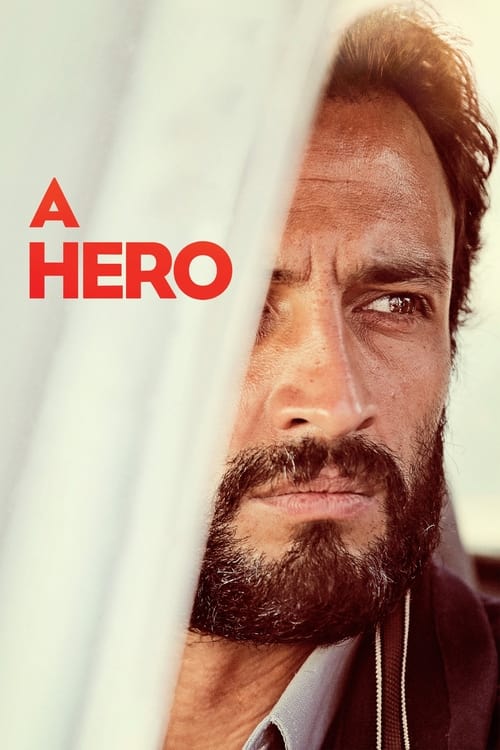
A Hero
2021 · Asghar Farhadi
A Hero came wrapped in a plagiarism suit from his own former student, which Iranian courts partly upheld — turning the moral-dilemma master into the subject of his own moral-dilemma discourse.
For when you want a film to chew on for days and debate over dinner — a moral puzzle rather than an escape. Choose it when you're up for tension of the ethical kind, not the jump-scare kind.
What it's about
Rahim, a soft-spoken sign-painter imprisoned in Shiraz over an unpaid debt, gets a two-day furlough to persuade his creditor to drop the complaint. When a bag of gold coins falls into his hands and he chooses to give it back, the prison, a charity, and the local media seize on his honesty and make him a public hero — and the film watches what that manufactured halo does to a man under scrutiny, and what small evasions it takes to keep a good story intact.
The experience
A slow-tightening knot: no villains, no violence, just an escalating tangle of good intentions, half-truths, and institutional self-interest that gets almost unbearably tense. You'll argue with yourself about who's right the whole way through.
Performances
Amir Jadidi is remarkable as Rahim — an eager-to-please smile masking pride and desperation, so that you keep recalibrating how much you trust him from scene to scene.
The craft
Asghar Farhadi builds suspense entirely out of screenwriting: each scene adds one small, plausible complication until an act of honesty has become a trap. The style is invisible on purpose — handheld realism, no score to tell you what to feel — which is exactly what makes the moral pressure feel like it's happening to you.
Why it matters
A Grand Prix winner at Cannes that confirmed Farhadi as world cinema's foremost dramatist of everyday moral compromise, and a pointed portrait of reputation-making in the social-media age.
Snapshot
A Hero (Ghahreman, قهرمان) is a Persian-language moral drama written and directed by Asghar Farhadi, his first feature shot in Iran since The Salesman (2016) and the first set in his native Shiraz rather than Tehran. Running roughly two hours and eight minutes, it follows Rahim (Amir Jadidi), a sign-painter imprisoned for an unpaid debt, who during a two-day furlough comes into possession of a handbag of gold coins. What begins as a possible means of settling with his creditor becomes, when he decides to return the money, a public-relations event: the prison, a charity, and local media seize on his apparent honesty and cast him as a model citizen. The film then watches that manufactured heroism corrode under the pressure of skepticism, bureaucratic self-interest, and the small evasions Rahim commits to sustain the story. It premiered in competition at the 2021 Cannes Film Festival, where it shared the Grand Prix — the festival's runner-up prize — with Juho Kuosmanen's Compartment No. 6. It is a characteristic Farhadi construction: a domestic and civic thriller assembled entirely out of ethical ambiguity, in which no character is a villain and every well-intentioned choice compounds the trap.
Industry & production
A Hero is a France–Iran co-production, developed through Farhadi's own production apparatus in Iran together with French partners with whom he had long worked, including Memento (the Memento Films group had distributed and helped produce his earlier European-facing work). Financing on this model — Iranian creative control paired with French co-production and international sales — had by 2021 become Farhadi's established route to global release, the same structure that carried A Separation and The Salesman to Academy Awards. International rights placed the film with Amazon Studios for United States distribution, reflecting the streaming-era appetite for prestige festival titles. Shot on location in and around Shiraz, the production made deliberate use of the city's texture — its heritage sites, prison, and administrative offices — as an authenticating backdrop. The choice of Shiraz, Farhadi's hometown, is itself a production fact worth noting: it moved him out of the Tehran milieu that dominates his filmography and into a provincial register, though the specific extent of location versus constructed sets is not something I can detail with confidence.
The production's afterlife became inseparable from a plagiarism dispute. Azadeh Masihzadeh, a former student who had made a documentary (All Winners, All Losers) about a real Shiraz prisoner who found and returned gold, publicly alleged that A Hero derived from her film and its subject. Farhadi maintained the story came from a real case he had independently encountered and pursued legal action; Masihzadeh countered. The matter was litigated in Iranian courts and widely covered in the international trade press, with conflicting reporting about the outcome. I will not assert a definitive verdict, because the public record as reported was contested and I cannot verify a final ruling — but the controversy is real, documented, and materially shaped the film's awards campaign.
Technology
A Hero is a digitally originated feature in the naturalistic mode Farhadi had settled into across the 2010s, favoring available and practical light, location sound, and an unobtrusive camera over any conspicuous technological signature. There is no reliance on visual effects, elaborate rigs, or stylized capture; the "technology" of the film is essentially transparent, subordinated to performance and blocking. One area where contemporary technology enters as subject rather than apparatus is the smartphone and the short video clip: the plot turns on recorded footage, viral circulation, and the way a phone camera can both make and unmake a reputation. The film is acutely a product of the social-media era in its dramatization of how images travel, are doubted, and demand verification — but this is thematic rather than a matter of production tooling.
Technique
Cinematography
The photography is observational and handheld-inflected, built on medium shots, shallow but unshowy depth, and a camera that tends to follow rather than anticipate its subjects — the house style Farhadi and his collaborators had refined over several films. The cinematography is credited to Ali Ghazi (co-camera credits on the production are plausible but I cannot confirm the exact division with certainty). The visual grammar keeps the frame busy with mid-ground obstruction — doorways, glass, vehicles, crowds — so that the audience is often positioned as an onlooker straining for a clear view, a formal analog to the film's concern with partial truth. Shiraz's honey-colored stone and heritage sites give the images a warmth that quietly ironizes the moral murk of the story.
Editing
Editing is by Hayedeh Safiyari, Farhadi's long-standing editor, whose cutting across his work prizes legibility of information over rhythm-for-its-own-sake. The film's suspense is fundamentally an editorial achievement: scenes are built as escalating negotiations, and the cut controls exactly when a new fact, a new doubt, or a new party enters the room. Safiyari's restraint — holding on faces during charged conversations, resisting the reaction-shot reflex — forces the viewer to weigh testimony in real time, which is the film's central experience.
Mise-en-scène / staging
Farhadi is, at root, a stager of rooms. A Hero is organized around institutional and domestic thresholds — the prison visiting area, a charity's offices, a shopkeeper's counter, a family apartment — and the drama is choreographed as people entering and leaving these spaces, each arrival shifting the balance of pressure on Rahim. Bodies are arranged to encode hierarchy and complicity: officials behind desks, family members crowded into small flats, the creditor Bahram (Mohsen Tanabandeh) framed as an immovable obstacle. The staging withholds privileged vantage; we rarely see more than the characters do.
Sound
The soundscape is location-based and dense with the ambient life of the city and its institutions — telephones, corridors, traffic, overlapping voices. Consistent with Farhadi's general aversion to non-diegetic scoring, music is used sparingly if at all as an emotional guide, so that tension arises from speech, silence, and environmental sound rather than from an underscore. I am not able to confirm the composer credit or the precise extent of any original music, so I will not attribute a score; what is safe to say is that the film's aural strategy is naturalistic and dialogue-forward.
Performance
Performance is where the film lives. Amir Jadidi's Rahim is built on an ingratiating, slightly evasive smile — a man who wants to be liked and keeps choosing the path of least resistance, so that his likability becomes the very thing that indicts him. Mohsen Tanabandeh's Bahram is the film's hardest and most sympathetic antagonist: aggrieved, righteous, and correct often enough to unsettle the audience's alignment with the hero. Sahar Goldust plays Farkhondeh, Rahim's fiancée and the one who initially finds the money, and the supporting ensemble — including Rahim's young son, whose stammer becomes a painful instrument in the family's public appeal — sustains the naturalist illusion that these are ordinary people caught in an ordinary catastrophe. Farhadi's direction of actors, honed in the theater, yields the overlapping, interrupting, socially specific speech that is his signature.
Narrative & dramatic mode
The dramatic mode is the Farhadian moral thriller: a structure borrowed from detective and courtroom fiction but applied to everyday ethics, in which the "mystery" is not who did a crime but what actually happened, who is telling the truth, and what the truth is worth. The screenplay operates on strict information economy — each scene grants or revokes a piece of knowledge — and on the domino logic by which a single benign lie (or a single omission) requires another to shore it up. There is no melodramatic villainy and no tidy exoneration; the film is engineered to keep the viewer perpetually re-adjudicating Rahim's case. This is dramaturgy descended from Ibsen and Arthur Miller (Farhadi's theatrical touchstones) as much as from cinema: the machinery of consequence is social, and the tragedy is that decency and self-interest are almost impossible to disentangle.
Genre & cycle
Formally the film is a social-realist drama with the pacing and grip of a thriller. It belongs to the strong Iranian tradition of ethically-centered realism, and within Farhadi's own oeuvre it forms part of a loose cycle of "one small deception spirals" narratives that includes About Elly, A Separation, and The Salesman. It also participates in a broader 2010s–2020s cycle of films about reputation in the age of virality — the way public opinion, mediated by phones and institutions, becomes a court that convicts and acquits faster than any real one. It is not a genre film in the marketing sense; it is prestige art-house cinema that adopts genre tension as a delivery system for moral inquiry.
Authorship & method
A Hero is an auteur work in the fullest sense: Farhadi wrote and directed it, and its method is recognizably his — screenplays developed over long gestation, dialogue that mimics the texture of real argument, ensemble casts of superb Iranian actors, and a refusal to supply the audience with a morally safe vantage. His working method treats the script as an almost architectural object of withheld and released information, and his direction subordinates every technical department to that structure. The key collaborators reinforce the continuity of the project: editor Hayedeh Safiyari, a repeat partner whose cutting is central to the film's suspense; cinematographer Ali Ghazi, working in the naturalist register Farhadi favors; and a company of actors led by Amir Jadidi and Mohsen Tanabandeh. On music, as noted, I cannot responsibly name a composer, and Farhadi's practice in any case minimizes score. The plagiarism dispute complicates the pure auteur narrative by raising, in public and in court, the question of the film's origins — a question I flag as genuinely unresolved in the reported record rather than settle.
Movement / national cinema
The film sits within post-revolutionary Iranian cinema, one of the most internationally celebrated national cinemas of the past half-century, whose lineage runs from Abbas Kiarostami, Mohsen Makhmalbaf, and Jafar Panahi through Farhadi's own generation. Farhadi represents a particular strain of that cinema: urban, middle-class, dialogue-driven realism concerned with the frictions of law, class, gender, honor, and religion in contemporary Iran, rendered through domestic and civic microcosms rather than overt political statement. His work has functioned as Iran's most reliable bridge to Western prestige audiences and awards bodies — Iran twice won the Academy Award for Best Foreign Language / International Feature Film with his films — even as filmmaking inside Iran remained subject to censorship and state pressure. A Hero's move to Shiraz slightly widens the geographic frame of that project while keeping its social preoccupations intact.
Era / period
Made and set in the early 2020s, A Hero is a film of its moment in two respects. First, it is steeped in the contemporary reality of Iranian economic hardship — debt, currency pressure, and the institution of imprisonment for unpaid debt provide the entire premise, grounding the story in a specific socio-economic present. Second, it is a film about the smartphone-and-social-media era's epistemology of reputation, in which a viral clip can manufacture a saint and a rumor can unmake one overnight. Its release also coincided with a difficult period for Iranian cinema's international standing and for Farhadi personally, given the awards controversy; the film thus arrives as both a product of, and a casualty of, its exact historical juncture.
Themes
The governing theme is the gap between truth and image — between what a person actually did and the story a society needs to tell about it. Around that core, the film braids: honor and shame as social currencies; the machinery of public opinion and its acceleration by media; institutional self-interest (a prison and a charity that need a good news story); the moral corrosion of the "small" lie; class and debt as engines of desperation; and the particular cruelty of asking a decent-but-weak man to be a symbol. Recurrent Farhadi concerns — the fragility of reputation, the instability of testimony, the way love and obligation entangle people in one another's downfalls, and the impossibility of a clean choice — all recur here in concentrated form. The title's question mark is the thesis: heroism, the film argues, is less a property of actions than a verdict rendered by others for their own reasons.
Reception, canon & influence
Critical reception was strong. The Cannes Grand Prix (shared with Compartment No. 6) confirmed Farhadi's standing among the festival's most decorated contemporary auteurs, and reviews broadly praised the film's moral intricacy, Jadidi's performance, and the screenplay's clockwork suspense, while some critics judged it a refinement of Farhadi's method rather than a departure from it. Its awards trajectory was then entangled with the plagiarism litigation: selected as Iran's official submission for the Academy Awards' Best International Feature Film, it advanced to the shortlist but was not among the final nominees, a disappointment widely linked in coverage to the swirl of controversy. (It also drew further festival and precursor recognition on the international circuit.) I am flagging specific award counts I cannot verify precisely and will not enumerate them.
Influences on the film run backward to Farhadi's own filmography — most directly the deception-and-consequence architecture of A Separation and The Salesman — and, beneath that, to the social-problem dramaturgy of Ibsen and Arthur Miller and the ethical realism of Kiarostami-era Iranian cinema. Influence from the film is best assessed cautiously given its recency: its most tangible legacy may be as a case study in the ethics of adaptation and authorship, owing to the public dispute over its origins, and as a durable entry in the "reputation in the age of virality" conversation. Its lasting critical position is likely to be as a strong, representative Farhadi work rather than a field-altering one — a consolidation of his signature moral thriller at the height of his international influence. Where the longer historical verdict lands, the record in 2021–2022 was too fresh, and too clouded by controversy, to state with certainty.
Reception
Landed at Cannes 2021 to warm reviews and the Grand Prix, but the glow faded fast — a real-life plagiarism dispute and a surprise Oscar snub (shortlisted but not nominated for Best International Feature) complicated its afterlife, and it's now often filed as 'good, not top-shelf Farhadi.'
How A Hero was received, from release to now →
Influences: the films it descends from and the films it influenced
- About Elly (2009) — Prototype for the snowballing lie: an ensemble's collective cover-story compounds under questioning, staged in overlapping naturalist argument where blame diffuses across every character rather than resolving onto one culprit.
- A Separation (2011) — Establishes the exact information-economy architecture A Hero refines — a single half-truth metered out through legal and familial hearings so the audience never holds a morally safe vantage, cut by the same editor Hayedeh Safiyari for escalating suspense.
- The Salesman (2016) — Direct sibling in the honor-and-shame engine — a wronged man weighing revenge against dignity — and shares the explicit Arthur Miller dramaturgy of ordinary moral culpability that A Hero inherits.
- Beautiful City (2004) — Ancestor whose plot machinery is nearly identical: a blood-money/forgiveness negotiation where a debt and a family's mercy must be bargained across bureaucratic thresholds, the moral outcome hinging on withheld financial fact.
- Fireworks Wednesday (2006) — Introduces the threshold-choreography and mid-ground obstruction Farhadi reuses — an observer wedged in doorways and half-seen through frames, learning a deception in fragments as bodies block the lens.
- The Past (2013) — Sibling in the technique of excavating a buried piece of information through sustained domestic argument, where each revealed fact retroactively re-implicates a character the audience had trusted.
- Close-Up (1990) — Foundational ancestor of the truth-versus-image theme: a man's fabricated identity tried in a real courtroom, blurring documentary and fiction so that reputation and authenticity become the film's actual subject.
- Where Is the Friend's House? (1987) — Source of the Kiarostami-era ethical realism A Hero descends from — an ordinary protagonist's small moral quest filmed in patient, mid-ground observational long takes without melodramatic scoring.
- Certified Copy (2010) — Sibling meditation on authenticity versus performance, dramatizing how a persona and a 'true' self become indistinguishable — the same suspicion of surface image that drives A Hero's viral hero-myth.
- Bicycle Thieves (1948) — Neorealist ancestor of the honest man cornered into a compromising act by debt and public witness, using non-heroic ensemble and street-level social observation as the ethical frame.
- Rosetta (1999) — Ancestor of the handheld-observational moral thriller — a camera pinned to a protagonist's back as economic desperation forces a dishonest choice, refusing score and legible reaction shots.
- Two Days, One Night (2014) — Sibling built on the same door-to-door negotiation structure, where a person must plead their case repeatedly and each encounter re-weights the moral ledger, shot in restrained handheld realism.
- The Hunt (2012) — Sibling in the mechanics of reputation collapse — a single unverified claim spreads through a community until social shame overrides truth, exactly A Hero's honor-in-the-age-of-rumor dynamic.
Similar films
- A Separation (2011) — influence & lineage
- Close-Up (1990) — influence & lineage
- About Elly (2009) — influence & lineage
- The Seed of the Sacred Fig (2024) — influence & lineage
- Two Days, One Night (2014) — influence & lineage
- Certified Copy (2010) — influence & lineage
- It Was Just an Accident (2025) — shared sensibility
- A Prophet (2009) — shared sensibility