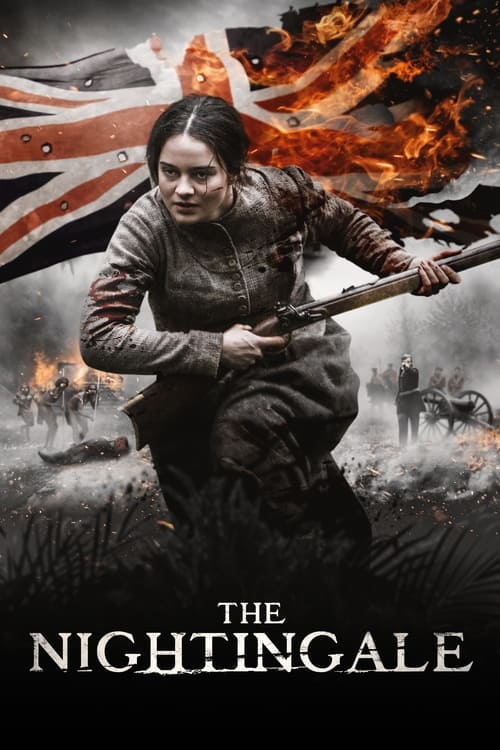
The Nightingale
2018 · Jennifer Kent
Only for when you're braced for a genuinely confronting film and want cinema that refuses to look away — this is challenge viewing, emphatically not a casual evening pick. Come to it when you want to be shaken and left thinking about history's real cost.
What it's about
Tasmania, 1825, at the height of colonial frontier violence. Clare, a young Irish convict woman held in servitude by a British lieutenant, sets out through the wilderness to hunt the man after he commits an atrocity against her family. To survive the bush she hires Billy, an Aboriginal tracker whose people and country have been destroyed by the same empire — and the film becomes the story of two shattered people slowly learning to see each other.
The experience
Harrowing and unflinching — this is a deliberately punishing watch, with depictions of sexual and racial violence that are brutal without being exploitative. It's also gripping, and its moments of tenderness land harder because of everything around them.
Performances
Aisling Franciosi is ferocious and raw as Clare, and Baykali Ganambarr, in his first film role, matches her with a performance of wounded dignity and dry wit that quietly steals the film.
The craft
Jennifer Kent shoots in a near-square frame that boxes the characters in and denies the wilderness any postcard grandeur — the rainforest feels oppressive, alive, and indifferent. The sound design and the film's severe restraint make its violence register as horror rather than spectacle.
Why it matters
A polarizing festival lightning rod that confirmed Kent as one of the most uncompromising directors working, and part of a broader reckoning in Australian cinema with the violence of colonization.
Snapshot
The Nightingale is Jennifer Kent's second feature, a colonial revenge drama set in 1825 Van Diemen's Land — present-day Tasmania — during the frontier violence now remembered as the Black War. Clare Carroll (Aisling Franciosi), a young Irish convict held past the end of her sentence by a British lieutenant, pursues her tormentor across the wilderness after he and his men rape her and murder her husband and infant. She hires Billy (Baykali Ganambarr), an Aboriginal tracker who has lost his own family and country to the same colonial machinery. What begins as a familiar rape-revenge and Western scaffolding turns into a study of two dispossessed people — one colonized woman, one colonized man — inching toward recognition of each other. The film is severe, deliberately hard to watch, and formally austere: shot in the near-square Academy ratio, saturated with rain and mud, and unusually frank about sexual and racial violence. It arrived four years after Kent's breakout horror film The Babadook (2014) and confirmed her as a major, uncompromising authorial voice while provoking real controversy over its depictions of assault.
Industry & production
The film was produced by the Australian company Causeway Films (Kristina Ceyton and Bruna Papandrea are among the credited producers), with backing from Screen Australia and other public-screen agencies — the standard hybrid public-private financing structure of Australian arthouse cinema. It was a modestly budgeted independent production rather than a studio picture, and its scale is legible on screen: intimate cast, remote locations, natural light. Principal photography took place in Tasmania, the setting itself, which was central to Kent's insistence on authenticity of place.
Crucially, the production was built around an Aboriginal consultation protocol. Kent worked with Tasmanian Aboriginal community members and elders — the palawa elder and writer Jim Everett-puralia meenamatta is among those associated with the cultural consultation — to shape the representation of Billy and of Aboriginal Tasmanian experience, and to guide the use of language and cultural material. This process was reported as a precondition of the film's making rather than an afterthought, reflecting a broader shift in Australian screen practice toward Indigenous cultural authority over on-screen representation. The specific mechanics of that consultation are documented mainly through interviews and press rather than a detailed public record, so its full extent is better described than quantified here.
The film premiered in competition at the 2018 Venice Film Festival, where it won the Special Jury Prize and where Baykali Ganambarr — a Yolŋu dancer from Elcho Island in his first screen role — won the Marcello Mastroianni Award for best young performer. It was distributed internationally by IFC Films in the United States and released in Australia through Transmission Films. It played as a specialized arthouse title rather than a wide commercial release; I don't have reliable box-office figures to cite, and its cultural footprint rests far more on critical debate and festival recognition than on gross.
Technology
The Nightingale is a digitally captured film that works hard to look and feel un-modern. Its most consequential technical decision is the aspect ratio: it is framed in the Academy ratio (roughly 1.37:1), the boxy near-square format associated with pre-widescreen cinema. In an era of anamorphic widescreen and 2:1 streaming frames, the choice is pointedly anti-spectacular — it walls the landscape in, presses the characters against the edges of the image, and refuses the panoramic sweep the Western genre conventionally promises. The technology serves a thesis: this is not a frontier of open horizons but of enclosure, entrapment, and claustrophobia.
Beyond the frame, the production leans on naturalistic tools — available and low, motivated light; practical firelight and candlelight for interiors and night scenes; weather (rain, mist, cold) used as a physical medium rather than fought against. The digital capture is graded toward desaturation and darkness rather than the burnished golds of period prestige cinema. The overall approach subordinates technology to a texture of hardship.
Technique
Cinematography
Radek Ladczuk, who also shot The Babadook, photographs the film. The Academy frame and the desaturated, rain-heavy palette are the signatures. Ladczuk favors close, often handheld or shoulder-borne framing that stays with faces and bodies, so that the Tasmanian bush becomes an oppressive surround rather than a vista. Interiors are dim and candle-lit; exteriors are gray, wet, and enclosed by trees. Where a conventional Western would open up the landscape as an emblem of freedom or destiny, Ladczuk's compositions keep insisting on confinement. The violence is often shot with a flat, unflinching directness — neither aestheticized nor cut away from — which is one source of the film's difficulty.
Editing
Simon Njoo, another Babadook collaborator, edits. The film runs long (around two and a quarter hours) and its rhythm is deliberately punishing in the early passages: the assaults are not elided but held, forcing duration on the viewer. Thereafter the cutting settles into the patient tempo of pursuit — the trudge through country, the accretion of exhaustion — punctuated by sudden, sharp eruptions of violence. Recurring dream and memory inserts (Clare's dead husband and child; birds) interrupt the linear chase, giving the edit a haunted, subjective layer beneath its procedural forward motion.
Mise-en-scène / staging
The world is built out of mud, wool, blood, and firelight. Costume and production design render 1820s convict Tasmania as materially miserable — sodden uniforms, rough dwellings, the improvised camps of a march. Kent stages the colonial hierarchy spatially and bodily: the casual, proprietary way soldiers occupy Clare's space; the way Billy is positioned as tool and target. The two birds of the title — Clare, "the Nightingale," made to sing for the men; Billy, who identifies with the blackbird ("Mangana") — are woven into the staging as a motif of caged song and shared dispossession. Landscape is used as antagonist and witness rather than backdrop.
Sound
Jed Kurzel — composer on The Babadook and a frequent collaborator of his brother, director Justin Kurzel — provides the score. It is sparing. The film relies heavily on the naturalistic sound field of the bush (rain, wind, birds, footfalls, breath) and on the human voice, so that music, when it appears, functions as a low, unsettling undertow rather than emotional cueing. Diegetic song is thematically central: Clare sings in Irish, and Billy sings in language, so that voice becomes an assertion of cultural identity against erasure. The restraint of the score keeps the violence from being softened by music and keeps the ambient world present and heavy.
Performance
The film is carried by three performances. Aisling Franciosi's Clare is a study in grief hardening into rage and then bending, incompletely, toward something else; she plays exhaustion and moral cost rather than avenging-heroine cool. Sam Claflin, cast against his romantic-lead image, plays Lieutenant Hawkins as a study in aggrieved, ambitious male entitlement — banal rather than gothic, which makes him more disturbing. Baykali Ganambarr's Billy, a first-time actor, brings humor, wariness, and wounded dignity, and his arc from hired guide to fellow mourner is the emotional pivot of the film; the Venice jury's Mastroianni Award recognized the debut. Damon Herriman appears among the supporting soldiers.
Narrative & dramatic mode
Structurally the film is a chase — a pursuit narrative that borrows the shape of both the Western manhunt and the rape-revenge thriller. But Kent uses that shape to withhold the catharsis those genres promise. The dramatic mode is tragic and interrogative rather than triumphant: revenge here is depicted as corrosive, and the film keeps asking what vengeance costs the avenger and whether it can restore anything. The narrative doubles its protagonists — Clare and Billy each carry near-mirror losses inflicted by the same power — so the story's real movement is not toward a kill but toward mutual recognition across the lines of race that colonialism drew between them. Dream and memory sequences give the film an interior, haunted register beneath the external quest.
Genre & cycle
The Nightingale sits at the crossing of at least three genres and critiques each. As a Western, it belongs to the Australian tradition of frontier films that turn the settler-colonial story into horror rather than myth — a revisionist, anti-mythic Western closer in spirit to the "meat-pie Western" lineage and to The Proposition (2005) than to the American frontier romance; the Academy ratio explicitly refuses the widescreen grandeur of the classic form. As rape-revenge, it deliberately strips the exploitation subgenre of its cathartic pleasures, presenting sexual violence as trauma with lasting weight rather than as a spur to a satisfying vigilante payoff. As historical trauma cinema, it dramatizes the Black War and the near-genocide of Aboriginal Tasmanians. Kent's move in each case is to inhabit a genre in order to negate its usual consolations.
Authorship & method
Kent wrote and directed the film alone, and it is unmistakably authored. Her method, on the record from The Babadook onward, foregrounds emotional truth and controlled dread; here she extends that from domestic horror to historical atrocity. Several key collaborators carry over from The Babadook, making The Nightingale legible as the work of a consistent creative unit: cinematographer Radek Ladczuk, editor Simon Njoo, and composer Jed Kurzel. That continuity accounts for much of the shared sensibility between the two films — the emphasis on dread, restraint, and the physical texture of fear.
What most distinguishes Kent's method here is the ethics of representation. Rather than depict Aboriginal experience from a purely settler vantage, she built the production around Indigenous consultation and cast a first-time Yolŋu performer in a co-lead role, insisting the film be made with cultural authority over Billy's story and language. Kent has also spoken about the difficulty of staging the film's violence responsibly — the choice to make it ugly and non-gratuitous rather than exciting — which is itself a methodological stance about what such images do to an audience.
Movement / national cinema
The film is a signal work of contemporary Australian national cinema and specifically of its ongoing reckoning with the colonial past. It extends a lineage of Australian frontier and settler-violence films — The Chant of Jimmie Blacksmith (1978), The Proposition (2005), Sweet Country (2017) — that use genre to indict the founding violence of the nation. It is also part of a wider movement toward Indigenous authority in Australian screen storytelling, and part of a global wave of women directors reworking genre cinema. Kent's own position — an Australian woman moving from horror into historical drama — links the film to both a national tradition of revisionist frontier film and an international one of feminist genre revision.
Era / period
The film is set in 1825 Van Diemen's Land, in the thick of the Black War, the period of frontier conflict and dispossession between British colonists and Aboriginal Tasmanians that intensified through the 1820s and into the 1830s. Its convict setting, its Irish protagonist, and its portrait of a brutal military and penal order are historically specific to that colonial moment. Made and released in 2018, the film also belongs to its own moment: it landed amid the #MeToo reckoning over sexual violence and in the midst of intensified public debate in Australia about frontier history and Indigenous recognition, both of which shaped how it was received.
Themes
The film's central subject is intersecting oppression — the way patriarchy, empire, class, and race operate through the same colonial apparatus. Clare's subjugation as an Irish convict woman and Billy's as an Aboriginal man are shown as products of one system, and the film's moral arc is the slow, halting solidarity that becomes possible when each recognizes the other's dispossession. Related themes run throughout: the cost and futility of revenge; trauma and grief as ongoing conditions rather than resolved plot points; the colonial genocide of Aboriginal Tasmanians and the erasure of language and country; and voice and song as sites of both coercion (Clare made to sing for the soldiers) and self-assertion (both leads singing in their own languages). The title's caged nightingale crystallizes the film's argument about who is made to perform and who is silenced.
Reception, canon & influence
Critical reception was strong but sharply divided over the film's violence. Many critics praised its formal control, its performances — Franciosi and especially the debut of Ganambarr — and its refusal to make either sexual assault or colonial murder palatable; the Venice Special Jury Prize and Mastroianni Award anchored its festival standing. At the same time, the graphic assaults prompted walkouts and heated debate at festival and public screenings about whether such unflinching depiction is necessary witness or is itself traumatizing; an incident of abuse reportedly shouted at a Venice screening became part of the film's story. That debate — over the responsibility of representing atrocity — is inseparable from the film's reputation.
Influences on the film (backward): it draws on the revisionist Australian frontier Western (notably The Proposition), the rape-revenge exploitation tradition it critiques, and the broader history of settler-colonial trauma cinema; the sensibility of Kent's own The Babadook — dread, restraint, psychological interiority — carries directly into it through her recurring collaborators.
Legacy (forward): it consolidated Jennifer Kent's standing as a serious auteur beyond horror and became a touchstone in critical conversations about depicting sexual and colonial violence on screen, about the ethics of trauma imagery, and about Indigenous consultation and authority in filmmaking. Alongside works like Sweet Country, it belongs to a contemporary current of Australian cinema confronting the frontier honestly. Because it is a recent film, its longer-term canonical position is still settling; what is already clear is its influence on the ongoing debate about how — and whether — cinema should show the worst of history.
Reception
It landed at Venice 2018 as the year's most confrontational premiere — walkouts, controversy, and a Special Jury Prize all at once — and the shock has since settled into respect: it's now widely treated as a serious, uncompromising follow-up to The Babadook rather than a scandal.
How The Nightingale was received, from release to now →
Influences: the films it descends from and the films it influenced
- The Babadook (2014) — ancestor — Kent's own template of controlled dread built with cinematographer Radek Ladczuk, editor Simon Njoo, and composer Jed Kurzel, whose sparse-score restraint and interior psychological framing carry over intact.
- The Proposition (2005) — ancestor — establishes the sun-scorched Australian frontier western where colonial violence is rendered as squalid moral horror rather than adventure, the exact revisionist register Kent transposes to Van Diemen's Land.
- The Virgin Spring (1960) — ancestor — the austere, morally interrogative rape-revenge structure staged in cold natural light, where the assault is withheld from spectacle and vengeance brings no catharsis, the anti-exploitation lineage Kent extends.
- Come and See (1985) — ancestor — first-person immersion in historical atrocity that refuses to make horror thrilling, the ethics-of-witness approach behind Kent's insistence that violence be ugly and non-gratuitous.
- The Searchers (1956) — ancestor — the obsessive cross-country pursuit western organized around racial hatred and a captivity logic, whose vengeance narrative Kent inverts by handing the quest to the colonized.
- Walkabout (1971) — ancestor — the settler/Aboriginal pairing traversing the bush, cut with elliptical dream-and-memory inserts and shot in available light, the doubled cross-cultural journey Kent restructures around Clare and Billy.
- The Chant of Jimmie Blacksmith (1978) — ancestor — an Aboriginal protagonist's retaliatory violence against colonial humiliation dramatized without exoneration or exploitation, the frontier-reckoning tradition Kent inherits.
- Meek's Cutoff (2010) — ancestor — the boxed Academy-ratio revisionist western told at walking pace through natural-light exteriors from a marginalized traveler's vantage, matching Kent's 1.33 framing, held durations, and refusal of frontier grandeur.
- The Piano (1993) — ancestor — female-authored antipodean colonial drama that binds landscape, tactile natural texture, and diegetic song to a woman's interiority, the sensibility Kent's diegetic ballads and close handheld framing descend from.
- Ms. 45 (1981) — ancestor — the grindhouse rape-revenge template of the wronged woman turned avenger, the very exploitation grammar Kent cites in order to critique and de-eroticize it.
- Sweet Country (2017) — sibling — contemporaneous Aboriginal-authored frontier western built on a pursuit across country and unflinching colonial reckoning, the closest craft peer in the current wave of honest Australian frontier cinema.
- True History of the Kelly Gang (2019) — sibling — revisionist Australian frontier film scored by Jed Kurzel in the same abrasive, sparse-drone register, sharing the collaborator-driven sonic dread that underpins Kent's soundscape.
- Utu (1983) — sibling — antipodean colonial revenge set in the New Zealand Wars, structured around a doubled pursuer driven by atrocity, a direct structural cousin to Clare-and-Billy's parallel vengeance.
Similar films
- Walkabout (1971) — influence & lineage
- Rabbit-Proof Fence (2002) — influence & lineage
- The Piano (1993) — influence & lineage
- The Babadook (2014) — influence & lineage
- The Proposition (2005) — influence & lineage
- Promising Young Woman (2020) — often watched together
- Birds of Passage (2018) — shared sensibility
- Hostiles (2017) — shared sensibility