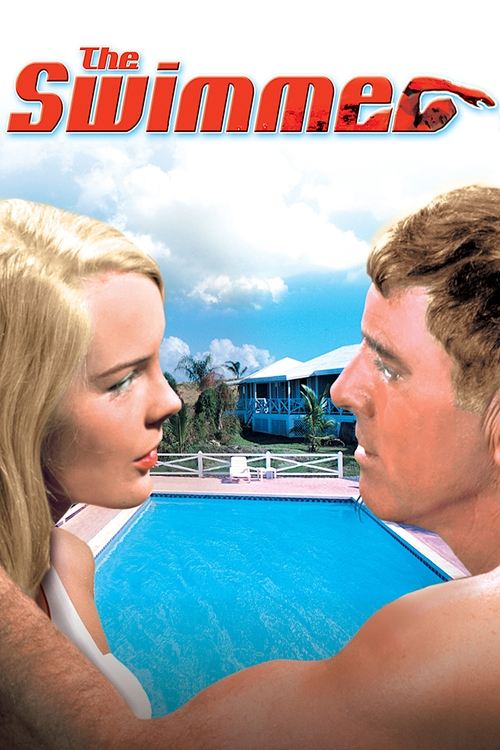
The Swimmer
1968 · Frank Perry
For when you want a film that sneaks up on you — something that looks like a breezy sixties curio and leaves you staring at the wall after. A challenge dressed as comfort; save it for a night you're ready to sit with it.
What it's about
On a bright summer day, a tanned, vigorous man in swim trunks appears in a neighbor's Connecticut backyard and announces a whim: he'll swim home across the county, pool by pool, through the gardens of everyone he knows. He names this chain of borrowed water after his wife and sets off with total confidence. But each backyard holds a slightly different reception, and the welcome cools in ways he refuses to notice — the day becomes a journey through his own life, taken one pool at a time.
The experience
It starts as a sun-dappled lark and slowly, almost imperceptibly, turns into something that tightens your chest — you keep waiting for the charm to hold and it keeps slipping. By the end it's genuinely haunting, the kind of unease that arrives without a single conventional scare.
Performances
Burt Lancaster, in his mid-fifties and nearly wordless about what's actually happening, gives one of his greatest performances — all that athletic charisma deployed as a mask, cracking a little more at each pool. He called it his favorite of his own roles for a reason.
The craft
Adapting a dozen-page John Cheever story into a feature is a strange bet, and Frank Perry wins it by keeping his half-naked hero in constant motion while the world around him supplies the plot. Sun-flared suburban photography and a lush, aching score make the affluent backyards feel like both paradise and trap. It rewards patience: the structure is doing quiet work the whole time.
Why it matters
A commercial failure that became one of the touchstone portraits of American suburban denial — the movie people reach for when they talk about the dark side of the postwar good life, and a peak of Hollywood's brief late-sixties appetite for genuine experiment.
Snapshot
A middle-aged man in swim trunks emerges from a wood into a neighbor's backyard, accepts a drink, and announces that he intends to swim home across the county — pool by pool, through the gardens of everyone he knows. He calls this chain of borrowed water the "Lucinda River," after his wife. What begins as a charming eccentricity curdles, over ninety-five minutes, into one of the most unnerving portraits of denial in American cinema.
The Swimmer adapts John Cheever's short story, published in The New Yorker in 1964 and collected that year in The Brigadier and the Golf Widow — roughly a dozen pages of compressed, seasons-shifting allegory — into a feature that keeps its protagonist half-naked and in motion for its entire running time. Burt Lancaster, fifty-four and still built like the circus acrobat he had been, plays Ned Merrill as a man made entirely of surface: tanned, grinning, relentlessly hearty, and hollow at the center. The film's method is subtraction. Each pool strips away one more layer of the story Ned tells about himself, until what is left arrives at a locked and empty house in the rain.
It failed on release, sat on Columbia's shelf while its authorship was contested, and has since become a durable cult object and a canonical text of suburban American disquiet.
Industry & production
The production is a case study in the instability of American filmmaking between the collapse of the studio system and the consolidation of New Hollywood. It was mounted through Sam Spiegel's Horizon Pictures — the outfit behind On the Waterfront, The Bridge on the River Kwai, and Lawrence of Arabia — with Frank Perry and Roger Lewis producing and Columbia distributing. Spiegel was a prestige producer of enormous appetite and enormous control; Perry was a New York independent whose debut, David and Lisa (1962), had been made for a pittance outside the studios and had nonetheless earned him an Academy Award nomination for direction. The pairing was combustible.
Principal photography took place in the summer of 1966 in Westport and neighboring Fairfield County, Connecticut — Cheever's own social terrain, or near enough — using real private estates and real pools. The film did not reach theaters until May 1968. The gap is the story. Post-production stalled; Perry departed or was removed depending on whose account one credits; and Sydney Pollack, who had directed Lancaster in The Scalphunters (1968) and would do so again in Castle Keep (1969), was brought in to reshoot material. Most consequentially, the long scene between Ned and his former mistress Shirley Abbott — the film's dramatic fulcrum — had originally been shot with Barbara Loden and was redone with Janice Rule. Pollack took no screen credit.
Three editors are credited (Sidney Katz, Carl Lerner, Pat Somerset), which is itself a legible symptom. So is the credit split in the camera department, with David L. Quaid as director of photography and additional photography credited to Michael Nebbia. The precise division of labor between Perry's and Pollack's contributions has never been fully documented, and anyone who claims to know exactly which shot belongs to whom is guessing; the honest position is that the finished film is a composite whose seams are real but whose overall design remains recognizably the one the Perrys drew.
Columbia had no idea how to sell it. A film with no genre, an unlikable-then-pitiable star, no chase and no crime, arriving into the market of 1968, went essentially unattended.
Technology
Technically the film is period-typical rather than innovative, and that is worth stating plainly: its distinction is behavioral, not mechanical. It was shot on 35mm color negative for 1.85:1 projection, largely on location, which in 1966 meant contending with the sun, the water, and the noise of suburbia rather than the controlled sound stage. The mid-sixties made this newly practical — lighter cameras, faster stocks, and above all the zoom lens, which by then had become the American location film's default tool for compressing distance and isolating a figure in a landscape.
Two period technologies shape the film's texture. The first is the long lens, used to flatten Ned against hedges and lawns, to hold him small inside a frame of manicured green, and to observe him as though from across a property line. The second is variable-speed photography: the film's lyric passages, particularly Ned's flight across the fields with the young Julie Ann, slow the image into something explicitly memorial — the look of a memory rather than an event. This was a fashionable device in 1966–68, and the film uses it knowingly, as a marker of Ned's interiority rather than as decoration.
Water itself is the production's real technical problem, and the film mostly solves it by staying above the surface. There is little underwater work; the camera meets the water at its skin, which keeps the pools reflective and opaque — surfaces, again, rather than depths.
One further technological frame: the film was made under a Production Code in visible collapse and released months before the MPAA ratings system replaced it in November 1968. Its nudist couple and its frank talk about adultery and money sit exactly in that transitional gap — content that would have been unshootable a decade earlier, handled with a discretion that would look quaint a year later.
The film's afterlife is also technological. A 4K restoration issued by Grindhouse Releasing in 2014 — accompanied by Chris Innis's feature documentary The Story of The Swimmer — is the reason the production history is as well understood as it now is, and the reason a generation encountered the film in something like its intended color.
Technique
Cinematography
The photography's governing idea is that paradise should look like a brochure and feel like a trap. The Connecticut summer is rendered in saturated greens and pool-blues, high-key and unshadowed, with the sun doing most of the lighting. There is no expressionist darkening as Ned's situation deteriorates; the film's cruelty is that the light never changes character until the weather itself turns. The dread accumulates in framing, not in exposure.
Compositionally, the camera keeps discovering Ned at the edges of other people's property — arriving over a wall, out of trees, at the far end of a lawn — so that his body is repeatedly presented as an intrusion into an ordered picture. Long lenses do the isolating; wide shots do the diminishing. As the day advances, the horizon lowers and the frames tighten, and by the public pool sequence the camera has abandoned pastoral distance for a crowded, jostling proximity that Ned's body cannot control.
Editing
The cutting is the film's most contested and most interesting element. Its transitions between pools are elliptical: we rarely see the walk from one garden to the next, so the film advances in jumps, each landing Ned in a new social micro-climate with no connective tissue. This reproduces Cheever's central trick — in the story, time passes vastly more than a single afternoon could allow, leaves turning and constellations shifting while Ned insists it is still that same summer day — without ever stating it.
Whether the resulting dreamlike discontinuity is authorial design or the residue of a troubled post-production is genuinely unresolvable, and the film benefits either way. What is certain is that the assembly refuses to smooth Ned's day into a chronology we can audit, and that refusal is what keeps the audience inside his delusion for as long as it does.
Mise-en-scène / staging
The film's boldest formal decision is a costume decision: Lancaster spends the entire picture in a pair of swim trunks. He has no pockets, no wallet, no watch, no keys — none of the props by which a man of his class signals himself. Everything he claims must be claimed verbally, against a body that is the only evidence he can produce.
Around this near-nudity, the film arranges a taxonomy of pools as a taxonomy of class and character: the tasteful old-money pool with its restrained hosts; the Hallorans' nudist calm; the Biswangers' brash, crowded, newly rich party where Ned is a debtor rather than a guest; the abandoned pool where a lonely boy pretends to swim in empty concrete; and finally the municipal pool, with its footbath, its whistle, its shower rule, and its indifferent, unmanicured crowd. Ned's journey is downhill in every sense — geographically, socially, financially, and physically.
Sound
The soundtrack is built from suburban ambience treated as an environment rather than as background: cicadas, sprinklers, the slap of water, the specific class-coded music of ice in glasses and cocktail chatter. Against this, Marvin Hamlisch's score — his first for a feature — is unembarrassedly romantic, all strings and pastoral lift. The score does not comment ironically on Ned; it agrees with him. It plays the afternoon as he experiences it, lyrical and golden, which is precisely what makes the gap between the music and the facts unbearable as the facts accumulate. Hamlisch would go on to a career of exactly this sort of melodic warmth, twice Oscar-honored in 1974; here that warmth functions as a symptom.
The final movement inverts everything: score falls away, the rain arrives, and the film ends in the sound of a man beating on a door that has nothing behind it.
Performance
Lancaster's performance is the reason the film survives. He built his stardom on physical authority — the acrobat's body, the teeth, the laugh — and here he deploys that entire arsenal as a mask and then lets it fail in increments. The smile arrives a half-second too fast; the heartiness is aimed slightly past the person receiving it; the athlete's carriage begins to cost visible effort. By many accounts Lancaster was not a strong swimmer and trained extensively for the part, and the labor shows productively: this is a man for whom swimming is work being sold as joy. He is reported to have counted it among his own favorite performances, and the claim is easy to believe.
Janet Landgard, then largely a television presence, plays Julie Ann with an openness that makes Ned's misreading of her both understandable and appalling. Janice Rule's single long scene supplies the film's coldest and most necessary information, delivered with a contempt that has clearly been rehearsed for years. Kim Hunter, Marge Champion, Cornelia Otis Skinner and others fill out the neighborhood; Joan Rivers appears early in her screen career at the Biswanger party; Cheever himself turns up briefly in a party crowd.
Narrative & dramatic mode
The film observes classical unity of time — one day, one continuous action — while systematically undermining our confidence that a single day is what we are watching. Its structure is picaresque in reverse: the episodic journey, normally a device for accumulation, is used here for stripping. Each station of the trip supplies one more piece of withheld exposition, and the film's suspense is entirely epistemological. We are not waiting to see what Ned will do; we are waiting to learn what has already happened to him.
This makes Ned an unreliable narrator without a narration. The film gives us no flashbacks, no omniscient corrective, no confidant. Everything true about Ned's ruin — the money, the marriage, the daughters, the affair — arrives obliquely, in the pauses and evasions of people who assume he already knows. The dramatic mode is therefore closer to tragedy than to melodrama: the protagonist's reversal has occurred before the curtain, and the action consists of his belated arrival at knowledge.
Genre & cycle
Nominally a drama; functionally an allegory that keeps brushing against horror. Its nearest generic relatives are the mid-century American literary adaptation (Williams, Miller, Inge, Cheever) and the emerging suburban-anomie film, but its actual grammar — the quest across a hostile landscape, the stations, the mounting revelation, the doomed homecoming — belongs to myth. The Odyssey is the obvious template, invoked and denied: the homecoming is the punishment.
It sits at the head of a cycle rather than inside one. In 1968 it had few American peers; the studios were still making suburbia either as sitcom or as social problem. The film's insistence that affluence itself is the horror — that the pools, the parties, and the lawns constitute the mechanism of destruction — is what later filmmakers would return to.
Authorship & method
Frank and Eleanor Perry worked as a unit: he directed, she wrote, and their run — David and Lisa (1962), Ladybug Ladybug (1963), The Swimmer (1968), Last Summer (1969), Diary of a Mad Housewife (1970) — constitutes one of the most coherent bodies of work in American independent filmmaking of the period. Their shared preoccupation is psychological damage inside respectable settings, approached with a literary writer's patience and a documentarian's willingness to shoot in real places. Eleanor Perry's screenplay here does the essential structural work: expanding Cheever's twelve pages by inventing or elaborating the Julie Ann episode, the boy at the empty pool, and the public pool humiliation, each of which converts a literary ellipsis into a dramatic scene. She became, in the following decade, one of the industry's most outspoken advocates for women in film. The couple divorced in 1971 and the collaboration ended with it; Frank Perry's later career, from Play It as It Lays (1972) to Mommie Dearest (1981), never regained that coherence.
Around them, the credits describe a divided authorship: Quaid and Nebbia on camera, three editors, Hamlisch scoring, Pollack shooting uncredited material, Spiegel and Lancaster exerting producer-level force. The Swimmer is not an auteur object in the pure sense. It is a film whose unity was assembled after the fact, and whose surviving power argues that Eleanor Perry's structure and Lancaster's performance were strong enough to hold under that pressure.
Movement / national cinema
The film belongs to the New York independent tendency — literary, psychologically minded, location-shot, oriented toward Europe rather than toward Hollywood — that ran alongside and slightly ahead of New Hollywood. Its European debts are legible: the single-day reckoning with a wasted life recalls Bergman's Wild Strawberries (1957); the affluent, beautifully photographed emptiness recalls Antonioni; the willingness to let an audience sit inside ambiguity for ninety minutes was, in 1966, an art-house rather than a studio prerogative.
What makes it distinctly American is its subject: not existential malaise in the abstract but a specific WASP capital-and-status economy, in which one's standing is measured in invitations, credit, and property lines, and in which a man can be socially dead while remaining physically magnificent.
Era / period
Shot in 1966 and released in 1968, the film is chronologically at odds with itself. Its world contains no Vietnam, no counterculture, no assassinations — only gin, tennis, and lawn care. Released into the year of 2001, Rosemary's Baby, Night of the Living Dead, and Faces, it looked to some viewers like a dispatch from an already-vanished order.
That dissonance is now the film's strength. It documents the establishment at the exact moment before it was told it was the establishment: the parents of the generation then in the streets, poolside, drinking, and entirely unaware that the ground had moved. The film's own charge is not political but moral, and it lands harder for being unfashionable.
Themes
The controlling theme is denial as a full-time occupation. Ned has not forgotten what happened to him; he has built an entire physical practice — the swim, the itinerary, the naming of the river after his wife — to avoid arriving at it. The film is about the labor that self-deception requires and about the exact moment the labor becomes unaffordable.
Braided through it: alcohol, everywhere, offered and accepted at every stop, the social lubricant that is also the solvent; class and credit, with the neighbors' hospitality revealed as bookkeeping and Ned's charm exposed as an overdrawn account; the body as capital, Lancaster's physique standing in for a manhood that has no other remaining asset; adultery and its bill, arriving in Shirley Abbott's flat refusal to be remembered romantically; fatherhood, in the lonely boy at the dry pool, a scene that gives Ned his one moment of genuine tenderness and simultaneously indicts everything he has done with his own daughters; and time, which the film manipulates so that a summer afternoon can quietly contain the collapse of a life.
Reception, canon & influence
On release. The film divided critics and found almost no audience. Reviewers who admired it tended to admire Lancaster and the concept; skeptics found it schematic, pretentious, or fatally uncertain in tone — a reasonable response to a picture assembled from two directors' footage after eighteen months of trouble. Columbia's marketing could not resolve the basic question of what it was. It disappeared quickly.
Influences on the film. Cheever above all — not just the plot but the sensibility, the sense that the American suburb is a stage set with a crime behind it. Behind Cheever, Fitzgerald's parties and self-invented men; beside him, Miller's Willy Loman, the American male whose sales pitch has outlived its market. Formally, Bergman's day-long reckoning and the European art film's tolerance for withheld information; from the Perrys' own filmography, the clinical attention to psychological breakdown established in David and Lisa. Structurally and mythically, the Odyssey, inverted.
Legacy. The film's rehabilitation came slowly, through repertory programming, television, and finally the 2014 restoration and documentary from Grindhouse Releasing — a label run by the editors Bob Murawski and Chris Innis, whose championing gave the film a level of scholarly documentation few commercial failures of 1968 ever receive.
Its forward influence is best described as tonal and thematic rather than as a chain of direct citations. The Swimmer is the founding text of a lineage of American work about affluent self-destruction — a line that runs through American Beauty (1999), Little Children (2006), and Revolutionary Road (2008), and that surfaces most conspicuously in Mad Men, whose creators have been open about their debt to Cheever's fiction and whose central figure is another handsome, invented man swimming through other people's houses. Critics have invoked the film so consistently in that context that it now functions as shorthand.
Within film culture proper, its standing rests on two things: Lancaster's performance, routinely cited as the finest of a long and physically defined career, and the audacity of its premise, which no one has successfully repeated. It remains a film that people describe to each other before they recommend it — a man decides to swim home — and that almost always exceeds the description.
A Deleuzian reading
A man comes out of the woods in swim trunks.
The full Deleuzian reading of The Swimmer →
Reception
Shot in 1966, shelved amid production chaos, and released in 1968 to baffled audiences and a shrug at the box office — it's since been reclaimed as one of the strangest, saddest things a Hollywood studio ever made, a cult touchstone of suburban midcentury malaise.
How The Swimmer was received, from release to now →
How to watch The Swimmer: what to notice on a first viewing
- Watch that Ned wears nothing but swim trunks the entire film. He carries no wallet, watch, or keys, so everything he claims about himself must be spoken, never proven by an object. His body becomes the only evidence he can offer for who he says he is.
- Watch how bright and unshadowed the light stays all afternoon. The Connecticut summer is shot in saturated greens and pool blues, high-key, with no darkening as Ned's day goes on. The light never turns against him, so whatever is wrong has to live inside the man, not the weather.
- Notice you never see Ned actually walk between two pools. The film jumps from garden to garden with no connective tissue, landing him in a new household each time with no transition. The missing walk keeps you from tallying how much time has actually gone by.
- Watch how differently each pool's owners treat Ned. The film arranges the pools as a taxonomy of class, from restrained old money to a brash new-money party to the crowded public pool. Each stop reads Ned's status back to him a little differently than the last one did.
- Watch Lancaster's smile arrive a half second too fast each time. His heartiness lands slightly past the person receiving it, and his athletic carriage starts to visibly cost him effort as the day continues. You can watch the mask working before you know what it is covering for.
The whole guide to watching The Swimmer, with the keys for a rewatch →
Influences: the films it descends from and the films it influenced
- Sunset Boulevard (1950) — Wilder makes a swimming pool the terminal image of an invented self, establishing the American pool as the arena where self-mythology is finally audited and the deluded protagonist's own account as the thing the film quietly withdraws.
- Death of a Salesman (1951) — Benedek lets Loman's past bleed into present-tense staging with no dissolve or announcement — the same unmarked temporal slippage the Perrys use as Ned's chronology collapses, around the same figure: a salesman still delivering a pitch whose market has closed.
- The Crimson Pirate (1952) — Lancaster's circus-acrobat body is displayed here as pure athletic capital, and that is the asset The Swimmer spends — the trunks-only costume only works because the audience carries this earlier body in memory and can measure the 1968 one against it.
- All That Heaven Allows (1955) — Sirk maps affluent suburbia as a taxonomy of patios, picture windows and party gossip that surveils and punishes the transgressor — the same spatial sociology the Perrys convert into a chain of backyard pools ranked by their owners' money.
- Wild Strawberries (1957) — Bergman's day-long journey structure — episodic stops that each strip another layer from an old man's self-flattering account, with biography released only in withheld fragments — is the template Eleanor Perry compresses into a single afternoon.
- La Notte (1961) — Antonioni follows the rich through one day with exposition deliberately withheld and figures compressed by long lenses against their own architecture, licensing The Swimmer's refusal to explain Ned until the last pool.
- David and Lisa (1962) — The Perrys' first feature fixes the working method — clinical, unhurried observation of psychological breakdown shot in real locations with a documentarian's patience — that The Swimmer transplants from the institution to the backyard.
- The Leopard (1963) — Visconti dramatizes Lancaster's obsolescence as an extended social ritual he can no longer perform inside — the aging body moving through a party that has moved on — which is the exact dramatic engine of Ned's progress from house to house.
- Seconds (1966) — Frankenheimer builds a film on a middle-aged man who erased his old life and is destroyed by re-entering it, locating the horror in the star's physical presence rather than in plot — The Swimmer's premise with the science fiction removed.
- Play It as It Lays (1972) — Perry adapts Didion by cutting to her ellipses, letting fragments of an affluent woman's dissociation replace causal narrative — the editorial logic of the pool-to-pool transitions pushed to its limit.
- The Ice Storm (1997) — Lee compresses a Cheeveresque suburb into a single event whose key party works as a class taxonomy and whose weather supplies the structure the narrative withholds — the descendant that solves the tonal problem three editors could not.
- American Beauty (1999) — Mendes shoots the suburb in high-key daylight as a stage set with a crime behind it and organizes it around a middle-aged man's regression into his own body, restoring the retrospective narration that gives the audience the certainty Ned never gets.
- Little Children (2006) — Field stages his central humiliation at a crowded public pool policed by other parents — the direct heir to Ned's public-pool sequence, an invention of Eleanor Perry's screenplay absent from Cheever's twelve pages — with a literary narrator doing the work Cheever's prose did.
- Short Cuts (1993) — Perry and Pollack's adaptation of John Cheever's short story transposes suburban malaise from a literary Eastern register to California geography using an episodic accumulative structure — exactly the transposition move Altman makes with Carver — letting incident pile without climax to produce weight the source's brevity never could.
- Beau Is Afraid (2023) — Episodic picaresque homeward journey in which each vignette strips away the hero's denial and exposes psychological collapse — Beau's quest structure precisely.
- The Graduate (1967) — Nichols turns the backyard pool into a psychological aquarium and shoots suburban running on long lenses that flatten forward motion into a treadmill — the same optic and the same joke as Ned's telephoto-compressed sprints across lawns.
- Petulia (1968) — Lester dissects affluent American unhappiness with zoom-lens location shooting and elliptical cutting that scrambles chronology mid-scene — the identical 1968 toolkit, and the same wager that a fracture in the cut can carry information the scene withholds.
- La Piscine (1969) — Deray sustains an entire drama on a pool's surface in high-key summer light, treating water and sunlit skin as the arena where class and sexual power get settled — the pool as social instrument rather than setting.
- They Shoot Horses, Don't They? (1969) — Pollack, who shot the uncredited Shirley Abbott sequence here, builds his next film on the same device: a durational physical ritual performed before spectators, with zooms tightening on a body being destroyed as public entertainment.
- Last Summer (1969) — The same Perry unit immediately reruns the method — leisure setting, real locations, an assault staged in flat vacation light — demonstrating that The Swimmer's structure was theirs and not an artifact of three editors salvaging footage.
Similar films
- The Swimming Pool (1969) — influence & lineage · often watched together
- Seconds (1966) — influence & lineage
- The Graduate (1967) — influence & lineage
- Wild Strawberries (1957) — influence & lineage · often watched together
- 3 Women (1977) — often watched together
- Smiles of a Summer Night (1955) — often watched together
- The Conversation (1974) — often watched together
- Nashville (1975) — often watched together