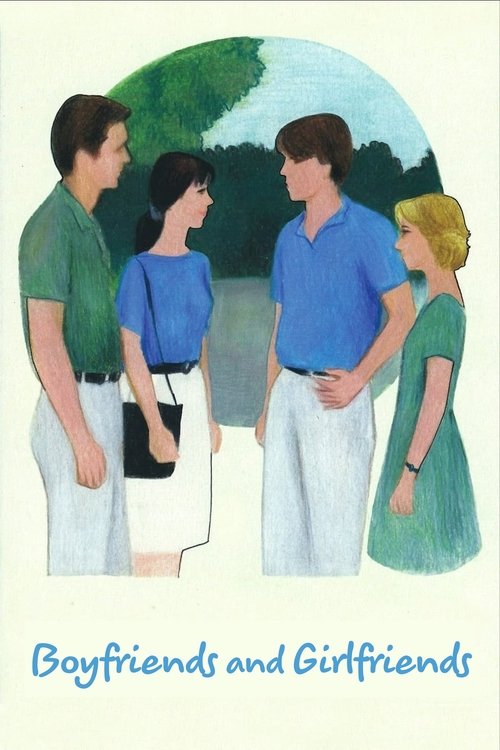
Boyfriends and Girlfriends
1987 · Éric Rohmer
For when you want a smart, low-stakes romantic comedy that respects your intelligence — a sunny afternoon film about crushes and confessions, all conversation and no melodrama. Comfort viewing for people who like to talk about feelings.
What it's about
In a tidy new-town suburb of Paris, shy office worker Blanche befriends the confident student Léa. Léa is drifting away from her boyfriend Fabien; Blanche is hopelessly, tongue-tied smitten with Léa's charming friend Alexandre. When Léa leaves on holiday, the four young people's affections begin to quietly rotate — friendship, attraction, and loyalty getting tangled in ways nobody planned.
The experience
Light, talky, and precise — it feels like eavesdropping on friends who say slightly more than they mean and mean slightly more than they say. The comedy is gentle but the embarrassments sting, and the sweetness sneaks up on you.
Performances
The young ensemble plays with a naturalism so unforced it barely reads as acting — every blush, evasion, and burst of tears feels caught rather than performed.
The craft
Rohmer builds the whole film from conversation, framing his quartet against the pastel geometry of a planned suburb so the modern setting becomes part of the joke about modern love. The plotting is secretly exact — a comedy of symmetries where every pairing clicks into place like clockwork. Nothing flashy, everything deliberate.
Why it matters
The final entry in Rohmer's six-film 'Comedies and Proverbs' cycle, it capped a decade-defining run and remains a touchstone for filmmakers who build romance out of talk, walks, and misunderstandings.
Snapshot
Boyfriends and Girlfriends — released in France as L'Ami de mon amie — is the sixth and final entry in Éric Rohmer's "Comedies and Proverbs" (Comédies et Proverbes) cycle, a series of six films the director made across the 1980s, each glossed by an epigraph in the manner of a moral fable. Its proverb, "Les amis de mes amis sont mes amis" ("The friends of my friends are my friends"), announces both the film's subject and its geometry: a quartet of young Parisians whose affections quietly rotate until the partners have swapped and the social knot is retied. Blanche, a reserved municipal employee, befriends the more assured Léa; Blanche pines mutely for Léa's charming friend Alexandre while drawing closer, almost by accident, to Léa's boyfriend Fabien. The film is slight in incident and exact in feeling — a comedy of misdirected desire staged with Rohmer's habitual patience, and set not in the storied Paris of the New Wave but in the planned new town of Cergy-Pontoise, whose glass, water, and greenery give the film an unusually contemporary, almost utopian sheen. It closes a decade of Rohmer's work on a note of comic symmetry and marks, in retrospect, the end of one of the most coherent film cycles in postwar European cinema.
Industry & production
The film was produced by Les Films du Losange, the company Rohmer had co-founded with Barbet Schroeder in the early 1960s and which produced essentially all of his mature work. By 1987 Rohmer's method was a fully institutionalized cottage industry: tiny budgets, minuscule crews, location shooting, and a repertory approach to casting drawn largely from young, often little-known performers. Margaret Menegoz, the longtime head of Les Films du Losange, is credited among the film's producers, and the picture belongs to the run of low-cost, high-control productions that let Rohmer retain near-total authorship — writing, directing, and effectively supervising design and sound within a single artisanal operation.
Rohmer's economics were a deliberate aesthetic. Because his films cost so little and were shot with such small teams, they did not need blockbuster returns to be viable, and this financial modesty underwrote his freedom to make talk-driven films with no stars and no spectacle. The "Comedies and Proverbs" cycle had been running since 1981 (beginning with The Aviator's Wife), and by its conclusion Rohmer commanded a secure, if specialized, place in the French industry and on the international art-house and festival circuit. Precise budget and box-office figures for L'Ami de mon amie are not something I can state reliably here; the general record establishes only that Rohmer worked cheaply and consistently, not exact grosses.
Technology
Technologically the film is conventional for its moment and milieu: 35mm color photography, direct location sound, and a reliance on available and naturalistic light rather than elaborate lighting rigs. Rohmer's practice was famously ascetic — he avoided the heavy apparatus of mainstream production, favoring lightweight setups that could move quickly through real apartments, offices, cafés, and outdoor spaces. There is no ostentatious technique on display and no reliance on optical effects; the "technology" of a Rohmer film is essentially the technology of unobtrusive recording, deployed so that the camera and microphone seem merely to attend to people talking. The film's contemporaneity registers less in its equipment than in its subject — the shining modern architecture of a new town, captured as it actually looked in the mid-1980s.
Technique
Cinematography
The cinematography is credited to Bernard Lutic. Its governing principle is clarity: even, naturalistic light; stable framing; medium and full shots that keep bodies whole and legible in their environments. Rohmer's camera prefers to observe conversations at a civil distance rather than to fragment them, and it lets the modern architecture of Cergy-Pontoise — its plazas, artificial lake, glass façades, and manicured greenery — function as a genuine co-subject rather than mere backdrop. The palette is one of the film's most discussed features: greens and blues recur with a coordination too consistent to be accidental, tying costume to setting and, critics have long argued, to Blanche's shifting emotional weather. Rohmer's attention to color as an expressive and structuring device is well documented in his practice generally, and this film is frequently cited as a particularly systematic instance of it.
Editing
Editing is credited to Maria Luisa García, a frequent Rohmer collaborator. The cutting is transparent and subordinate to performance and speech. Scenes tend to run long enough for conversations to develop their own rhythm, with cuts motivated by dialogue and glance rather than by momentum or suspense. The film's comedy of crossed affections depends on the audience holding the whole social configuration in mind, and the editing serves this by keeping scenes clear and continuous rather than elliptical. There is no showy montage; the structural wit lies in the arrangement of episodes across the narrative, not in the joins between shots.
Mise-en-scène / staging
Staging is where Rohmer's authorship is most visibly concentrated. The film unfolds through walk-and-talk exchanges, café conversations, apartment scenes, and excursions to the lake and the surrounding landscape, with characters continually placed against the geometry of the new town. Rohmer choreographs bodies in real, specific spaces so that setting comments on situation — the openness and newness of Cergy-Pontoise lending the romantic confusions an airy, provisional quality. Costume and color are integral to the staging rather than decorative, and the recurrent blues and greens knit the human drama into its built and natural environment. The overall effect is of behavior observed within a designed world, the artificiality of the town quietly rhyming with the social artifice of courtship.
Sound
The soundtrack is dominated by speech — Rohmer's essential material — recorded on location so that ambient life remains audible around the dialogue. The original music is credited to Jean-Louis Valéro, who scored several of Rohmer's films of this period; consistent with Rohmer's general aesthetic, music is used sparingly and does not underscore emotion in the manner of conventional melodrama. Rohmer distrusted non-diegetic scoring as a manipulation, and the film's sound design accordingly foregrounds the texture of conversation and environment over musical commentary.
Performance
The ensemble is young and, by design, largely unfamiliar: Emmanuelle Chaulet as the shy, self-scrutinizing Blanche; Sophie Renoir as the more confident Léa; Éric Viellard as Fabien; and François-Éric Gendron as the polished Alexandre. (Sophie Renoir belongs to the Renoir family, a lineage of note in French cinema; I would flag any more specific biographical claim as beyond what I can verify here.) The performances are naturalistic and finely calibrated to Rohmer's dialogue, which the director developed in close collaboration with his actors before shooting. Chaulet's Blanche in particular carries the film: her blushing hesitancy, small evasions, and eventual clarity give the comic mechanism its emotional ballast. Rohmer's actors are asked not to "perform" so much as to inhabit ordinary self-presentation — the everyday theater of people managing how they appear to one another.
Narrative & dramatic mode
The film's mode is the comedy of manners raised to a near-geometric precision. Its drama is almost entirely interpersonal and verbal: there are no external obstacles, only the self-deceptions, hesitations, and misreadings of four people negotiating attraction. The plot advances through the classic engine of romantic comedy — mismatched desire that must be reshuffled into its proper pairing — but Rohmer strips this of farce's frenzy and lets it proceed at the tempo of real acquaintance. The governing proverb frames the action as a demonstration, almost a proof: by the end, the friend of one's friend has indeed become one's own, and the initial cross-purposes resolve into a symmetrical and satisfying arrangement. The dramatic interest lies in the gap between what characters say, what they feel, and what they will admit to themselves — the Rohmerian territory of talk as both revelation and concealment.
Genre & cycle
As the sixth and last of the "Comedies and Proverbs," the film is best understood within that cycle. The series — The Aviator's Wife (1981), A Good Marriage (1982), Pauline at the Beach (1983), Full Moon in Paris (1984), The Green Ray (1986), and Boyfriends and Girlfriends (1987) — each pairs a moral epigraph with a contemporary romantic situation, extending the project Rohmer had begun decades earlier with his "Six Moral Tales." Where the Moral Tales centered on masculine self-deception, the Comedies and Proverbs more often foreground women's inner lives and social predicaments. L'Ami de mon amie sits squarely in the tradition of the talk-driven French romantic comedy-drama, and it functions as a lighter, more resolved bookend to the cycle after the searching melancholy of The Green Ray.
Authorship & method
The film is a near-pure expression of Rohmer's authorial method. A former critic and editor of Cahiers du cinéma, Rohmer built a body of work defined by literate dialogue, moral seriousness worn lightly, contemporary settings, and a refusal of cinematic ornament. He wrote his own scripts, worked repeatedly with a small circle of collaborators, and developed dialogue in rehearsal with his actors so that the finished speech would sit naturally in their mouths. His key collaborators here are consistent with that circle: cinematographer Bernard Lutic, editor Maria Luisa García, and composer Jean-Louis Valéro, each working within Rohmer's established discipline of restraint. Rohmer's own credit as writer-director understates his effective control over color, costume, location, and sound — dimensions he treated as authorial rather than departmental. The result is a film in which every element is subordinated to a single, coherent sensibility: observe closely, judge gently, and let people talk themselves toward the truth.
Movement / national cinema
Rohmer was one of the founding figures of the French New Wave — a Cahiers critic turned filmmaker alongside Godard, Truffaut, Chabrol, and Rivette — but by 1987 he had long since developed a signature so distinct that his films read as a school of one. L'Ami de mon amie is unmistakably a work of French auteur cinema in the New Wave's lineage: personal, low-budget, location-shot, and intellectually assured. Yet its temperament diverges from the movement's early iconoclasm. Rather than the disruptive stylistics of Godard, Rohmer offers a classical clarity in the service of moral and psychological inquiry. The film also belongs to a specifically French tradition of the conversation film — cinema as a space for people to reason aloud about love, desire, and self-knowledge — of which Rohmer remains the exemplary modern practitioner.
Era / period
Made and set in the mid-to-late 1980s, the film is a vivid document of its moment, and unusually so for Rohmer. Its choice of Cergy-Pontoise — one of the villes nouvelles, the planned new towns built to organize growth around Paris — anchors it in a distinctly contemporary France of modernist urban design, leisure landscapes, and young white-collar professionals. Rohmer, who had a scholarly interest in space and the built environment, treats this shining, deliberately engineered suburb almost documentarily, so that the film preserves a specific vision of late-twentieth-century French urbanism. The clothes, interiors, and social manners are equally of their time. The effect is paradoxical and characteristic: a timeless comic pattern of misdirected love, embedded in a hyper-specific, freshly built modern world.
Themes
The film's central theme is the unreliability of self-knowledge in matters of desire — the way people mistake whom they want, and must be gently corrected by circumstance and honesty. Around this turns a cluster of Rohmerian concerns: friendship and its entanglement with romance (the proverb literalizes the passage from one to the other); shyness, sincerity, and the labor of saying what one feels, embodied above all in Blanche; and the gap between social self-presentation and inner truth. The setting deepens these themes: the planned, transparent, harmonious new town offers an implicit image of order against which the characters' emotional confusions play out, and the eventual romantic symmetry mirrors the designed symmetry of their environment. Nature and leisure — the lake, the greenery, the excursions — recur as spaces where feeling can be tested away from the constraints of work and habit.
Reception, canon & influence
As the capstone of a celebrated cycle by a major director, the film was received as a graceful, minor-key conclusion — praised for its precision, its charm, and its exact observation, and understood in the context of Rohmer's larger achievement of the 1980s. I would be cautious about attributing specific awards, festival prizes, or quantified box-office results to it without firmer documentation; what the record clearly supports is its status as a well-regarded entry in a highly regarded series, rather than a breakout sensation on its own.
Looking backward, the influences on the film are essentially Rohmer's own accumulated practice: the literary tradition of the moral fable and the comedy of manners; the New Wave's ethos of personal, contemporary, location-based filmmaking; and Rohmer's decades-long project, from the Six Moral Tales onward, of using talk to anatomize desire. Looking forward, the film's legacy is inseparable from Rohmer's broader influence on later filmmakers of intimate, dialogue-driven cinema — a lineage in which directors devoted to conversation, walking, and the fine texture of romantic hesitation frequently cite Rohmer as a touchstone. Within the director's own filmography, Boyfriends and Girlfriends holds a settled place: the point at which the Comedies and Proverbs closed, and the door opened toward the historically and formally more adventurous work — the Tales of the Four Seasons and the period films — that would occupy Rohmer's later career.
A Deleuzian reading
Blanche talks all day.
The full Deleuzian reading of Boyfriends and Girlfriends →
Reception
Received in 1987 as one of the lighter, breezier entries closing out Rohmer's Comedies and Proverbs, it has since climbed into favorite-Rohmer territory — now routinely recommended as the ideal gateway into his whole filmography.
How Boyfriends and Girlfriends was received, from release to now →
How to watch Boyfriends and Girlfriends: what to notice on a first viewing
- Notice green and blue recurring in costume and setting. Characters' clothes keep echoing the color of the water, grass, and glass facades around them, a coordination too consistent to be accidental. Color is running like a second script under the dialogue, tracking feelings nobody says out loud.
- Watch the new town's plazas, lake, and glass buildings. The planned architecture of Cergy-Pontoise appears constantly behind and around the characters, functioning as a real setting rather than a neutral backdrop. A town this designed and orderly sits underneath romantic confusion that is anything but, and the contrast is doing quiet work.
- Watch Blanche blush and go quiet around Alexandre. She talks easily to everyone else, but around him the words simply stop coming, and the film lingers on that failure rather than rescuing her from it. Her blush is telling you everything her dialogue won't, without a single line of confession.
- Notice scenes run long enough for talk to find its own rhythm. Cuts are motivated by conversation and glance rather than pace or suspense, letting exchanges develop at something like real time. The unhurried cutting is what lets you actually track four people's shifting feelings across the film.
The whole guide to watching Boyfriends and Girlfriends, with the keys for a rewatch →
Influences: the films it descends from and the films it influenced
- The Rules of the Game (1939) — The interlocking, misaligned romantic pairings choreographed across a single shared social space set the template for Rohmer's group-of-friends geometry and his light-touch comedy of manners.
- A Day in the Country (1936) — Desire staged outdoors in real weather and available light rather than on sets — the location naturalism Rohmer, a devoted Renoir critic, made foundational to his own practice.
- Faust (1926) — Rohmer's doctoral thesis analyzed the organization of screen space in Murnau; his habit of treating built architecture as an active compositional agent (the villes-nouvelles here) descends directly from that study.
- Journey to Italy (1954) — A couple's estrangement observed through real locations with documentary plainness and no dramatic underscoring — a film Rohmer canonized as a critic and whose refusal of scoring he absorbed into his sparse diegetic soundtracks.
- Pickpocket (1959) — Bresson's drilling of non-star 'models' toward flattened, rehearsed line-delivery is the disciplinary precedent for Rohmer's method of rehearsing dialogue until it sits naturally in an amateur ensemble's mouths.
- My Night at Maud's (1969) — The Six Moral Tales blueprint named in the dossier: extended, literate talk deployed as the precision instrument for anatomizing desire and self-deception.
- Claire's Knee (1970) — Color-coded costume and landscape keyed to a character's erotic fixation — the direct precursor of this film's systematic color-coordination between characters and their settings.
- Metropolitan (1990) — An openly Rohmerian comedy of manners among literate young bourgeois, driven entirely by talk in which social self-presentation is the subject and the source of gentle judgment.
- Before Sunrise (1995) — Extends Rohmer's walk-and-talk staging to feature length, carrying romantic hesitation almost wholly through continuous strolling conversation with Rohmer a stated touchstone.
- In the City of Sylvia (2007) — Patient, near-wordless observation of a man tracking a woman through a city, elevating architecture-as-co-subject and the fine texture of watching to the whole substance of the film.
- Certified Copy (2010) — A couple walking and talking through Tuscan architecture while their own self-accounts prove unreliable — extending Rohmer's dialogue-as-anatomy and his theme of unreliable self-knowledge.
- Frances Ha (2012) — An ensemble of young urbanites whose rehearsed-sounding naturalistic dialogue governs the cutting, with transparent continuity editing kept subordinate to the flow of talk.
- Right Now, Wrong Then (2015) — Builds a moral-proverb structure of paired variations from long walk-and-talk takes that expose the characters' self-flattering, unreliable self-knowledge — Rohmer's method transposed to Korea.
- The Worst Person in the World (2021) — A chaptered comedy of a young woman's romantic indecision and unreliable self-knowledge, reprising the Comedies and Proverbs template of episodic titles framing a heroine's drift toward truth.
- Pauline at the Beach (1983) — Same Comedies and Proverbs cycle, sharing the device of an opening epigraph-proverb that the ensuing plot then quietly ironizes.
- The Green Ray (1986) — The immediately prior Comedy and Proverb: semi-improvised dialogue and unadorned direct location sound tracking a solitary young woman's romantic drift through real spaces.
- Cléo from 5 to 7 (1962) — A New Wave sibling in walking a woman through real Paris in near-real time, letting the city's streets and architecture function as co-subject rather than backdrop.
- Days of Heaven (1978) — Cinematographer Néstor Almendros carried the available-light, magic-hour naturalism he developed shooting Rohmer's Moral Tales into American cinema — the same lighting discipline Bernard Lutic sustains here.
Similar films
- The Green Ray (1986) — influence & lineage
- My Night at Maud's (1969) — influence & lineage
- Before Sunrise (1995) — influence & lineage
- A Summer's Tale (1996) — shared sensibility
- Jules and Jim (1962) — shared sensibility
- The Mother and the Whore (1973) — shared sensibility
- Summer of 85 (2020) — shared sensibility
- Just an Illusion (2026) — shared sensibility