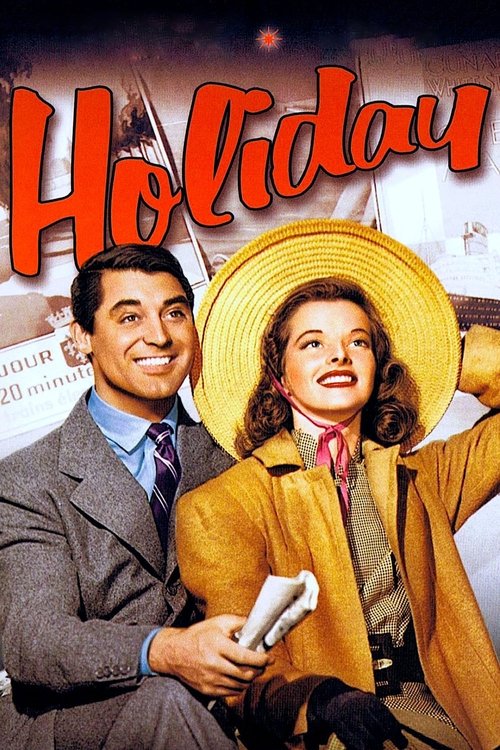
Holiday
1938 · George Cukor
When you want champagne-fizz romance with something to say — a New Year's Eve kind of movie for anyone who's ever wondered whether the safe path is worth it. Comfort viewing with a spine.
What it's about
Johnny Case, a self-made young financier, gets engaged to an heiress after a whirlwind romance — then discovers her family expects him to take a desk at her father's bank, when his actual plan is to retire young, see the world, and figure out what life is for. Inside the family's Fifth Avenue mansion he finds an unexpected ally: his fiancée's restless sister Linda, who's been hiding out in the old upstairs playroom.
The experience
Sparkling and fast on its feet, but with a real ache underneath — the jokes land while the film quietly asks whether money is a means or a prison. It leaves you buoyant and a little wistful at once.
Performances
Cary Grant does literal handsprings while playing a man arguing for his own soul, and Katharine Hepburn makes Linda's mix of wit and buried grief the film's beating heart — it's one of the great screen pairings running at full charge.
The craft
Adapted from Philip Barry's Broadway play, it stages nearly everything inside one mansion and turns the house itself into the argument — cold formal rooms downstairs, one honest playroom upstairs. Cukor's direction gives the banter room to breathe while keeping the emotional current taut under the comedy.
Why it matters
A high-water mark of 1930s romantic comedy that helped define the Grant–Hepburn partnership, and proof that screwball could carry real moral weight.
Snapshot
Holiday is the film in which American screen comedy briefly stops laughing and admits what it wants. Adapted from Philip Barry's 1928 Broadway play, it takes a premise that sounds like froth — a young man engaged to an heiress would rather take a few years off than take a job at her father's bank — and turns it into a sustained argument about what money is for, staged almost entirely inside one Fifth Avenue mansion. Cary Grant plays Johnny Case, self-made and unimpressed; Katharine Hepburn plays Linda Seton, the sister of his fiancée, exiled to a fourth-floor playroom that is the only honest space in the house. The comedy is genuine — Grant does handsprings, the supporting players clown with toy puppets — but the film's engine is grief, and its subject is the cost of belonging to a family that has confused wealth with virtue.
It arrived in June 1938 at a peculiar moment for everyone involved. Hepburn had just been named in the Independent Theatre Owners of America's notorious trade advertisement branding a list of stars "box office poison," and had left RKO. Grant was two films into his transformation from studio contract player into the defining light-comic presence of the American sound film. Cukor was mid-career, loaned out and simultaneously entangled in the Gone with the Wind preparations that would end badly for him the following year. The film they made was admired and did not sell tickets. Its reputation has risen more or less continuously ever since, and it now reads as the essential middle term between Bringing Up Baby and The Philadelphia Story — the place where the Hepburn persona learned to be wounded without becoming pitiable.
Industry & production
Holiday is a Columbia picture, and that matters. Under Harry Cohn, Columbia had spent the 1930s converting itself from a Poverty Row operation into a studio with genuine prestige, largely on the strength of Frank Capra's run from It Happened One Night (1934) onward. The studio's method was to spend selectively — buy a proven property, import talent on loan, keep the physical production tight — and Holiday fits that template exactly: a Broadway hit of a decade earlier, two borrowed stars, a director on loan, and a production largely confined to a handful of standing interiors.
Barry's play had opened on Broadway in 1928 and been filmed once already, by Pathé in 1930, directed by Edward H. Griffith with Ann Harding as Linda (a performance that drew an Academy Award nomination), Mary Astor as Julia, and Robert Ames as Johnny. Remaking a property after only eight years was unusual for a prestige title; Columbia evidently judged that the play's Depression-era argument had grown more pointed, not less, in the interval. One connective thread survives across both versions: Edward Everett Horton plays Nick Potter in each, a rare instance of an actor carrying a supporting role intact from one adaptation to its remake.
Hepburn's involvement carries the deeper history. She had understudied Hope Williams as Linda in the original Broadway production and knew the part thoroughly before she had a screen career at all. The standard account of her path to the film has her declining RKO's assignment of Mother Carey's Chickens after Bringing Up Baby, buying out the remainder of her contract, and moving to Columbia — where the role she had shadowed a decade earlier was waiting. Figures for the buyout circulate widely in the literature but vary; the essential fact is that she paid to leave and arrived at Holiday as a free agent with something to prove.
The film was not a commercial success. Precise accounting for individual Columbia releases of the period is not reliably in the public record, and it would be irresponsible to attach numbers, but the consensus of the trade history and of Hepburn's biographers is that Holiday underperformed and did not reverse her box-office standing — that would wait for The Philadelphia Story in 1940, a property she took the precaution of controlling herself. In Britain the film circulated under the alternative titles Free to Live and Unconventional Linda. Its single Academy Award nomination went to the art direction of Stephen Goosson and Lionel Banks.
Technology
Technically, Holiday is a mainstream 1938 studio production and makes no claim to innovation — which is itself worth stating plainly, because the film's sophistication is entirely in staging and performance rather than apparatus. It is black-and-white, shot on 35mm nitrate at the standard Academy ratio, on panchromatic negative of the generation that had just been meaningfully improved: Eastman's faster emulsions of the mid-to-late 1930s gave cinematographers more latitude in low-key interiors and permitted smaller apertures, and therefore deeper focus, than had been practical at the start of the sound era. Holiday uses that latitude conservatively, for clean modeling of faces in large rooms rather than for the aggressive deep-focus effects that Gregg Toland would push three years later.
Sound recording is by the optical variable-density and variable-area systems then standard across the majors, with the noise-reduction refinements of the mid-1930s that had made quiet dialogue scenes viable. Microphone booms had by 1938 been mobile for years, and the film's willingness to let actors cross large rooms while talking reflects that. Studio records on Columbia's specific recording licensee for this title are not something I can confirm, so I will leave the trade name aside.
Incandescent lighting on tungsten-balanced stock, rear projection reserved for a small number of exteriors, and a near-total absence of optical effects beyond dissolves complete the picture. This is a film made with tools that had become invisible — the point of 1938 studio technology was that it no longer announced itself.
Technique
Cinematography
Franz Planer shot the film, one of his earliest American assignments after emigrating from Europe, where he had been among the most accomplished operators in German-language production (his work for Max Ophüls on Liebelei in 1933 is the usual reference point). Planer's contribution here is disciplined rather than showy. The Seton house is lit as a real architecture of light: the ground-floor reception rooms are broad, even, and cold, lit to read as public space; the fourth-floor playroom is warmer, lower-keyed, cluttered with practical sources and shadowed corners. The film's moral geography is legible in exposure before it is spoken in dialogue.
Hepburn is photographed with unusual care — Planer favours a soft key placed high and slightly off-axis that emphasizes the architecture of her face without flattering it into anonymity, and he is not afraid to let her go partly dark in the playroom scenes where Linda is talking herself out of hope. Grant is lit more flatly and more brightly, appropriate to a character who has nothing hidden. Camera movement is modest: reframing pans, a few unhurried dollies into the group, no signature crane gestures.
Editing
The cutting, credited to Otto Meyer with Al Clark also associated with the picture, is invisible in the classical sense and slower than the screwball norm. Where Hawks in Bringing Up Baby cuts to accelerate, Holiday frequently declines to cut at all: the long conversational scenes in the playroom run in sustained two- and three-shots, letting Barry's dialogue set the rhythm. When the film does cut fast, it does so pointedly — the New Year's Eve sequence intercuts the formal party descending the staircase below with the small refuge above, and the editing carries the film's central contrast without a word of exposition. The overall tempo is theatrical in the best sense: the film trusts that a scene played through is more powerful than a scene assembled.
Mise-en-scène / staging
This is where Holiday is genuinely major. Goosson and Banks's Seton mansion is conceived vertically as a moral diagram — a monumental entrance hall and staircase, an elevator, floors of increasing formality and decreasing life, and at the top the playroom, preserved from the children's youth and inhabited by the two Setons who never recovered from it. Cukor stages the film as a series of ascents and descents. Characters are constantly arriving from below or retreating upward, and the film's climax is a departure through the front door that reads as escape.
The playroom itself is one of the great sets of the period: a trapeze or gym apparatus, a piano, toys, a fireplace, accumulated childhood debris. It is where the puppets come out, where Ned drinks, where Linda says what she means, and where Johnny performs the acrobatics that mark him as constitutionally unfit for the drawing room. Cukor's blocking within it is loose and lived-in — actors sit on the floor, lie across furniture, move without motivation. Downstairs, by contrast, everyone stands, and the staging is frontal and stiff. The film never says the rich are embalmed; it just poses them that way.
Sound
The soundtrack is spare. Columbia's music department under Morris Stoloff handled the picture, and the scoring is largely confined to main and end titles and to transitional passages; the specific composing credits on Columbia program features of this period are inconsistently documented and I will not guess at them. What the film uses instead is source music — the party orchestra, "Auld Lang Syne," Ned at the playroom piano — so that music arrives as something happening in the room rather than as commentary. Dialogue is recorded cleanly and played mostly without overlap; unlike Hawks, Cukor wants each line audible, because Barry's lines are arguments, not noise. The near-silence of the final scenes gives the ocean liner sequence its lift.
Performance
Holiday is an actor's film assembled by a director famous, to his own irritation, as a "woman's director" — a label Cukor rejected on the grounds that he directed everyone.
Grant's Johnny is the performance that establishes what he would do for the next twenty-five years: charm as a form of moral seriousness. The acrobatics are real and biographical — Grant had come up in Britain in the Bob Pender troupe as a knockabout and stilt-walker — and the handsprings function as characterization, an eruption of a body that will not sit still behind a desk. Hepburn's Linda is her first fully modulated screen performance of loneliness; she plays intelligence as a burden rather than a weapon, and the shifts between brittle wit and open distress are managed without a visible seam. Lew Ayres's Ned is the film's quiet devastation, one of the most unsentimental portraits of alcoholism the Production Code era permitted — Ayres plays him as lucid, funny, and entirely without illusions about his own surrender. Doris Nolan's Julia is crucially not a villain; the film's toughness depends on her being sincere. Horton and Jean Dixon as the Potters supply warmth and a working alternative model of marriage, while Henry Kolker's Edward Seton, Henry Daniell's Seton Cram and Binnie Barnes's Laura give the household its chill.
Narrative & dramatic mode
Structurally the film is a comedy of manners built on a substitution: the audience knows within twenty minutes which sister Johnny should marry, and the remaining hour is spent watching everyone else catch up. Suspense is therefore not about outcome but about cost — whether Linda will betray her sister, whether Johnny will take the job, whether Ned will find the nerve to leave.
The mode is closer to high comedy than to screwball proper. There is no farcical machinery, no chase, no mistaken identity; the plot advances through conversations in which people say almost exactly what they mean. Barry's dramaturgy is essentially Shavian — characters articulate positions, and the drama is the collision of articulated positions — and the adaptation by Donald Ogden Stewart and Sidney Buchman preserves that rather than breaking it up. The film observes something close to unity of place, and its few departures from the house (the opening with the Potters, the closing shipboard scene) function as prologue and release.
Genre & cycle
1938 is the peak year of the screwball cycle, and Holiday is usually shelved there by default — same year as Bringing Up Baby, same stars, same director-adjacent milieu, same rich-family-and-outsider premise. But the classification sits awkwardly. Screwball runs on humiliation, velocity, and the collapse of dignity; Holiday runs on articulacy and restraint. Its true lineage is the Broadway comedy of manners that Hollywood had been mining since the coming of sound, filtered through the Depression's insistence that money be justified.
Stanley Cavell's Pursuits of Happiness (1981), the book that did most to establish the philosophical seriousness of this body of work, does not include Holiday among its seven remarriage comedies — Johnny and Linda have no marriage to remake — though the film shares the cast, the director, the playwright, and much of the moral vocabulary of the films Cavell does treat, and it is routinely discussed alongside them. The most useful placement is as the pivot between the anarchic screwball of 1934–38 and the more reflective, dialogue-driven romantic comedy of 1940–41 that The Philadelphia Story and The Lady Eve would define.
Authorship & method
Cukor's authorship is a matter of attention rather than signature. He shot in sequence where he could, rehearsed extensively, and built performances through conversation with actors — a method inherited from his own years directing on Broadway in the 1920s. His camera does not editorialise; his sets and his blocking do. What makes Holiday recognizably his is the refusal to caricature: the Setons are given their dignity, and the film's critique lands harder for it.
The writing credit is significant on both sides. Donald Ogden Stewart had appeared in the original Broadway production of Holiday — he played Nick Potter — and so adapted a text he had performed; two years later he would adapt Barry's The Philadelphia Story and win the Academy Award for it. Sidney Buchman was Columbia's most valuable staff writer of the period, closely associated with Capra's Mr. Smith Goes to Washington the following year. Both men were later blacklisted, Buchman after refusing to name names before HUAC, and it is not a stretch to hear in Holiday's skepticism about inherited capital the political temper that would put them there.
Franz Planer's photography, discussed above, was the beginning of a long American career that runs through Letter from an Unknown Woman, Roman Holiday, The Big Country and Breakfast at Tiffany's. Robert Kalloch's costumes do specific narrative work — Linda's clothes are consistently less finished than Julia's, a distinction the film never mentions. The art direction by Goosson and Banks earned the film's lone Oscar nomination, correctly: the house is the argument.
Movement / national cinema
Holiday belongs to no movement; it belongs to an industry at the height of its powers. It is classical Hollywood in the strict sense — continuity editing, invisible technique, star-centred construction, genre framing, studio manufacture. What it does illustrate vividly is two migrations that shaped that cinema. The first is the Broadway-to-Hollywood pipeline that sound opened: Barry, Stewart, Cukor, Hepburn, Horton and Dixon all came out of the New York theater, and the film's confidence with talk is a direct inheritance. The second is the European émigré influx of the 1930s, represented here by Planer, whose continental training in low-key interior lighting arrived in Los Angeles just as American production was ready to use it.
Politically, the film sits within the broader Popular Front sensibility of American culture in the later 1930s — not a party position, but a widely shared assumption that unearned wealth required a defense and could not simply be admired. Holiday is not a radical film; Johnny wants to stop working, not to redistribute anything. But it takes for granted that a bank is a moral problem, and that assumption is period-specific.
Era / period
The film is a document of 1938 in several overlapping ways. The Roosevelt Recession of 1937–38 had punctured the sense that the Depression was ending, which lends Johnny's proposal to stop earning while he is young a sharper edge than it carried in Barry's 1928 boom-era original — the play's target was complacent prosperity, the film's is the persistence of a class untouched by the general disaster.
Institutionally, it is a Production Code picture, and the Code's fingerprints are visible in what the film handles obliquely: Ned's alcoholism is unmistakable but never named clinically, and the attraction between Johnny and Linda is conducted entirely through talk and proximity. The studio system was simultaneously at its commercial peak and about to be challenged — the Justice Department filed its antitrust suit against the majors in July 1938, a month after the film's release, beginning the process that ended in the Paramount decree a decade later. And the "box office poison" advertisement that spring is inseparable from the film's reception history: Holiday was released into a marketplace that had just been told, in print, that its leading lady did not sell tickets.
Themes
The film's governing opposition is between money as accumulation and money as freedom. Edward Seton cannot conceive of wealth as anything but a thing to be increased; Johnny wants only enough to buy time, and the film treats that as a genuinely dangerous idea because it is a repudiation rather than an ambition. Barry's insight, preserved intact, is that the Setons' objection to Johnny is not that he is poor but that he refuses to be acquisitive — the class system defends itself against indifference more fiercely than against poverty.
Under that runs a theme of arrested childhood and its salvage. The playroom is where the dead mother's influence survives, and both Linda and Ned are frozen there, one still fighting and one no longer. The film is unusually clear-eyed that escape is not universally available: Ned's decision to stay, delivered without self-pity, is the price the film insists on paying for Linda's departure. Alcohol functions throughout as the household's permitted anesthetic, respectable in a way that leaving is not.
Finally there is the question of authenticity as a form of work. Johnny's holiday is not indolence — he wants to find out what he is for before he spends forty years finding out he was wrong. That formulation, that self-knowledge is a legitimate use of a life, is the film's most durable idea and the one that has kept it legible to audiences long after the specific class arrangements it depicts dissolved.
Reception, canon & influence
Contemporary notices were broadly favourable, praising Cukor's handling, the writing, and Hepburn's and Grant's playing; the trade and metropolitan press treated it as a quality adaptation rather than a major event. Commercially it did not perform, and it neither rescued Hepburn's standing nor damaged it further. The Academy recognized only its art direction.
Backward, its influences are clear and largely literary: Philip Barry's play, itself shaped by the Shavian discussion-comedy tradition and by the specific milieu of upper-class New York that Barry wrote about repeatedly (Paris Bound, The Animal Kingdom, later The Philadelphia Story); the 1930 Pathé adaptation, which established the property's screen viability and supplied Horton; and, more diffusely, the whole run of early-sound Broadway adaptations that taught Hollywood how to film conversation.
Forward, its most immediate legacy is The Philadelphia Story (1940), which reunites Barry, Stewart, Cukor, Hepburn and Grant on a property Barry wrote for Hepburn and which she controlled — a film that would not exist in that configuration without Holiday having proved the combination. Hepburn's screen persona for the next decade, and the Cukor–Hepburn collaboration that continued through Adam's Rib and Pat and Mike, both run through this picture. Grant's post-Holiday career is the clearest evidence of what the film unlocked: the fusion of physical comedy with emotional gravity that Only Angels Have Wings, His Girl Friday and Notorious would exploit.
Critically, the film's standing rose steadily through the revival-house and television circulation of the 1960s and 1970s, the Cukor reassessments that accompanied auteurist criticism, and the wave of scholarship on 1930s comedy that Cavell's work catalyzed; a Criterion release has since given it the restoration and apparatus of a canonical title. Its influence on later filmmaking is more atmospheric than direct — the preserved childhood room in a wealthy, emotionally frozen household has become a recurring figure in American film, and critics have often noted the affinity between the Seton playroom and comparable spaces in later work such as The Royal Tenenbaums, though affinity is the honest word rather than lineage. What Holiday transmitted most durably is a tone: the discovery that a comedy can be about renunciation, that its funniest character can be its saddest, and that a film may end with two people running away without ever quite telling us they are in love.
A Deleuzian reading
A man turns a handspring in a room full of toys, four floors above the party he is supposed to be attending.
The full Deleuzian reading of Holiday →
Reception
It underperformed in 1938 — right in the middle of Hepburn's 'box office poison' era — and was overshadowed for decades by The Philadelphia Story. Now it's the cinephile's pick of the Grant–Hepburn films, Criterion-canonized and routinely called the best thing Cukor, Grant and Hepburn ever did together.
How Holiday was received, from release to now →
How to watch Holiday: what to notice on a first viewing
- Watch which floor of the house each scene happens on. Goosson and Banks built the Seton mansion as a vertical moral diagram: formal rooms below, an elevator, and at the top a playroom preserved from childhood. Cukor stages people constantly arriving from below or retreating upward. The house itself presses on everyone inside it, a space large enough to demand that somebody, eventually, has to act.
- Notice the light get warmer as the rooms rise. Planer lights the ground-floor rooms broad, even, and cold, like public space, while the fourth-floor playroom is warmer, lower-keyed, and full of shadowed corners and practical sources. The film's moral geography is visible in the lighting before anyone says a word about it.
- Count how rarely Cukor cuts during the long talks. The playroom conversations run in sustained two- and three-shots, letting Barry's dialogue set the rhythm instead of the edit. Where a screwball comedy would cut to speed things up, Cukor holds. A scene played all the way through carries more weight here than one assembled from pieces, so the stillness is the style.
- Watch Grant's body for sudden bursts of physical play. Grant does his own tumbling, drawing on years in Britain's Bob Pender knockabout troupe. The handsprings are not comic relief bolted on. They are a body that will not sit still behind a desk. The acrobatics tell you who Johnny is before a single line of dialogue argues his case.
- Notice who stands stiffly and who sits on the floor. Downstairs the family holds fixed, frontal positions at a polite distance. In the playroom actors sit on the floor, lie across furniture, move without motivation. Cukor never states the difference. He blocks it. The posture itself argues a social position, rich people posed stiff, before a single word of dialogue makes the case.
The whole guide to watching Holiday, with the keys for a rewatch →
Influences: the films it descends from and the films it influenced
- Holiday (1930) — The direct screen precursor from the same Barry text, and the source of Edward Everett Horton's Nick Potter — Cukor imports the performance, tempo and line readings wholesale, along with the playroom-as-sanctuary staging that the 1938 film converts into a full vertical diagram.
- The Animal Kingdom (1932) — Barry's discussion-comedy architecture in its first successful screen form: the hero's choice between the money-woman and the life-woman is argued out in sustained drawing-room talk rather than dramatized in incident, with the camera holding on two people negotiating a moral position.
- A Bill of Divorcement (1932) — Establishes the Cukor–Hepburn method — performances built in rehearsal and then shot in long two-shots with a non-editorializing camera — and Hepburn's over-articulate, wounded daughter marooned in the family house that Linda Seton refines.
- Liebelei (1933) — Franz Planer's German house style before Hollywood: low-key interiors lit by practical sources, faces modeled with an off-axis key that leaves half the portrait in shadow, and intimacy staged in a small upper room against a grand social ritual below.
- Dinner at Eight (1933) — Cukor's own template for the crosscut party — an ensemble tracked through the rooms, landings and staircase of a single stratified house on the night of one social event, with the staircase descent reserved as the structural punchline.
- Sylvia Scarlett (1935) — Where Cukor first paired Grant with Hepburn and discovered the music-hall body under the leading man — the Pender-troupe tumbler — which Holiday cashes in as the backflips and handstands used as emotional punctuation rather than gag.
- My Man Godfrey (1936) — The plutocratic mansion staged as a class diagram: the outsider enters from below, the staircase is the axis along which status is contested, and the household's foolishness is measured against a servant-level floor the camera keeps returning to.
- The Awful Truth (1937) — McCarey's on-set improvisation built the Grant instrument Cukor uses a year later — the double take, the hat business, the pratfall deployed as punctuation for jealousy — comic physicality carrying feeling the dialogue refuses to state.
- Only Angels Have Wings (1939) — Hawks casts the post-Holiday Grant precisely for the fusion Cukor proved out: the acrobat's physical ease held perfectly still so that grief is displaced entirely into props and business ('Who's Joe?', the steak, the match) instead of expression.
- The Philadelphia Story (1940) — The identical apparatus reassembled — Barry play, Donald Ogden Stewart adaptation, Cukor, Hepburn, Grant, Stewart — reusing the rehearsed long-take two-shot and the anatomy of a moneyed household diagnosed by outsiders across a single compressed social occasion.
- His Girl Friday (1940) — Hawks takes the Grant that Holiday assembled — vaulting body, withheld feeling — and inverts Cukor's discipline of clean non-overlapping delivery, accelerating the stage-derived two-shot conversation into deliberate overlap.
- Notorious (1946) — Both of Holiday's signature figures, weaponized: a party crosscut between the reception floor and a private space below it, and a staircase used as an explicit moral gradient in the final descent — plus Grant's acrobatic control reduced to punishing stillness.
- Letter from an Unknown Woman (1948) — Planer's American continuation of the same visual thesis: a stairwell as the film's vertical spine, ascents and descents standing in for changes of fortune, and low-key interiors where the key light rakes across a face rather than fronting it.
- Adam's Rib (1949) — The Cukor–Hepburn working method matured — extensive rehearsal, shooting in sequence, then parking the camera for whole scenes in unbroken two-shot so the comedy arrives through performance timing rather than cutting.
- Metropolitan (1990) — Barry's deb-season discussion comedy rebuilt: an outsider in borrowed evening dress admitted to a Park Avenue apartment, unity of place, and a class that articulates its own critique in continuous talk while the film declines to caricature it.
- The Royal Tenenbaums (2001) — The Seton playroom as recurring American figure — the sealed room preserving a dead childhood inside a tall, emotionally frozen family house, entered as refuge from the formal floors below, with the house itself framed as a doll's-house cross-section of arrested development.
- Mr. Smith Goes to Washington (1939) — Sidney Buchman's scenario method carried straight over from Holiday — the scene constructed as a continuous two-person moral argument in a single room, and the idealist's plain vocabulary set against inherited money's polished one.
- The Rules of the Game (1939) — The same year, the same device: the great house read vertically, a fête crosscut between salon and servants' corridors, and — crucially — the refusal to caricature the rich, so that the critique lands through staging and sympathy rather than satire.
Similar films
- The Philadelphia Story (1940) — influence & lineage
- Adam's Rib (1949) — influence & lineage
- The Awful Truth (1937) — influence & lineage
- Bringing Up Baby (1938) — shared sensibility
- Breakfast at Tiffany's (1961) — shared sensibility
- Charade (1963) — shared sensibility
- Roman Holiday (1953) — shared sensibility
- Sabrina (1954) — shared sensibility