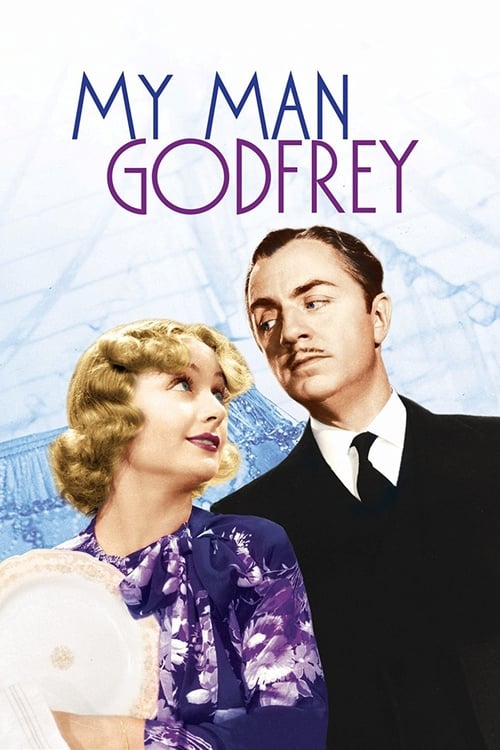
My Man Godfrey
1936 · Gregory La Cava
For a night when you want pure sparkling fun — witty, romantic, zero heaviness — or the perfect gateway into classic Hollywood comedy. Total comfort viewing with a brain.
What it's about
During a Depression-era society scavenger hunt, ditzy Fifth Avenue heiress Irene Bullock needs to bag a "forgotten man" — and finds Godfrey, a derelict living on a city dump by the East River. She brings him home and hires him as butler to her spectacularly unhinged family, where he turns out to be the only sane adult in the house, her spiteful sister schemes to get him fired, and Irene falls hopelessly, loudly in love with him.
The experience
Fast, silly, and razor-sharp all at once — the dialogue crackles, the household chaos escalates beautifully, and underneath the froth there's a real sting about wealth and who gets forgotten. It's the kind of comedy that makes you grin for ninety minutes straight.
Performances
William Powell is effortlessly droll as Godfrey, dignity intact amid the madness, and Carole Lombard — his real-life ex-wife — is a comic force of nature as Irene, playing lovesick delirium at full tilt. The film earned nominations in all four acting categories, the first ever to do so.
The craft
Gregory La Cava directed with a loose, improvisational touch that keeps the ensemble scenes feeling like genuine bedlam, and the script lands its class satire without ever stopping the laughs. Gleaming black-and-white Deco interiors make the Bullocks' mansion its own joke — a padded cell with chandeliers.
Why it matters
One of the defining screwball comedies and the most socially pointed of them, it opens on a shantytown and never lets its audience forget the Depression outside the penthouse. It cemented Lombard as the era's great comedienne.
Snapshot
A socialite on a scavenger hunt needs "a forgotten man." She finds one on an ash heap by the East River, brings him home, and installs him as the family butler. Out of that single reversal — the derelict as the only competent adult in the house — Gregory La Cava built the most socially pointed of the great screwball comedies, and one of the few that never quite lets its audience forget where the joke started.
My Man Godfrey arrived in September 1936, at the crest of the screwball cycle and at the lowest ebb of Universal's fortunes. It paired William Powell, on loan from MGM at the height of his Thin Man fame, with Carole Lombard, whom he had married in 1931 and divorced in 1933, and who here consolidated the comic persona that would define her. It earned six Academy Award nominations — Director, Actor, Actress, Supporting Actor, Supporting Actress, Screenplay — and won none, becoming the first film nominated in all four acting categories, and doing so, oddly, without a Best Picture nomination.
What distinguishes it inside its genre is not the romance, which is almost perfunctory, but the film's double vision: an affectionate farce about a rich family's derangement, bracketed at both ends by a shantytown the film insists on returning to. The Bullocks are funny. The dump is not.
Industry & production
The picture was made at a studio in receivership. In the spring of 1936, after years of overreach — Carl Laemmle Jr.'s expensive prestige program, capped by Show Boat — the Laemmle family lost control of Universal to a group led by Standard Capital's J. Cheever Cowdin, and Charles R. Rogers took over production. My Man Godfrey was among the first releases of the "new Universal," and it became one of the young regime's clearest successes: a mid-budget comedy that returned prestige and profit to a company that had little of either. (Reliable rental figures for Universal in this period are scarce; the film's standing as a strong earner rests on trade reporting and studio histories rather than on published accounts.)
The source was Eric Hatch's 1935 novel 1101 Park Avenue, serialized in Liberty under the title "Irene the Stubborn Girl." The screenplay is credited to Morrie Ryskind and Hatch — Ryskind bringing the pedigree of Of Thee I Sing and the Marx Brothers, which is to say a trained instinct for anarchy aimed at institutions rather than merely at people.
Casting was the decisive production choice. Powell, whose contract gave him unusual leverage, is consistently reported to have requested Lombard for Irene; their divorce had been amicable and their professional rapport survived it. Around them Universal and La Cava assembled a bench of specialists so strong that the supporting roles carry equal comic weight: Alice Brady's vaporous Angelica, Eugene Pallette's boiled-over Alexander, Gail Patrick's elegantly vicious Cornelia, Mischa Auer's freeloading "protégé" Carlo, Jean Dixon's flat-voiced maid Molly, Alan Mowbray as the old classmate who blows Godfrey's cover, and Franklin Pangborn presiding over the scavenger hunt in a state of collapse.
The Production Code, enforced since mid-1934 under Joseph Breen, shapes the film structurally rather than superficially. With sex unavailable as an explicit subject, screwball displaced it into aggression, humiliation, and speed — and Godfrey obliges: shoves into ash piles, a cold shower administered to a hysterical heiress, a marriage effectively imposed on the groom in the final minute. The class satire, meanwhile, passed with little difficulty; the Code was vigilant about bedrooms, not about the rich.
Technology
The film is a competent, unshowy example of mid-thirties studio craft at the moment that craft had fully matured. It was shot on black-and-white nitrate stock in the Academy ratio (1.37:1), running roughly 94 minutes. Eastman's faster panchromatic negatives, introduced in the mid-1930s, made the low-key night exteriors at the dump practical on a backlot without banks of arc light; the mansion interiors, by contrast, are lit in the high-key incandescent style that had become house standard once tungsten and panchromatic stock replaced arcs and orthochromatic film.
Sound is double-system optical recording with noise-reduction, and — crucially for a dialogue comedy — the film benefits from the by-then-routine practice of postproduction re-recording, which allowed dialogue, effects, and music to be layered rather than captured in one pass. That freedom is audible in the overlapping family scenes. Camera mobility still carried a cost: blimped Mitchell bodies were heavy, which makes the picture's fluid opening move all the more deliberate a choice. Process photography handles the taxi and car material in the conventional manner of the period.
One technological footnote governs the film's entire afterlife. Its copyright was never renewed, and it passed into the American public domain, where it circulated for decades in unlicensed television and home-video dupes of poor quality. For a generation, My Man Godfrey was a famous film that mostly looked terrible. Its rehabilitation on disc — a Criterion edition on DVD and later a Blu-ray drawn from a new high-resolution restoration — restored Ted Tetzlaff's actual photography to view, and with it the film's visual argument.
Technique
Cinematography
Ted Tetzlaff, who had photographed Lombard repeatedly at Paramount and would later shoot Notorious (1946) before directing The Window (1949), gives the film two distinct visual registers and lets the contrast do the thematic work.
The dump is shot low and dark, with figures picked out of shadow against the glow of the city across the water — closer to the social-realist night photography of the period's newspaper pictures than to comedy. The Bullock house is bright, glossy, and deep, with Lombard held in the soft, forgiving close-ups reserved for stars. The film opens by drifting through a nocturnal riverfront in which the main titles themselves appear as illuminated signs — a self-conscious flourish that reads as a signature from a director who began in animation — before settling down among the ash heaps. That single movement, from advertised glamour to refuse, is the film's thesis stated before a word is spoken.
Editing
Ted J. Kent, a Universal fixture who would later cut Douglas Sirk's melodramas, works in transparent continuity style, and the picture's cutting rates vary intelligently with its material. The scavenger-hunt sequence in the hotel ballroom is the film's most fragmented passage — a crossfire of short shots and colliding bodies that renders the leisure class as pure noise. The family scenes, by contrast, are cut sparingly, holding groups in frame so that reactions overlap rather than being served up one at a time. The dramatic scenes between Godfrey and Tommy Gray, or Godfrey and Cornelia, slow further still, sometimes to near-static two-shots.
Mise-en-scène / staging
Charles D. Hall's art direction is the film's least discussed strength. Hall had designed Dracula, Frankenstein, and Bride of Frankenstein for Universal, and Chaplin's City Lights and Modern Times; the Bullock mansion he provides is a Gothic proposition in disguise — a vast, vertical, badly inhabited house whose grand staircase functions as the film's class diagram. Characters are constantly ascending and descending it, and Godfrey's mobility on that axis (pantry to bedroom to drawing room) is the plot. The servants' quarters and pantry give the film its zone of sanity, from which Molly comments on the household like a chorus.
La Cava stages in depth and in groups. He is unusually willing to let three, four, five performers occupy a frame simultaneously and to permit business at the edges — a habit inherited from silent comedy and from the loose ensemble work he would extend the following year in Stage Door. Lombard's gowns, credited to Travis Banton, her Paramount couturier, are deployed as comic armature: the more extravagant the dress, the more thoroughly Irene is likely to be humiliated inside it.
Sound
The film belongs to the 1930s project of learning to make dialogue overlap without becoming unintelligible — the project that culminates in His Girl Friday (1940). Godfrey is not yet that dense, but its family scenes are built on interruption, competing complaints, and Pallette's bass grousing from offscreen. Scoring is sparse, largely confined to titles and transitions, with music otherwise motivated within the scene; the effect is to leave the comedy resting on voices and timing rather than on underlining. Auer's celebrated gorilla routine runs essentially without dialogue, a passage of pure silent-comedy physical business inserted into a talking picture.
Performance
The film's engine is a deliberate mismatch of acting styles. Powell underplays to the point of stillness, working in micro-inflections and delayed reactions; Lombard plays at full extension, vocally and physically, hurling herself at furniture and at Godfrey with equal abandon. Neither modulates toward the other, and the comedy lives in the gap.
Around them, each supporting performance is pitched to a single well-chosen note: Brady's fluttering non-sequiturs, Pallette's exhausted rage, Patrick's poised cruelty (she is the only Bullock who is genuinely dangerous), Auer's parasitic appetite, Dixon's deadpan. Lombard's nomination here was the only one of her career. Brady would win the following year for In Old Chicago; Auer's nomination made him a Universal fixture; Patrick eventually left acting to produce television's Perry Mason.
Narrative & dramatic mode
Structurally the film is a comedy of infiltration rather than of courtship. Godfrey enters the household as an object — a scavenger-hunt prize — and converts himself into its moral and financial agent, with the romance arriving late and almost as an imposition. Irene pursues; Godfrey resists; the plot is resolved not by mutual recognition but by Godfrey's competence.
Two mechanisms drive the second half. Cornelia hides her pearls in Godfrey's room to frame him; Godfrey, having found them first, quietly liquidates them and plays the market, using the proceeds to rescue Alexander Bullock from the consequences of the securities he has improperly pledged — and sinking his own profit into a nightclub, "The Dump," built on the site of the shantytown and staffed by its residents. The film thus resolves a class problem through a private act of financial cleverness, and hands the audience an ending that is simultaneously triumphant and evasive.
The dramatic mode is farce shot through with genuine desolation. Godfrey's confession to Tommy Gray — that he came to the river after a romantic humiliation, contemplated ending things, and was taught self-respect by men with nothing — is played straight and without irony. The film's willingness to stop being funny for three minutes is what separates it from its peers.
Genre & cycle
Godfrey sits in the exact middle of the screwball cycle conventionally dated from It Happened One Night (1934) to about 1942, and it shares its year with Mr. Deeds Goes to Town and Theodora Goes Wild. It carries most of the cycle's markers: the madcap heiress, the class-crossed pairing, physical comedy substituting for sex, an eccentric family as comic ecosystem, and an antic tempo.
It departs in one respect that matters. Most screwball uses poverty as costume — a temporary condition the protagonists pass through en route to reconciliation. Godfrey keeps the poor onscreen as a population, gives them names, returns to them, and ends among them. Its nearest kin in this regard is not the remarriage comedy but Capra's populist strain and, later, Sturges's Sullivan's Travels (1941), which interrogates the same question — what comedy owes the destitute — more self-critically.
It is worth noting that Godfrey falls outside Stanley Cavell's influential canon of remarriage comedies in Pursuits of Happiness (1981), and instructively so: there is no prior marriage to restore, no equality of wit between the leads, and no shared education. Irene does not grow; Godfrey does not really change. What the film offers instead of mutual transformation is a class masquerade resolved by disclosure.
Authorship & method
Gregory La Cava came to features from animation — he had run William Randolph Hearst's International Film Service cartoon operation in the 1910s — then through silent comedy shorts and features, including two with W. C. Fields. By the mid-1930s he had a reputation, unusual in the studio system, as a director who worked from thin scripts, rewrote on set, and built scenes out of what his actors did in rehearsal. Accounts of the Godfrey shoot describe dialogue arriving in the morning and structure being negotiated as filming proceeded; the specifics are thinly documented and often retold secondhand, so the method is better inferred from the results than from anecdote. What is verifiable is on the screen: overlapping ensemble playing, scenes that run past their plot function, and performances that feel discovered rather than blocked.
His political sensibility is also relevant. La Cava had directed Gabriel Over the White House (1933), a Hearst-backed fantasy of authoritarian national rescue — a film whose crisis rhetoric shares more with Godfrey's benevolent-fixer ending than is comfortable to admit.
The key collaborators: Morrie Ryskind and Eric Hatch on script, supplying respectively the structural satire and the source material's social observation; Ted Tetzlaff on camera, providing the two-register photography that carries the argument; Ted J. Kent cutting; Charles D. Hall on sets. Music is credited to Universal's department under musical director Charles Previn; studio practice at the time pooled uncredited contributions across the music staff, so attributing individual cues to a single composer is unreliable, and the film's restraint in scoring is in any case the more significant choice.
La Cava followed Godfrey with Stage Door (1937), his other major work, and Primrose Path (1940). His career declined through the 1940s, and his reputation has never fully recovered from the difficulty of separating his authorship from his ensembles' — which is, arguably, the point of his method.
Movement / national cinema
This is Hollywood studio filmmaking at its most confident: vertically integrated, genre-fluent, and addressed to a mass domestic audience during the Depression's second half. Godfrey has no formal debt to European modernism, but it belongs to a transatlantic moment in which the servant's-eye view of the leisure class was being worked over simultaneously and independently — Renoir's La Règle du jeu (1939) most notably, with its own upstairs-downstairs architecture and its own aristocracy in denial. The resemblance is convergent rather than influenced.
Domestically the film sits inside the Popular Front decade's broad sympathy for the dispossessed, expressed here through a studio comedy rather than a social-problem picture. Its rich-family satire also draws on a long American stage tradition of the eccentric household, which the same era would formalize in Kaufman and Hart.
Era / period
The film's terms are specific to 1936. "The forgotten man" was not a coinage of the screenwriters: Franklin Roosevelt used the phrase in a 1932 radio address, inverting William Graham Sumner's 1883 essay of the same title, and by 1933 it was common enough to anchor a Busby Berkeley production number in Gold Diggers of 1933. That a Fifth Avenue scavenger hunt should list a forgotten man as a collectible is a joke that required no explanation to its first audience.
The East River shantytown is likewise drawn from fact; New York had several such settlements through the early thirties. By 1936, with the New Deal in place and Roosevelt heading to a landslide re-election, the question the film addresses is no longer whether destitution exists but who should fix it — and Godfrey answers, pointedly, that a Harvard man with capital and a good idea can do it privately. Whether that is a New Deal parable or an argument against needing one has been contested since; Andrew Bergman's We're in the Money (1971) reads the screwball cycle broadly as a machinery of class reconciliation, and Godfrey is among the strongest cases for that reading.
Themes
Class as performance. Everyone in the film is playing a role. Godfrey performs servitude while concealing patrician origins; the Bullocks perform gentility while behaving like children; Carlo performs artistic sensitivity while eating. Only Molly and the men at the dump are what they appear to be, and they are the only characters granted moral authority.
Competence as virtue. The film's ethical measure is not kindness or love but capability. Godfrey earns his standing by being able to do things — cook, manage, read a market, keep his head — in a household where no one can. This is a deeply American resolution and a conservative one.
Idleness as a form of ruin. The Bullocks are not villains; they are unoccupied, and the film treats unoccupation as a kind of illness — "pixies," in Angelica's word for it. Godfrey's cure for the shantytown is, precisely, employment.
Charity versus enterprise. The film explicitly rejects almsgiving. The Dump is a business, and its residents become staff rather than beneficiaries. The gesture flatters the audience's dignity while leaving the structure that produced the ash heap entirely intact — which is the film's central and unresolved tension.
Rescue and coercion. Godfrey saves people who have not asked to be saved, and is finally married by one. The romance's comedy depends on consent being cheerfully overridden in both directions.
Reception, canon & influence
Contemporary reception. Reviews on release were strongly favorable in both the trade and daily press, with particular attention to Lombard's transformation into a comedienne and to the ensemble's balance; the six Academy nominations, spanning every acting category, register the industry's own estimate. The absence of a Best Picture nomination — in a year Frank Capra took Director for Mr. Deeds and The Great Ziegfeld took the top prize — has been remarked on ever since as a category anomaly. The film won nothing.
Influences on the film (backward). Its immediate models are the screwball templates set two years earlier by It Happened One Night and Twentieth Century (Lombard's own breakthrough, under Howard Hawks). Its comic architecture — the household as menagerie — comes out of American stage farce. Its physical vocabulary, especially Auer's set piece and the ash-pile business, is silent comedy carried forward by a director trained in it. And its politics come directly out of New Deal rhetoric, filtered through the crisis-fixer fantasy La Cava had already staged in Gabriel Over the White House.
Legacy (forward). Godfrey helped fix the eccentric-rich-family ensemble as a durable Hollywood form, feeding directly into You Can't Take It with You and Holiday (both 1938) and, at a distance, into the deadpan dynastic comedy of Wes Anderson's The Royal Tenenbaums (2001). More specifically, it established the servant-as-moral-center as a comic premise with real staying power: Arthur (1981) and Trading Places (1983) both run variants of the class-masquerade plot, and Parasite (2019) inverts it exactly, keeping the infiltration and the architecture while removing the benevolence.
Its own remake — Henry Koster's 1957 version at Universal, with David Niven and June Allyson, recasting Godfrey as an undocumented European immigrant — is chiefly interesting for what it loses: with the Depression gone, the ash heap becomes a plot device rather than an accusation.
Critically, the film's standing has risen as the screwball cycle has been read politically rather than as escapism. Scholars of Depression cinema return to it because it is the cycle's most legible test case: a comedy that sees the poor clearly and then resolves their situation with a nightclub. That the ending is unsatisfying is now generally taken as evidence of the film's honesty rather than its failure — it cannot imagine a solution its audience would have accepted, and it declines to pretend otherwise.
Selected to the National Film Registry in 1999 and restored for the Criterion Collection after decades of public-domain neglect, My Man Godfrey now circulates in the condition its craft deserves. It remains the screwball comedy that keeps one eye on the river.
A Deleuzian reading
Water first.
The full Deleuzian reading of My Man Godfrey →
Reception
A smash in 1936 — the first film ever nominated in all four acting Oscar categories (it went home empty-handed, and wasn't even up for Best Picture) — it then spent decades circulating in murky public-domain prints before a 2018 Criterion restoration reminded everyone how sharp it actually looks.
How My Man Godfrey was received, from release to now →
How to watch My Man Godfrey: what to notice on a first viewing
- Watch how much time characters spend on the staircase. Godfrey moves constantly between pantry, bedroom, and drawing room on the Bullocks' grand staircase, and his position on it tracks his shifting standing in the house. The house itself is a diagram of class, and the stairs are where you read it.
- Notice the two completely different kinds of light in this film. Tetzlaff shoots the riverside dump low and dark, figures picked from shadow, while the Bullock mansion is bright, glossy, and deep with soft close-ups for Lombard. The film argues its whole point in light alone, before a single joke is told.
- Watch how little Powell moves compared to Lombard. Powell underplays to near stillness while Lombard hurls herself at furniture and at Godfrey, and neither ever adjusts toward the other's register. Powell's stillness is itself a costume: it says master in a house that pays him as staff.
- Notice how many people La Cava fits into a single frame. He often stages three, four, or five performers together in one shot, letting business happen at the edges instead of isolating each speaker. The crowded frame is how the film shows a family that never quite listens to itself.
- Listen for the family talking over each other and complaining offscreen. Family scenes run on interruption and competing complaints, with Pallette's bass grousing drifting in from another room entirely. The noise itself tells you this is a house nobody is actually running.
The whole guide to watching My Man Godfrey, with the keys for a rewatch →
Influences: the films it descends from and the films it influenced
- It Happened One Night (1934) — Established the Riskin-Capra armature Godfrey rebuilds — a declassed man who tutors a runaway heiress in economics inside the romantic banter, with the pedagogy carried by dialogue scenes rather than plot events.
- Twentieth Century (1934) — Hawks broke Lombard of her mannequin diction by pushing her into instinctive, full-body playing at a shrieking upper register — the exact instrument La Cava then pitches against Powell's stillness.
- The Front Page (1931) — Codified the overlapping-cue delivery and the roving-camera-plus-variable-cutting-rate treatment of a single crowded room that Godfrey's family-in-motion ensemble scenes run on.
- Dinner at Eight (1933) — Cukor's blocking of a Manhattan society household as connected performance rooms — clustered deep groupings, servants crossing behind the principals — is the staging grammar Charles D. Hall's Bullock mansion set is built to serve.
- Ruggles of Red Gap (1935) — The servant-as-moral-center premise in its immediate pre-form: the valet whose bearing and self-possession quietly indict his employers, built by McCarey out of long takes assembled around what Laughton found in rehearsal.
- The Thin Man (1934) — Fixed Powell's signature register — unflappable underplaying, throwaway line readings, comedy generated by refusing to react — which Godfrey deploys as the fixed point against four escalating performance styles.
- Gabriel Over the White House (1933) — La Cava's own crisis-fixer construction: a single benevolent authority who resolves mass economic suffering by fiat, returning here as the nightclub-on-the-dump ending and its unearned rescue of the forgotten men.
- Wild Boys of the Road (1933) — Supplied the Depression-realist night exterior — panchromatic low-key lighting on a shantytown built as a location rather than a stage — which Tetzlaff's East River dump adopts wholesale as the film's first register.
- Trouble in Paradise (1932) — Depression-era class-masquerade comedy descending from Trouble's premise of the impostor moving through the moneyed world by charm and disguise.
- You Can't Take It with You (1938) — Takes Godfrey's household-as-menagerie directly: a fixed set of eccentric specialists pursuing incompatible hobbies in one house, staged as simultaneous foreground/background business for an outsider to walk into.
- Holiday (1938) — Extends the class-stratified mansion as moral map — the outsider finds his allies in the playroom while the money stays downstairs — using room-to-room movement, as Godfrey does with the pantry and the servants' quarters.
- Notorious (1946) — Tetzlaff carries forward his own opening device: the crane that descends from an establishing altitude into a crowded social space, here the party-to-key shot, there the titles painted on the dump before the camera drops among the men.
- My Man Godfrey (1957) — The instructive failed remake — retains the infiltration plot and the ensemble blocking but, with the ash heap demoted to exposition and Godfrey recast as an immigrant, loses the two-register lighting scheme that made the premise an accusation.
- Gosford Park (2001) — Rebuilds the upstairs/downstairs house as a multi-track sound environment, radio-miking the full cast so overlapping dialogue and background business become the primary information stream — the 1936 ensemble technique industrialized.
- The Royal Tenenbaums (2001) — Deadpan dynastic ensemble confined to one over-designed house, with a servant (Pagoda) as the household's only unshakable figure and each family member introduced as a fixed comic category, as Godfrey introduces the Bullocks.
- Parasite (2019) — Runs the infiltration plot in reverse — the servant hired into the mansion is the schemer, not the moral center — while keeping the architecture-as-class-diagram staging and the hard cut between the rich house's light and the flooded lower depths.
- Bringing Up Baby (1938) — La Cava encoded the class-friction screwball schema — a competent male (Powell) navigating chaos generated by a wealthy, aggressive female (Lombard) — establishing the gender-inversion of social competence that Baby systematizes.
- The Philadelphia Story (1940) — Sharpened the comedy-of-manners critique of wealthy frivolity judged by an outsider's authenticity, the class-and-pretension theme Philadelphia Story routes through the magazine-reporter intrusion.
- Sullivan's Travels (1941) — Folds Depression 'forgotten man' social conscience into screwball farce, the tonal recipe of laughter-plus-pity that Sturges pushes to its breaking point.
- Midnight (1939) — Codifies the Depression class-masquerade plot — an outsider passed off among the rich — and the Cinderella-in-reverse conceit Midnight rewires into a chorus-girl impersonating a baroness.
- Sabrina (1954) — Builds an entire comedy out of servant's-eye staging — the help watching the rich family from below stairs — supplying the vertical blocking grammar Sabrina formalizes as chauffeur's-apartment-over-the-garage and girl-in-the-tree looking down on the terrace party.
- Boudu Saved from Drowning (1932) — Independently arrives at the same device — a derelict pulled from a river and installed in a bourgeois household — and stages it in deep, cluttered domestic space where the intruder is constantly framed with the family he disorders.
- Stage Door (1937) — La Cava repeats his working method exactly: thin script, dialogue written overnight from listening to the cast, ensemble scenes that run past their plot function with three conversations audible at once.
- The Awful Truth (1937) — The other 1930s comedy built on-set rather than from a script — McCarey arriving with scraps and developing business in rehearsal — producing the same discovered-not-blocked quality in the performances.
Similar films
- It Happened One Night (1934) — influence & lineage
- The Awful Truth (1937) — influence & lineage
- The Thin Man (1934) — influence & lineage
- The Rules of the Game (1939) — shared sensibility
- The Heiress (1949) — shared sensibility
- Bringing Up Baby (1938) — shared sensibility
- Modern Times (1936) — shared sensibility
- Grand Illusion (1937) — shared sensibility