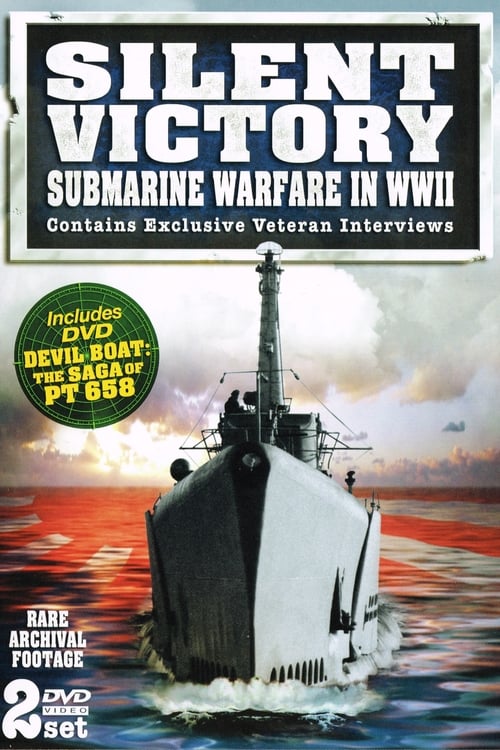
Silent Victory Submarine Warfare in WWII
2010
For a history-documentary evening when you want to come away actually knowing something new — an easy, low-commitment watch that rewards anyone curious about the war stories the headlines skipped.
What it's about
A World War II documentary with a revisionist argument: the Pacific War wasn't won by the celebrated aircraft carriers but strangled from below by the American submarine service. Making up less than two percent of Navy personnel, the 'silent service' sank the majority of Japanese merchant shipping — cutting off the oil, rice, and steel that fed an island empire — and did it for nearly two years while saddled with a torpedo that didn't work.
The experience
A straightforward, archival-footage history lesson with a genuine thesis to argue — the pleasure is in watching the case get built, including the infuriating scandal of the defective Mark 14 torpedo that the Navy blamed on its own crews.
The craft
Television-style archival documentary craft: period footage, narration, and a clear argumentative through-line rather than visual flash. The title nods to Clay Blair Jr.'s landmark history of the submarine campaign, and the film wears its research honestly.
Why it matters
A useful corrective to carrier-centric Pacific War history, bringing the submarine blockade — one of the war's most decisive and least celebrated campaigns — to a general audience.
A television-style archival documentary built on a genuinely revisionist thesis: that the Pacific War was strangled not by the celebrated carrier task forces but by the American submarine service, the 'silent service' that operated beneath both the ocean and the headlines. The historical record backs the provocation. Submariners made up less than two percent of U.S. Navy personnel yet accounted for the majority of Japanese merchant tonnage sent to the bottom, severing the shipping lanes that fed an island empire its oil, rice, and steel — a blockade in all but name. The story has its scandal, too: for nearly two years American boats went to war with the defective Mark 14 torpedo, whose failures the Navy's bureaucracy blamed on its own crews before conceding the weapon was broken. The title nods to Clay Blair Jr.'s landmark 1975 history of the campaign, the standard account of a victory purchased at terrible cost — the submarine force suffered the highest casualty rate of any branch of the American armed services. The film assembles its case plainly, from period footage; the argument supplies the drama.
A Deleuzian reading
Water with nothing on it.
The full Deleuzian reading of Silent Victory Submarine Warfare in WWII →
Reception
How Silent Victory Submarine Warfare in WWII was received, from release to now →
Influences: the films it descends from and the films it influenced
- The March of Time (1935) — Established the newsreel-as-editorial: archival and staged footage cut not to report but to advance a persuasive thesis under an authoritative Voice-of-God narrator, the compilation-argument grammar this film inherits.
- Why We Fight: Prelude to War (1942) — Marshals captured and library footage into a prosecutorial argument via maps, narration, and rhythmic cutting — the template for the thesis-driven compilation documentary rather than neutral chronicle.
- The Fighting Lady (1944) — Built a feature from in-service gun-camera and shipboard combat footage narrated as a single vessel's tribute, the period-naval-footage service documentary this film descends from.
- The Battle of San Pietro (1945) — Shaped front-line combat footage into a somber counter-narrative that quietly indicts official optimism about cost — the revisionist edge inside a compilation of service imagery.
- The Memphis Belle: A Story of a Flying Fortress (1944) — Focused a whole documentary on one crew and machine, using authentic mission footage to turn a single unit's tour into representative institutional narrative — the ship's-company structure echoed here.
- Target for Tonight (1941) — Pioneered the dramatized-service documentary in which the operational routine of a specific weapon-system is walked through procedurally, feeding the patrol-procedure spine of submarine-service films.
- Victory at Sea (1952) — The foundational NBC naval archival-compilation series: symphonic scoring married to library sea-war footage and measured expository narration, the direct television grammar of this documentary.
- The World at War (1973) — Set the long-form WWII compilation standard, weaving footage, maps, and testimony toward analytical arguments about command decisions and institutional failure rather than mere event chronology.
- Hell Below (2016) — Submarine-warfare series mixing archival footage with dramatized patrol reconstruction, extending this film's silent-service subject and boat-by-boat patrol-narrative structure into later television.
- The Silent Service (1957) — Dramatized actual US submarine patrol reports episode by episode, canonizing the 'Silent Service' subject and the single-boat patrol-narrative structure the documentary reprises in nonfiction form.
- The Civil War (1990) — Codified the modern American historical-compilation method — panned stills, first-person readings, and unifying narration over a scored bed — the aesthetic register of this television documentary.
- The Fog of War (2003) — A revisionist thesis about wartime institutional decision-making built as sustained argument rather than chronicle, the argument-driven counter-history mode shared here (via a different, interview-based means).
- The War (2007) — Contemporary WWII archival-compilation pairing library footage with personal testimony and expository narration, the direct stylistic peer of this same-era production.
- Apocalypse: The Second World War (2009) — All-archival, talking-head-free compilation carried entirely by restored period footage and narration, a same-moment sibling in pure period-footage assembly.
- WWII in HD (2009) — Colorized/restored archival-compilation for cable television driven by narration and veteran voiceover, sharing the period-footage-plus-expository-track construction and 2000s-production toolkit.
- Battlefield (1994) — Analytical battle documentary using maps and combat footage to argue why outcomes turned as they did — the argument-driven military-history register applied to campaigns.
Similar films
- Tora! Tora! Tora! (1970) — shared sensibility
- Pearl Harbor (2001) — shared sensibility
- Midway (1976) — shared sensibility
- The Forgotten Battle (2021) — shared sensibility
- Das Boot (1981) — shared sensibility
- Letters from Iwo Jima (2006) — shared sensibility
- Godzilla Minus One (2023) — shared sensibility
- The Long Voyage Home (1940) — shared sensibility
All the films related to Silent Victory Submarine Warfare in WWII →